F-Class ace Erik Cortina has interviewed noted author and Olympic Gold Medal-winning shooter Lanny Bassham. For his popular video channel, Cortina asked Lanny about his book With Winning in Mind. The two talented shooters also broadly discussed the “mental game” in the shooting sports and Lanny’s program for visualization of a winning performance. Lanny explains that after you have mastered your rifle skills, and learned to read the wind, it is important to adopt a winning mentality and to visualize success. Lanny should know. He won a shooting Gold Medal in the Olympics along with 22 world individual and team titles.
Watch Full Video Interview
Here is the wide-ranging and fascinating hour-long Lanny Bassham interview hosted by Erik Cortina. If you are looking to enhance your motivation, discipline, and “mental focus” when competing, this video is worth watching:
Visualization is a process of mental preparation that is done before you get to the range. Many of the greatest shooting champions have used this technique to get ready for big matches, and to optimize their performance during record fire. If you want to enhance your “mental game” through pre-match visualization, we strongly recommend Lanny Bassham’s book, With Winning in Mind.
As a competitive smallbore 3P shooter, Bassham developed a mental management system. Using this system, Lanny Bassham won 22 world individual and team titles, set four world records, and captured an Olympic Gold Medal in Montreal in 1976. His techniques have been embraced by professional and Olympic athletes in many sports. With Winning in Mind covers a complete system of “mental management” techniques used by Olympians and elite champions.
Putting principles into practice — Anette Wachter
Our friend Anette Wachter, aka “30CalGal”, did a series of videos for the NRAWomen.com site. In one episode, Anette talks about the “mental game” in competition. Specifically she explains how to “visualize success”:
I have found that a lot of my success in competition has come through what I call a ‘mental rehearsal’. I actually visualize every stage of the match and I visualize the success of the match and winning the match.
I actually visualize that round going downrange into the target, and the target coming up with a dead-center ‘X’. I visualize this over and over. If you visualize success you will achieve success.
Whether you should from the bench, or from prone, it’s great to have your cartridges in a convenient, easy-to-reach position. This article explains how you can build your own height-adjustable ammo caddy for under ten bucks. Credit Martin Tardif for this great Do-It-Yourself (DIY) project. Martin’s flex-arm caddy design works great for F-Open competitors as well as anyone who shoots with a pedestal front rest, either on the ground or from a bench. The ammo caddy attaches, via a flexible arm, to your front rest. The flexy arm allows you to position your ammunition close to your rifle’s feeding port. That makes it easy to grab cartridges and load them into the chamber without shifting your shooting position.
Kudos to Martin Tardif for his clever use of inexpensive materials. The total cost of the whole project, according to Martin, was just $8.00! (With Bidenflation, materials could run a bit more these days, but the project would still be very inexpensive.)
Martin Explains How to Build the Ammo Caddy
Here are some pics of my DIY P.L.A.B. (Port Level Ammo Block). I cannibalized the goose neck from a Craftsman bendy-style utility light and bought a 3.5″x 1″ Acetal disk on eBay. I then drilled out the disk to accept twenty .284 Winchester rounds and screwed the disk to the bendy arm. The arm, by itself, wasn’t sturdy enough to support my fully loaded ammo block, so I inserted a 1/8″-diameter steel rod cut to length into the arm before I screwed it to the disk. On this Bald Eagle rest, I wasn’t using the windage adjustment cable. That allowed me to secure the bottom end of the arm to the unused 5/16″ x 18 bolt hole for the cable. [Editor’s Note: For other pedestal rest types/brands you may need to drill a hole for the base of the flexy arm.]
Want to learn the basics of position shooting? Then you should check out an article by Gary Anderson, DCM Emeritus, in On the Mark digital magazine (Summer 2014, pp. 6-13). This article covers all the key elements: body position (prone, sitting, standing), sling use/adjustment, sight picture, aiming process, and trigger control. While this 8-page article was specifically written for Rimfire Sporter shooters, the techniques described by Anderson apply to all types of position shooting, whether you shoot air rifles, smallbore rifles, or centerfire rifles.
Here’s what Anderson says about aiming — how to keep your sights steady and get them centered on the middle of the target:
Trigger Contact and Center As soon as aiming at the target begins, the index finger must move from the trigger-guard to contact the trigger. It is important to get initial pressure on the trigger as soon as aiming begins. Then the shooter must focus on the sight picture and centering the sight picture movements over the aiming point. No one, not even champion shooters, can hold the aligned sights perfectly still. The sights are going to move a little bit or a lot, depending on the shooter’s skill level. The secret is to center those sight picture movements over the aiming point on the target (see trace illustration) before pulling the trigger.
When the sight picture movements on the target are centered, the last step in firing the shot is to add… smooth pressure on the trigger until the shot breaks.
Anderson also discusses the 5 Basics of Shot Technique:
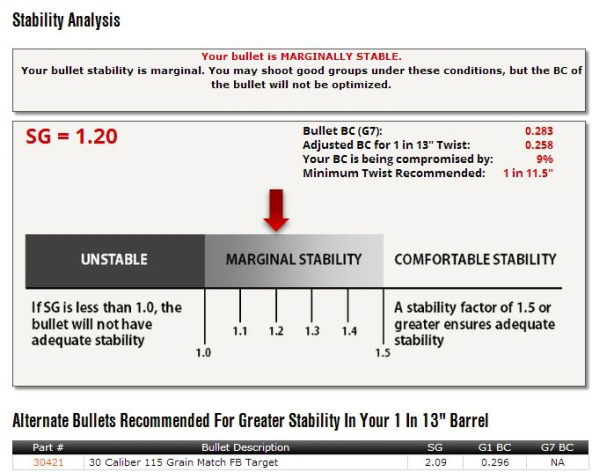
Berger Twist-Rate Stability Calculator On the Berger Bullets website you’ll find a handy Twist-Rate Stability Calculator that predicts your gyroscopic stability factor (SG) based on mulitiple variables: velocity, bullet length, bullet weight, barrel twist rate, ambient temperature, and altitude. This cool tool tells you if your chosen bullet will really stabilize in your barrel.
How to Use Berger’s Twist Rate Calculator
Using the Twist Rate Calculator is simple. Just enter the bullet DIAMETER (e.g. .264), bullet WEIGHT (in grains), and bullet overall LENGTH (in inches). On its website, Berger conveniently provides this info for all its bullet types. For other brands, we suggest you weigh three examples of your chosen bullet, and also measure the length on three samples. Then use the average weight and length of the three. To calculate bullet stability, simply enter your bullet data (along with observed Muzzle Velocity, outside Temperature, and Altitude) and click “Calculate SG”. Try different twist rate numbers (and recalculate) until you get an SG value of 1.4 (or higher).
Gyroscopic Stability (SG) and Twist Rate
Berger’s Twist Rate Calculator provides a predicted stability value called “SG” (for “Gyroscopic Stability”). This indicates the Gyroscopic Stability applied to the bullet by spin. This number is derived from the basic equation: SG = (rigidity of the spinning mass)/(overturning aerodynamic torque).
If you have an SG under 1.0, your bullet is predicted not to stabilize. If you have between 1.0 and 1.1 SG, your bullet may or may not stabilize. If you have an SG greater than 1.1, your bullet should stabilize under optimal conditions, but stabilization might not be adequate when temperature, altitude, or other variables are less-than-optimal. That’s why Berger normally recommends at least 1.5 SG to get out of the “Marginal Stability” zone.
In his book Applied Ballistics For Long-Range Shooting (3rd Ed.), Bryan Litz (Berger Ballistician) recommends at least a 1.4 SG rating when selecting a barrel twist for a particular bullet. This gives you a safety margin for shooting under various conditions, such as higher or lower altitudes or temperatures.
Story idea from EdLongrange. We welcome reader submissions.
The 2024 Pyramyd Cup is one of the biggest and most prestigious airgun competitions in North America. This year’s Pyramyd Cup will be held September 11-14, 2024 at the Cardinal Shooting Center in Marengo, Ohio. With a wide selection of disciplines (Gunslynger, Field Target, and Benchrest), this year’s competition is set to be one of the most exciting and competitive in the event’s history. If you want to participate, CLICK HERE to Register.
The 2024 Pyramyd Cup will feature top-tier competitions, including the precision-driven 100 yard Benchrest, the action-packed Gunslynger showdown, and the World Class Field Target competition. As always, top airgunners from around the world will gather to test their skills and vie for top prizes.
John McCaslin, President of AirForce Airguns, stated: “We are excited to sponsor this year’s Pyramyd Cup. We are grateful to Val Gamerman, the owner of Pyramyd Air for graciously hosting this event and bringing the airgun community together for [a great] event.”
Field Target Discipline Is Challenging
“Field Target is one of the most difficult shooting disciplines out there,” says recent Pyramyd Air Cup Match Director, Tyler Patner. “Combine the multiple skills required to rise to the top of your game, with the myriad of factors you take into account at each lane, and you’ve got a challenging sport.”
“Targets are small, metal silhouettes of animals that consist of a kill zone and a colored paddle,” explains Pyramyd’s Tyler Patner. “Placed at unknown distances from between 10 yards to as far as 55 yards, the targets have kill-zones ranging in size from 3/8 inch to 1 1/2 inches. When the pellet passes through the kill zone and hits the paddle, the target falls and you’re awarded a point. It’s a game of precision and practice. You range-find with your scope, dope for distance, take the wind into account, and then you have to execute. There are different restrictions based upon your selected class, but the challenges remain the same. Wind-doping, range-finding, and remaining mentally tough over the entire course of fire are the biggest hurdles competitors face.”
Huge Prize Table for Competitors
Competition prizes are being provided by many airgun, optics, and gear manufacturers including: Accu-Tac, AirForce Airguns, Air Arms, Air Venturi, Athlon, ATN, Crosman, Birchwood Casey, Diana, Firebird Targets, FX Airguns, Hatsan USA, H&N, Hawke, Hill Air Pump, Hawke Sport Optics, JTS Airguns, Leapers, Norica, Predator, Pyramyd, RAW, RX Target Systems, Saber Tactical, Sightron, Sportsmatch, Umarex, Vortex, Weihrauch and more. “You’d be hard-pressed to find an airgun competition with a better selection of prizes for its winners,” says says Pyramyd Air CEO, Joshua Ungier. “Our winner’s packages help assure shooters that if they’re limited to traveling to only one competitive shooting event, they recognize the Pyramyd Air Cup as the industry’s premier event.”
CLICK HERE for full list of 2024 Pyramyd Cup Sponsors.
This evening, Shooting USA TV will feature a major U.S. Practical Shooting Association (USPSA) competition — the USPSA Production Class Nationals. Watch the broadcast at 9:00 pm Eastern/Pacific, 8:00 PM Central on the Outdoor Channel. SEE Shooting USA info. This week’s show also features a review of the new ZEISS Conquest HD Binoculars — great for hunters.
The USPSA Production division is easily the most approachable in terms of equipment. These are virtually out of the box guns with minimal enhancements. Even so the national championship chase is highly contested and the level of competition is extremely high.
Broadcast Times: Wednesday 9:00 PM Eastern/Pacific, 8:00 PM Central on Outdoor Channel.
You can also subscribe for $1.99/month to watch broadcasts “on demand” at any time on Vimeo: vimeo.com/ondemand/shootingusa
About the USPSA — Active Sports Group Nationwide
The United States Practical Shooting Association (USPSA) is a leading competitive shooting organization dedicated to promoting safe, fair, and fun practical shooting sports. Members engage in dynamic and challenging courses of fire, where speed, accuracy, and power are equally tested. USPSA shooters of all skill levels can enjoy shooting on the clock at steel and reactive targets. Whether you’re a seasoned shooter or new to the sport, USPSA offers fun and well-run competitions.
Hit Factor Scoring Based on Time AND Accuracy
Scoring is more complicated than fixed time events or steel shooting where your time is your score. In USPSA and IPSC each stage is worth a specific number of points. After a competitor completes a stage, the total score they shoot on the targets is divided by the time it takes to finish the stage. This establishes their hit factor. The competitor with the highest hit factor wins the stage and earns the total number of points available for that specific course of fire. The remaining competitors receive a percentage of the stage points based on their hit factors.
Top photo credit: Paul Erhardt, U.S. Air Force, Public Domain, Wikimedia.org.
The Rimfire Challenge Shooting Association (RCSA) will host its annual World Championship next month. The 2024 RCSA World Championship will take place October 19-20, 2024 at the Cavern Cove Competitive Shooting facility in Woodville, Alabama. This RCSA World Championship event will feature multiple stages with metal targets, shot with both rimfire rifle and rimfire pistol. See Rimfire Challenge action from last year’s RCSA Championship below:
Watch Action from the 2023 Rimfire Challenge Championship at Cavern Cove Range in Alabama
The RCSA promotes rimfire competition nationwide, supports beginning competitors and clubs, and solicits support for rimfire events from industry businesses. The RCSA is now an official partner of the +ONE Movement, a mentorship program organized by the National Shooting Sports Foundation (NSSF). NSSF +ONE programs encourage mentorship related to firearm safety, firearm basics, shooting sports, and hunting. The +ONE program focuses on peer-to-peer development in shooting sports and hunting.
About the Rimfire Challenge Shooting Association
Designed to introduce new shooters to shooting sports in an exciting, family-friendly format, Rimfire Challenge matches focus on competition with .22 LR rifles and pistols. Matches are open to shooters of all shooting experience levels, with events conducted at ranges nationwide. The video below shows the Rimfire Challenge Shooting Association 2022 Championship.
This article is Copyright 2023 AccurateShooter.com. No reproduction on any other site is permitted.
Rimfire tactical-style matches are now one of the fastest-growing types of rifle competition in the country. The USA has seen a big growth in rimfire tactical matches over the last five years. NRL22 and PRS Rimfire matches are held throughout the country. Right now there are probably ten times as many rimfire tactical matches as sanctioned PRS and NRL centerfire matches. The reason is simple — rimfire ammo is much less costly, and clubs can run challenging rimfire tactical matches at nearly any outdoor gun range that allows shooting out to 200+ yards.
The National Rifle League (NRL) started off sponsoring major centerfire tactical matches, similar to PRS competitions. That proved successful so the NRL added a .22 LR Rimfire series, called NRL22. The NRL22 rimfire discipline has been a major success, as rimfire guns are fun to shoot and ammo is very affordable. The most popular NRL22 matches have drawn up to 200 rimfire competitors. And now PRS has its own PRS .22 Rimfire series.
Precision Rimfire Match with Through-the-Lens Video
Here’s an interesting video featuring a top-tier .22 LR MDT-chassis rifle. The host, Pieter “Piet” Malan from South Africa, runs the excellent Impact Shooting YouTube Channel, which now has 320+ videos on target shooting and hunting. This video features a TriggerCam unit attached to the scope, so you can see hits on the targets, just as the shooter does.
NRL22 — Affordable, Challenging Rimfire Competition Series
NRL22 is a great way to get into competition shooting with minimal expense. There are five (5) classes: Open, Base, Ladies, Young Guns (8-16) and Air Rifle. Base Class is for the budget-minded shooter — the combined MSRP of Rifle and Optic may not exceed $1200.00 (so you could spend $700 on a rifle and $500 on a scope for example). That keeps the sport affordable. Open, Youth, and Ladies Classes have no price limits on Rifle and Optic. Visit NRL22.org to find an NRL22 match near you.
Precision Rimfire Competition Match Report
This excellent video covers a big rimfire precision match, the King of 0.28 Miles event, held at the Rush Lake Range in MN. The video shows multiple stages with targets out to 300 yards, followed by a 465-yard challenge. Host Dave shot the match with a Vudoo Gunworks V22 rifle in a Grayboe Ridgeback stock, with a Trijicon Accupower 4.5-30x56mm FFP scope. The ammo was Lapua Center-X, a top-tier choice.
Introduction to the .22 LR Rimfire Precision Game
The Modern American Rimfire Series (MARS) was created to offer “a practical/tactical event” that could be shot at modest distances. David Luu founded MARS (intially as the Mid-Atlantic Rimfire Series) to provide PRS-type competition at shorter ranges with more affordable ammo. Though the distances are shorter, the challenge remains: “Shooting a .22 LR at 200-yards is like shooting a .308 at 1,000-yards”, Luu told Guns.com. In this video, to help beginners get started, Luu provides a shortlist of beginner tips and tricks for rimfire PRS. The lead photo in this article come from the MARS website.
Rimfire Ammo Selection — Why Comparison Testing Is Important
Every gun and barrel is different, so you should test various ammo types in YOUR rifle. Additionally, you can benefit from lot testing with particular ammo types to optimize your ammo choice even more. If you’re serious about rimfire accuracy, lot testing can be very helpful, whether at your own rage or a testing center. There is no replacement for starting with a good lot of ammunition your rifle likes.
First Rimfire Precision Match — Lessons Learned
Here’s a helpful video for folks getting started in the Precision Rimfire game. Our buddy F-Class John, a top F-Open competitor (and YouTube video creator), is getting starting in the .22 LR precision discipline. Here he provides lessons learned from his first .22 LR precision match.
Tripod Review — Options for Precision Rimfire Shooters
The NRL22 match format is a great shooting discipline. NRL22 offers a high fun factor at relatively low cost. You don’t have to reload match ammo. A couple of 50-round boxes of .22 LR ammo will get you through the match. While some people bring lots of gear to matches, that’s by choice and not by necessity. You can keep it simple and still be competitive (and win).
Tips for NRL22 Competitors by Jonathan Ocab
I am a match director at my gun club and run our local NRL22 matches. People often ask me for tips for competing in NRL22. First, I recommend getting the course of fire for the month in advance and practicing those stages at the range. Here are other specific tips that should help NRL22 competitors improve their gun-handling and match results.
1. Dry Fire Practice — If you are not able to do live fire practice at the range, I encourage shooters to practice their shooting positions at home via dry fire. Setup props or barricades with pasters or other faux targets on a wall in the garage or inside the house and run through each stage.
2. Scope Magnification Level — The most common issue I see with newer shooters in NRL22 is the tendency to maximize their scope magnification. The timer will start, and the shooter gets into position on a target, but the scope is set to 15x or higher and the shooter can’t find the target. The shooter lowers the magnification, locates the target, and then increases the magnification again, takes the shot, transitions to another target, and repeats the process of decreasing magnification, locating target, etc. Novice NRL22 shooters should try using the mid-range magnification. Try shooting 7x-12x and learn to balance field of view and target image.
GREAT DEAL on Practice Ammo for Precision Rimfire Matches
Sure you can spend $10/box (or more) for top-tier .22 LR ammunition. But if you are just getting starting in NRL22 and PRS rimfire competition, you don’t want to bust your budget in the beginning. You need to practice often as you learn to shoot from barricades and various shooting positions. Expect to put many hundreds of rounds down-range as you hone your skills.
If you are looking for ultra-affordable rimfire training ammunition, we recommend Norma TAC-22. We have shot this ammo in multiple rimfire rigs and it has performed very well. And right now it is available at Palmetto State Armory for just $2.99 per box. You read that right — just $2.99 for 50 rounds which works out to just SIX CENTS per round. Grab it while you can at this Labor Day Sale Price.
The Lapua Monarch Cup is a prestigious smallbore silhouette rifle competition with events in both the USA and Mexico. We congratulate Finland’s Marko Nikkos on winning the first event of the 2024 Lapua Monarch Cup. Nikkos, who scored a 107/120X shooting Lapua Midas+ ammo, edged out Team SK’s Jake Stine in a shootout to collect the $1,000 top prize. Over the three stages (sub-matches) of this event, Nikkos scored 33/40, 36/40, and 38/40, then winning in a final shootout.
The Lapua Monarch Cup is a two-leg, multi-national smallbore silhouette series with the winner earning the title of North American Champion. Competitors are scored by division (Master, AAA, AA, & A), giving all shooters an opportunity to benefit from $100,000 in cash and prizes. With such valuable awards for participants, the Lapua Monarch Cup is a hugely prestigious and popular competition in the smallbore silhouette shooting world.
The first segment of the Lapua Monarch Cup was conducted at the Ridgway Rifle Club in Ridgway, Pennsylvania at the 2024 NRA Smallbore Rifle Silhouette Championship, held July 28-30, 2024. The second leg of the Lapua Monarch Cup is slated for October 5-6, 2024 at the Club Saltillo in Mexico.
Basics of Smallbore Silhouette Competition
Smallbore Silhouette shooting is a fun and challenging shooting discipline that has competitors taking aim at a variety of steel chickens, pigs, turkeys, and rams. Shooters, standing and unsupported, take aim at four banks of silhouettes at increasing distances, shooting 40 targets in all. For every silhouette knocked down, the competitor earns one point. Smallbore Silhouette competitors typically shoot at distances of 40, 60, 77, and 100 meters at metric matches.
CLICK HERE to learn more about the Lapua Monach Cup, with information on rules, entries, and venues.
Do you occasionally get completely unexplained flyers, or have a shot land straight down at 6 O’Clock, right below your point of aim? That could be caused by poor or inconsistent trigger technique. How you pull the trigger can and does affect your accuracy.
Many gun enthusiasts start with pistols. When they later start shooting rifles they may carry over some not-so-good practices acquired from shooting handguns with heavy 4 to 6-pound trigger pulls. You may want to “re-learn” your trigger techniques to get better rifle results.
Shooting Sports USA has a good article on trigger technique that offers many useful tips. That article also has many helpful illustrations, including the one shown above. Another illustration shows different types of trigger shoes (straight vs. curved) and explains how each makes a difference: “With a lightly curved trigger, the shooter’s finger can contact the trigger either high or low according to preference. Higher contact will increase the resistance.” READ ARTICLE HERE.
The article analyzes common errors, such as pulling the trigger with the very tip of the finger rather than the pad of the index finger: “Using the tip of the finger can lead to lateral pressure on the trigger, which throws off the shot.”
The article also explains that you should check your trigger regularly to make sure it is functioning properly and is not out of adjustment: “Just like any other moving part, the trigger can suffer from wear. In such a precise mechanism, tiny amounts of wear can cause major problems.”
The ergonomics of the Eliseo Tubegun allow a nice, straight trigger pull.
Trigger Tips
Six Suggestions for Making your Trigger Control More Consistent.
1. If your triggers are adjustable, set the pull weight appropriate to the discipline. For a hunting rifle, you don’t want an ultra-light trigger pull. For High Power, you may want a two-stage pull, while on a Benchrest rifle you may prefer a very light trigger.
2. If you have a two-stage trigger, experiment with different combinations of First Stage and Second Stage.
3. Have a friend watch you as you pull the trigger, and maybe even take a close-up video as you pull the trigger. This can reveal a variety of flaws.
4. Practice dry-firing to see if flaws in trigger technique are causing gun movement.
5. As an experiment, try pulling the trigger with your middle finger. Ergonomically, the middle finger has a more straight alignment with the tendons in your hand. This exercise can help you identify alignment issues with your index finger.
6. For stocks with adjustable Length of Pull you may want to set the LOP differently for bench shooting vs. prone or F-Class shooting.
When Only the Best Will Do…
German-made Bix’N Andy triggers, available from BulletCentral.com, are among the very best you can buy. Available in both single-stage and two-stage, Bix’N Andy triggers are extremely precise, repeatable and smooth. The unique internal, friction-reducing roller ball system allows for extremely low reset force, yielding an ultra-crisp let-off. Bix’N Andy triggers can be fitted with a variety of trigger shoes according to shooter preference.


 F-Class ace Erik Cortina has interviewed noted author and Olympic Gold Medal-winning shooter Lanny Bassham. For his popular video channel, Cortina asked Lanny about his book With Winning in Mind. The two talented shooters also broadly discussed the “mental game” in the shooting sports and Lanny’s program for visualization of a winning performance. Lanny explains that after you have mastered your rifle skills, and learned to read the wind, it is important to adopt a winning mentality and to visualize success. Lanny should know. He won a shooting Gold Medal in the Olympics along with 22 world individual and team titles.
 Our friend Anette Wachter, aka “30CalGal”, did a series of videos for the NRAWomen.com site. In one episode, Anette talks about the “mental game” in competition. Specifically she explains how to “visualize success”:


 As soon as aiming at the target begins, the index finger must move from the trigger-guard to contact the trigger. It is important to get initial pressure on the trigger as soon as aiming begins. Then the shooter must focus on the sight picture and centering the sight picture movements over the aiming point. No one, not even champion shooters, can hold the aligned sights perfectly still. The sights are going to move a little bit or a lot, depending on the shooter’s skill level. The secret is to center those sight picture movements over the aiming point on the target (see trace illustration) before pulling the trigger.




 Shooting USA TV will feature a major U.S. Practical Shooting Association (USPSA) competition — the USPSA Production Class Nationals. Watch the broadcast at 9:00 pm Eastern/Pacific, 8:00 PM Central on the Outdoor Channel. SEE


