Watch the video below to learn about the kneeling position, as explained by National Paralympic Coach Bob Foth and 2012 Olympian Amanda Furrer. Three-time Olympian and Silver Medalist Bob Foth details the proper techniques (both body position and gun-handling) for kneeling position shooting. Putting Foth’s coaching tips into practice, three-Position smallbore shooter Amanda Furrer demonstrates how to properly shoot from a kneeling position using a .22 LR match rifle.
Amanda, a member of the 2012 U.S. Olympic team, shows how to set up the right body position when kneeling, how to support the rifle, and how to relax breathing to steady the shot. This takes practice, but remarkable accuracy can be achieved from the kneeling position by top-level shooters. This is a great video, well worth watching.
The video uses superimposed graphics and diagrams to show rifle hardware/sights, and key aspects of the head position, sling set-up, and hold. If you are a position shooter, this is a “must-watch” video. Narrated by Olympian Bob Foth, it is very informative.
Watch Kneeling Position Video
As a member of the U.S. Olympic Team, Amanda Furrer competed in the Womens 3P 50m event at the 2012 Olympics, finishing 15th. Amanda first started shooting at 11 years old with the Spokane Junior Rifle Team. Shooting is a family sport and all compete and shoot guns together. Furrer’s father shoots tactical matches and her mom shoots pistols. Amanda qualified for the national team as a member of the 2007 Pan American Team at the age of 16. She won bronze in the 2011 National Championships. Amanda is currently a student at Ohio State’s Fisher College of Business, majoring in Finance and competing on the Rifle Team.
Registration Is Now OPEN for the 2023 NRA F-Class National Championships
The 2023 F-Class National Championships commence Sunday, October 29, 2023 at the Ben Avery Shooting Facility (BASF) in Phoenix. For 2023, the Nationals combine both Mid-Range and Long-Range competitions in one extended mega-match. The Mid-Range U.S. F-Class Nationals start on Sunday, October 29, 2023 and run through Wednesday, November 1, 2023. All shooting will be at 600-yard targets.
The Long Range U.S. F-Class National Championships then run Thursday, November 2, 2023 through Sunday, November 5, 2023. All Long Range matches are at 1000 yards. The competitions will have two different divisions: F-Open and F-TR (Target Rifle). Registration LINKs for both Mid-Range and Long-Range Championships are below. An official program for the event will be coming soon.
2023 U.S. NRA Long Range F-Class Nationals
Thursday, November 2 through Sunday, November 5
Located on 1,650 acres in north Phoenix, Ben Avery is one of the nation’s largest publicly-operated shooting facilities. A City of Phoenix “Point of Pride,” the facility has received a five-star rating from the National Association of Shooting Ranges. A camping area is available for competitors. Contact Ben Avery Shooting Range Camping to reserve a camping spot.
Firing line at 2015 F-Class Nationals at Ben Avery Shooting Facility.
You’ll see some serious hardware on the firing line at Ben Avery. Here’s a modern F-Open rig with a handsome maple stock. The gun, belonging to David Mann of Texas, shoots as good as it looks.
RULES: Current NRA F-Class Rules shall apply. TARGETS: MR-1FC at 600 yards and LRFC at 1000 yards. TARGET SERVICE: Competitors will pull their own targets. SCORING: Competitors will score. Any competitor failing to perform his scoring duties may be disqualified. CLASSIFICATION: NRA F-Class Classifications will be used. Those competitors unclassified or without proof of a lower classification, will be required to compete in the Master class. Please indicate classification on the registration and entry form. EMPTY CHAMBER INDICATOR (ECI): Approved NRA empty chamber indicators are required to be used at all times except during the preparation period time and firing.
For years we have touted the advantages of Burris Signature rings, with polymer Pos-Align Inserts. PRS/NRL shooters take note — this technology is available in a beefier, heavy-duty ring system for tactical rifles. The impressive Burris XTR Signature Rings offer six (6) clamping bolts per ring plus strong, dual steel base-clamps that self-center on Weaver or Picatinny rails. These aluminum XTR Signature Rings provide strength and holding power, plus the key benefits of Pos-Align inserts. As impressive as XTR rings are — they aren’t that expensive, with 1″-diameter XTRs starting at about $90.00 per pair (30mm and 34mm XTRs cost a bit more).
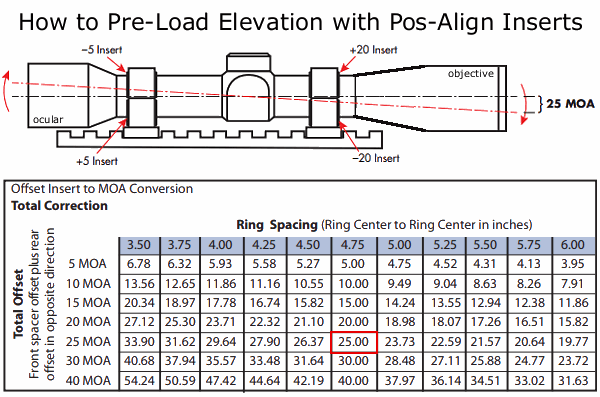
The polymer inserts in Signature rings perform three key functions. First, the inserts provide full, uniform scope-to-ring contact, with no need for lapping. You get a very secure “grip” on your scope without ring marks. Second, the Pos-Align inserts can provide elevation “pre-load”. With eccentric (offset) inserts, you can raise the back of the scope relative to the front, gaining up to 54 MOA of built-in elevation, without the need for expensive tapered bases. Third, the offset inserts can be rotated clockwise or counter-clockwise to shift point of impact. This lets you zero your rifle easily while keeping the turrets in the center of their travel.
Burris XTR Signature Rings are offered in 1″, 30mm, and 34mm diameters, and three (3) different heights: 1″, 1.25″, and 1.5″. Each ring set includes two sets of concentric inserts and one set each of the following offset inserts: +/-5 MOA, +/-10 MOA, +/-20 MOA. These allow you to “pre-load” elevation and/or center up your cross-hairs.
– Pre-load Elevation. No need for expensive tapered bases for long-range shooting.
– Correct misalignment caused by off-center receiver holes.
– Correct for bases or rings being slightly off-center.
How to Pre-load Elevation
To add elevation, set the Pos-Align Offset Inserts to raise the rear of the scope and lower the front. As long as there remains sufficient clearance between the front objective bell and the barrel, Burris recommends lowering the front of the scope the most and raising the rear of the scope the least. The amount of actual elevation “pre-load” will depend on the ring spacing (see chart). In the illustration, with 4.75 inches between ring centers, a +/- 20 MOA pair in the front combined with a -/+ 5 MOA pair in the rear will yield +25 MOA of total elevation. (If the rings are positioned further apart, you’ll get less elevation pre-load.)
Using Inserts to Adjust Point of Impact in Any Direction
Although it is convenient and most understandable to refer to the ring inserts as a “bottom” or “top” insert, the inserts may be rotated to any angle within the scope rings. This allows the shooter to correct the point-of-impact in any direction. The drawings below show how the inserts can be rotated to induce both elevation and windage changes at the same time.
Product tip from Boyd Allen. We welcome reader submissions.
This week, Shooting USA TV spotlights the 2022 GAP Grind, the largest PRS Pro-Am Tactical match with nearly 400 competitors. The 10th Annual GA Precision/Elite Tactical GAP Grind PRO-AM was held September 30 through October 2, 2022 at the K&M Shooting Complex in Tennessee. The GAP Grind, the largest, most popular PRS match in the world, drew nearly 400 amateur and pro shooters. Recognized as the premier PRO-AM precision rifle match with both individual and team competition, the GAP Grind has introduced thousands of new shooters to the sport since its inception. It was great to see the GAP Grind successfully mark its 10th Anniversary.
SHOW TIMES: This Shooting USA Episode airs Wednesday, April 12, 2023 at 9:00 PM Eastern and Pacific; 8:00 PM Central. If you miss the regular broadcast, you can stream the show at any time on Vimeo for $0.99 per episode.
In this video Eagle Eye Shooting Shares Highlights from the 2022 GAP Grind
Big Prize Table at 10th Annual GAP Grind Event
The year’s largest PRS match drew hundreds of attendees, and more than 80,000 rounds were fired throughout the three-day event. Bushnell gave out $5,000 to the top place finishers and added over $5,000 worth of product to the prize table. Trophies were awarded to the top 5 teams, top 5 professionals, and to the top 5 amateurs.
Lots of Action, with 20+ Stages
The GAP Grind is a challenging, “high tempo” match with minimal down-time between stages. Over the course of 20+ stages, competitors will fire 200+ shots at a variety of steel, paper, moving, and reactive targets out to 1,200 yards. Targets vary in size/difficulty based on the shooter’s position, distance, and time allotted. Most stages include “stressors” — i.e. time limits or required movement(s).
This extensive, 45-minute video shows many of the 2022 GAP Grind Stages
GAP Grind Pro-Am Format — Seasoned Shooters Help Newcomers
The GAP Grind typically attracts nearly 400 competitors — half experienced shooters and the other half newcomers to the sport. The key to growing the shooting sports is attracting new shooters. The best way to bring in “new blood” seems to be the Pro-Am type format. At the GAP Grind, experienced shooters share their knowledge and guide the new shooters through the competition.
GAP Grind Hardware
You’ll find the latest and greatest PRS hardware at the GAP Grind. Over the past few seasons, most top competitors have “stepped down” from the 6.5/6mm Creedmoor to the smaller, more efficient 6mm Dasher, 6BRA, 6 GT and other 6mm cartridges. The Dasher offers excellent accuracy with less recoil than the 6.5 Creedmoor. Also, many competitors will be switching to the impressive new Zeiss FFP LRP S3 and S5 scopes in the months ahead.
Berger’s James Fox won the 2023 California Regional High Power Service Rifle Championship shooting Berger factory ammunition and 80.5gr bullets. Fox had a Grand Aggregate score of 1282-48X. Notably, at the closer ranges, Fox shot Berger factory-loaded .223 Rem 77gr OTM ammunition in his AR-platform rifle. For the 600-yard targets, Fox shot ammo loaded with Berger 80.5gr Fullbore bullets. Fox noted: “The Berger 80.5 Grain Fullbore bullets are truly the ‘easy button’ for Service Rifle, because they seem to just shoot in any barrel I have[.]”
The 2023 California Regional Service Rifle High Power Championship was hosted by the Coalinga (CA) Rifle Club on April 1st and 2nd, 2023. With two days of shooting, Fox finished in first on Day One with a score of 792-33X, and first again on Day Two with a 490-15X. In High Power Service Rifle, competitors test their skill in four stages: 200yd Slow-fire Standing, 200yd Rapid-fire Sitting (or kneeling), 300yd Rapid Prone, and 600yd Slow-fire Prone.
With the vast amount of rain California has received in 2023, the Coalinga Range was lush and green. The shooting conditions were also quite good at this April match, with minimal mirage, and mostly consistent winds, making for fairly “easy” shooting and high scores. Competitor Greg Brown noted: “The weather conditions were very pleasant and the winds mild this year. This wind was not a factor for off-hand which helped everyone to generally good scores at the 200-yard line. The winds were somewhat swirly for 300-yard Rapid Fire stage both days and cost some points lost. Conditions for the 600-yard stage looked benign, but tricky enough to prevent any perfect scores, but several 199s were fired on Saturday.”
Archive photo from a past year. The Coalinga Range was far more green and lush in April 2023.
Berger Ammo and Bullets Used by James Fox
“The California Regional Service Rifle Championship was the start to my 2023 shooting season. It was 23 years since the last time I shot at the Coalinga Rifle Club, which both times have resulted in very favorable outcomes for me”, stated Fox. “The first time in 2000 I earned my last Leg Points to become a CMP Distinguished Rifleman, and this year winning the Championship for the first time. During the two-day Aggregate match, I found some early success in the Rapid-fire Sitting stage at 200 yards, where I shot a sub 1-MOA group using Berger’s .223 Remington 77gr OTM ammunition. And later in the day at 600 yards, I fired Berger 80.5gr Fullbore bullets as they held great elevation allowing me to keep rounds in the middle, despite the wind conditions. The Berger 80.5gr Fullbore bullets are truly the ‘easy button’ for Service Rifle, because they seem to just shoot in any barrel I have, with a wide range of powder charges, Vihtavuori N140 seemingly being the best.” Fox will compete next month at the CMP Eastern Games.
Abundant Grass After Much Rain Attracted Cattle to the Range
Greg Brown noted that there were some special challenges at this match — grazing cattle: “The Coalinga Range was at its most scenic this early April time with deep green hills and the grazing yearling steers getting fatter by the hour. Several times the cattle grazed too lose and the shooters turned cowboys had to wrangle them safely off the range.”
Do you occasionally get completely unexplained flyers, or have a shot land straight down at 6 O’Clock, right below your point of aim? That could be caused by poor or inconsistent trigger technique. How you pull the trigger can and does affect your accuracy.
Many gun enthusiasts start with pistols. When they later start shooting rifles they may carry over some not-so-good practices acquired from shooting handguns with heavy 4 to 6-pound trigger pulls. You may want to “re-learn” your trigger techniques to get better rifle results.
Shooting Sports USA has a good article on trigger technique that offers many useful tips. That article also has many helpful illustrations, including the one shown above. Another illustration shows different types of trigger shoes (straight vs. curved) and explains how each makes a difference: “With a lightly curved trigger, the shooter’s finger can contact the trigger either high or low according to preference. Higher contact will increase the resistance.” READ ARTICLE HERE.
The article analyzes common errors, such as pulling the trigger with the very tip of the finger rather than the pad of the index finger: “Using the tip of the finger can lead to lateral pressure on the trigger, which throws off the shot.”
The article also explains that you should check your trigger regularly to make sure it is functioning properly and is not out of adjustment: “Just like any other moving part, the trigger can suffer from wear. In such a precise mechanism, tiny amounts of wear can cause major problems.”
The ergonomics of the Eliseo Tubegun allow a nice, straight trigger pull.
Trigger Tips
Six Suggestions for Making your Trigger Control More Consistent.
1. If your triggers are adjustable, set the pull weight appropriate to the discipline. For a hunting rifle, you don’t want an ultra-light trigger pull. For High Power, you may want a two-stage pull, while on a Benchrest rifle you may prefer a very light trigger.
2. If you have a two-stage trigger, experiment with different combinations of First Stage and Second Stage.
3. Have a friend watch you as you pull the trigger, and maybe even take a close-up video as you pull the trigger. This can reveal a variety of flaws.
4. Practice dry-firing to see if flaws in trigger technique are causing gun movement.
5. As an experiment, try pulling the trigger with your middle finger. Ergonomically, the middle finger has a more straight alignment with the tendons in your hand. This exercise can help you identify alignment issues with your index finger.
6. For stocks with adjustable Length of Pull you may want to set the LOP differently for bench shooting vs. prone or F-Class shooting.
When Only the Best Will Do…
German-made Bix’N Andy triggers, available from BulletCentral.com, are among the very best you can buy. Available in both single-stage and two-stage, Bix’N Andy triggers are extremely precise, repeatable and smooth. The unique internal, friction-reducing roller ball system allows for extremely low reset force, yielding an ultra-crisp let-off. Bix’N Andy triggers can be fitted with a variety of trigger shoes according to shooter preference.
The CMP Offers Pistol Marksmanship 101 courses, with handguns and ammunition provided.
Those wanting to enhance their pistol skills now have a great opportunity thanks to the Civilian Marksmanship Program (CMP). The CMP will offer Pistol Marksmanship 101 Courses at the 2023 CMP Eastern Games Matches and the CMP’s Talladega Quarterly Matches. These hands-on pistol courses are designed for seasoned pistoleros as well as those completely new to bullseye pistol shooting. Notably, pistols and ammo will be provided by the CMP.
The CMP Eastern Matches will be held April 28 to May 7, 2023 at the Camp Butner National Guard Training Facility in North Carolina, with the Marksmanship 101 Course set on the opening day. In addition, Pistol Marksmanship 101 courses will be conducted during the CMP’s Talladega Quarterly Matches, held at the Talladega Marksmanship Park in Alabama, on May 13 and August 26, 2023.
The CMP’s Marksmanship 101 Courses, taught by highly skilled instructors, train individuals on firearm essentials and competition basics in a closely monitored setting. Participants learn safety, positioning, how to load/clear a pistol and more through classroom work and active training on the range. At the close of the course, students will shoot an Excellence-In-Competition match. NOTE: Hearing and eye protection are required during live firing. Juniors must be at least 14 years old to participate.
About the CMP Travel Games:
The Travel Games are regional competitions held throughout the year, featuring CMP’s own rifle and pistol outdoor events. A common part of the CMP schedule for the last decade, the Games are centered around recreation-oriented competition and educational activities that are designed to accommodate experienced marksmen as well as those hoping to learn more about the sport. See CMP’s full lineup of Travel Games at https://thecmp.org/competitions/cmp-travel-games.
Will you compete at this year’s NRA National Matches at Camp Atterbury, Indiana? Then there’s an excellent digital magazine you should read. Shooting Sports USA has a guide to the 2022 NRA National Matches with great photos, match results, and interviews with top shooters. Featuring complete coverage of last year’s competitions at Camp Atterbury, including the High Power Rifle, Smallbore Rifle, and Precision Pistol National Championships, the recap can be viewed for free online. CLICK HERE to READ.
2022 NRA National Matches — Full Report
At the NRA National Matches at Camp Atterbury, high-level competitive shooters from around the nation can test their skills and celebrate their achievements with medals and trophies. The 2022 NRA National Matches special edition magazine, published digitally by Shooting Sports USA, celebrates the 2022 NRA National Rifle and Pistol Championships at Camp Atterbury, Indiana.
SSUSA’s 2022 digital recap begins with the opening day festivities, including the First Shot Ceremony with Indiana First Lady Janet Holcomb, and goes on to cover the three different phases of the NRA National Matches. Plus, there is special coverage of the 2022 Pershing International Trophy Match, where the U.S. smallbore rifle team recorded a historic victory over Great Britain.
The home of the NRA National Matches since 2021, Camp Atterbury is an active National Guard training facility located south of Indianapolis, near Edinburgh, Indiana. For the 2022 National Matches, Camp Atterbury employed 30 Silver Mountain electronic targets for the Rifle Range Six. The moder e-targets allow faster, more efficient matches, with no pit duties for competitors.
The USAMU’s SFC Brandon Green shot superbly last year at Camp Atterbury. Green won numerous matches, capturing the Long Range Rifle Championship and many other honors. Here’s Brandon with his trophies from 2022.
Here are Cadets Hayle and Jesse Mayer, from the Texas A&M Reserve Officers’ Training Corps (ROTC), at the 2023 U.S. Army Small Arms Championships at Fort Benning, Georgia in March 2023. The annual, live fire training event is open to Army ROTC cadets and all soldiers in the active duty, Army Reserve, and National Guard, and is therefore commonly called the ‘All Army’. CLICK HERE to Read Full Story on USAMU website. (Photo by Lt. Col. Michelle Lunato.)
Cadet Sisters Compete at the U.S. Army Small Arms Championships Story by Lt. Col. Michelle Lunato U.S. Army Marksmanship Unit
This year’s U.S. Army Small Arms Championships was more than just a unique training event for two Texas A&M ROTC cadets, it was a family affair. Cadets Hayle Mayer and Jesse Mayer, who are sisters, participated in the week-long, comprehensive, live-fire marksmanship training event that brings together more than 250 soldiers from across the U.S. Army to the Maneuver Center of Excellence.
The annual event, which is commonly called the “All Army”, is hosted by the U.S. Army Marksmanship Unit (USAMU) and begins with All Army competitors receiving a variety of classes from the USAMU champions and experienced trainers.
After that, the soldier competitors, who were a mix of service members from active duty, Reserve, National Guard, and ROTC, competed in 11 different courses of fire during the week … both rifle and pistol matches, with and without combat gear, as well a 4-stage multi-gun match.
As a senior, All Army 2023 was Jesse’s second year to compete and the cadet said each year has been extremely helpful in developing her soldier skills. “I think both times that I have come here, I have really grown as a marksman … just learning the basics, what I am capable of, watching improvement each year, and just learning how complex marksmanship is. It’s been really incredible each time.”
For her sophomore sister, Hayle, it was her first All Army experience. With limited prior marksmanship experience … Hayle said she was trying to absorb all that she could. “I am just learning basically everything you can about shooting.”
Cadet Hayle Mayer, with Texas A&M ROTC, competes in the Bullseye Pistol Match at the 2023 U.S. Army Small Arms Championships at Fort Benning, Georgia.
Sisters Come from a Multi-Generation Military Family
Though Hayle and Jesse may at be different levels of marksmanship knowledge, the sisters say that military life in general is nothing new to them. In fact, they were born into that life since both their parents were Marines, both grandfathers were soldiers, and a grandmother was an Airman.
That meant that military life was just always there. It’s what we saw and respected, Jesse explained. “Everyone was so disciplined and so patriotic. There was just such a higher purpose to the military that I always saw, and I wanted to be part of that.”
So when it came time for college, joining an Army ROTC program was nothing out of the ordinary because both our parents instilled a strong sense of independence and strength in us, Jesse said.
“Growing up, I watched it — the honor, the sacrifice, and what it meant to give back and serve other people, your Country and your family.”
With all that, Jesse is proud to say that she is contracted to commission in May of 2024 and looks forward to carrying on her family’s tradition of service.
“It means a lot to me to serve my Country, to push myself in any way that I can, and it is part of a family legacy — being in the military — and I just want to complete that and do that for my family.”
Berger Twist-Rate Stability Calculator On the Berger Bullets website you’ll find a handy Twist-Rate Stability Calculator that predicts your gyroscopic stability factor (SG) based on mulitiple variables: velocity, bullet length, bullet weight, barrel twist rate, ambient temperature, and altitude. This cool tool tells you if your chosen bullet will really stabilize in your barrel.
How to Use Berger’s Twist Rate Calculator
Using the Twist Rate Calculator is simple. Just enter the bullet DIAMETER (e.g. .264), bullet WEIGHT (in grains), and bullet overall LENGTH (in inches). On its website, Berger conveniently provides this info for all its bullet types. For other brands, we suggest you weigh three examples of your chosen bullet, and also measure the length on three samples. Then use the average weight and length of the three. To calculate bullet stability, simply enter your bullet data (along with observed Muzzle Velocity, outside Temperature, and Altitude) and click “Calculate SG”. Try different twist rate numbers (and recalculate) until you get an SG value of 1.4 (or higher).
Gyroscopic Stability (SG) and Twist Rate
Berger’s Twist Rate Calculator provides a predicted stability value called “SG” (for “Gyroscopic Stability”). This indicates the Gyroscopic Stability applied to the bullet by spin. This number is derived from the basic equation: SG = (rigidity of the spinning mass)/(overturning aerodynamic torque).
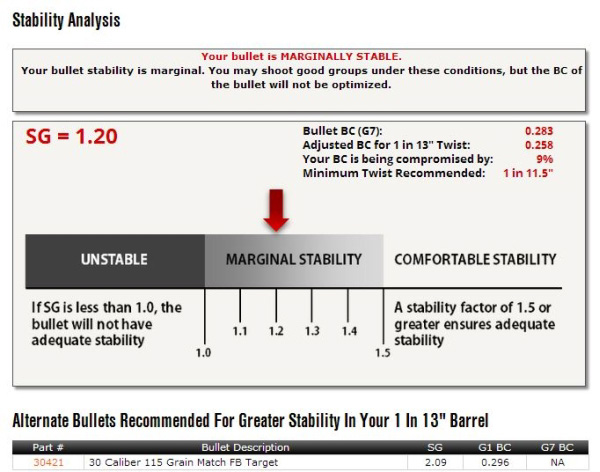
If you have an SG under 1.0, your bullet is predicted not to stabilize. If you have between 1.0 and 1.1 SG, your bullet may or may not stabilize. If you have an SG greater than 1.1, your bullet should stabilize under optimal conditions, but stabilization might not be adequate when temperature, altitude, or other variables are less-than-optimal. That’s why Berger normally recommends at least 1.5 SG to get out of the “Marginal Stability” zone.
In his book Applied Ballistics For Long-Range Shooting (3rd Ed.), Bryan Litz (Berger Ballistician) recommends at least a 1.4 SG rating when selecting a barrel twist for a particular bullet. This gives you a safety margin for shooting under various conditions, such as higher or lower altitudes or temperatures.
Story idea from EdLongrange. We welcome reader submissions.


 Watch the video below to learn about the kneeling position, as explained by National Paralympic Coach Bob Foth and 2012 Olympian Amanda Furrer. Three-time Olympian and Silver Medalist Bob Foth details the proper techniques (both body position and gun-handling) for kneeling position shooting. Putting Foth’s coaching tips into practice, three-Position smallbore shooter Amanda Furrer demonstrates how to properly shoot from a kneeling position using a .22 LR match rifle.