|
|
April 10th, 2009
 On the eve of the new competitive shooting season, the rulemakers of the International Benchrest Shooters (IBS) issued two decisions that will affect the short-range benchrest game.
On March 31st, the IBS Executive Board took the following actions:
Modification of Bolts-Out Rule
In order to safely allow competitors to check seating depth, et. al. in the loading area, the E-Board voted to allow the allow insertion of bolts in the loading areas. However, placing the bolt in the gun while in the loading area is permitted ONLY under the following circumstances (read carefully).
1. Competitor strips the bolt of the fire control system.
2. Competitor uses a dummy round without primer or powder.
3. Competitor inserts a NRA “chamber flag” or other IBS-approved indicator inside the bare bolt.
4. Competitor displays all of these items to those around him.
NOTE: Violation of the above rules will result in an immediate disqualification from the tournament. According to the IBS Executive Board: “The change in the bolts-out rule will not take effect until we establish the exact type of bare bolt indicator that will be readily available to competitors. A likely date of inception is June 1, 2009. Until that time, the existing ‘bolts-out rule’ applies.”
Approval of Current Beggs Stock
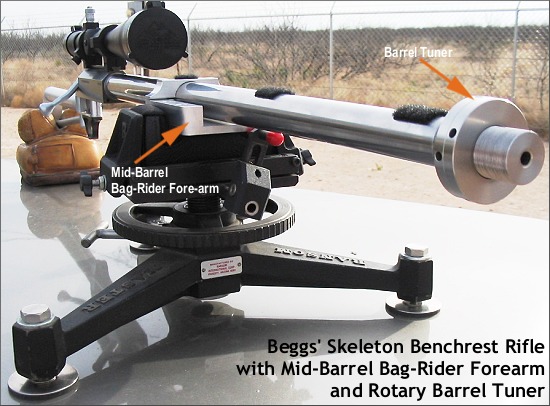
An IBS member asked the Executive Board to rule on the legality of the Gene Beggs’ modular stock for competition. This stock (shown below) features a separate, clamped bag-riding forearm rather than a conventional one-piece stock. The Excutive Board determined: “After consulting the Group and Score Committees there was a consensus among board members that the rules really did not envision a stock of this type. In the interest of not inhibiting innovation, the E-Board approved the Beggs Stock as currently configured, for HV, LV, SP, and VFS (as appropriate) competition in 2009. So that similar innovations can be more readily assessed, the Executive board will do a comprehensive review of the stock configuration rules prior to the July 1 deadline for agenda item submission.”
April 8th, 2009
 Our own Asst. Editor, Jason Baney, runs a popular “postal match” called “Smack the Smiley”. Four times a year (Spring/Summer/Fall/Winter) you can shoot an official target at your own range, and then submit it for judging. Over $2000.00 in prizes will be awarded for each 2009 seasonal match. You can compete with shooters from across the continent.
Jason started the Smiley matches in 2004. Since 2006, a share of monies collected from entry fees have been donated to American military marksmen via AmericanSnipers.org. These donations have totaled over $5000.00.
Jason is accepting entries for the current Spring Match. Order your targets now. The Spring Match officially starts April 13, 2009. Your finished Spring targets must be returned (postmarked) by May 26, 2009. Targets will be scored and ranked on shooting forums including SnipersHide.com, West Coast Tactical, SnipersParadise, and the main contest site, SmackTheSmiley.com
Smack the Smiley Prizes
Prizes donated by manufacturers are raffled off, lottery-style, after each match. This means that every participant has a chance at winning a valuable prize. The prize list totals over $2000.00 in value for each Smack the Smiley match. You’re smart to shoot all four seasonal matches (Spring/Summer/Fall/Winter). A four-match Aggregate will be tallied this year with a possible prize for the Aggregate winner.
CLICK HERE for Smack The Smiley 4-Season Match Calendar
Smack The Smiley Postal Match Rules
● There are two classes, rimfire and centerfire, with no other rifle restrictions. Rimfire guns shoot at 50 yards, while centerfire rifles shoot at 100 yards.
● All rifles must be shot from the ground, either sitting or prone position, with NO tripod rests allowed. Only bipods or other field expedient rests are allowed.
● You must shoot official targets only, ordered from SmackTheSmiley.com. These cost $3.50 each with a max of 4 targets per class. One dollar ($1) from each target goes to Americansnipers.org.

April 7th, 2009
One of our readers recently observed: “You know there’s so much negative news about the economy, gun laws etc., we need to read something positive to keep things in balance. Why don’t you guys do a ‘good news’ story every week in the Daily Bulletin?”
Good suggestion! Here’s an item that we think has a positive slant — a new shooting program for shooters with physical impairments….
 Open Range Day for Disabled Shooters
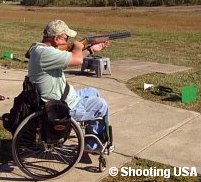
On April 11, the NRA, lead by Disabled Shooting Services Manager Vanessa Warner, is hosting a first-ever “Open Range Day” at the Ben Avery Shooting Facility in Phoenix, Arizona. This event is the latest program offered by the National Rifle Association’s Disabled Shooting Services. The day will focus on introductory shooting for people with physical disabilities. Open Range Day will offer shotgun, rifle, pistol, and air rifle instruction. Warner expects around 80 participants for the inaugural event. “This is a pilot program for what we hope to expand to a national program,” Warner said.
Warner has secured the support of Colt Defense, Ruger Firearms, White Flyer Target, Remington, Kowa Optimed, Birchwood Casey, Davidson’s, Beeman, and Lapua. “We’re still accepting door prize donations,” Warner said.
The event is the first of its kind and will give participants the opportunity to fire a wide variety of firearms. NRAblog.com plans to report live from the event. For more information about Open Range Day or other services for disabled shooters, call Vanessa Warner at NRA Headquarters, (703) 267-1495, or e-mail disabled_shooting@nrahq.org.
 Bob Foth Hired as Paralympic Shooting Coach
In related matters, USA Shooting announced the hiring of Olympic silver medalist Bob Foth as its new Paralympic Shooting Coach and Program Manager. A three-time Olympian in rifle, Foth brings a tremendous amount of experience to his new position. He began shooting competitively in 1972 and won numerous national and international medals during his shooting career. He was part of several world champion teams and set six world records. He joined the USA Shooting staff as Youth Programs and Coach Development Manager in 2006 and assumed his new role as Paralympic Coach/Manager on April 6, 2009. Foth will join Warner and NRAblog at the Ben Avery Shooting Complex in Phoenix on April 11 for Open Range Day.
CLICK HERE for large Ben Avery Map.
April 7th, 2009
 Alliant Techsystems (NYSE:ATK) has been awarded a contract from the U.S. Army to continue operating the Lake City Army Ammunition Plant for an additional four (4) years. Under the new contract, ATK will continue to supply small-caliber ammunition through September 2013. The contract extension assures an uninterrupted supply of ammunition to the U.S. military beyond ATK’s current 10-year contract. The U.S. Army also awarded ATK $481 million under the new contract for production of 5.56mm, 7.62mm, and .50-caliber ammunition and to continue work to modernize the Lake City facility.
ATK is now the #1 producer of small arms ammunition in the world, manufacturing billions of rounds each year. Lake City is a key source of ATK ammo production. ATK began operating the plant, located in Independence, Missouri, in April 2000 and has increased production from 350 million to more than 1.4 billion rounds annually. The plant has the capability to produce a mix of 5.56mm, 7.62mm, .50-caliber, and 20mm cartridges, as well as ammunition links.

April 4th, 2009
The recent multi-trillion-dollar orgy of federal spending has many economic experts worried about the “I word” — inflation. As the government borrows more and more money, these experts caution we can expect the dollar to fall and prices to rise. Are there “safe havens” in inflationary times? Real estate is depressed, the stock market has been devastated, and as for bonds… well if interest rates rise in the months ahead, you have to be very careful about buying low-return bonds right now.

We are NOT qualified to hand out investment advice, particularly in these troubled economic times when all the “conventional wisdom” has gone by the wayside. Nonetheless, it appears that demand for fine firearms remains high. In particular, “classic” high-grade revolvers have been appreciating even while stocks tumble and home values sink.

Colt Python — An Appreciating Asset
Among the most desirable of double-action revolvers is the Colt Python, preferrably with Colt’s famous high-polish Royal Blue finish. Pristine blued Pythons sold for $800.00-$900.00 just a few years ago. Now the same revolvers are fetching up to $1900.00 at auction. The mint-condition 1977 6″ Python shown below sold for $1850.00 just last week on Gunbroker.com, and there were 15 bidders! (See Completed Auction 125683644.)

Would a Python be a good short- or long-term investment? You have to decide that for yourself. But consider this: Colt stopped producing Pythons in 2005, so the supply is fixed. And the recent Pythons are not (yet) considered as desirable as Pythons made in the 60s, 70s, and 80s. So the price of the older Pythons keeps rising. Pythons were produced with 2.5″, 4″, 6″ and 8″ barrels. All lengths are popular, but the 6″ Python seems to be the most sought-after currently.

If you’ve ever carefully inspected a Royal Blue Python, and worked the action, you’ll understand why they are so popular. The liquid-like ultra-smooth blued finish is simply the best ever offered on an American handgun. Chuck Hawks writes: “Colt’s Royal Blue is the ultimate polished blue finish for steel guns. No other blued production revolver can compare to the beauty of Colt’s Royal Blue Python.” And the Python’s double-action trigger is considered by many to be the smoothest ever made. The triggers on S&W Performance center revolvers are very, very good, but the trigger in a 60s or 70s Python is better — right out of the box. Typically, Pythons are extremely accurate, shooting sub-inch at 25 yards. Ergonomically, Pythons are a pleasure to shoot because the bore axis is lower than on most other large-frame revolvers. Chuck Hawks agrees: “Subjectively, this finest of all DA revolvers is a soft shooter… most shooters feel that the Python kicks less than other DA magnum revolvers of comparable weight.”

April 3rd, 2009
Congress has just approved a new $3.6 TRILLION dollar budget for fiscal 2010. This will include $1.75 trillion in deficit spending according to independent analysts (though House Democrats assert the deficit will only be $1.2 trillion). The budget was approved on party lines. No Republicans voted for the budget. In the Senate, the budget was approved 55-43, while in the House of Representatives the vote was was 233-196, with 20 Democrats dissenting.
With the U.S. population estimated at 305,529,237 as of 1/1/2009, (U.S. Census Bureau data), President Obama’s $3.6 TRILLION budget represents a historically unprecedented level of spending (and borrowing) per capita. Check out them zeros: $3,600,000,000,000.00!
The 2010 Federal Budget works out to $11,783.00 for every man, woman, and child in the United States, and represents $30,635.00 per household. This figure ($30,635) is 61% of the median American household income.*
A Trillion Here, a Trillion There…
For many Americans, the scale of the numbers being tossed around by Washington politicos is hard to comprehend. To put things in perspective, PageTutor.com has created a handy visualization of what one trillion dollars would look like, in stacked $100.00 bills. Here, for starters, is a mere $100,000,000:

The image below shows one Trillion dollars ($1,000,000,000,000) in stacked $100.00 bills. (Pallets are double-tiered). To give you a sense of scale, the little red figure in the lower left corner is a human, the same guy in the picture above. Is your mind sufficiently boggled now?

How Much is a Trillion?
Here are some other interesting Trillion-dollar calculations, offered by Doug Furton, a physics Professor at Grand Valley State University:
• 1 trillion dollar bills stitched together end to end in a line would stretch about 94 million miles — a bit more than the distance from earth to the sun.
• 1 trillion dollar bills stitched together to form a quilt would cover an area about the size of the state of Connecticut.
• If we spent $1.00 every second, it would take 32,000 YEARS to spend 1 trillion dollars.
How about repaying the $1.75 trillion dollars Congress intends to borrow in fiscal 2010? Think that will be easy? Think again. Prof. Furton explains: “If we borrowed 1 trillion dollars at 6% APR with terms similar to a conventional home loan the debt would accumulate interest at a rate of $1929 per second. If we paid the debt off at the rate of $2000 per second we could discharge it in about 56 years — a working lifetime. By the end of this massive loan we would have paid a total of nearly 3.5 trillion dollars, putting a tidy 2.5 trillion dollars in the coffers of whoever made us the loan”.
*According to the Census Bureau, the average American Household size is 2.6 persons. U.S. Median Household Income is $50,233.00, last officially calculated in 2007.
April 3rd, 2009
Every month ShootingUSA offers a handsome new firearm in a drawing. This month the prize is a S&W 1911 with Crimson Trace Laser-Grips, MSRP $1,493.00. Sweet Pistol. To enter the contest, you need to provide personal info and the name of an FFL-holder to whom the gun can be shipped. In addition, you need to answer a question. We thought all our readers should know the answer to the current question: “You shoot a One MOA group at 1,000 yards — How wide is the spread of the group?” The suggested answers range from 5 inches to 12 inches. HINT: 1 MOA is 1.047″ at 100 yards.

About the Contest Gun
The S&W 1911 PD is a Commander-size model with 4 1/4″ barrel, carbon steel slide, and Scandium frame. With an 8+1 round capacity, it weighs 28 ounces empty. This model features a Novak rear sight, external extractor (for reliability), and wrap-around Desert Tan Crimson Trace Laser grips. This Editor owns a full-size, all-stainless S&W 1911. My gun has proven exceptionally accurate and has excellent fit and finish. With handloads my gun will shoot as accurately as some Baer and Wilson customs I’ve tried. Below is 5-round group I shot offhand at 10 yards with my 5″ S&W 1911. The bullet hole edges are sharp because I was using semi-wad-cutters. I used Vihtavuori N320 (my favorite powder for 45acp) and 200-grain SWCs from Precision Bullets in Texas. The only thing I would change on my S&W 1911 is the trigger shoe. I prefer the old-fashioned short trigger in 1911s (but that’s a matter of personal preference).
Target from Editor’s 5″ S&W 1911 (not contest pistol).

April 1st, 2009
 Air rifles and air pistols are not considered “firearms” under federal law. Therefore, in all 50 states, air rifles and air pistols can be purchased “over the counter”, without background checks. The lack of controls on pneumatic guns has long troubled many California lawmakers who have “taken aim” at the airgun industry with tough new legislation. This year, California extends its sweeping gun-control policies to air rifles and pistols under the terms of new legislation, AB 1984, recently codified into law. Under this bill, air rifle and pistol owners will be required to pay an “Air Excise Tax” on all canister refills and CO2 propellants. In addition, all refills must be done by state-licensed air refill centers operated by the California Air Resources Board (CARB). In order to qualify for refills (and purchase propellant cartridges), air rifle and pistol owners must first obtain a state-endorsed “Air User Certificate”, which will cost $95.00, renewable annually. These new regulations take effect June 1, 2009.

New Law Carries Stiff Penalties, Yet Fear of Air “Black Market” Persists
Recognizing that air is an abundant and otherwise free resource, the new law contains tough provisions to prevent air rifle and pistol owners from filling their air canisters from non-approved sources. Any air rifle/pistol owner caught refilling canisters from a private pump or compressor will be subject to a $10,000 fine for the first offense, with criminal penalties (up to 5 years in prison) for repeat offenders. This may, initially, cause some practical problems. Currently, CARB has no certified filling stations for airguns, and given California’s current budgetary crisis, it may be many months before the first filling stations come on-line. In the mean-time, using $8.3 million in Federal Stimulus funding, CARB will hire 65 “Air Security & Surveillance Officers” (ASSOs) to find scoff-laws who continue to fill their airguns with unregistered air. Some observers worry that one unfortunate side-effect of AB 1984 could be the creation of a criminalized “black market” for air in the Golden State.
 Democratic legislators praised the new regulations. An official statement by the Assembly Democratic Caucus declared: “This is a great day for all Californians. Air rifles can be just as dangerous as powder-fired weapons. These air rifles are silent killers and even when used for target sports they can put your eye out.” California Governor Schwarzenegger did not issue a formal statement about the new Air Excise Tax. However an aide to the Governor, who declined to be named, remarked: “Look, this state is $40 billion in the red. Any new revenue source is welcome.” Off the record, he added: “We tax gasoline, we tax real estate, we tax health care, we tax income, we tax all the products you buy in stores, and we even tax you when you die. Why not tax air? It’s brilliant. Heck, if we could tax sunshine, we would”.
The California State Employees Union also expressed support for the new legislation, noting that it would create up to 200 new, permanent high-paying jobs. Sacramento has an abundance of workers skilled in the dispensing of hot air, so CARB believes it can quickly fill the new positions mandated by AB 1984. The California Legislative Analyst’s Office (CLAO), tasked with estimating the costs of new legislation, has predicted that Air Excise Tax revenues should “more than cover the hardware costs of air filling stations.” However, the CLAO cautioned that “attendant administrative and enforcement costs, including salaries, entitlements, and mandatory pensions, could run into the tens of millions of dollars annually.” Asked to comment on those projected costs, AB 1984’s author, Assemblywoman Juanita Wilson (D. Berkeley), observed: “Let’s worry about that later. This is about Hope and about Change…we’re doing this for the children. Plus California needs jobs, and my ground-breaking legislation will put hundreds of Californians back to work.”
April 1st, 2009

At the U.S. Army’s Aberdeen Proving Ground, a team of ballistics technicians, supported by some of the U.S. Army’s top sniper instructors, has been quietly developing a radical new “dimpled” bullet. The exterior of the bullet resembles the dimpled surface of a golf ball. The function of the special dimpled skin is to reduce projectile drag, providing a flatter long-range trajectory, and greater retained energy at the target.
.338 Projectile with MIM Exo-Jacket
(3D-CAD Artist’s Rendering) |
 |
In their pursuit of a lower-drag bullet, the Army tried a variety of designs, including bullets with circumferential drive bands, dual-radius ogives, and rebated boat-tails. The dimpled “golf-ball” design was considered a “long shot” according to the design team, but it has performed beyond all expectations. The nominal drag coefficient (Cd) has improved by about +.040, while cartridge muzzle velocity has increased by nearly 80+ fps because the bullet’s dimpled skin reduces in-barrel friction. What’s more — the terminal performance of the dimpled bullet has been “spectacular”. The Aberdeen team set out to produce a slightly more slippery bullet for U.S. Army snipers. What they ended up with is a bullet with dramatically enhanced long-range ballistics and superior killing power on “soft targets”.
 Lt. Col. Ben Eldrick, Long-Range Projectile Project (LRPP) team leader, told AccurateShooter.com how the radical bullet was conceived: “During our initial design work, we wanted the benefits of a high-BC, pointed bullet, but in a design that could be mass-produced and could work as a tracer. We consulted some of the top civilian bullet experts, including ballistician Bryan Litz of Berger Bullets. Mr. Litz really got the ball rolling. He suggested that the ‘next big step’ in bullet design would involve the turbulent boundary layer over the body of the bullet. Litz told us that ‘pointing bullet tips will take you only so far… think about optimizing the airflow over the entire bullet’. That made a lot of sense to us. When you design a race car to be aerodynamic, you sculpt the whole body, not just the front bumper.”
Lt. Col. Eldrick continued: “It turns out Litz was right on the money. By employing a golf-ball type dimpled surface, we were able to optimize the turbulent boundary layer on the bullet body. This reduced the low-pressure wake zone behind the bullet significantly, resulting in reduced base drag. As a result the bullet experiences much less overall drag, effectively raising the BC.” The Army team had discovered that what works for golf balls also works for bullets.
 After testing a series of prototypes, the Aberdeen bullet design team settled on a copper-jacketed bullet with dimples about 0.5 mm in diameter. The first-generation bullets were formed in special binary impact swages that press-form the dimples after the bullets were pointed up in conventional dies. Future production bullets will be made with an advanced metal-injection-molding (MIM) process that forms the dimples directly into the surface of the bullets. Rather than simply wrap the core material (which is classified), the MIM is molecularly bonded to the core. The Aberdeen LRPP team calls this “Exo-Jacket” construction, as in “Exo-Skeleton”.
 Higher Velocities Achieved
There was a surprise benefit of the dimpled bullet design — higher muzzle velocities. Given the same powder charge, dimpled bullets exit the muzzle faster because they produce less in-barrel friction than do conventional bullets. This is because the recessed dimples effectively reduce the metal-on-metal bearing surface. Lt. Col. Eldrick revealed: “the added velocity was an unexpected bonus. With equal-pressure loads, dimpled .308 bullets will fly about 80 fps faster than normal .308 bullets. With the large .338-caliber projectiles, the difference is even greater… we can pick up nearly 150 fps.” Given the observed velocity gains achieved with dimpled bullets, Aberdeen designers are now working on dimpled shell casings for larger artillery projectiles.
Dimpled Jacket Delivers ‘Explosive’ Fragmentation
While the internal design and core materials of the new dimpled bullet remain classified, the design team revealed that the terminal performance of the new bullet has been “spectacular”. The bullet penetrates like a FMJ but then explosively fragments, resulting in a devastating energy release in the target. According to Capt. Jack Sarazen, an Aberdeen engineer, “the enhanced terminal performance of the dimpled bullet was unanticipated. This was a serendipitous effect of the slight thinning of the jacket material where the dimples are pressed.” Sarazen explained: “Most FMJ bullets break along the cannelure and then fragment into two or three large pieces. With the dimpled bullets, you have multiple fragmentation points so the bullet literally blows up like a grenade in the target.”
April 1st, 2009
Major commodities exchanges announced that they would commence trading of cartridge primers and primer futures contracts, starting on April 2, 2009. This marks the first time that an ammunition component will be exchange-traded, alongside oil, gas, precious metals, and agricultural products. Federal, CCI, Remington, and Wolf primers will be listed on the NYMEX (N.Y. Mercantile Exchange), CME Group (Chicago Mercantile Exchange), and the USFE (U.S. Futures Exchange).
“Primers may be the pork-bellies of the future.” — V. DeMarco, Commodity Trader
 The price of primers has skyrocketed in recent months, with Federal 205M primers rising from the mid-20 dollar mark to $60.00 per box (see chart). Price hikes have been driven by increased demand as Americans salt away large caches of primers in fear of future shortages. The demand for primers (half of American households have guns), combined with the volatility of bulk primer prices, convinced commodity exchange managers that it was time to start trading primers and primer futures. Vince DeMarco, a trader on the Chicago Mercantile Exhange, explained: “Primers may be the pork-bellies of the future. Demand is at an all-time high. With the ability to buy and sell primer futures, now investors can make money on price movements.” Leslie Woods, an analyst for Forbes magazine, noted that “We are seeing significant hoarding. People are buying primers by the hundreds of thousands, yet many purchasers have no intention of ever using all those primers. Many of the buyers are not even active shooters. They are clearly acquiring large stocks of primers for speculative purposes. Now, with primers being traded as commodities, these investors can maintain their stake in the primer market without actually holding physical inventory.”
Marcus Singleton, a V.P. with the N.Y. Mercantile Exchange (NYMEX) explained: “We should have done this (trade primers as commodities) years ago. More Americans buy primers than will ever buy gold or silver bullion. Primers are consummable, which means that there will always be a lag between supply and demand, which is what moves markets. And a moving market, whichever way it goes, makes money for the exchanges.” Singleton also noted: “Let’s face it, people don’t really want to have half a million primers stashed under their bed. That’s a potential fire hazard. And due to Haz Mat charges, large quantities of primers are very expensive to ship. For the small investor, concerned about rising primer prices, it’s much better to purchase primer futures contracts. That way he gets price protection in the long run and he doesn’t actually have to store anything.”

|


