Can a rifle built on a Savage target action be “big-league” competitive? Apparently so. Forum member Nat Lambeth (aka “Rustystud”) reports that Jeff Saunders shot a 200 with 14 Xs at 600 yards last Saturday at an F-Class Match in Camp Butner, NC. This is one “X” off the National Record (200-15X) on the new F-Class target, and topped the 600-yard F-Open record (200-13X) set by Charles Ballard. Jeff was shooting a Savage target action with a 31″ Broughton 1:8″, 5C barrel chambered in 6mmBRX, in a modified Stockade stock topped with a 12-42×56 Nightforce scope. Jeff is a relatively new shooter and is learning the art of reading the wind. Jeff shot five shots in a row into a 1.75″ spotter before hitting the spindel and destroying the spotter.
Now matter what you’re shooting (even a railgun with a $1300 action in a barrel block), five shots into 1.75″ at 600 yards is impressive. To do it with a $450.00 Savage action is even more impressive. These actions, which have three (3) action screws and come complete with AccuTrigger, can be purchased from a number of vendors, including Bruno Shooters Supply. An FFL is required to receive the action. Bruno’s list these items in inventory:
SAG18183 Savage Target Action 223 RB,LP Stainless $448.68
SAG18185 Savage Target Action 223 RB,RP Stainless $448.68
SAG18182 Savage Target Action 308 RB,LP Stainless $448.68
SAG18184 Savage Target Action 308 RB,RP Stainless $448.68
Results for the 2008 Creedmoor Cup & CMP Games have been posted on the CMP Competition website. The match, hosted at the Ben Avery Shooting Facility in Phoenix, AZ, was hugely successfully drawing hundreds of shooters. You can find the winners of all categories on this Results Page. Then click on the “Ranked” link beside the winner’s name to get a list of all finishers in order of score.
Ronald Zerr, shooting a Match Rifle, won the Creedmoor Cup Aggregate overall with a 791-31X score. Forum member Jerry Tierney was runner-up in the Match Rifle Class with a 774-19X. In the Service Rifle Division, Trent Hering shot an impressive 789-25x, toping a field of 138 Service Rifle Shooters. Forum member Shawn McKenna finished second with a 782-23X score.
21 Teams Compete For Service Rifle Team Title
Among the big attractions of the CMP Games and Creedmoor Cup are the tightly-fought team events. In Service Rifle, 21 Teams competed for honors. This year, the USMC Arrieta team took first place, with a 1915-53X Aggregate. Team members are: MSgt Alex Arrieta (Coach), SW02 Peter Burns (Captain), SSgt Daniel Duitsman, CWO4 James Fraley, and SSgt Jason Haislip. The Oregon State Shooting Assn. Team finished second (1902-46X), with the Bushmaster/Remington Team in third (1892-42X).
Vintage Rifle Matches Are Very Popular
In other Western CMP Games events, Wesley Shumaker won the Garand Match, Arland Anderson won the Springfield Rifle Match, CW02 Peter Burns won the Vintage Rifle Match, and Creedmoor Sports Gen. Manager Dennis DeMille won the Garand Re-Entry Match. For the Overall Three-Gun Aggregate (Garand, Springfield, and Vintage Rifle), the top five shooters were: Michael Miller (823-11X), Arland Anderson 821-9X), James Denovchek (814-11X), Wesley Shumaker, and Ronald Foos. These older military-rifle matches were hugely popular, with large numbers of competitors. There were 135 shooters in the Garand Match and 51 in the Springfield Match. These kind of events, using vintage rifles that can be obtained at moderate cost from the CMP itself, reward fundamental marksmanship skills. They are much more a test of shooter abilities than a technology race.
In our Gun of the Week section, we’ve featured Gary Eliseo’s innovative R5 Tubegun, chambered in 6mmBR. Gary produces an accurate, ergonomic, and affordable Kit for Cross-the-Course and High Power Shooters. Now Creedmoor Sports has introduced a new, complete rifle based on a second-generation Eliseo system. And the big news? The Creedmoor CSR-1 is designed to shoot the popular medium-sized cartridges: 6XC, 6.5×47 Lapua, 6.5 Creedmoor, and .308 Winchester. (It is also available in .223 Rem.) The new CSR-1 offers sling-shooters a complete, turn-key rifle that rivals the performance of the Tubb 2000 for less money. (The Creedmoor CSR-1 costs $3750.00 complete with adjustable butt stock, but not sights). With the capability of shooting the .308 Winchester, the CSR-1 should also be popular with Palma and even F-TR shooters (who could also shoot the gun in .223 Rem).
The CSR-1 custom match rifle is optimized for across-the-course or long-range shooting. Built around a custom Pierce Engineering action, this new rifle features a 28” Broughton 5C (canted lands) barrel, a Gary Eliseo stock, +15 MOA sight rail, a superb, 2-stage Jackson Trigger with adjustable trigger shoe plus a fully adjustable (and removable) rear stock. Friends, these are ALL top-of-the-line components. Lefties rejoice! The CSR-1 will be offered in BOTH right-handed AND left-handed versions. To allow further shooter fit adjustment, the tubular front hand guard can rotate 15° from center in either direction.
The rifle also includes two (2) custom single-stack 5 round magazines, a single-round loading device (SLED), two (2) removable butt stock 4.8 oz. weights, plus an adjustable hand stop. The adjustable buttstock is top of the line. It can adjust for length of pull, drop, cheekpiece height, and cant angle. Rifle weight (without sights) is 13.25 lbs. Estimated all-up weight (with sights) is 14.75 lbs. Creedmoor Sports also offers a recommended sight kit for $797.90. This includes: Phoenix Top Mount ¼ minute rear sight, Gehmann 510 adjustable rear iris, T2K Ladder front sight with level and extra mount, and Gehmann 2.4 – 4.4mm adjustable front iris.
Shown below is a video of Gary Eliseo shooting his R5 Repeater chambered in 6BR. The new CSR-1 will be a very similar gun, albeit with a superior Pierce action inside and a larger magazine system capable of holding up to .308-sized cartridges.
Special Offer — FREE Ammo or Kalispel Gun Case
If you purchase a CSR-1 rifle before January 9th, 2009, Creedmoor Sports will kick in one FREE case of 6.5 Creedmoor ammo (must be chambered in 6.5 Creedmoor, does not apply to other calibers) OR a free Kalispel aluminum gun case. For more info, visit CreedmoorSports.com. You can request a catalog through the website or by calling 800-273-3366.
Last week we revealed that Lapua will resume production of .222 Remington Brass. If you’re thinking of chambering a rifle in this very accurate caliber, or if you already have a .222 Rem, we’ve found a useful resource on the web for you.
Forum member Peter Simonsen has created a new website, TripleDeuce.Net. Peter tells us: “I started a little informative (non-commercial) web site about the .222 Remington, TripleDeuce.Net. You’re welcome to visit and share your thoughts and ideas.” Peter’s site includes extensive reloading advice, plus links to the major bullet-makers and powder manufacturers. His Reloading Page shows targets shot with different powder/bullet combos using Peter’s .222 Rem factory rifles. Unfortunately Peter omits actual powder charge weights — so one must still go back to the reloading manuals. Peter offers this advice for those getting started with the Triple Deuce cartridge:
“I religiously use the load data right off the Hodgdon web site. Recently I have gravitated toward using the old tried and true IMR4198 and H4198 powders for hunting using 40gr bullets. These two powders provide a velocity edge over the other powder choices while still maintaining safe and acceptable pressure levels. You can see this in the Hodgdon data where a max load of IMR4198 yields 3583 fps whereas H322 produces 3313 fps. So for hunting where higher velocity and terminal performance are important and accuracy is as good or close I would choose one of the two 4198 powders. This situation is similar, although not as dramatic, with 50gr bullets.
For target shooting H322 works extremely well. H4895 also provides impressive results and is a chosen powder for accuracy baseline testing by some manufacturers. I have begun experimenting with Vihtavuori N133 and Accurate 2015. Both seem very promising. But H322 and H4895 are two [dependable choices.]”
We told you our friend Vanessa Warner would accomplish good things as the NRA’s new Manager of Disabled Shooting Services. Here’s proof — the NRA has just announced that the first-ever, nationwide indoor Air Rifle Championship series for disabled shooters will be held in 2009. The new event will be conducted at clubs and facilities nationwide, employing a Sectional Championship format. This will give competitors with physical disabilities a chance to compete in national individual and team events by comparing their scores with those fired in clubs all over the country. Scores are comparable because of the similar conditions existing in indoor ranges.
Sectional Championships are already held by the NRA, and now disabled shooters will be part of the action. Each year the NRA conducts National Open Rifle Sectional Championships in NRA 3-position Smallbore Rifle, 4-position Smallbore Rifle, International 3-P Smallbore Rifle and International Air Rifle. The Championships are the largest event of the indoor season and will now include International Indoor Air Rifle for disabled shooters.
“This championship was created with the goal of full integration into the NRA Open Indoor Air Rifle Championships in the future,” stated Vanessa Warner, NRA’s Manager of Disabled Shooting Services. “The plan is to eventually… allow both disabled and able-bodies to compete shoulder to shoulder for the title of National Champion.”
According to the U.S. Census Bureau survey in 2003, there are currently 50 million people living with disabilities in America today. The integration of the Disabled Indoor Air Rifle Championships with the Open Indoor Air Rifle Championships will expand opportunities for disabled individuals to participate in the shooting sports. To learn more, visit the NRA’s Disabled Shooting Services Webpage or contact Vanessa Warner at 703-267-1495 or disabled-shooting [at] nra-hq.org.
New Zealand Shooters’ Success Stories
If you want to read about the experiences of a disabled shooter, check out Parashooting.co.nz, the website of Robert Berger, one of New Zealand’s leading Paralympic target shooters. Injured many years ago in a motorcycling accident, Robert took up target shooting in 2007. Under the tutelage of fellow Kiwi and Paralympic Champion shooter Michael Johnson, Robert soon discovered that he has a great aptitude for the sport. In his first year of competition, Robert captured the “Top Shooter” trophy for best combined score in the 36th New Zealand Paralympics National Championship. Robert has also represented his country in the Oceania Games in Sydney, Australia.
Robert writes: “I was introduced to target shooting for the disabled by Michael Johnson, current world champion. I became a paraplegic in 1975 after a [motorcycle accident]. During my rehab, I looked at several sports but because I was not into basketball, rugby etc. I moved on to other things.
Early in 2007, I had a go at target shooting with an air rifle. I was coached by Michael for a while using a borrowed gun from Parafed Auckland. After a short time, I decided to get more serious about the sport and bought my own rifle. Once I had my new Feinwerkbau 700 rifle I became more competitive and practiced harder.
In order to represent New Zealand at Oceania I had to shoot two Paralympics New Zealand Minimum Qualifying Standards (PNZ MQS) in each of the disciplines, Standing and Prone. The MQS for Standing is 570 and Prone 575 out of a possible 600 in 60 shots. With lots of practice and six attempts I got there. As a wheelchair user, ‘standing’ is not quite the right description, but what it means is that you sit holding the rifle without any support from your elbows resting on the table. ‘Prone’ is a similar position but with your elbows on the table.”
Robert’s coach and mentor, Michael Johnson of Auckland, New Zealand, is one of the top disabled shooters in the world. Michael won gold medals at the Athens 2004 Paralympics and at the 2006 World Championships. Michael contributes to another excellent website, Shooting4Disabled.com. Mike offers advice for disabled shooters on positions and equipment, and he explains the Classifications and rules. Mike’s web site also has a great photo gallery of indoor rifle ranges around the world.
Shooting has been part of the Paralympic Games since Toronto in 1976, with competitors now coming from 59 counties. Athletes compete in Rifle and Pistol events from distances of 10, 25 and 50m, in men’s, women’s and mixed competitions. Paralympic shooting utilizes a functional classification system, which enables athletes from different disability classes to compete together either individually or in teams.
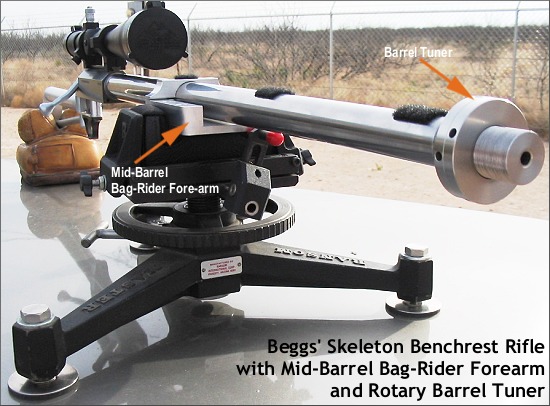
Gene Beggs is a Texas shooter and gunsmith known for “out of the box” thinking. He has successfully pioneered the 220 Beggs and 6mm Beggs cartridges in BR competition, and has developed radical new rifle designs and tuners at his West Texas research facility (with a 100-yard indoor shooting tunnel). Recently Beggs has tackled the challenge of indexing centerfire barrels. It looks like he has engineered a workable solution that will allow shooters to index their barrels without altering the critical headspace dimension. If this really works, Gene has come up with an important new gunsmithing procedure with the potential to enhance accuracy for a wide variety of firearms.
Barrel Indexing Basics
Barrel Indexing is a procedure for optimizing the rotational position of a barrel relative to the action. With a conventional barrel installation, if you were to put a mark on the outside of a barrel and then screw the barrel into the action, that mark might end up at at 12 o’clock, or 6 o’clock or pretty much any position on the “clock-face”, depending on where the shoulder is cut on the barrel. When the shoulder butts up against the face of the action (or recoil lug), you can’t screw the barrel in any farther. At that point, the barrel’s rotational position is fixed and can’t be changed without altering headspace.
Tests with rimfire barrels suggest that careful barrel indexing can produce accuracy gains. We’re not quite sure why — there are different theories — but it has been clearly demonstrated that by rotating the barrel relative to TDC (top dead center) on the action, you can move bullet point of impact quite dramatically. On rimfire barrels machined with a cone breech and secured with a barrel block system (as on an Anschutz 2000-series action), gunsmiths such as Mike Ross have been able to easily experiment with index positions. CLICK HERE for Mike Ross Indexing Tests.
But indexing centerfire barrels has been a challenge. You can use shims to adjust the barrel’s index position relative to action TDC, but this moves the shoulder in and out, effectively altering headspace by the width of the shims used.
Is there a way to index a centerfire barrel without changing the headspace? Texas Benchrest shooter and gunsmith Gene Beggs thinks he has the answer.
The Beggs Barrel Indexing Solution
With a conventional barrel installation, the action/receiver has an internal female thread. The threaded breech end of the barrel, or tenon, has a male thread. The barrel simply screws in until its rotation is stopped (and index position fixed) when the shoulder hits the action face or recoil lug.
Beggs has come up with an ingenious solution using an intermediary threaded bushing that fits between the action thread and the tenon threads. The barrel tenon is reduced in diameter slightly and re-threaded to mate with the inner bushing. This inner bushing is shorter than the receiver threads so it can be adjusted inwards and outwards. Its position is fixed with a set-screw. The effect of moving the inner sleeve inwards and outwards is to change the index position at which the barrel tenon threads start to “grab” as they are spun inwards. Set the inner sleeve at one position, and the tenon threads may start contact at 6 o’clock for example. Rotate the inner sleeve a half-turn and the threads will start at 12 o’clock.
Now, as you continue to screw the barrel inwards, it will still stop when the shoulder hits metal — so headspace is always the same. But…and this is the key point, the barrel’s rotational index position will vary depending on the position of the inner bushing. By adjusting the bushing position, you control where the barrel’s threads start to “connect”. The result is that the rotational orientation of the barrel can be indexed at any point on the dial.
Boyd Allen has given this example which may help readers visualize things: “Think of a slot-head machine screw being tightened till it bottoms. The final orientation of the slot after tightening depends on where it picks up the first thread of the threaded hole. If the hole itself is rotated then the final position of the slot, relative to the viewer, will be rotated by a similar amount. Screw a slot-head machine screw all the way into a nut. Now turn the nut. The slot rotates with it.”
System Slated for Production
Gene Beggs is excited about the new indexing system and plans to create a kit that can be used by gunsmiths. Gene writes:
“Inserted in between the action threads and the barrel tenon is a bushing that can be adjusted fore and aft in the action. This makes it possible for the barrel tenon shoulder to contact the receiver face at any position of the clock. Of course, the barrel tenon must be turned down and threaded to match the inside threads of the bushing. A small stainless steel set screw now holds the bushing securely in place. Adjustments are quick, easy and secure.
I spent two days in the tunnel testing the system. The test rifle is a Cobra sporter chambered in 6mm Beggs stocked with one of my Ultralite aluminum stocks. Barrel torque was rechecked each time the barrel was re-indexed and never seemed to loosen up. The sweet spot was found on the second adjustment at the six o’clock position. After a couple of days of testing, I now have complete confidence in the rifle and indexing system. Unless problems arise, we will soon be tooling up and producing kits which will require gunsmith installation.”
For more information on the Beggs Indexing system, email Gene at genebeggs [at] cableone.net, or call (432) 631-5124, or (432) 367-0329.
Czech arms-maker CZ produces a popular range of accurate, yet affordable rimfire and centerfire rifles. The CZ 452, in various versions, is one of the best rimfire bolt-actions under $400.00 retail. The 22LR version is favored by many club-level silhouette shooters, and is an excellent youth rifle. Model 452s chambered in 17 Mach 2 or 17 HMR also make excellent varminters. Typical model 452 “Street Price” is about $375.00.
Model 527 — Mini-Mauser Action Ideal for .223-sized Cartridges
For centerfire shooters, CZ’s Model 527 has won more awards in the “light rifle” category in Europe than any other rifle…ever. Designed to fit small-base calibers perfectly, the CZ 527 is a true micro-length Mauser style action, with detachable magazine, hammer forged barrel and single set trigger. CZ offers various versions of the 527 chambered in .17 Remington, .221 Fireball, .22 Hornet, .222 Remington, .223 Remington, and .204 Ruger.
New Chambering for Model 527? Vote for Your Choice!
CZ-USA is now conducting a poll, asking website visitors to help choose a new chambering for the Model 527. It looks like CZ has done its homework. We were surprised to see that the “candidates” include popular wildcat cartridges like the 20 VarTarg and 20 Tactical, plus the excellent 6.5 Grendel. Most large manufacturers don’t even know these chamberings exist, much less consider offering them. We wish CZ-USA would also consider the .223 Rem necked down to 20 caliber (aka the “20 Practical”). It does everything the 20 Tactical does, with no special dies needed.
Sierra has a new 155gr Palma bullet, and it’s a winner. The new 155gr MatchKing bullet, featuring a longer ogive and factory-pointed meplats, was used by Team USA at the recent Spirit of America match. According to many team shooters and coach Emil Praslick III, the new bullet helped the American team achieve an impressive victory over arch-rival England and other national squads.
Matt Reams of Sierra Bullets confirmed that the new bullet, Sierra part # 2156, will shortly enter full-scale production. Sierra is planning a late-December 2008 release date, but Matt says “first week of 2009 should be a safe bet.” The bullets will be priced “roughly 5% higher than current Sierra 155gr MatchKings”, according to Matt.
Sierra worked closely with Team USA on the design of the new bullet. Dennis Flaharty, USA Palma Captain, tells us: “We worked very closely with the people at Sierra and they really came up with a winner. We tested several prototypes before we settled on this one. Each one better than the next. This bullet has a lot going for it. I honestly believe that we managed many 10s that would have been 9s. This bullet gave the consistent and high degree of accuracy you have come to expect from Sierra. As compared to other bullets Sierra has a reputation for being ‘forgiving’. By this I mean you can shoot them in the lands or off. We tested this bullet from +0.010 into the lands to -0.100 off.”
Bullet Design Features and Factory Meplat Pointing
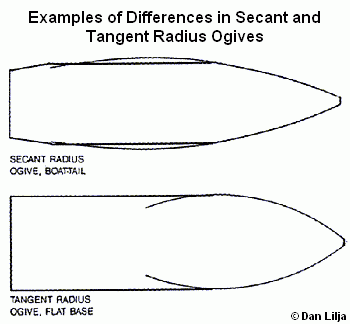
The new bullet is a conventional tangent ogive design, not a secant ogive VLD-style. However, the new bullet has a longer ogive (curved section) than Sierra’s current 155gr MatchKing. It also has a somewhat shorter bearing surface. Most importantly, the meplats on the new 155s will be pointed up on a special extra die used for the final stage of bullet manufacturing. Currently, many reloaders are using the Whidden Pointing Die System to point up their bullets. (Photo at left shows a 107gr MatchKing pointed with the Whidden Die.) Many tests, including our own research done by Jason Baney, prove that bullet-pointing has real benefits. First, pointing the meplats reduces bullet-to-bullet BC variation. This can help tighten vertical spread at long range. Second, bullet-pointing can also reduce drag, effectively increasing average bullet BC. The result is a bullet with less drop at long range, and less wind drift (all other factors being constant). In Jason’s tests, pointed Clinch River 106gr bullets impacted 18″ higher at 1000 yards than non-pointed bullets from the same lot. That’s dramatic evidence that meplat-pointing enhances BC.
Higher BC Predicted by Actual Match Results
Sierra has not yet completed field-testing to determine the ballistics of the new 155gr MatchKing, so no official BC has been released. Matt Reams noted: “We will not release a BC until comprehensive field tests are complete. At Sierra we don’t ‘guesstimate’. Our BC numbers are based on real-world testing.” Nonetheless, Sierra’s bullet testers and USA Palma team members are telling us that the new bullet definitely impacts higher than the old Sierra Palma bullet when driven at the same velocity. This was observed during the Spirit of America match, and is a sure sign that the new bullet has less drag and a higher effective BC. Team members also believe that the new bullet exhibits less wind drift than the previous 155gr MatchKing:
“As one of the line coaches on the American teams at SOA, I witnessed first-hand the difference between the old and new green box 155s. On practice/warm-up day before the team matches we tested the new bullet against the old bullet at 1K to get elevation zeroes on the new bullet. What we saw was the new 155 printed two (2) MOA higher at 1000 yards than the old bullet with the only difference being the bullet…. In my opinion, the new bullet was at least a minute inside of the old bullet at 1K.” — Steve Hardin
Palma Shooters Praise New ‘Top-Secret’ 155gr MatchKing
In the wake of Team USA’s big win at Spirit of America, many members of the USA Palma Team have commented on the impressive performance of the new bullet. You can read their testimonials in THIS THREAD on the Long-Range.com Forum (registration required to access Forum). Team Coach Emil Praslick III had this to say:
“Sierra was very responsive to the US Team’s request that [Sierra] come up with a new design for a 155 grain projectile. After testing a few prototypes designed by the smart guys at Sierra (mainly Pat Daly) we settled on one that seemed to be a good compromise between an efficient design, and a bullet that would shoot well out of a variety of barrels and chambers. Through testing and practice, we have found that the bullet shoots well into the lands, as well as off. One rifle tested jumped them .050″ with good results!
The bullet QC is excellent, and it definitely does shoot. During the team matches at SOA, I felt that the bullet was well inside the other bullets being shot on the line, but as a coach, I am much more concerned with accuracy over chasing a BC ‘magic number’…. The inherent accuracy of the new bullet is what has sold me on it.
The ogive is well back on this bullet, and will probably jump quite a bit at max length in longer than a ‘standard’ Palma 95/WTC 95 chamber. Some, notably Warner Tool and Wayne Forshee, are working on reamer designs. For now, an existing, ‘short throat’, Palma 95 chamber that seats the old Sierra at approx. 2.780″ to touch the lands should work fine.”
Late this year or early in 2009, Browning will release a new A-Bolt Target rifle. The new A-Bolt Target rifle represents a whole new direction for Browning — no doubt spurred by the success of Savage’s F-TR and F-Class Target rifles. The A-Bolt Target will be offered in both matte blued and stainless versions, in three calibers: .223 Rem, .308 Win, and 300 WSM.
Featuring a laminated wood stock (with adjustable comb), heavy-contour 28″ button-rifled barrel, and single set-trigger, the new Browning should be effective in F-TR (target rifle) class. (Sorry, Browning hasn’t released the set-trigger’s end pull-weight.) With detachable box magazines, and a quick 60° bolt lift, these rifles may also proove popular with tactical shooters (though tac guys may want to shorten the barrels). The .223 version also would make a nice varminter. The .223 has a 1:9″ twist while the .30-caliber guns come with a 1:10″ twist rate.
The Browning A-Bolt Target rifles have some nice features normally found on custom rifles. The action comes glass-bedded in the stock. According to press releases, the buttoned barrels will all be hand-chambered for improved accuracy. The stocks features a satin finish with nice checkering on the grip. The varmint-style forearm looks rigid enough to work well with a bipod, but we think the forearm should be longer for better weight distribution (longer “wheelbase”). The stock is not 3″ wide, so you’d probably want to mount a 3″-wide sled if you shoot this gun from the bench or in F-Open class. What’s all this cost? MSRP for the stainless .223 and .308 rifles is $1489, while the matted blued guns in the same calibers are $1269. 300 WSM versions cost $30.00 on top of those prices for stainless and blued respectively.
Glen Harrison, designer/creator of the original Nesika actions, now has a new Montana-based company, Phoenix Machine Technologies. In time, Harrison plans to produce a full series of high-grade custom actions, using state-of-the-art CNC machining. Currently, Phoenix has been producing CNC-crafted Remington-clone actions. These seem to be working very well and are being used by GA Precision and other top gunsmiths.
Current Phoenix Machine production receivers are Remington 700 derivatives that utilize Remington-style bolts and are being manufactured in long, short and M7 lengths. Teaming up with Dave Kiff of Pacific Tool & Gauge (PT&G), Harrison will offer a selection of custom bolt components made by PT&G. This allows the owner of a Phoenix action to fit out the finished action in many ways. Want a colored bolt shroud? No problem. You can also a choose variety of fluting styles, and pick from a selection of PT&G-crafted bolt handles. There are many action-makers offering Rem-clone style receivers in chrome-moly or stainless steel. With the wide variety of bolt components offered by PT&G, the Phoenix action offers the action-buyer an impressive array of optional features.
For more information about Phoenix Machine Technologies, LLC, call (406) 756-2727 or write 36 Jellison Lane, Suite B, Columbia Falls, MT 59912. Email inquiries may be sent to Lisa [at] boltactions.net.


 Results for the 2008 Creedmoor Cup & CMP Games have been posted on the


 We told you our friend Vanessa Warner would accomplish good things as the NRA’s new Manager of Disabled Shooting Services. Here’s proof — the NRA has just announced that the first-ever, nationwide indoor Air Rifle Championship series for disabled shooters will be held in 2009. The new event will be conducted at clubs and facilities nationwide, employing a Sectional Championship format. This will give competitors with physical disabilities a chance to compete in national individual and team events by comparing their scores with those fired in clubs all over the country. Scores are comparable because of the similar conditions existing in indoor ranges.
 Sectional Championships are already held by the NRA, and now disabled shooters will be part of the action. Each year the NRA conducts National Open Rifle Sectional Championships in NRA 3-position Smallbore Rifle, 4-position Smallbore Rifle, International 3-P Smallbore Rifle and International Air Rifle. The Championships are the largest event of the indoor season and will now include International Indoor Air Rifle for disabled shooters.
 New Zealand Shooters’ Success Stories
 In order to represent New Zealand at Oceania I had to shoot two Paralympics New Zealand Minimum Qualifying Standards (PNZ MQS) in each of the disciplines, Standing and Prone. The MQS for Standing is 570 and Prone 575 out of a possible 600 in 60 shots. With lots of practice and six attempts I got there. As a wheelchair user, ‘standing’ is not quite the right description, but what it means is that you sit holding the rifle without any support from your elbows resting on the table. ‘Prone’ is a similar position but with your elbows on the table.”



 Sierra has a new 155gr Palma bullet, and it’s a winner. The new 155gr MatchKing bullet, featuring a longer ogive and factory-pointed meplats, was used by Team USA at the recent Spirit of America match. According to many team shooters and coach Emil Praslick III, the new bullet helped the American team achieve an impressive victory over arch-rival England and other national squads.
 Bullet Design Features and Factory Meplat Pointing


 Glen Harrison, designer/creator of the original Nesika actions, now has a new Montana-based company,


