|
|
August 28th, 2008
Remington Arms offers a handsome collection of photographic “wallpapers” you can use as backgrounds for your computer’s desktop. There are dozens of stunning, high-resolution photos, all free for the downloading.

Remington Wallpapers are available in 640×480, 800×600, 1024×768 and 1280×1024 pixel sizes and can be used on both PC and Mac computer systems. After downloading each file to your computer, you can set the image as your desktop background via your system control panel (or, with some operating systems, just open the picture file, right click on the image, and designate the photo as “desktop background”.)

Be sure to look through the wallpaper collections for years 2007 and earlier, as well as the current collection. The 2001 collection has gorgeous product shots of rifles and shotguns, while the 2005 and 2006 collections feature stunning outdoor nature photography. (There are 12 wallpapers per year. Below are previews of half the images from 2005 and 2006).
CLICK HERE for 2007 and Older Wallpaper Sets.

Photos © copyright Remington Arms Co., All Rights Reserved.
August 27th, 2008
This Labor Day weekend (Aug. 30 through Sept. 1st), the Los Angeles Silhouette Club (LASC) hosts its annual ‘Extravaganza of Silhouette’. This major west coast silhouette FUN MATCH combines all the popular disciplines (rimfire AND centerfire) in one spot. The cost is $50.00 for three days and “all the entries you can shoot”. Classes will include: Long Range – Smallbore – Hunter/Field Pistol – Smallbore Hunter Pistol – Cowboy Rifle – Smallbore Rifle – Cast Bullet Rifle.

For more info visit LASC Extravaganza Page.
Extravaganza organizers say: “From its conception in 1995, the Extravaganza has only one purpose — more fun than you can have in three days! It is the only major event anywhere with IHMSA & NRA Silhouette shooters and even non-silhouette shooters together with common goals — shooting, fun, food, door prizes and camping in a huge, non-championship three day holiday weekend. The extravaganza is a celebration of the shooting sports and those that participate in it. It is LASC’s way of saying ‘Thank You’ to everyone that has ever shot Silhouette, worked on a range or helped support the shooting sports.
The Extravaganza offers 27 different categories of handgun and rifle, small bore and long range silhouette shooting for one $50.00 entry fee for the entire three day event. At the Extravaganza, most firearms and action types are welcome — if you have it, bring it! The only restriction is target damage, so bring plenty of ammo for all of your guns. Included in your $50.00 entry are TWO all-you-can-eat BBQs, free tent camping, free RV electric hook-up, free gun drawings, free door prizes and more.”
Good Food Served All Weekend
Modestly Priced Breakfast & Lunch Served All Three Days. Free All You Can Eat BBQs For All Paid Participants Saturday & Sunday Evenings. (Guests can pay $5.00 for the Saturday BBQ or $10.00 for the Sunday BBQ.)

Located at the Angeles Gun Ranges
126451 Little Tujunga Canyon Road
Lake View Terrace, CA 91342
August 26th, 2008
 The landmark U.S. Supreme Court decision in D.C. v. Heller recognized the Constitutional right of District of Columbia residents to own handguns. In the wake of this victory for gun rights, on August 24th, the National Shooting Sports Foundation (NSSF) sponsored a free “First Shots” seminar expressly for District of Columbia residents.
Participants received an introduction to handgun shooting at the Arlington-Fairfax Isaak Walton League shooting range in Centreville, Virginia. A classroom presentation covered topics such as D.C. firearm regulations, safety, grip, sight alignment and trigger control, and then it was on to the range where participants shot .22-caliber revolvers and pistols, with a certified instructor by their side. The team of NRA-certified instructors was led by multiple USPSA and IDPA champion Julie Goloski.
Many female D.C. residents came to the seminar. Attendees also included legislative staffers and a reporter from the Washington Informer, an African-American newspaper in the District. “We were very pleased with this initial First Shots seminar for D.C. residents,” said NSSF President Steve Sanetti. “It shows that District residents, after having their Second Amendment rights denied for over 30 years, have a strong interest in firearms ownership.” Smith & Wesson and Taurus provided loaner pistols and revolvers. Sunday’s program was the first in a series of planned no-cost First Shots seminars in the D.C. area.
‘First Shots’ Programs Offered Nationwide
Interested in hosting a “First Shots” session at your club or range? CLICK HERE to learn more about the First Shots program, or watch the promo video linked below.
Click Here to Watch Video of NSSF First Shots Seminar at Ben Avery Range in Phoenix, AZ.

August 22nd, 2008
At the recent IBS 100/200 Yard Nationals, Benchrest legend Tony Boyer shot a spectacular 0.1697 Grand Agg in the Heavy Varmint class (0.1552 at 100, and 0.1843 at 200). This is the combined, distance-adjusted average group size for five targets at 100 yards and five targets at 200 yards. Interestingly, Tony was shooting a very unusual new gain-twist barrel from Bartlein Barrels of Wisconsin. A “gain-twist” barrel has rifling with a variable twist rate, that starts with a slower twist and transitions into a faster twist. The barrel used by Boyer had a very slight gain twist: 1:15″ twist at the breech end, increasing to 1:14.25″ at the muzzle.

Gain twist barrels are nothing new. Barrel-makers in the 19th century experimented with gain twist. More recently, Dan Lilja did quite a bit of testing with gain-twist barrels in the 1980s. However, Lilja concluded that gain twist offers no accuracy advantages: “You get just as good or better accuracy with a standard twist…just as long as the twist remains exactly the same the entire length of the bore.” (See Elements of Accuracy Article.)
 Gain Twist — Does It Offer an Accuracy Advantage?
Given Boyer’s impressive performance, maybe it’s time to revisit gain twist technology. The theory is that a slower initial twist rate may be “kinder” to bullets as they start to engrave in the rifling. There may be some slight velocity advantages as well.
Frank Green of Bartlein barrels has noted: “Gain twist type barrels have been around forever. It was used a lot back in Pope’s day with the false muzzle loaders shooting lead bullets. A lot of lead bullet shooters and rimfire shooters have asked us to do [gain-twist] barrels for them. Also shooters shooting the new, solid, machined-type bullets with driving bands on them want a gain twist type barrel. Supposedly it’s easier on the driving bands as the bullet enters the rifling. Also in bigger calibers like 20mm the gain twist is used. Mostly because you are starting a very heavy bullet into the barrel.
At Bartlein, we designate gain-twist type rifling as “T” style rifling (“T” for transitional). Why? Simply because we can cut [many variations]: straight conventional-style twist, a very uniform slow gain-type twist, or a radical gain-type twist. We can [create] anything the customer wants. The tooling still plays a part and can effect the cost of the barrel on a gain type twist.
Is gain twist for everyone? At this point in time I would say no still. Also remember, way back when, gain twist type barrels had a radical type gain. The one that Tony and couple of other guys have are not a drastic type gain. The [gain twist barrel] that Tony has only goes from a 1-15 at the breech to 1-14.25 at the muzzle. It didn’t seem to hurt him at all at the Nationals. He picked the twist and we made it for him.
I would agree with the general statement that most gain twist type barrels don’t shoot conventional jacket/lead core bullets well or should I say [they can be] temperamental. However, a slight gain seems to be OK after what Tony did.”
Lou Murdica has been evaluating Bartlein gain-twist barrels with a 1:14″-1:13.25″ twist. Lou won a Benchrest match with a 14-13.25 Bartlein gain-twist in Sacramento convincingly, and Lou told Bartlein that a similar gain-twist barrel on Lou’s railgun has been very accurate and ultra-consistent when tested with a wide variety of bullets. Lou can’t speculate as to why, but the Bartlein gain-twist BR barrels appear to be working extremely well and are not finicky about bullet choice.
Tony Boyer photo courtesy IBS.
August 21st, 2008
 Beijing isn’t the only location where shooters from many nations are competing this month. The United States Int’l Muzzle-Loading Team turned lead bullets and shot into gold, silver and bronze medals at the 23rd World Muzzle Loading Championships, held August 11-16 in Adelaide, Australia. 205 competitors, representing 17 nations, vied for honors with a variety of muzzle-loading arms, ranging from matchlock muskets to sophisticated percussion target rifles and pistols. Both original antiques and modern replica guns are used, competing in different divisions.

Top honors were taken by Dr. Michael Arnette, whose score of 93 in the original division of the “Lamarmora” 50-meter offhand percussion rifle-musket event not only won the gold, but set a new world record in the process. Arnette took the same gun to the 100-meter line for the “Minie” prone match, shooting well enough to help a team of Arnette, Allan Godshalk, Gary Crawford, Frank Kapper, and Tony Ulisse take 3rd place in the “Grand Prix de Versailles”, an aggregate for military longarms that is often considered the overall world team championship. An equally strong performance was turned in by Harry Sparks, who took both gold and bronze in individual shotgun events.
CLICK HERE for Photo Gallery from Adelaide
The World Muzzle Loading Championships are held biennially, with Pacific and European Zone Championships in the off years. The 24th World Championships will be held in Portugal in August 2010. CLICK HERE for more info on precision long-range muzzle-loader shooting.
August 18th, 2008
Army Specialist K. C. Eusebio of the United States Army Marksmanship Unit (USAMU) edged out B. J. Norris to win his second Steel Challenge World Speed Shooting title in Piru, California. Eusebio finished with a record time of 79.16. K.C. first won the Steel Challenge while still in High School — an amazing performance for such a young shooter. K.C. has set speed-records for many of the Steel Challenge’s stages, including “Smoke & Hope” shown in the video. Eusebio’s win is the third time an Army Marksmanship Unit member has taken the title in the past four years. Staff Sergeant Max Michel took the title in 2005 and 2007. Below is exclusive video taken by AccurateShooter.com at the Steel Challenge on August 16.
CLICK HERE or on screen to WATCH VIDEO.
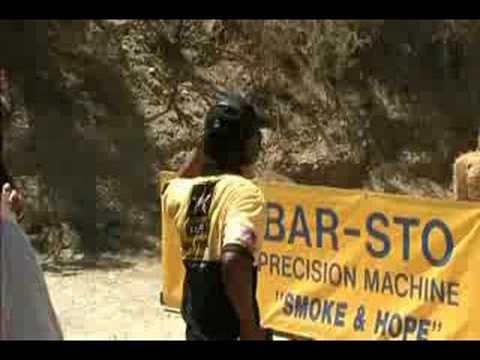
In the women’s division Kay Clark-Miculek took her seventh Women’s Steel Challenge title with a time of 105.85. Miculek now has twice as many titles as any other female shooter. In the Limited Category, Phil Strader of the US Shooting Academy’s 93.49 time was good enough to defeat 2006 World Champion JJ Racaza by just over 9 tenths of a second.

August 17th, 2008
The IBS 100/200 yard Group Benchrest Nationals were held from August 11-16th at the Kelbly’s range in North Lawrence, Ohio. When the dust settled, Harley Baker, IBS 2007 Group Shooter of the Year, was the big winner, taking the Two-Gun, Three-Gun, and Four-Gun overall. Mark Buettgen, Gene Bukys, and Jack Neary also shot extremely well — these three shooters all finished in the top four in the multi-gun standings. Harley Baker triumphed over a field of roughly 150 shooters including benchrest Superstars Tony Boyer, Wayne Campbell, Joe Krupa, and Bart Sauter. Bill Goad won the Light Varmint Grand Agg, while Tony Boyer won the Heavy Varmint Grand. Ryan Kelbly was the top junior shooter.

Here are the top ten finishers in the multi-gun combined Aggregates:
| 2-Gun Overall |
3-Gun Overall |
4-Gun Overall |
1. HARLEY BAKER 0.2093
2. MARK BUETTGEN 0.2121
3. GENE BUKYS 0.2240
4. JACK NEARY 0.2253
5. BILL GOAD 0.2265
6. BOB SCARBROUGH 0.2286
7. TONY BOYER 0.2345
8. L. HOTTENSTEIN 0.2401
9. JEFF SUMMERS 0.2407
10. SMILEY HENSLEY 0.2418 |
1. HARLEY BAKER 0.2062
2. JACK NEARY 0.2230
3. MARK BUETTGEN 0.2258
4. GENE BUKYS 0.2280
5. SCOTT WATSON 0.2383
6. BOB SCARBROUGH 0.2392
7. L. HOTTENSTEIN 0.2409
8. BILL GOAD 0.2411
9. JOE KRUPA 0.2454
10. GEORGE WALDREP 0.2457 |
1. HARLEY BAKER 0.2245
2. JACK NEARY 0.2351
3. GENE BUKYS 0.2379
4. MARK BUETTGEN 0.2381
5. L. HOTTENSTEIN 0.2511
6. HARRY ROWALD 0.2532
7. JOE KRUPA 0.2551
8. BOB SCARBROUGH 0.2585
9. LARRY COSTA 0.2615
10. JEFF SUMMERS 0.2636 |
While the multi-gun Agg results were, not surprisingly, in the low twos, there was some spectacular shooting done at the match in specific events. At 100 yards, the top five shooters in BOTH the Light Varmint AND Heavy Varmint Class all posted “Teen Aggs”. This shows you the kind of accuracy these rifles (in the hands of ace shooters) can deliver:
| Light Varmint 100-yard Aggregate |
Heavy Varmint 100-yard Aggregate |
1. BILL GOAD 0.1614
2. GENE BUKYS 0.1686
3. PAT CANNING 0.1880
4. DAVE DOHRMAN 0.1894
5. BOB SCARBROUGH, JR. 0.1920 |
1. TONY BOYER 0.1552
2. LOWELL HOTTENSTEIN 0.1736
3. JOE KRUPA 0.1798 (tied)
3. SCOTT WATSON 0.1798 (tied)
5. GEORGE KELBLY, SR. 0.1872 |
Complete IBS 100/200 Nationals Match Results are posted on the IBS website. You can also download Target by Target Details as a .pdf file.
August 16th, 2008
Breaking News: Pfc. Vincent Hancock, a USAMU shooter from Georgia, captured the Gold medal in men’s skeet-shooting, topping Norway’s Tore Brovold in a shoot-off to win the gold. Definitely check out the VIDEO below–you have to see how fast this kid is!!
CLICK HERE to Watch Vince Hancock’s Skeet Shooting. Click “Best Shots” for Quick Highlights.

Though just 19 years old, Hancock is a World Champion and current world record holder. Previously this summer he captured the Gold Medal in the Men’s Skeet event at the 2008 ISSF World Cup for Shotgun in Suhl, Germany, June 12. A prodigy of sorts, Hancock won his first ISSF World Championship at the ripe young age of 16, competing in Lonato, Italy.
Hancock’s fast reflexes and superb eyesight have put him at the top of the game in International Skeet shooting, a discipline that demands quick reactions. Hancock explains: “Compared to American, International’s targets travel 20 miles per hour faster at 60 miles per hour. After you yell, ‘Pull’, the targets can be released anywhere from immediately to three seconds later, keeping you on your toes. You have to hold your gun down, with the butt below a line on your vest and then mount after you call for the target. And three of the stations send out two targets; in American skeet you can have your gun mounted, and you don’t have any doubles.”
CLICK HERE for Shotgunning Tips from Vince Hancock
August 16th, 2008
There’s been some controversy surrounding the “ideal” 6mm bullet diameter. This is compounded by the fact that 6mm match barrels are available with both .236″ and .237″ land diameters. It has become quite clear to us that bullet diameter is an important variable to consider when choosing the best projectile for your particular barrel. Some barrels prefer “fat” bullets while other barrels prefer “skinny” bullets. There is solid evidence, for example, that skinny bullets like the 105gr Scenar may shoot best in a .236 barrel.
German Salazar recently measured a selection of 6mm bullets, recording bullet diameter, overall length (OAL), and bearing surface length. His results are interesting.
Salazar Measurements
| 6mm Bullet Brand |
Diameter |
OAL |
Bearing Surface |
| 105 Berger VLD |
0.2432″ |
1.237″ |
0.368″ |
| 105 Hornady AMAX |
0.2434″ |
1.230″ |
0.450″ |
| 105 Lapua Scenar |
0.2430″ |
1.252″ |
0.450″ |
| 107 Sierra MK |
0.2432″ |
1.227″ |
0.415″ |
| 108 Euber |
0.2428″ |
1.218″ |
0.490″ |
| 115 Berger VLD |
0.2431″ |
1.333″ |
0.414″ |
| 115 DTAC |
0.2436″ |
1.293″ |
0.480″ |
Some months ago, Jason Baney measured 12 different sets of 6mm Match Bullets, including a couple different lots of the same bullet design. Notice, some bullets measure a bit different, compared to German’s numbers — this may reflect lot variances and/or measuring methods. Interestingly, Jason did measure the “old” Berger 105 VLD, the “new” Berger 105 VLD (first lot from the new die), and the “new, improved” Berger 105 VLD from the new die, after it was polished. Ten (10) Bullets were measured per type. Each bullet was measured three times (3X) around the largest circumference, normally where a pressure ring would be located (some bullets have a pronounced pressure ring, others do not).
Baney Measurements

Download this CHART as an MS Word Document.
Columns one and two of the chart show the smallest and largest bullet diameters measured for each 10-bullet sample. The third column shows the extreme spread over each 10-bullet set. Note, these numbers are NOT averages, but represent the “low” and “high” diameters for each set. A Mitutoyo Micrometer was used, zero-checked for each bullet.
August 16th, 2008
There has been much interest in Ultrasonic case cleaning. Here are two tips to achieve the best results:
De-gas the Solvent Before Adding Brass
One of our readers, Eddy M. in Glasgow, Scotland writes: “I have read a couple of articles recently about ultrasonic cleaning of cases and not one has mentioned de-gassing the cleaning liquid before starting to clean items. As an engineer who travelled around for ten years servicing ultrasonic tanks I would like to point out that the cleaning liquid when first put into the tank has invisible disolved air bubbles in it which will absorb ultrasonic energy until the liquid de-gasses. (10 minutes in a powerful industrial tank–longer in a small hobby tank). You must let the tank run on its own for 20 minutes on the first use of the liquid to allow this to happen. Only after the new liquid or re-introduced liquid has been de-gassed will the tank give good results.”
Apply Dry-Lube Inside Case Necks
Jason Baney has found that Ultrasonic cleaning leaves the inside of the case-necks so “squeaky clean” that there is excess friction when seating bullets. On a fired case that has been cleaned conventionally (no ultra-sound), a thin layer of carbon remains to lubricate the bullet entry and exit. To restore that lubricity in cases cleaned with ultrasound, Jason applies a dry lube to the inside of his case necks. Jason prefers the $10.95 moly dry lube kit from Neconos.com. With this kit, small carbon steel balls transfer moly to the neck when you place your brass nose-down in the container.

|


