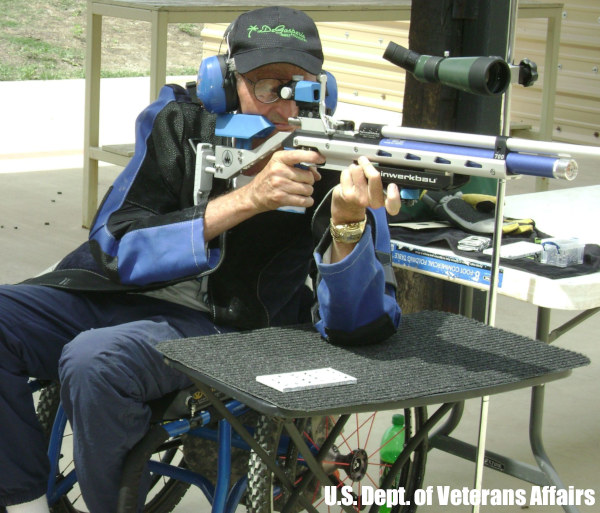
Photo shows Joseph (“Skeet”) Borden, with match rifle built by his son, Jim Borden.
On this Father’s Day 2024, we celebrate three pairs of fathers and sons who enjoyed competitive shooting together. This story can remind us how shooting together can help build life-long bonds between fathers and sons.
Joseph Borden and Jim Borden
A while back, Jim Borden made a post on his Facebook Page that made us think about how shooting can build important connections between father and son. Jim recalled how he would go to Piedmont, North Carolina with his father every year for a shooting match: “17 years ago this weekend was the last time dad was able to make the trek to North Carolina for the annual Groundhog contest and the match at Piedmont. Loved the time we spent together. Dad shot competitive benchrest with me from 1980 until June 2001. He passed in August 2001.”
This prompted others shooters to respond with cherished memories of their own fathers:
“I’d give a year’s pay to have my Dad back for an hour, let alone a day. Spend all the time you can with them while they’re here”. — Kerry S.
“I think how lucky some folks are to look back in life and have fond memories of doing things with their parents that both enjoyed. I have missed my dad for 44 years and think of him every time I hunt, fish, trap or work on a household project. We did it all together.” — Bill McC.
Another poster explained how he now attends matches with his own young son:
“The time you spent with your father meant as much or more to him. Always cherish [those memories], as I know you will. Last year, I spent … over 400 hours with my then 10-year-old son going to rifle matches. This year will be similar. This photo was from today of my 11-year-old son.” — John C.
So here’s a message to all dads — take some time to introduce your sons (and daughters) to the joys of shooting. Spend quality time with your youngsters while you can. Time passes quickly, boys grow up into men. Ensure you enjoy a life outdoors together whenever you can.
About Jim Borden and Borden Accuracy
Jim began shooting high power silhouette and benchrest matches in the mid 1970s while working for a Fortune 500 company as an engineer. In the early 1980s he began building rifles for himself and then for others. Jim has a background as a gunsmith, machinist, registered mechanical engineer, engineering instructor, project manager, hunter, and benchrest competitor. In benchrest competitions he has set ten world records and won 11 National Championships thereby earning induction into the Benchrest Hall of Fame. Jim also served six terms as President of the International Benchrest Shooters (IBS).
Jim operates Borden Rifles/Borden Accuracy with his wife Joan, sons Jim Junior and John, daughter Andrea Mecca and son-in-law John (Mike) Mecca. Jim is also an outstanding photographer.
Another Father/Son Duo — Sam Hall and Hunter Hall
Sam Hall is a multi-time IBS 600-yard Shooter of the Year, who holds many IBS mid-range records. It’s tough to beat Sam when he’s on his game. But it looks like Sam has a worthy challenger — his own son Hunter Hall, now in his late teens. At age 12, Hunter won the North Carolina State 1000-yard Light Gun Group Title.
At a very young age, Hunter Hall showed an interest in his father’s shooting hobby. It turns out Hunter has the God-given talent for hitting the target. Yes there would be another champion in the Hall family. Here is Hunter, at age 12, winning the NC 1000-Yard Group title. Not bad for a kid not even in High School yet!
Even at just 6 years of age, Hunter showed a keen interest in shooting. Back in 2012 Sam reported: “This weekend we practiced freehand shooting with his BB gun at cans. After that I was needing to zero my Light Gun and get started with a few loads at 100 yards. To my amazement my 6-year-old wanted to accompany me. I could not believe it when he wanted to shoot my competition rifle. I had just put a new barrel and scope on it and needed to zero it. After two shots to get it zeroed he hit a .25 inch dot at 100 yards. I let him do everything — loading it, ejecting rounds, and even working my Farley joystick rest.”
Ken Klemm and Ian Klemm — Father and Son F-TR Aces
Over the last 30 years, a family saga has been playing out in rural Wisconsin: a father fosters within his son the joy of competitive target shooting. It started in a basement shooting range of a small-town elementary school, shooting single-shot rimfire target rifles while cementing the fundamentals of sight alignment, breathing, trigger control, and safety. With a background of competitive smallbore shooting in school and the U.S. Navy, Ken Klemm coached his son, Ian, in a father/son indoor winter shooting league. Ian was determined to shoot as well or better than his Dad and would pursue that goal for the next 30 years. Even after his engineering career took him to the Washington DC area for defense-related work, Ian continued to compete with his Dad by mailing “postal match” targets back and forth for many years.
Father and son shooting together. Her Ian spots for his father Ken Klemm, who is shooting.
Ian has now risen to the pinnacle of his F-TR discipline. Ian Klemm has now won three National F-TR Championships in four years. Ian captured back-to-back titles in 2017 and 2018, winning at Lodi, WI in 2017, and Raton, NM in 2018. Ian also finished second at the 2019 Nationals. Ian put on another great performance to win the F-TR National title in 2020 under very challenging conditions.
Here is Ian with proud parents Karen and Ken Klemm after Ian won his Second Straight F-TR National Championship in 2018. Father Ken also competed at the 2018 F-Class Nationals, shooting great in both individual and team events.
Editor’s Note: The CMP National Matches at Camp Perry are less than a month away. This article covers key points for rifle competitors at major matches. To do well, you want to be an “informed competitor” with a positive attitude and full knowledge of the course of fire and match rules.
Don’t Be “That Guy” (The Bad Apple on the Firing Line)
By SFC Norman Anderson, USAMU Service Rifle Team Member
You know the guy, he’s still talking at the coffee jug when his preparation period begins, then his magazines aren’t loaded when the command “STAND” is given, and finally, he doesn’t know the rules when he argues with the block officer as his target comes up marked “9 and No”. Although this guy might be the highlight of the “after match” activities, he is the proverbial bad apple on the firing line. With this example fresh in your mind, let’s go over how not to be “that guy”.
While the sport of High Power shooting is a hobby for most, all are passionate about performance throughout the day. In order to achieve your maximum performance each and every day, it is essential that you conduct yourself as a professional competitor. As a competitor, you have a personal responsibility to know the course of fire as well as the rules and procedures that apply to it and to be prepared to follow them. Knowing this will not only make you a better competitor, but it will enable you to resolve situations with other targets besides your own. So what does all this mean? I’ll explain…
Know the Course of Fire
Know the course of fire. It sounds easy enough, as we all shoot plenty of matches, but it’s more than that. If you think about it, how many people in the pits, for example, do not really know what is happening on the firing line? This leads to targets being pulled early during a rapid fire string or missing a shot during a slow fire string. In cases like this, the result is the same, delays in the match and upset competitors. To avoid being “that guy,” it is imperative that you stay tuned to the events as the day progresses. When you are at the range shooting a match, be at the range shooting the match.
At any firearms competition — be sure you know (and understand) the course of fire.
Know the Rules
Now, let’s discuss rules. As you have probably heard more than once, the rulebook is your best friend. Here is why. I can virtually guarantee that most competitors know some of the rules based only on the old “this is how we do it at home” adage. The funny part of that is, the same green NRA rulebook and orange CMP rulebooks are used to govern High Power matches all over the country.*
It is vital that all shooters be familiar with the rules as they are written, not with “how they are applied at home”. This creates consistency and continuity in how matches are conducted, from local club matches to state tournaments to National Championships. Knowledge is power when it comes to scoring targets under contention, what to do in the case of a malfunction, or even how to file a protest correctly. These rules are in place for a reason and it benefits everyone to both know and operate by these rules.
Maintain Composure and Humility — Exhibit Good Sportsmanship
One aspect of competing that cannot be forgotten is bearing. As I mentioned earlier, you must be prepared for both good and bad to happen. All too often we all see “that guy” (or that “that guy’s” gear) flying off of the firing line in disgust. Remember that we all must maintain our composure and humility in all conditions, not matter what happens. After all, it’s just a game. To put it into perspective, if it were easy, attendance would be a lot higher. Sportsmanship must be displayed in an effort to keep from ruining the day for all those around you. It doesn’t cost anything to smile, and smiling never killed anyone. So turn that frown upside down and keep on marching, better days will come.
Like a Boy Scout — Always Be Prepared
Lastly, I would like to cover preparedness. Being prepared goes beyond simply having your magazines loaded and a zero on your rifle. It means approaching the firing line, knowing what you are about to do, being ready for what is going to happen (good or bad), and being ready for the results. If you approach the firing line to merely shoot 10 shots standing in your next LEG match, you are not going to be pleased with the result. You must be prepared mentally and physically, not only for the next stage, but also the next shot. By being prepared physically (equipment ready), you give yourself peace of mind which is an essential part of being prepared mentally, and by being prepared mentally, you are less likely to become distracted and are more likely to maintain focus for each and every shot.
Conclusion — Informed Competitors Make for Better Matches
The culmination of these efforts results in a shooter that knows how to be ready for success on the range, but also and perhaps more importantly, a shooter who knows what it means to be a competitor. When you have a range full of competitors who know and follow the rules and proper match procedures, the match runs smoothly, everyone shoots well, and a good time is had by all. In the end, isn’t that what it’s all about?
* After this article was originally written, the CMP separated its rules into multiple Rulebooks, which can all be downloaded from the CMP.org/rulebooks page:
The CMP Highpower Competition Rules 2024 (27th Ed.) for CMP-sponsored and sanctioned matches for Highpower Rifle events in National Trophy Matches, Excellence-In-Competition (EIC) Matches, CMP Cup Matches and other CMP-sanctioned competitions.
The CMP Pistol Competition Rules 2024 (27th Ed.) for CMP-sponsored and sanctioned Pistol Matches in the National Matches, National Trophy Matches, Excellence-In-Competition (EIC) Matches, and other CMP-sanctioned competitions.
Are you a High Power or F-Class marksman looking for official bullseye paper targets? Here are bulk sets of 25, 50 and 100 targets from Creedmoor Sports. All these can can be used for general practice, fun matches, or official sanctioned events. Choose the official 200-yard SR target with all scoring rings (X,10,9,8,7,6,5), priced at $49.95 for 50. For long-range practice, try the NRA Official 600-yard High Power Target ($58.95 for 25ct), or the Official “Full Face” MR-65 500-Yard F-Class Target ($31.95 for 50ct). Creedmoor also offers a variety of Repair Centers, including the 300-Yard SR-3C Target Repair Center ($34.95), or the 600-yard MR-1 Target Repair Center ($32.95). These target centers can be used on top of full targets, or by themselves for practice on smaller target frames.
Creedmoor Sports also offers match-grade spotter discs. These are used to mark shot locations. They are offered in three diameters: 1.5″, 3.0″, and 5.0″. In addition, you can purchase the spindles used with spotter discs along with orange Golf Tees also employed to mark shots. These are placed in the shot holes by pit workers.
Frankly for practice, we recommend a target cam, or ShotMarker system.
One of the great thing about shooting is that marksmanship is one of the few sports where physically-challenged persons can compete at the highest level — with some provisions for wheelchair access and mobility. For example, in the world of F-Class competition, Matt Schwartzkopf is one of the best in the nation. Matt, a rangemaster at Ben Avery in Arizona, is a double amputee (below the knee). He hasn’t let that challenge stop him. He has been a Top-10 finisher at major F-Class matches, and was chosen to shoot with F-TR Team USA.
F-TR Team USA member Matt Schwartzkopf is a double amputee below the knee, having had his lower legs removed due to a birth defect. That hasn’t held him back. Matt is an inspiration to us all. He told us: “This condition has not held me back from anything.” Jokingly, he added, “I may not have ‘a leg to stand on’, but that doesn’t mean I can’t still shoot 10s and Xs at 1000.” Matt is living proof that competitive shooting is a sport for all individuals — young and old, able-bodied and physically challenged.
Matt isn’t just a talented shooter — he runs range operations at Ben Avery in Arizona. During a major match, Matt can be seen supervising the firing line, organizing pit crews, and posting match results.
New USA Nationwide Adventure Database for Adaptive Shooters
Here’s a great new opportunity for shooters and sportsmen with physical limitations. The NRA has created a nationwide database of hunting and fishing adventures for individuals with disabilities. There are programs throughout the country with 45+ organizations such as Buckmasters, Freedom Hunters, Hope Outdoors, Hunting with Heroes, and Safari Club International.
“Venturing into the outdoors has long been acknowledged as healing for the body and soul”, said NRA National Adaptive Shooting Programs Manager Dr. Joe Logar, PT, DPT. “These benefits can be even more profound for someone experiencing an illness, injury, or disability.”
NRA’s Hunter Services and Adaptive Shooting Programs have maintained a list of organizations offering people with disabilities outdoor opportunities. Now available in a searchable database, any adaptive shooter can easily choose from adventures such as guided whitetail hunts, chartered fishing trips, and accessible hiking trails anywhere across the country. To find a program, visit the NRA Adaptive Shooting Program’s Hunting/Fishing Trip Database.
NRA Resources for Adaptive Shooting Events
The NRA Adaptive Shooting Program also provides information for organizations planning an event to include person with disabilities. Events may be organized by veterans’ groups, rehabilitation facilities, and gun clubs. For more information visit AdaptiveShooting.NRA.org.
Adaptive Shooting Programs in the United Kingdom
Across the pond, the National Rifle Association of the United Kingdom (NRAUK) also has adaptive shooting programs. The NRA.ORG.UK website has a wealth of information for shooters with physical challenges.
The NRAUK states: “There are many different types of target shooting available for people to try in Great Britain. Some of them are readily accessible to disabled people, others less so. Also, shooting clubs and facilities do not all cater for every discipline; some only offer one, whilst larger complexes can cater for many of them. The only place in the country where almost all disciplines can be tried is Bisley Camp in Surrey. Access to the outdoor ranges is being improved all the time, although most are already accessible.
If the disciplines that you particularly fancy are not suitable for your type of disability at the moment, or are not currently available in your area, do not give up hope! The key skills for target shooting are very similar for all disciplines, so you could start with a different but similar option, learn those key skills, and take up your first choice when it is available to you.”
Making Ranges Suitable for Disabled Shooters
The Summer 2019 issue of NRA Club Connections magazine has a feature on Adaptive Shooting. This article explains how range owners can make their lines of fire more accessible with the addition of a simple mat.
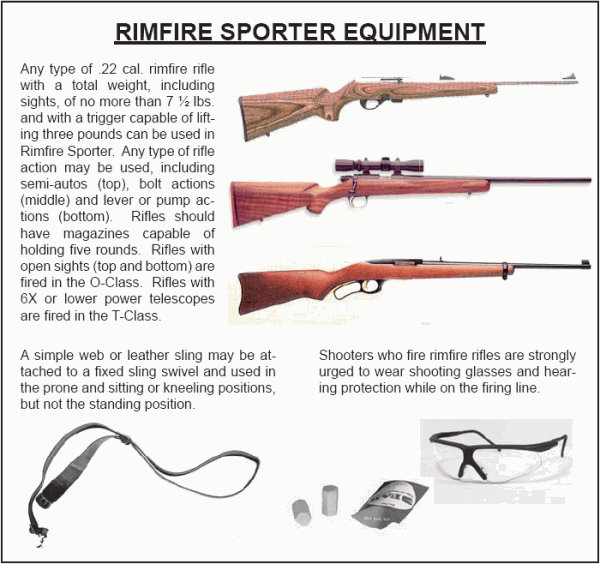
The CMP Rimfire Sporter discipline is for smallbore rifles that weigh 7 1/2 pounds or less with sights. Firing is done at 25 and 50 yards in prone, sitting, and standing positions, in slow and rapid-fire modes. The CMP has a special smart-phone App that helps speed up scoring. Rimfire Sporter matches are held throughout the country in connection with the CMP’s Travel Games.
And each summer, the major National Rimfire Sporter Match attracts hundreds of shooters to the shore of Lake Erie at Camp Perry. This year’s Rimfire Sporter Match at Camp Perry will be held on Saturday, July 13, 2024 — just five weeks away. The CMP National Rimfire Sporter Rifle Match offers shooters a recreation-oriented competition where they use affordable, smallbore sporter rifles with either scopes or iron sights. All you need are a .22 LR rifle, sling, and ammo.
Rifles may be manually operated or semi-automatic, in three classes: the standard “O Class” for open-sighted rifles, “T-Class” for telescope-sighted rifles, and the “Tactical Rimfire” Class. Firing is done at 50 and 25 yards on a target with a 1.78″ ten-ring. The target is simple enough for a beginner to hit, yet challenging enough that only one competitor in the history of the match has ever fired a perfect 600 score.
Rimfire Sporter Course of Fire
At the Rimfire Sporter Match, competitors complete slow fire prone, rapid fire prone, slow fire sitting or kneeling, rapid fire sitting or kneeling, slow fire standing, and rapid fire standing shot sequences.
What is Required for the Camp Perry Rimfire Sporter Match
Competitors need to bring their own .22 cal. Rimfire rifle(s) and ammunition. Special target shooting equipment, shooting jackets, or shooting gloves are not permitted, but you can bring a spotting scope and ground cloth or shooting mat. The firing points have grass (sometimes a bit wet with rain). Competitors are strongly urged to wear hearing and eye protection. Assistance for disabled competitors is provided.
A free Shooters’ Clinic is usually held in connection with the Rimfire Sport match at Camp Perry. The Clinic covers Rimfire Sporter rules, safety instructions, course of fire, and competition procedures. Shooters who have not previously attended a CMP Rimfire Sporter Match are strongly encouraged to attend.
Do you know someone who recently purchased his/her first handgun and is getting started in the shooting sports? Or do you need to brush up your own pistol skills? Then check out a FREE video training series from the SIG Sauer Academy: Shooter’s Edge — Learning to Shoot.
Here is the Second Video from the Shooter’ Edge series, covering Basic Rules of Firearms Safety:
This video series features foundational handgun classes at the SIG Sauer Academy in New Hampshire. The ten-episode series takes viewers into the classroom and onto the range as the instructors walk through the fundamentals of handgun safety, shooting techniques, practice and training exercises, along with instruction in equipment options and handgun selection. The series was shot on location during several of the Academy’s introductory classes.
Click Below to Access Full Video Series on SigSauer.com:
The Shooter’ Edge Series includes the following episodes: Learn to Shoot at SIG Sauer Academy; Basic Rules of Safety; Types of Handguns and Ammunition; Foundational Shooting Techniques; How to Practice and Train Effectively; Choosing the Right Gun; Equipment and Its Purpose; Holsters — Presentation and Recovery; Magazines — Loading and Unloading; and What Happens After Learning to Shoot.
A Kestrel Wind Meter will record wind speed with its impeller wheel. However, to get the most accurate wind velocity reading, you need to have your Kestrel properly aligned with the wind direction. To find wind direction, first orient the Kestrel so that the impeller runs at minimal speed (or stops), and only then turn the BACK of the Kestrel into the wind direction. Do NOT simply rotate the Kestrel’s back panel looking for the highest wind speed reading — that’s not the correct method for finding wind direction. Rotate the side of the Kestrel into the wind first, aiming for minimal impeller movement. The correct procedure is explained below by the experts at Applied Ballistics.
How to Find the Wind Direction with a Kestrel Wind Meter
Here is the correct way to determine wind direction with a Kestrel wind meter when you have no environmental aids — no other tools than a Kestrel. (NOTE: To determine wind direction, a mounted Wind Vane is the most effective tool, but you can also look at flags, blowing grass, or even the lanyard on your Kestrel).
Step 1: Find the wind’s general direction.
Step 2: Rotate the Wind Meter 90 degrees, so that the wind is impacting the side (and not the back) of the wind meter, while still being able to see the impeller.
Step 3: Fine-tune the direction until the impeller drastically slows, or comes to a complete stop (a complete stop is preferred). If the impeller won’t come to a complete stop, find the direction which has the lowest impact on the impeller.
Step 4: Turn the BACK of the Kestrel towards the direction from which the wind is blowing. Then press the capture button, and record your wind speed.
Do NOT simply point the Kestrel’s back into the wind until you get the highest wind speed — that’s not the correct method.
Leading powder-maker Vihtavuori will be a Platinum sponsor for the 2024 G.B.F.C.A European F-Class Championships slated for September 3 to 8, 2024 in Great Britain. The competition will be held at the world-famous Stickledown Range at the Bisley National Shooting Centre in the UK. This has been the home of the UK’s National Rifle Association since 1890.
The Championships are expected to bring more than 270 top shooters to compete in F-TR and F-Open classes. The event consists of both individual and team matches at 800, 900 and 1000 yards. There are daily Aggs and Grand Aggregates on Friday and Saturday. CLICK HERE for more information about the 2024 G.B.F.C.A European F-Class Championships. You can also visit www.gbfclass.com.
The 2024 European F-Class Championship event is run by the GB F-Class Association. “We’re really thrilled to extend our partnership with Vihtavuori as one of our main sponsors. Working together to create this successful event strengthens the shooting community and offers great development opportunities for our sport”, comments Richard Jones, Chairman of the G.B.F.C.A committee.
“The G.B.F.C.A European F-Class Championships is one of the long range shooting season’s highlights. We’re excited and proud to support this event that brings together the world’s top F-class shooters”, states Vihtavuori Sales & Marketing Manager Olof Borgstrom.
Summer is almost here, so it’s time to focus on fun. Here are four specialty targets with game themes: Dartboard, Billiards Table, Bowling Alley, and Poker Cards. Each target features multiple aiming points. Shoot the dartboard like a regular game or make up your own sequence. For the billiards target shoot the balls in number sequence or alternate stripes/solids. Click any target to load FREE downloadable PDF files. Then print the targets and take them to the range for a fun shooting session. A big thanks to our friends at NRABlog.com and NSSF for creating these colorful “fun & games” targets. Enjoy!
Dartboard Target
With this fun Dart-Board Target, aim for the four outer bullseyes, then go for the center bull. The colored darts provide additional targets. With an accurate rifle you can also aim for the colored stripes.
NSSF Billiards Table Target
This Billiards Table Target offers 15 brightly-colored numbered balls with the cue ball at the bottom. Aim for the numbers, shooting 1-15 in sequence, or alternate between stripes and solids. You can also draw an “X” on the white cue ball (or attach a paster), and use that to set your zero. This target is fun for shooting outdoors with rifles at 50 or 100 yards or indoors with pistols.
This billiards target is part of a set of 12 Fun Targets from the NSSF. These were issued a couple seasons back for National Shooting Sports Month, held in August of each year. The other free targets include Golf Links, Bowling Pins, Fireworks, Baseball Diamond, Dutch Windmill, Water Balloons, Light Bulbs, Dartboard, and three Bullseye targets.
NRA Bowling Pins with Bowling Ball Target
Here’s a fun target for close-range pistol or 100-yard rifle shooting. This NRA Bowling set target has 8 bulleyes. The largest bullseye is on the blue bowling pin. Then there are three slightly smaller bulls on the center of three of the seven bowling pins. Finally there are four small bullseyes located on the top of the first, third, fifth, and seventh pin. To test your skills, start with the bowling ball and then work up to the more challenging bulleyes.
Poker Target — Get the Best Hand
With this playing card-themed target, each shooter takes five shots and the one with the highest hand wins. With the Poker Game Target you can also shoot for 4-of-a-kind, against the clock, fastest four (without a mistake) wins.
File photo showing Kestrel 5700 Elite. See video below for 6.5 Creedmoor rifle.
It’s not easy to place a first shot on target at 1500 yards. You must measure the wind speed with precision, know your exact muzzle velocity, and have a sophisticated ballistics solver. In this short video from Ryans Range Report, the shooter manages a first-round hit on a steel silhouette at 1500 yards. He used a Kestrel 4500 NV Weather Meter with Applied Ballistics software to figure out the trajectory for his 6.5 Creedmoor rounds.
The Kestrel recorded a wind velocity, and the internal software calculated a solution of 17 Mils elevation (that’s 928 inches of drop) with 2.5 Mils windage. “Bang” — the shooter sends it, and 2.6 seconds later “Clang” he had a hit (flight time was 2.6 seconds). Bryan Litz observes: “This is the science of accuracy (in the form of an Applied Ballistics Kestrel) being put to good use at 1500 yards”.
Later in the video (1:05-1:15) the shooter places three rounds on steel at 1000 yards in just 10 seconds. The three shots all fall within 10″ or so — pretty impressive for rapid fire. The shooter reports: “[In my 6.5 Creedmoor] I’m using a 136gr Lapua Scenar L. This bullet has impressed me. It screams out of my barrel at 2940 fps and holds on all the way out to 1,500 yards.”
The rifle was built by Aaron Roberts of Roberts Precision Rifles (RPRifles.com). Chambered for the 6.5 Creedmoor, it features a Leupold Mark VI 3-18x44mm scope.
Roberts Precision Rifles
19515 Wied Rd. Suite D
Spring, Texas 77388
Phone: 281-651-5593
Email: rprifles @ gmail.com


 Joseph Borden and Jim Borden


 Know the Rules


 F-TR Team USA member Matt Schwartzkopf is a double amputee below the knee, having had his lower legs removed due to a birth defect. That hasn’t held him back. Matt is an inspiration to us all. He told us: “This condition has not held me back from anything.” Jokingly, he added, “I may not have ‘a leg to stand on’, but that doesn’t mean I can’t still shoot 10s and Xs at 1000.” Matt is living proof that competitive shooting is a sport for all individuals — young and old, able-bodied and physically challenged.





 It’s not easy to place a first shot on target at 1500 yards. You must measure the wind speed with precision, know your exact muzzle velocity, and have a sophisticated ballistics solver. In this short video from


