Have you been struggling to find brass, powder, and (especially) primers? No luck finding rimfire ammunition or loaded ammo for your pistols or hunting rifles? Well, now there’s a free web-based search service that can help you find what you need. The service costs nothing and you don’t have to sign up to run searches.
GunBot.net employs “search bots” to scour the internet for available inventories of ammo, powder, primers, brass and magazines. GunBot.net checks the inventories of over sixty retailers, including leading vendors AmmoMan, Bass Pro, Brownells, Cabelas, Cheaper Than Dirt, Grizzly, JG Sales, Dan Killough, Midsouth Shooters Supply, Midway USA, Powder Valley, Rainier Arms, Sinclair Int’l, Sportsman’s Guide,, Wholesale Hunter, and Wideners.
Results can be sorted by price or time (most recent results first). You can even get email alerts notifying you when the product you need is available. (To get alerts, you must first log-in and create an account with GunBot.net. There is no charge for this service.) GunBot.net’s search spiders work constantly, so results are normally very current. Pages auto-refresh when new “matching items” are found.
Primers Found Efficiently with GunBot.net GunBot.net saves us time by instantly checking inventory at many dozens of online retailers. In May, we were looking high and low for large rifle magnum primers. Then a quick search with GunBot.net revealed that site sponsor Powder Valley, Inc. had some in stock. We placed our order and had the primers in our hands the next week. Here’s a screenshot showing primer inventories on June 17, 2013:
Products in the 2013 CMP catalog include: M1 Garand Rifles, Smallbore Rifles, Air Rifles, Replacement Barrels (newly manufactured), Garand Stock Sets, m1903 Stock Sets, M1 Carbine Stock Sets, Ammunition (commercial and surplus), Tools/Gauges, Rifle Cases, Shooting Coats, Shooting Gloves, Shooting Mats, and Instructional DVDs. Note: To order a rifle from the CMP, purchasers must provide proof of: 1) U.S. Citizenship (and age); 2) Membership in a CMP-Affiliated Organization; and 3) Participation in a Marksmanship or Other Firearms-Related Activity.
Current demand for loaded ammunition and reloading components is very high. To meet this demand, ammo imports into the USA have nearly doubled. But supplies are still short. One reason is that domestic ammo manufacturers are already operating at full capacity — and they have been doing so for the past decade or so. The machines just can’t run any faster…
Now an important domestic ammo-maker has committed to a significant increase in production capacity. Remington Arms Company, LLC (“Remington”) recently announced a major expansion of its Lonoke (Arkansas) Ammunition Plant. Remington will spend $32,000,000 to add new structures and machinery.
Work on the expansion, which will include the construction of a new building, is expected to begin second quarter of 2013. The $32 million expansion plan is projected to be in operation by the second quarter of 2014. The Remington’s Lonoke Ammunition Plant, opened in 1969, produces a wide variety of commercial ammunition.
“We continue to invest in all of our manufacturing operations because we are committed to ensuring quality, increasing product availability, and improving on-time delivery. This significant investment in Lonoke is a testament to that commitment. Our customers can count on Remington to invest in its manufacturing operations in order to ensure that its facilities are state-of-the art”, said Kevin Miniard, Chief Operating Officer of Remington. Read about Remington ammunition.
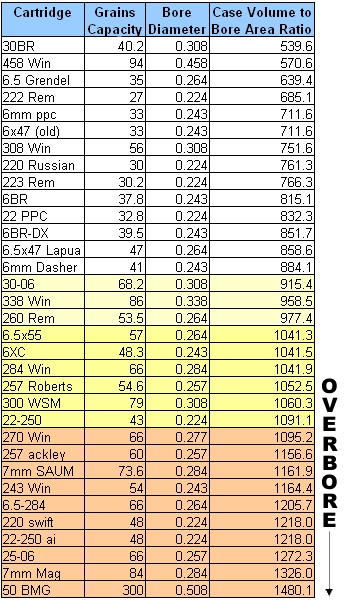
Forum Member John L. has been intrigued by the question of “overbore” cartridges. People generally agree that overbore designs can be “barrel burners”, but is there a way to predict barrel life based on how radically a case is “overbore”? John notes that there is no generally accepted definition of “overbore”. Based on analyses of a wide variety of cartridges, John hoped to create a comparative index to determine whether a cartridge is more or less “overbore”. This, in turn, might help us predict barrel life and maybe even predict the cartridge’s accuracy potential.
John tells us: “I have read countless discussions about overbore cartridges for years. There seemed to be some widely accepted, general rules of thumb as to what makes a case ‘overbore’. In the simplest terms, a very big case pushing a relatively small diameter bullet is acknowledged as the classic overbore design. But it’s not just large powder capacity that creates an overbore situation — it is the relationship between powder capacity and barrel bore diameter. Looking at those two factors, we can express the ‘Overbore Index’ as a mathematical formula — the case capacity in grains of water divided by the area (in square inches) of the bore cross-section. This gives us an Index which lets us compare various cartridge designs.”
OVERBORE INDEX Chart
So what do these numbers mean? John says: “My own conclusion from much reading and analysis is that cartridges with case volume to bore area ratio less than 900 are most likely easy on barrels and those greater than 1000 are hard on barrels.” John acknowledges, however, that these numbers are just for comparison purposes. One can’t simply use the Index number, by itself, to predict barrel life. For example, one cannot conclude that a 600 Index number cartridge will necessarily give twice the barrel life of a 1200 Index cartridge. However, John says, a lower index number “seems to be a good predictor of barrel life”.
John’s system, while not perfect, does give us a benchmark to compare various cartridge designs. If, for example, you’re trying to decide between a 6.5-284 and a 260 Remington, it makes sense to compare the “Overbore Index” number for both cartridges. Then, of course, you have to consider other factors such as powder type, pressure, velocity, bullet weight, and barrel hardness.
Overbore Cases and Accuracy
Barrel life may not be the only thing predicted by the ratio of powder capacity to bore cross-section area. John thinks that if we look at our most accurate cartridges, such as the 6 PPC, and 30 BR, there’s some indication that lower Index numbers are associated with greater inherent accuracy. This is only a theory. John notes: “While I do not have the facilities to validate the hypothesis that the case capacity to bore area ratio is a good predictor of accuracy — along with other well-known factors — it seems to be one important factor.”
Dennis DeMille of Creedmoor Sports sent us a reminder that the Eastern CMP Games and Creedmoor Cup is coming up in just three weeks. The event runs May 4-12 at Camp Butner in North Carolina. If you want to join the action you should register soon. This event is limited to 200 shooters. Last year’s Eastern Games and Cup were a great success so a big turn-out is expected this year.
Ammo, Brass, and Bullets Available
In related news, Creedmoor Sports announced that limited quantities of Hornady bullets, brass, and ammo, as well as Sierra bullets, that are currently in stock. If you need ammo or components, this may help you. Here is a partial list of the products in inventory as of yesterday.
H2420 Hornady 6mm .243 75gr HP Bullet –19 Boxes In Stock
H3095 Hornady Match 30 Cal (.308 Diameter) 195gr BTHP Bullet– 15 Boxes in Stock
H8097 Hornady .308 Win 168gr BTHP Match Ammo — 26 Boxes In Stock
H8620 Hornady .243 Win Brass — 13 Boxes In Stock
H81170case Hornady .30-06 Garand Ammo, 168gr Amax, CASE Lot (200 rds)
S1740C Sierra 140 gr. HPBT Match Bullets — 3 Boxes In Stock
S2190 Sierra .30 Cal. 150 gr. HPBT Match Bullets (500 ct) — 15 Boxes In Stock
Most of our readers know that MTM Case-Gard offers a vast selection of ammo boxes for pistol, rifle, and shotgun ammunition. However, with such a wide inventory of box styles and sizes, it can be difficult, at first, to select the right box for your particular cartridge and carrying needs. MTM has now simplified that task by publishing comprehensive Ammo Box Charts on its website. Just log on to the Box Charts Page, and select Rifle, Handgun, or Shotshell boxes. That will open a large chart listing cartridge types, small to large, in the left column. Pick your cartridge and you will see all the storage options. MTM even codes the entries so you can see if a box allows Tip Up AND Tip Down storage, Tip Down only, or Tip Up only. For most popular rifle cartridges, there are 20-round, 50-round, and 100-round cases. Below is the first part of the Rifle Ammo Box Chart. The entire chart is four pages long.
New MTM Ammo Belt Pouch
MTM has also introduced a handy product that should work great for rimfire shooters. The new MTM Ammo Belt Pouch conveniently holds 100 rounds (two boxes) of .22LR rimfire ammo. With a sturdy snap latch and heavy-duty belt clip, all you have to do is pour out the ammo, then clip the pouch on your belt or jeans pocket. The Belt Pouch is also handy for saving fired centerfire brass.
Suggested retail for MTM’s Ammo Belt Pouch is a modest $4.95. However, Grafs.com currently sells the item for $3.59 (Prod. #MTMABP). Designed to hold a 100 rounds of 22 long rifles. Holds: .22 Long rifle, 22 Magnum, 22 Short, 17 Win Super Mag, 17 HMR, 17 Mach 2, Pellets, and BBs.
By Michael Bussard, edited by John B. Allen, David Kosowski, Charles F. Priore, Jr.
If you’re a serious shooter, the latest 4th Edition of the Ammo Encyclopedia (released in August, 2012), belongs in your library. This 972-page book is probably the most comprehensive and up-to-date book in print covering current and obsolete cartridges and shotshells. Bussard’s Ammo Encyclopedia is a massive resource work. The 4th Edition now boasts over 100 chapters.
One of the best features is a 12-page color section depicting actual size drawings of 265 current rimfire/centerfire cartridges and shotshells. You won’t find that many “life-size” cartridge drawings in one place even on the internet. Cartridge profiles and ballistic charts have been expanded to include all new factory cartridges. The authors have even included air rifle pellets and historical images and charts. Softcover, 972 pages.
Comments from guys who bought the book:
“This book contains a vast array of information on many modern and even obsolete ammunition. Definately recommend for any modern reloader novice or experienced.” – Duggaboy460
“It’s a great reference book for individuals who reload their own ammunition. There is a lot more info in this Edition. Everyone who likes this information should have it in their library.” – Reloader
“I like the general and technical comments that are available for each and every cartridge. Information that predicts if a cartridge will stay in production for many more years or rapidly become obsolete.” – RSL1
The Sporting Arms and Ammunition Manufacturers’ Institute (SAAMI) has produced an amazing 25-minute video that shows what actually happens to sporting ammunition involved in a fire. This video shows the results of serious tests conducted with the assistance of professional fire crews. We strongly recommend you watch this video, all the way through. It dispels many myths, while demonstrating what really happens when ammunition is burned, dropped, or crushed.
Watch SAAMI Ammunition Testing Video
Over 400,000 rounds of ammunition were used in the tests. Some of the footage is quite remarkable. Testers built a bonfire with 28,000 rounds of boxed ammo soaked in diesel fuel. Then the testers loaded five pallets of ammo (250,000 rounds) in the back of a semi-truck, and torched it all using wood and paper fire-starting materials doused with diesel fuel.
The video shows that, when ammo boxes are set on fire, and ammunition does discharge, the bullet normally exits at low speed and low pressure. SAAMI states: “Smokeless powders must be confined to propel a projectile at high velocity. When not in a firearm, projectile velocities are extremely low.” At distances of 10 meters, bullets launched from “cooked-off” ammo would not penetrate the normal “turn-out gear” worn by fire-fighters.
We are not suggesting you disregard the risks of ammo “cooking off” in a fire, but you will learn the realities of the situation by watching the video. There are some amazing demonstrations — including a simulated retail store fire with 115,000 rounds of ammo in boxes. As cartridges cook off, it sounds like a battery of machine-guns, but projectiles did not penetrate the “store” walls, or even two layers of sheet-rock. The fire crew puts out the “store fire” easily in under 20 seconds, just using water.
Additional Testing: Drop Test, Projectile Test, Crush Test, Blasting Cap Test
Drop Test
The video also offers interesting ammo-handling tests. Boxes of ammo were dropped from a height of 65 feet. Only a tiny fraction of the cartridges discharged, and there was no chain-fire. SAAMI concludes: “When dropped from extreme heights (65 feet), sporting ammunition is unlikely to ignite. If a cartridge ignites, it does not propagate.”
Rifle Fire Test
SAAMI’s testers even tried to blow up boxes of ammunition with rifle fire. Boxes of loaded ammo were shot with .308 Win rounds from 65 yards. The video includes fascinating slow-motion footage showing rounds penetrating boxes of rifle cartridges, pistol ammo, and shotgun shells. Individual cartridges that were penetrated were destroyed, but adjacent cartridges suffered little damage, other than some powder leakage. SAAMI observed: “Most of the ammunition did not ignite. When a cartridge did ignite, there was no chain reaction.”
Bulldozer Crush Test
The test team also did an amazing “crush-test” using a Bulldozer. First boxes of loaded ammo, then loose piles of ammo, were crushed under the treads of a Bulldozer. A handful of rounds fired off, but again there was no chain-fire, and no large explosion. SAAMI observed: “Even in the most extreme conditions of compression and friction, sporting ammunition is unlikely to ignite. [If it does ignite when crushed] it does not propagate.”
Blasting Cap Test
Perhaps most amazingly, the testers were not able to get ammunition to chain-fire (detonate all at once), even when using blasting caps affixed directly to live primers. In the SAAMI test, a blasting cap was placed on the primer of a round housed in a large box of ammo. One cartridge ignited but the rest of the boxed ammo was relatively undamaged and there was no propagation.
Here’s an oddball item cited on The Firearm Blog. There’s a new service that loads a decedent’s ashes into shootable ammunition. This story will shock some readers, amuse others, and have some saying, “Well why not?” Thanks to Holy Smoke LLC, when a person passes away, and is cremated, his ashes can now be loaded up into commemorative ammo, and fired off in tribute… or used on one “final hunt”.
Choose Shotshells, Rifle Rounds, or Pistol Cartridges for Your Decedent
We kid you not… Holy Smoke LLC is offering a service by which a loved one’s ashes can be placed in shotshells, rifle cartridges, or pistol cases. Holy Smoke says: “One pound of ash is enough to produce 250 shotshells (one case).” If the decedent is not a shotgunner, you can also chose either 100 rifle cartridges or 100 pistol cartridges. We’re told that “Wildcat cartridges” are no problem (for a slight extra fee). So, if you want to make your “final flight” propelled by a Dasher or 300 Boo-Boo, that’s possible.
Could “one final trip downrange” be the perfect send-off for the avid rifleman, shotgunner or hunter? Perhaps. This option could appeal to some folks. And if you really don’t feel too good about blasting old grand-dad’s ashes into the air, Holy Smoke LLC also offer “mantle-worthy wooden carriers with engraved name plates”.
Having attend some ceremonies where ashes were distributed at sea, or cast to the winds, I think a “final salute” with shotshells could be handled with dignity. But 250 shotshells or 100 rifle cartridges is a lot to shoot on one occasion. Maybe the better idea would be to have all the ashes fired off in a cannon in one big bang. Now that would be impressive! As for you 3-gunners, Holy Smoke doesn’t list a “mix and match” option with shotgun, rifle, and pistol rounds, but that might be a future option. Heck, you could even have a memorial 3-gun match — with ammo supplied.
How did Holy Smoke LLC get started? Well the company’s founders are both game wardens who love shooting and hunting. One day the subject of burials came up:
“We were discussing the passing of one of our relatives and the topic of conversation turned to our own demise and whether we preferred burial or cremation. I told my friend that I had some cost, waste of space and ecological issues with burials and that I thought I wanted to be cremated and in some fashion, have my ashes tossed into a river or spread through the woods.
My friend smiled and said ‘You know I’ve thought about this for some time and I want to be cremated. Then I want my ashes put into some turkey load shotgun shells and have someone that knows how to turkey hunt use the shotgun shells with my ashes to shoot a turkey. That way I will rest in peace knowing that the last thing that one turkey will see is me, screaming at him at about 900 feet per second‘.”
What does it cost? The price for either 250 shotshells or 100 cartridges (rifle or pistol) is $850.00 (this does not include cremation costs). Could you load a decedent’s ashes yourself for less? Yes, of course, but there may be legal issues involved with the disposition of cremated remains. Even the $850.00 price is a fraction of what typical funeral burial services cost. If you’re interested in Holy Smoke’s unique services, visit www.myholysmoke.com or call (251) 232-4414 or (251) 213-1211.
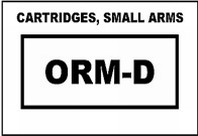
The days of the “ORM-D: Small Arms Cartridges” labels for ammo shipments are numbered. The Dept. of Transportation (DOT) is phasing out the current ORM-D ammo labels, replacing them with a larger striped diamond label that does not mention “Small Arms Cartridges”. This change is designed to harmonize U.S. shipping rules with United Nations standards. You can start using the new “Limited Quantity” diamond labels for ammo shipments immediately, but they are not mandatory — yet. You can continue to use the old ORM-D “Cartridges, Small Arms” labels until December 31, 2013. As of January 1, 2014 you MUST use the Striped Diamonds.
OFFICIAL UPS RULES — Elimination of ORM-D Classification In an attempt to harmonize and align with international standards, the DOT has amended the 49CFR regulations regarding the ORM-D classification. Effective January 19, 2011, with the publication of the HM-215K final rule, the hazard class of ORM-D is being eliminated. Those materials may still be shipped classified as a limited quantity (“Ltd Qty”). In conjunction with ORM-D hazard class elimination in HM-215K, limited quantity ground shipments will no longer require shipping papers when prepared under the new rule. This includes those materials previously classed as Ltd Qty that required shipping papers via ground transport.
Ground Ltd Qty Marking
Air Ltd Qty Marking
NOTE: These illustrations are not true to scale. The actual default Ltd Qty Diamond label to be used for ammo shipments is much larger, about 5″ per side. A smaller 2″ per side version of the Ltd Qty striped diamond can be used on smaller packages.
There is a transition period for shippers to comply with the new classification, marking and labeling requirements. Until December 31, 2013 a limited quantity package containing a consumer commodity as defined in 171.8 may be reclassed as ORM-D, or until December 31, 2012 for ORM-D-Air material. UPS began accepting materials with the new markings effective April 1, 2011. Note: To be in compliance with TDG, Standard (ground) Ltd Qty shipments to Canada prepared under HM-215K require the verbiage ‘Limited quantity’ or ‘Ltd qty’ to also be marked on the carton.
Download OLD and NEW Label Formats
On the Parallax Curio and Relic Forum, a thread includes PDF samples of both the new Diamond Ltd Qty Labels and the current ORM-D Labels. The thread explains: “The good news is the new label doesn’t have any indicator that the package contains ammunition. The bad news is the new label is gigantic compared to the old ORM-D label. You are required to use one of the larger labels on one side of any package containing ammunition. If the package is too small for one of the larger labels then you are permitted to use one of the smaller labels instead. Because of the size requirement in the regulations, you only get two of each label on standard piece of printer paper.”
If you want to still use the ORM-D Small Arm Cartridges Labels until the new Diamond Labels are mandatory, here are links to PDF sheets of ORM-D labels. These PDFs have many rows of labels per page so you can save printer paper. The black version and blue version will use up more printer ink, so you might want to use the white version to be more economical.


 Have you been struggling to find brass, powder, and (especially) primers? No luck finding rimfire ammunition or loaded ammo for your pistols or hunting rifles? Well, now there’s a free web-based search service that can help you find what you need. The service costs nothing and you don’t have to sign up to run searches.


 Dennis DeMille of
 Most of our readers know that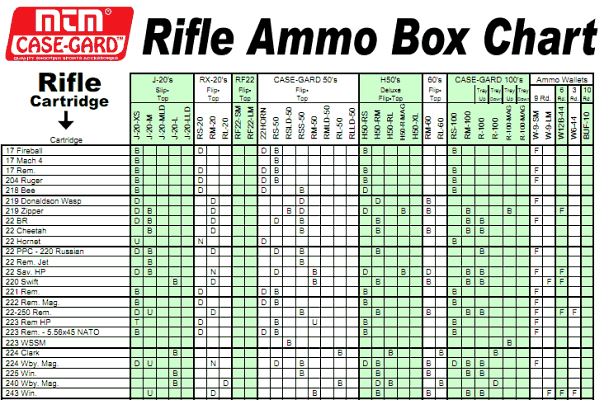
 New MTM Ammo Belt Pouch
 By Michael Bussard, edited by John B. Allen, David Kosowski, Charles F. Priore, Jr.
 The Sporting Arms and Ammunition Manufacturers’ Institute (
 We are not suggesting you disregard the risks of ammo “cooking off” in a fire, but you will learn the realities of the situation by watching the video. There are some amazing demonstrations — including a simulated retail store fire with 115,000 rounds of ammo in boxes. As cartridges cook off, it sounds like a battery of machine-guns, but projectiles did not penetrate the “store” walls, or even two layers of sheet-rock. The fire crew puts out the “store fire” easily in under 20 seconds, just using water.
 Here’s an oddball item cited on
  Could “one final trip downrange” be the perfect send-off for the avid rifleman, shotgunner or hunter? Perhaps. This option could appeal to some folks. And if you really don’t feel too good about blasting old grand-dad’s ashes into the air, Holy Smoke LLC also offer “mantle-worthy wooden carriers with engraved name plates”.
 In an attempt to harmonize and align with international standards, the DOT has amended the 49CFR regulations regarding the ORM-D classification. Effective January 19, 2011, with the publication of the HM-215K final rule, the hazard class of ORM-D is being eliminated. Those materials may still be shipped classified as a limited quantity (“Ltd Qty”). In conjunction with ORM-D hazard class elimination in HM-215K, limited quantity ground shipments will no longer require shipping papers when prepared under the new rule. This includes those materials previously classed as Ltd Qty that required shipping papers via ground transport.