|
|
March 20th, 2010
From April 30 – May 2, the Original Pennsylvania 1000 Yard Club will host a multi-day, long-range benchrest school at its Williamsport range. For $250, up to 36 students will enjoy 1 night and 2 days of intensive training under the tutelage of some of the nations’ top 1000-yard shooters. There are still some spots available for the class, which is designed for novice to intermediate shooters. The sign-up deadline is April 25th.

On Friday night (April 30), students will meet their mentors, including school director Frank Grappone. Saturday (May 1), the class moves to the range for a full day of hands-on technical training. Topics will include precision reloading, load development, gun handling, use of chronograph, analysis of shooting results, gun cleaning, and target analysis. The Williamsport Club will provide the rifles and all reloading components. Saturday’s sessions are followed by a steak dinner, included in the $250 seminar price.

On Sunday (May 2), after an early training session covering bench set-up and match strategies, students will participate in a 1000-yard match, spending time both behind the trigger and in the pits. Instructors will explain how to read conditions, and will demonstrate target measuring and analysis after the relays. The program wraps up before 4:00 pm on Sunday.
The 1000-yard Benchrest School is limited to 36 students (with less than 3 students per advisor). Intructors include Gunsmiths Bruce Baer and Mark King, our Asst. Editor Jason Baney, and many Williamsport Hall of Fame shooters. For more info, email School Director Frank Grappone, frankgrappone [at] sbcglobal.net.

March 5th, 2010
We recently received a prototype version of the new NEO rest from SebCoax.com. Designer Sebastian Lambang’s new rest is an engineering tour de force. Your editor can say, straight up, that this is the best joystick rest I’ve ever used. It is butter smooth in horizontal travel. The NEO does not suffer from the jerky, or jumpy vertical movement of some other joystick rests. With a 17-lb gun on the rest, yes there is more resistance in the vertical plane than in the horizontal, but you can still move the crosshairs up smoothly in one motion. You don’t have to “over-shoot” and then come back down on your aiming point. If you’ve used other coaxial rests, you know that the upward movement can be jerky if the resistance is set so that the joystick does not droop when you let go. Not so with the NEO. Seb Lambang has fitted the NEO rest with expensive, new German-made internal bearings. These new teflon liner bearings, plus two additional internal leaf springs for weight support, make all the difference.
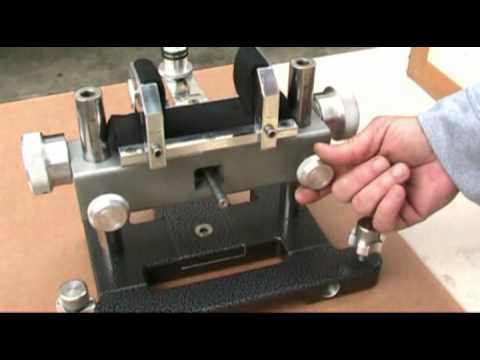
The upward movement is MUCH smoother than before. In this Editor’s opinion, the NEO is smoother (with less jumpiness) than the Farley. It is also easier to set joystick tension on the NEO rest that on the previous (Gen 1) SEB rest. Before you had to fiddle with hex-head bolts. On the NEO rest, SEB has provided two, large diameter knobs. It is easy to set the tension so the joystick doesn’t fall on release, but travel is still smooth and positive in all planes.

Make no mistake, joystick movement on this rest is smooth and fluid, even in straight upwards motion with a 17-pound rifle. No more of the jumpiness or stacking found on lesser designs. SEB has got a winner here. Just as a top-fuel dragster lives or dies on quarter-mile speed, a coaxial rest is judged, foremost, on its ability to move quickly and precisely to point of aim in ONE MOVEMENT. Here the NEO rest shines. It may be the smoothest-functioning coaxial rest ever produced. And it also has the unique feature of adjustable front bag width (see videos). That’s great if you shoot both wide benchrest rigs and narrow-forearm rifles. Also, when disassembled, the NEO rest packs up very compactly — a big plus when traveling. If you didn’t like joystick rests before, the SEB NEO may make you a believer.

Triple-Sandbag Configuration and Vibration Damping
How about shooting performance? The rest is rock-solid, with no wobbly movement, so no mechanical flaws should prevent match-winning performance. However, the NEO rest has three separate, fairly thin bags. This configuration has been used with success in rimfire benchrest. Some European centerfire rests use a similar tri-bag arrangement. However, we are concerned that the smaller, separate bags could behave differently than a conventional front bag. There may be differences in vibration damping and how the bag responds under recoil. We have NOT done enough testing to judge how the NEO’s tri-bag system performs compared to a conventional one-piece sandbag. But it’s something to consider.
NEO Rest Offers More JoyStick Travel
The SEB NEO rest has a very wide range of travel. Running the joystick to max travel, we placed shots 43 MOA apart vertically and 48 MOA apart horizontally. That’s four FEET of horizontal travel at 100 yards using JUST the joystick! If you need more than 43 MOA of vertical travel, the whole coaxial carriage moves up and down on two large columns, delivering a bag height range from about 5″ to 10″ above the bench top. That’s a HUGE amount of travel. The gross height is adjusted with two large knobs, one on either side of the carriage. This movement is very smooth — as if the carriage is on ball bearings.
The geometry of the NEO Rest is somewhat unique. Although the NEO can be positioned in either direction (i.e. it is reversible), it is designed to have the long, narrow foot out front, on the target side. This opens up the entire area behind the rest, so there is no interference with the joystick’s movement. “But what about my vertical speedscrew?” you may be saying. Well, with the SEB NEO’s 43 MOA of vertical travel, you really don’t need a vertical adjustment screw on the shooter’s side of the rest when aiming your rifle. There ARE two adjustment screws on the left and right rear sides, but these are intended to level the rest only.

Overall, we were very impressed with the quality, range of adjustment, and versatility of the NEO rest. It has more than enough joystick travel to shoot an ARA rimfire target with 25 bulls. It has enough gross vertical adjustment for 1000-yard F-Class use, even if the target is way up on a hill or down in a valley. And, the rest is relatively easy to transport, with a fairly small footprint and a convenient carry handle built into the “back” side of the rest.

NEO Rest Specifications
- Reversible base configuration: Rest can work with joystick tension adjustments in front, or in rear, per user preference. If you want the single long foot on the “driver’s side”, that is also possible.
– Size assembled: Approx. 13″ wide x 14″ long, 8.6″ tall.
– MOA adjustment (joystick travel): At least 40 MOA (vertical) x 44 MOA (horizontal).
– Net weight: approx 9.3 kgs (20.5 lbs), with standard aluminum base and filled bags.
– Bag Width Range: 200 mm (approx 7.874″) between posts CTC. This allows a max forearm width of about 4″ (four inches).
– Height Range (from bottom of base to top of horizontal bag): Approx. 5″ (lowest) to 10″ (highest).
– Sand Bag Thickness: Approx. 3/4″ for the “horizontal’ bag, approx. 1/2″ for the side chambers.
– Construction: All metal throughout. Base is cast aluminum. Rack gear posts and pinion are stainless steel (SUS 420J). Coaxial body, rest top, forearm stopper are made from aircraft grade alumunium.
– Price: Not yet set, but probably $675.00 to $750.00 US.
NEO Rest vs. SEB Standard Rest
Seb told us: “The NEO rest is NOT designed to replace the regular SEB rest. It’s only for people that need faster elevation adjustment, and a rest that can be set to a lower level overall or a higher lever overall. On the production NEO rests, the ‘body’ of the coaxial unit will be polished, just like the current (Gen 1) rest. The current (Gen 1) rest will remain in production, so don’t worry if you prefer that design. I haven’t established the final price of the NEO rest yet, but I think it will be about $675.00 to $750.00. Yes, it will be somewhat more expensive because of the extended travel capability and increased cost of materials.”

Further Enhancements for Production Model?
The NEO we received is a prototype model and SEB tells us that he may add or modify some features in the final production version. What changes would we like? First, we think a front rest in the $700+ price range should have a built-in level. Obviously you can buy a bubble level and stick it on, but Seb should include one. Second, we’d like to see some variations on the side sand chambers. They tend to plump up in the middle. For stocks with side flats, such as the McMillan Edge, the thickest part of the side bags is a bit too high. Also the side tension knobs push the bags inwards well above the contact point with the stock. We also would like to have more forearm stop travel. As made, the front forearm stop has a good range of adjustment. But an optional, longer extension for the stop would better suit rifles that balance/shoot best with the rest placed well back on the forearm.
Included Cord Helps Rest Alignment
Included with the NEO rest is a nylon cord with metal ends. Just pop one end of the cord in a hole in the middle of the forearm stop and draw the cord back in line with the target, running the cord through the ears of your rear sandbag. This allows you to center and align the rear bag optimally. The cord is a thoughtful accessory provided by SEB.


Review Disclosure: SebCoax.com provided the Seb NEO rest for testing and evaluation. The rest’s manufacturer is not currently advertising with AccurateShooter.com.
February 26th, 2010
Jeff Stover, President of the IBS (International Benchrest Shooters) just sent us the final rules and safety guidelines for AR benchrest competition under the IBS. Jeff noted: “Shooters should understand that the ranges and clubs will determine whether to allow AR rifles in their particular IBS benchrest matches.” This program is not mandatory, and each club will decide, based on its own priorities, whether ARs will be allowed to compete. When they ARE “invited”, AR-platform rifles will run in their own separate class.

Click the links below to download two .PDF files:
DOWNLOAD: IBS AR Benchrest Final Rules
DOWNLOAD: IBS AR Benchrest Safety Checklist
February 9th, 2010
Mark Trope, Webmaster of the Gun Owner Network website, has written a very thorough review of the SEB Coaxial front rest. Mark’s SEB Rest Review covers all the bases, showing how the rest works with a variety of rifle types, including both wide-forearm match rifles and narrow-forearm sporter rifles.

Mark provides dozens of good photos of the rest, including many close-ups showing the fine points of SEB’s impressive design. The review shows how to set-up and level the rest, and how to tune the “feel” of the joystick to suit your preferences. Some rest users prefer the joystick to move quite freely, while others prefer to dial in some resistance so there is no chance of movement when you remove your hand from the joystick.

After covering the features and performance of the SEB Rest, Trope turns his attention to the SEB “BigFoot” rear bag. He explains why it’s a super-stable choice in rear bags, one of the best products available. You’ll note we acquired a SEB BigFoot rear bag for our latest AccurateShooter.com Project Rifle (see story above). After providing tips on how to fill the bag with heavy sand, Trope shows how to adapt a RubberMaid “ActionPacker” plastic storage bin to carry both the SEB Front Rest and the BigFoot Bag.

If you are considering the purchase of a joystick-style front rest, or joystick-style rest top, you should definitely read Trope’s Rest Review. It will definitely help you identify the features you need, so you can make an informed decision, whatever brand you ultimately choose. To learn more about the SEB coaxial rest, or to place an order, contact Sebastian Lambang’s American dealer, Ernie Bishop:
Ernie Bishop
306 West Flying Circle Drive
Gillette, WY 82716
(307) 257-7431
ernieemily [at] yahoo.com
February 6th, 2010
The new IMR 8208 XBR powder is quickly acquiring a reputation for accuracy and pressure stability over a very wide range of temperatures. In addition, it looks like 8208 XBR has a huge load window for accuracy, at least in the 6 PPC cartridge. Here are five successive targets shot by journalist James Mock. With loads range from 30.5 grains to 31.5 grains, Mock nailed five “zero” groups in a row. (These were all three-shot groups.) Mock nailed “zeroes” over a full grain load-weight spread. That’s very impressive, and it bodes well for those who want to spend less time “tuning” their loads.

James observes: “[Here are] 5 consecutive ‘zeroes’ with charges from 30.5 to 31.5. I used a Krieger barrel (583 rounds) and a BAT Model B action. The bullets are from Del Bishop. I used both Wolf SR and Fed 205 primers.The combination that I used that day was really working. The Bishop 65 grain FB bullets were seated to just touch the lands in a barrel with 583 rounds.”
January 31st, 2010
The IBS recently announced that it would allow AR-platform rifles to compete in local IBS benchrest matches in their own class. If you plan to campaign your AR in this new class, you should definitely add a 3″-wide front sled and some kind of rear bag-rider to your gun. Without a flat fore-arm “sled” and rear bag-rider, ARs tend to be very wobbly, and the standard rear stock (with sling loop in place) is terrible in a rear sandbag.

 
Robert Whitley’s AR-X Enterprises has just what you need to improve your AR’s bench behavior. AR-X sells precisely-fitted Delrin bag-riders, crafted expressly for ARs by Evolution Gun Works (EGW). The 3″-wide front bag rider (aka “sled”) features a “twin rail” design and attaches to a tubular fore-arm via a swivel stud. The rear bag-rider mates to the bottom of a standard AR stock and attaches via the rear sling swivel anchor. This provides a smooth, straight surface to ride the bags.
These Delrin EGW bag-rider units were originally designed and prototyped for AccurateShooter.com’s 20 Practical AR project rifle. We tried many different designs, and the final production versions really work — as you can see in the video above. The AR bag-riders cost $40 front and $40 rear, or $75.00 for the set of two. To order, visit 6mmAR.com, or email Robert Whitley: rcw3 [at] erols.com .
January 29th, 2010
 Defying its reputation as a stodgy, conservative organization, the IBS will allow AR-style rifles to compete in their own class at IBS benchrest matches next year. Both AR15-platform and AR10-platform rifles can compete in this new, provisional class. Defying its reputation as a stodgy, conservative organization, the IBS will allow AR-style rifles to compete in their own class at IBS benchrest matches next year. Both AR15-platform and AR10-platform rifles can compete in this new, provisional class.
This will NOT displace any of the current classes (e.g. Sporter, LV, HV, Unlimited), nor change any rules for current classes. The “AR Experiment” will last for one year and then the IBS will determine whether to make the class permanent. IBS President Jeff Stover stressed three points:
1. This is an experiment for a one-year trial.
2. Clubs MAY have an AR class, but they are not required to do so.
3. The IBS Nationals are NOT affected — there will be no ARs at any Nationals
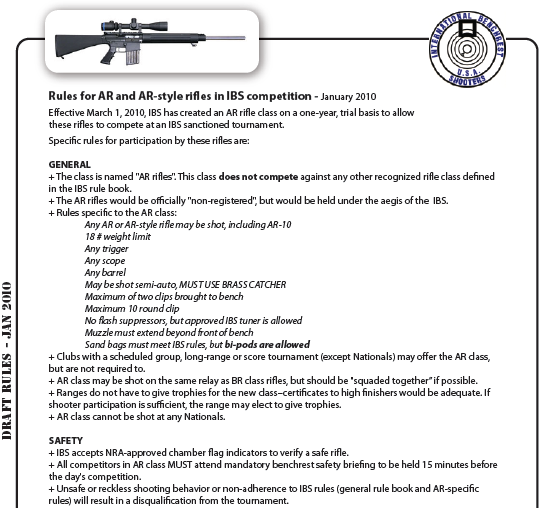
The IBS has distributed proposed draft rules, and the IBS plans to adopt final rules on March 1, 2010. Here are some of the key proposed rules:
January 28th, 2010
 We know many of our readers are interested in the new IMR 8208 XBR powder distributed by Hodgdon Powder Company. Early test lots of this new propellant have already won important benchrest matches, and field testing has shown that it is extremely stable across a wide temperature range. At SHOT Show 2010, we interviewed Chris Hodgdon, who gave us the “inside story” on this new powder. Before we started taping, Chris shared with us lab test results showing how pressure of a fixed load varied with ambient temperature. The data was stunning. Basically 8208 XBR showed almost constant pressures from below freezing to well over 100° F. This editor has personally never seen a powder test that revealed “flat-line” results like 8208 XBR, with recorded pressures remaining virtually unchanged over a huge temperature range. If the test results are to be believed, this is indeed a very exceptional powder. We know many of our readers are interested in the new IMR 8208 XBR powder distributed by Hodgdon Powder Company. Early test lots of this new propellant have already won important benchrest matches, and field testing has shown that it is extremely stable across a wide temperature range. At SHOT Show 2010, we interviewed Chris Hodgdon, who gave us the “inside story” on this new powder. Before we started taping, Chris shared with us lab test results showing how pressure of a fixed load varied with ambient temperature. The data was stunning. Basically 8208 XBR showed almost constant pressures from below freezing to well over 100° F. This editor has personally never seen a powder test that revealed “flat-line” results like 8208 XBR, with recorded pressures remaining virtually unchanged over a huge temperature range. If the test results are to be believed, this is indeed a very exceptional powder.
On some internet Forums, skeptics have suggested that IMR 8208 XBR is just an “odd lot of H322″, and that, accordingly, 8208 XBR may not be available for long. Chris told us that the skeptics are misinformed — those who have suggested that 8208 XBR is re-labeled H322 are completely wrong. IMR 8208 XBR IS something new and it IS here to stay. IMR 8208 XBR is NOT merely a “tweaked” blend of H322. Though 8208 XBR has small kernels like H322, allowing it to meter well, 8208 XBR is a completely new formulation. Moreover, IMR 8208 XBR is not going to be a “one-production-run” wonder. Chris explained that Hodgdon is fully committed to long-term production of this new powder. So if you acquire some now, and develop a great load, rest assured that you will be able to obtain more IMR 8208 XBR in the future. As Chris explains in the interview, Hodgdon is strongly committed to IMR 8208 XBR and Hodgdon plans to keep it in production for a long time.

January 27th, 2010
Howa previewed some impressive new varmint models at SHOT Show 2010. We liked the new Howa 1500 Thumbhole. This features a skeletonized, laminate varmint stock with a nice wide, flat fore-arm. The fore-arm is about 2.25″ wide and is completely flat on the bottom. Slab sides run almost all the way back to the action. This provides a very stable platform that should track well in the bags. Varminters put lots of rounds down-range, so barrel heat can be an issue. To help keep your barrel cool, the fore-arm has four “Buick” vents on each side (left and right), plus SIX large vents cut in the bottom.


Behind the action there is a comfortable pistol grip carved at a good angle for shooting from the bench. It has a nice palm swell at the bottom but is narrow enough at the top that you can get your thumb around for secure, properly aligned grip. I tried out this stock and it was very comfortable. The slightly raised comb was shaped nicely and the grip really felt good in the hand. The middle section of the stock is completely carved away (presumably to save weight). However on the last 5″ or so, the stock has a conventional section on the bottom. This provides a solid platform to ride the bags.

The new Howa 1500 Thumbhole Varminter will cost between $695 and $830 depending on chambering. It will be offered in both short action and long action versions. Available chamberings are: 204 Ruger, 223 Rem, 22-250, 243 Win, 6.5×55, 25-06, 270 Win, 308 Win, 30-06, 300 Win Mag, 7mm Rem Mag, and 338 Win Mag. For more information, contact Legacy Sports Int’l, USA Distributor for Howa rifles.

January 20th, 2010
Streamlined DBM Mag Release from American Precision Arms
Jered Joplin of American Precision Arms (formerly Patriot Arms) showed us a smart new product that should speed up mag changes for tactical bolt-gun competitors. The new APA detachable box magazine (DBM) bottom metal has two, spring-loaded tabs, one on either side of the tigger guard. Just push down on the tab on either side and the magazine drops out quickly and easily. You don’t have to fumble around with hard-to-operate latches anymore.

American Precision Arms’ DBM system uses the well-proven AICS magazine, as several others do, but APA’s version has the most streamlined and user-friendly mag release mechanism. Releasing the magazine with the trigger finger is very intuitive. The release levers are machined to fit flush with the trigger guard edges, so there is virtually no change of a snag or unintentional release. For more information, call Jered Joplin at (706) 534-1577.
New Protektor Model Deluxe Rear Bags
We stopped by the Protektor Model booth and were pleased to find some new deluxe rear bags on display. The DR bag, a large square rear bag, is one of Jason’s favorites. He suggested to Protektor that it combine this flat top design with the larger Loaf design, shown at right in the picture below. The loaf provides extra stabiity and it can serve as a hand/arm rest as well.
One new Protektor product that caught our attention was a thick-botomed bag with a carry handle. The thick bottom is crafted from hard, thick leather with an extra layer of suede on the bottom for enhanced grip. Though designed for bench use, I dubbed this model the “F-Class Bag” because the extra height would be very helpful when shooting from the ground, and the built-in handle would be ideal for carrying the bag out to the shooting positions. This new F-Class Bag is not on Protektor’s website yet, but it is a production model that should retail for roughly $70.00 unfilled and about $80.00 filled with sand. (Protektor conveniently offers both filled and un-filled versions of most of its sandbags.)

|


