|
|
December 20th, 2008
 John Loh is widely respected for the ultra-high-quality front rests he creates for JJ Industries. These rests exhibit some of the finest machining you’ll find anywhere. John has recently turned his attention to a new product — stainless supports for windflags. John Loh is widely respected for the ultra-high-quality front rests he creates for JJ Industries. These rests exhibit some of the finest machining you’ll find anywhere. John has recently turned his attention to a new product — stainless supports for windflags.
These are not the typical collapsing tripod stands. Rather, they are designed with a strong pointed tip that you drive into the ground. The Loh windflag supports have telescoping segments of stainless rod, with locking collars. This allows you to easily adjust the height of your wind flags, while the telescoping design permits compact storage. You can easily fit three supports under the foam in a hard rifle case (between the foam and case wall) and still have room for your rifle. Built of aircraft-grade stainless steel with TIG-welded joints, these wind-flag supports are extremely rigid and sturdy, despite being relatively compact and easy to store.
John Loh recently introduced his stainless windflag stanchions at Benchrest matches out west. Used by Gary Sinclair, the stands have proven very popular and John sold out his first production run. But he has tooled up to make more, priced at $50.00 each. Contact JJ Industries, (562) 602-5553, info [at] jj-industries.com, for more information or to order. Note, these supports will work well on most terrain, but for some ranges that have very hard or rocky soil, a conventional tripod stand may work better.


December 7th, 2008
Hall of Fame benchrest Shooter Speedy Gonzalez has written a helpful article that explains how to eliminate mechanical and gun-handling problems that cause vertical spread in your groups. Speedy’s article addresses both the human and the hardware factors that cause vertical. CLICK HERE to read article. Here are a few of Speedy’s tips:
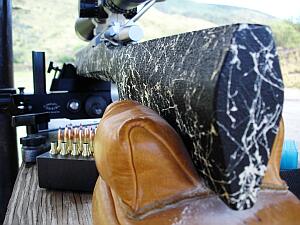 • Front Bag Tension — Vertical can happen if the front sand bag grips the fore-arm too tightly. If…the fore-arm feels like it is stuck in the bag, then the front bag’s grip is too tight. Your rifle should move in evenly and smoothly in the sand bags, not jerk or chatter when you pull the gun back by hand. • Front Bag Tension — Vertical can happen if the front sand bag grips the fore-arm too tightly. If…the fore-arm feels like it is stuck in the bag, then the front bag’s grip is too tight. Your rifle should move in evenly and smoothly in the sand bags, not jerk or chatter when you pull the gun back by hand.
• Sandbag Fill — A front sandbag that is too hard can induce vertical. Personally, I’ve have never had a rifle that will shoot consistently with a rock-hard front sandbag. It always causes vertical or other unexplained shots. Free Recoil–Free recoil shooters should be sure their rifle hits their shoulder squarely on recoil, not on the edge of their shoulder or the side of their arm.
• Front Rest Wobble — You will get vertical if the top section of the front rest is loose. Unfortunately, a lot of rests have movement even when you tighten them as much as you can. This can cause unexplained shots.
• Stock Flex — Some stocks are very flexible. This can cause vertical. There are ways to stiffen stocks, but sometimes replacement is the best answer.
• Rifle Angle — If the gun is not level, but rather angles down at muzzle end, the rifle will recoil up at butt-end, causing vertical. You may need to try different rear bags to get the set-up right.
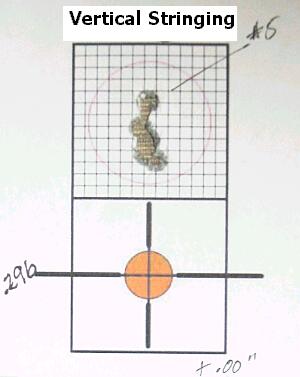
• Last Shot Laziness — If the 5th shot is a regular problem, you may be guilty of what I call “wishing the last shot in”. This is a very common mistake. We just aim, pull the trigger, and do not worry about the wind flags. Note that in the photo below, the 5th shot was the highest in the group–probably because of fatigue or lack of concentration.
CLICK HERE for Speedy’s full article with more tips and advice.
October 12th, 2008
 Conditions were hot and windy at the 2008 NBRSA 100/200 Nationals, held this week at the Ben Avery Shooting Facility in Phoenix, AZ. When the dust settled Tony Boyer came out on top, again proving his mastery of the sport in very challenging conditions. (During many matches, winds gusted from 15-25 mph.) Boyer, widely regarded as THE best short-range benchrest shooter in history, won the Four-Gun Overall, the Three-Gun Overall, and the Sporter/LV Two-Gun Overall Championships. Consider Boyer’s class by class Grand Agg rankings: Conditions were hot and windy at the 2008 NBRSA 100/200 Nationals, held this week at the Ben Avery Shooting Facility in Phoenix, AZ. When the dust settled Tony Boyer came out on top, again proving his mastery of the sport in very challenging conditions. (During many matches, winds gusted from 15-25 mph.) Boyer, widely regarded as THE best short-range benchrest shooter in history, won the Four-Gun Overall, the Three-Gun Overall, and the Sporter/LV Two-Gun Overall Championships. Consider Boyer’s class by class Grand Agg rankings:
| UnLtd. |
LV |
HV |
Sporter |
| #1, .2710 |
#1, .2407 |
#3, .2321 |
#4, .2298 |
Tony won all the marbles by showing great consistency with a TOP 10 or better finish in nearly every class and every distance. But it wasn’t easy — Boyer had some very tough competition. Tony’s protegé, Wayne Campbell, finished second in both the Four-Gun and Three-Gun Overall Championship. Mike Ratigan and Harley Baker also shot superbly throughout the match. Mike finished third in the Four-Gun, and second in the Sporter/LV Two-Gun. Larry Costa, Joe Krupa, and Bob Scarbrough were some of the other top performers.

Overall, this was a very successful match with 130+ shooters, including most of the big names in the sport. There were Hall of Famers up and down the line. Match Director (and railgun world-record holder) Gary Ocock ran a smooth match.

For complete NBRSA Nationals results, with the scores of all 130+ competitors, visit the NBRSA Nationals Thread on Benchrest.com. Woody from Colorado has posted .pdf and text files with all the Grand Agg details, multi-gun results, plus most of the individual events (e.g. LV 100, HV100, Sporter 200 etc.). Below are highlights, with the top 15 shooters in the 4-Gun, and 3-Gun Grand Agg.
Four-Gun Overall Champion Ranking
Rank Name U10-100 U10-200 HV5-100 HV5-200 LV5-100 LV5-200 SP5-100 SP5-200 GrandAgg
1. BOYER, TONY 0.2198 0.3217 0.2076 0.2566 0.2038 0.2775 0.2022 0.2574 0.2433
2. CAMPBELL, WAYNE 0.2386 0.3401 0.2766 0.2457 0.2802 0.2474 0.2646 0.2183 0.2639
3. RATIGAN, MIKE 0.2764 0.3057 0.2660 0.3919 0.2792 0.2499 0.1720 0.2685 0.2762
4. COSTA, LARRY 0.2755 0.4436 0.2136 0.3157 0.3238 0.3114 0.2078 0.2359 0.2909
5. SCARBROUGH, BOB JR 0.3480 0.4123 0.2428 0.2863 0.2360 0.3036 0.2132 0.2914 0.2917
6. HUCKEBA, CHARLES 0.2928 0.2598 0.2498 0.3419 0.2622 0.3654 0.2444 0.3288 0.2931
7. HARRIS, CHRIS 0.2750 0.4120 0.2274 0.3232 0.2336 0.3538 0.2910 0.2418 0.2947
8. BAKER, HARLEY 0.3446 0.4868 0.1472 0.3131 0.2720 0.3203 0.2448 0.2556 0.2981
9. SAUTER, BART 0.2899 0.3715 0.3022 0.3594 0.2912 0.3023 0.2398 0.2889 0.3056
10. CONRY, MIKE 0.2329 0.3634 0.2824 0.3727 0.2306 0.3769 0.2786 0.3198 0.3072
11. KRUPA, JOE JR 0.3158 0.5200 0.1652 0.3856 0.2986 0.3003 0.1908 0.2866 0.3079
12. BRUNO, LESTER 0.2490 0.3716 0.2306 0.5405 0.2520 0.3229 0.2530 0.3025 0.3153
13. ADAMS, ED 0.2761 0.4694 0.2820 0.2907 0.2716 0.2959 0.2916 0.3596 0.3171
14. CREACH, DON 0.3106 0.3371 0.3916 0.3704 0.3444 0.2843 0.1968 0.3365 0.3215
15. BUKYS, GENE 0.2881 0.5199 0.2518 0.2942 0.2260 0.3874 0.2868 0.3187 0.3216
Three-Gun Overall Champion Ranking
Rank Name HV5-100 HV5-200 LV5-100 LV5-200 SP5-100 SP5-200 GrandAgg
1. BOYER, TONY 0.2076 0.2566 0.2038 0.2775 0.2022 0.2574 0.2342
2. CAMPBELL, WAYNE 0.2766 0.2457 0.2802 0.2474 0.2646 0.2183 0.2555
3. BAKER, HARLEY 0.1472 0.3131 0.2720 0.3203 0.2448 0.2556 0.2588
4. SCARBROUGH, BOB 0.2428 0.2863 0.2360 0.3036 0.2132 0.2914 0.2622
5. COSTA, LARRY 0.2136 0.3157 0.3238 0.3114 0.2078 0.2359 0.2680
6. BROWN, Rodney0.2740 0.3778 0.2564 0.2662 0.2070 0.2429 0.2707
7. KRUPA, JOE JR 0.1652 0.3856 0.2986 0.3003 0.1908 0.2866 0.2712
8. RATIGAN, MIKE 0.2660 0.3919 0.2792 0.2499 0.1720 0.2685 0.2713
9. HARRIS, CHRIS 0.2274 0.3232 0.2336 0.3538 0.2910 0.2418 0.2785
10. MEYER, TERRY 0.2226 0.2317 0.2858 0.2897 0.3294 0.3725 0.2886
11. KELBLY, GEORGE SR 0.2832 0.3326 0.2826 0.3353 0.2234 0.2837 0.2901
12. BURBY, BERNIE 0.2296 0.2935 0.2710 0.3726 0.2806 0.3022 0.2916
13. BUKYS, GENE 0.2518 0.2942 0.2260 0.3874 0.2868 0.3187 0.2942
14. SAUTER, BART 0.3022 0.3594 0.2912 0.3023 0.2398 0.2889 0.2973
15. ADAMS, ED 0.2820 0.2907 0.2716 0.2959 0.2916 0.3596 0.2986

Special Thanks to Match Director Gary Ocock (above) and to Jeff Welker for his match photos.
September 10th, 2008
Kelbly’s will conduct a Benchrest School at its range in North Lawrence, Ohio, September 20-21st. Past BR school sessions have earned high marks from participants. Jim Kelbly and Greg Walley will be teaching this year. Greg reports: “We still have room for a few more students at the Autumn 2008 benchrest school. (Class size is limited to twelve students.) This class is recommended for the beginner interested in benchrest competition, or the varmint-target shooter looking to optimize his rifles and loading techniques for maximum accuracy. History shows that the weather is usually good at this time of year (rare in these parts!), so we should all have a good time. No need to bring a rifle if you don’t have one, since we will be supplying benchrest rifles, ammunition, rests, wind flags, etc. The cost of the weekend class will be $250. Lunch will be provided each day.”

 Two-Day Program Two-Day Program
The sessions will run eight hours each day, and will be geared for the beginning benchrest shooter who wants to compete in NBRSA or IBS registered group-shooting matches. Saturday’s class will be in a classroom-style setting with Q&A sessions and a slide/video presentation covering many topics:
• Use and maintenance of benchrest target rifles
• Preparation and loading of benchrest grade ammunition using custom loading tools and techniques
• The application of ballistics and load development for optimum accuracy
The Sunday session will cover hands-on shooting, benchrest technique, range condition reading, and range etiquette. Rifles, rests, wind flags, ammunition and rifle cleaning equipment will be provided for the students. Participants can bring their own rifles if desired.
For more info or to register, visit Kelby’s Benchrest School webpage, email greg [at] kelbly.com, or call (330) 683-4674.
July 25th, 2008
Shooting in the Unlimited (rail gun) class, James “Jim” McGowin shot a 0.355″ 5-shot group at 300 yards. This has now been officially “certified” as a new NBRSA record. McGowin’s group beat the previous 0.373″ shot by Art Freund in 1981. McGowin was shooting the 6mm Beggs cartridge in a match in St. Louis, MO. For his record group, Jim used his own 63 grain BT bullet, a 7.5 ogive made on J-4 .750 jackets in a Niemi die.
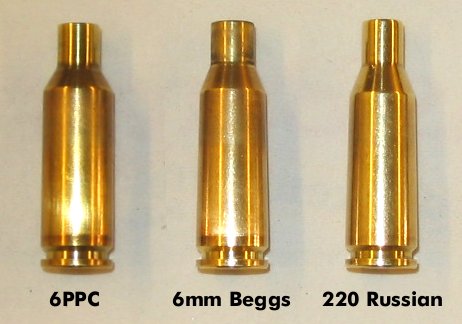
The 6mm Beggs cartridge is basically a 220 Russian necked up to 6mm, with a very small modification of the radius at the neck-shoulder junction. (Gene Beggs added a tighter radius to reduce case lengthening on repeated firings.) The 6mm Beggs, and its smaller cousin, the 220 Beggs, have slightly less capacity than a fire-formed PPC case. However, in a good BR gun, the “raw accuracy” of the Beggs’ cartridges can rival that of a 6 PPC. Indeed a standard, unmodified 220 Russian is competitive in the 100/200 yard BR game. Lou Murdica, a top shooter on the short-range BR circuit, has won many matches with a “plain-jane” unmodified 220 Russian.

July 8th, 2008
At our request, 2008 IBS 600-yard National Champion Samuel Hall has prepared a 9-minute VIDEO showing his techniques for shooting from the bench. Sam covers a number of topics including bag set-up, body position, bolt manipulation, and loading skills. He also explains the importance of having a relaxed, comfortable posture and keeping your head in the same position shot to shot.
CLICK HERE to watch SAM HALL VIDEO

If you’re serious about accurate benchrest shooting, at ANY distance, you should watch this video. Sam’s tips can really help you. We guarantee it. While the video itself is grainy and wind noise affects the audio, you can still glean many great points from the video. From minute 8:00 on Sam shoots a 5-shot string on camera with his BAT-actioned, Leonard-stocked 6BR. Though he was fighting blustery, 20-mph winds Sam achieves a half-inch group at 200 yards. Quarter-MOA in such conditions is good shooting.
July 5th, 2008
If you want to test your long-range shooting skills against some of the best shooters in the country (including our own Jason Baney), head to Pennsylvania next weekend for the Williamsport World Open. Shooters will compete in Light Gun and Heavy Gun classes for a host of prizes including scopes, actions, and barrels. Sponsors include Nightforce Scopes, BAT Machine, and Bartlein, Hart, and Krieger barrel-makers, among many others. In addition, the Original Pennsylvania 1000-Yard Club will give $1000.00 CASH to anyone breaking the match time current Light Class or Heavy Class Ten-Shot Benchrest World Record during this event. (Award limited to person shooting smallest group of the weekend.)

The schedule of events will be: Saturday Morning – Light Gun Match One; Saturday Afternoon – Heavy Gun Match One; Sunday Morning – Heavy Gun Match Two; Sunday Afternoon – Light Gun Match Two. Complete Event info, including Course of Fire, Rules, and a list of nearby motels, is found on the World Open Webpage, or contact Matt Dienes, 724-479-0790.
CLICK HERE for World Open APPLICATION
The deadline for entry to the World Open at 7:00 pm Friday night. Rotations will be drawn at this time so please get your entry fees in before that time. NO LATE ENTRIES will be accepted on Match Day. The cost is $60.00 per Class for the two day event ($120 for both Classes both days). The Pig roast held Saturday evening is included in this fee.


June 29th, 2008
The 2008 IBS 600-yard Nationals concluded Saturday at Oak Ridge, TN. Many of the nation’s top shooters were there, including multiple world record-holders. Sam Hall was the big winner at the match. He took the Two-Gun Grand Agg, while winning Heavy Gun (HG) group Agg., HG score Agg., and Light Gun (LG) Score Agg. As Greg Seigmund said, Sam “tore the place down.” Glen Sterling shot well to finish second in the Two-Gun Grand. Richard Schatz compiled an impressive 2.242″ average to win Light Gun Group Aggregate. Richard’s Dasher really performed — three of his eight LG targets were mid-inch: 1.395″, 1.473″, and 1.736″. Joel Kendrick shot the small LG group of the match, an 0.984″, but Sam Hall wasn’t far behind, with a 1.089″ on his third target.
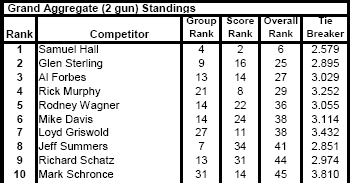
CLICK HERE for Complete Match Results (438kb .pdf file). Equipment lists are found on pp. 9-11.
Hammerin’ Hall Talks About the Nationals
After the match, Sam gave us the details of his impressive win: “First off, I would like to thank Larry Sparks, Dave Tooley, Greg Seigmund, Larry Isenhour, Steve Shelp and everyone else that helped out to put on the match. They all did a great job. It was run very well and smoothly. Everyone I talked to said they had a really great time. I really enjoyed meeting all the guys from other states I had heard about and read about. Everyone I talked to was humble and top-notch.”
Q: How did it feel to win the Championship?
Sam: It is just starting to sink in that I won after I have got home. But, I still can’t believe I won. As they say, I was floating around on cloud nine after the win. It really meant the most to me when I got home and got to show and tell my two young boys and my wife what I had done.

Q: What were the conditions like?
Sam: We started with Light Gun each day. Every morning was pretty calm, but by mid-morning the mirage and breezes started. They were very switchy at times. We also had some pretty severe thunderstorms on the first two afternoons that “ate some peoples’ lunch”.
Q: Tell us about your equipment.
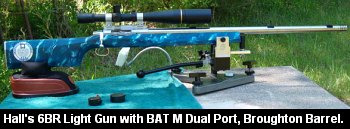
Sam: Both my Light Gun (LG) and Heavy Gun (HG) are straight 6BRs, with .268 necks. In LG I shot my Blue/White Shehane-stocked ST-1000 with 103 Spencer VLDs. The blue gun, smithed by BAT’s Tom Dixon, features a BAT M dual port, Broughton Barrel (1800 rounds), and Leupold 45X Competition scope. (Note: the equipment list is incorrect, I did not shot my Leonard-stocked gun in LG). In HG I shot another Shehane ST-1000 (orange/ white) but with Berger 105 VLDs. The orange rifle (smithed by Leonard Baity) weighs 28 lbs. (lots of lead in the stock). It has a Lilja 31″ straight-fluted barrel (800 rounds), BAT MB dual port, March 50x scope.
Q: What loads were you running?
Sam: I have been shooting the same loads in these two rifles for two years: Alliant Reloder 15, CCI BR-4 primers, Lapua brass, with 103 Spencers in my LG and 105 Berger VLDs in my HG. Both are barely in the rifling so my bolt is easy to close and I won’t pull a bullet out if I have to eject a live round (which I did have to do). My LG brass is the original 100 with about 18 reloadings. My bolt lift was getting a little sticky at the top in the middle of the day, so I put ice packs around my ammo in the heat of the day to keep pressure down. I certainly don’t recommend this to anyone! I just know this load and its limits.
Q: What was the key to victory for you?
Sam: I had the mindset when I went into the match that I was going to actually take more time shooting, remember my fundamentals, follow through each shot, and be as careful I could shooting. I figured if I did not get in a hurry, and thought through each shot, I was more likely not to have a big group that would kill me. Richard Schatz said the same thing at the end of the match. Richard tells people you don’t have to shoot little bitty groups at the Nationals to win, you just can’t shoot any really big ones.
Q: What are your plans for the rest of the season?
Sam: As far as anything new, I am actually thinking of an improved BR next year for the wind. Hoping I can get the velocity at a lower pressure. I might put these two barrels in semi-retirement and try to get another couple of barrels going. If I can’t get anything shooting better than my old barrels, I will put them back on when the stakes get high again. These two rifles and loads are like old gloves, I am used to them and trust them. They can sit unused for weeks, but when I pull them out, they perform as well as before.
The DQ Problem
Many top shooters experienced DQs during the match. In some cases the DQs were wind-related. However, a number of shooters DQ’d by shooting a record round on the sighter target which remained in place during record fire. After the match many shooters asked “Why don’t they just take down the sighter targets when record fire commences?” That would eliminate this potential problem. Alternatively, a large orange sticker could be placed over the sighter center, warning shooters not to fire at that target. In short-range benchrest, in the case of certain errant shots, there is a rule providing a 1-MOA penalty rather than a DQ. That’s worth considering for the 600-yard game.
June 11th, 2008
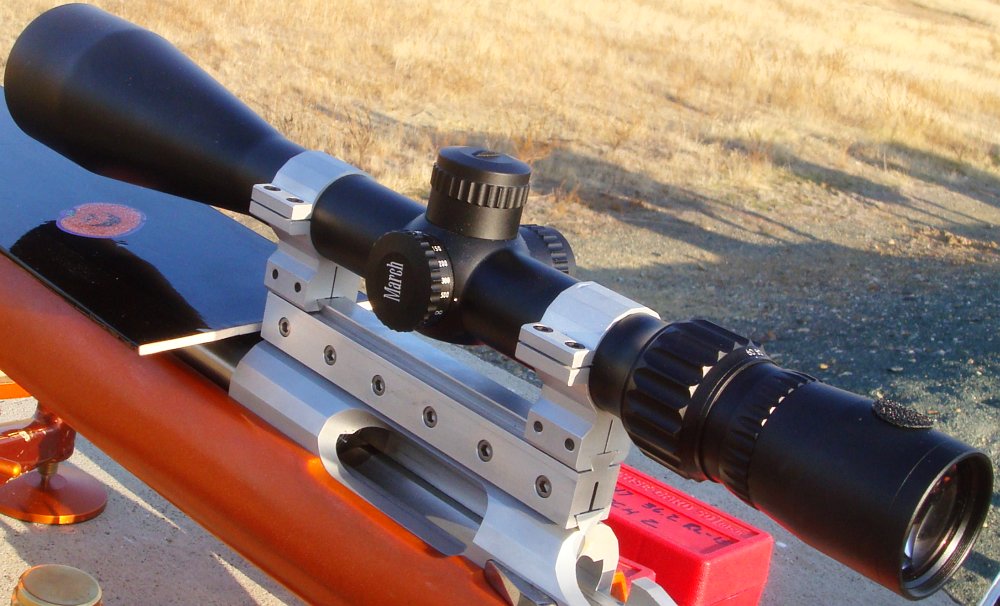
Right now the March line of scopes represent the “state of the art” in high-magnification Benchrest scopes. They are unexcelled for brightness, sharpness, and perhaps most importantly, shot-to-shot reliability. Many top short-range benchrest shooters, who can’t tolerate even a tiny shift in the scope’s reticle moving the point of impact a few hundreths of an inch, are using the March 40X, 50X, and 60X, and now the new 10-60X Zoom.
CLICK HERE for complete MARCH SPECIFICATIONS


March scopes are made in Japan by DEON. In the USA they are sold exclusively by Kelbly’s. Jim Kelbly reports: “Some 40s and 50s are in stock now. The 10-60X zooms will be in stock in about two months unless the back order list gets longer as it is everyday. If you want a March scope you should not wait till they are in stock. We have a waiting list and you should get on it if you would like one in next two months.”
Current March Scope pricing:
40×52, 50×52, and 60×52 fixed focal length: $2100.00
10-60×52 Zoom: $2400.00


May 25th, 2008
For racing fans, Memorial Day weekend means the Indy 500 at the Brickyard. The equivalent of the Indy 500 for precision Benchrest shooters is Kelbly’s Firearms Industry Super Shoot at the Kelbly’s range in North Lawrence, Ohio. Despite high gas prices, 330+ shooters made the pilgrimage to North Lawrence to compete in the most prestigious event in Benchrest shooting.

Topping an incredibly competitive field, Larry Costa won the Two-Gun Overall championship. Larry did extremely well in both rifle classes, finishing second in BOTH Light Varmint Grand (100 +200) and Heavy Varmint Grands. Congrats to Larry for his outstanding shooting. We’ve been told that Larry brings pre-measured, weighed charges (and then loads his rounds at the match), but we’re still waiting for confirmation. Jeff Summers, displaying great consistency, combined 4th in the LV Grand and 4th in HV Grand, to place Second Overall in the Two-Gun behind Costa. Andy Shiffle finished third in the Two-Gun, matching his placing in the HV Grand. We were pleased to see George Kelbly, “Founding Father” of the Super Shoot, take second in the LV 100.
Overall Two-Gun Standings
1 – Larry Costa
2 – Jeff Summers
3 – Andy Shifflett
4 – Gene Bukys
5 – Lou Murdica
6 – Billy Stevens
7 – Jeff Stover
8 – Bart Sauter
9 – Tony Boyer
10 – Joe Krupa |
11 – Joe Hynes
12 – Stan Bowerman
13 – Mike Rattigan
14 – Charles Huckeba
15 – Bill Goad
16 – Milt Craven
17 – Howie Levy
18 – Danny Sutphin
19 – Jack Lyons
20 – Kent Harshman |
LV 100 – Top 3
1 – Lowell Hottenstein
2 – George Kelbly
3 – George Carter |
LV 200 – Top 3
1 – Gene Bukys
2 – Larry Costa
3 – Mike Rattigan |
LV Grand – Top 5
1 – Gene Bukys
2 – Larry Costa
3 – George Carter
4 – Jeff Summers
5 – Bill Goad |
HV 100 – Top 3
1 – Tony Boyer
2 – Bart Sauter
3 – Bud Mundy |
HV 200 – Top 3
1 – Andy Shifflett
2 – Jeff Summers
3 – Larry Costa |
HV Grand – Top 5
1 – Tony Boyer
2 – Larry Costa
3 – Andy Shifflett
4 – Jeff Summers
5 – Bart Sauter |
|