Based on the questions we get on a daily basis on our 800 (Customer Support) line, twist is one of the most misunderstood subjects in the gun field. So let’s look deeper into this mystery and get a better understanding of what twist really means.
When you see the term 1:14″ (1-14) or 1:9″ twist, just exactly what does this mean? A rifle having a 1:14″ twist means the bullet will rotate one complete revolution every fourteen inches of the barrel. Naturally a 1:9″ turns one time every nine inches that it travels down the barrel. Now, here’s something that some people have trouble with. I’ve had calls from shooters thinking that a 1:14″ twist was faster than a 1:9″ because the number was higher with the 1:14″. The easiest way to remember this is the higher the number, the slower the twist rate is.
Now, the biggest misconception is that if a shooter has a .223 with a 1:8″ twist, his rifle won’t stabilize a 55gr bullet or anything lighter. So let’s look at what is required. The longer a bullet is for its diameter, the faster the twist has to be to stabilize it. In the case of the .223 with a 1:8″ twist, this was designed to stabilize 80gr bullets in this diameter. In truth the opposite is true. A 1:8″ will spin a 55gr faster than what is required in order to stabilize that length of bullet. If you have a bullet with good concentricity in its jacket, over-spinning it will not [normally] hurt its accuracy potential. [Editor’s Note: In addition, the faster twist rate will not, normally, decrease velocity significantly. That’s been confirmed by testing done by Bryan Litz’s Applied Ballistics Labs. There may be some minor speed loss.]
Many barrel-makers mark the twist rate and bore dimensions on their barrel blanks.
Think of it like tires on your truck. If you have a new set of tires put on your truck, and they balance them proper at the tire shop, you can drive down a street in town at 35 MPH and they spin perfect. You can get out on the highway and drive 65 MPH and they still spin perfect. A bullet acts the same way.
Once I loaded some 35gr HP bullets in a 22-250 Ackley with a 1:8″ twist. After putting three shots down range, the average velocity was 4584 FPS with an RPM level of 412,560. The group measured .750″ at 100 yards. This is a clear example that it is hard to over-stabilize a good bullet.
Twist-rate illustration by Erik Dahlberg courtesy FireArmsID.com. Krieger barrel photo courtesy GS Arizona.
A hot new 6mm match bullet has arrived — the impressive Berger 109-grain Hybrid. This new 109-grainer, officially called the Long Range Hybrid Target (LRHT), features a formed meplat (bullet tip) for more consistent Ballistic Coefficient (BC). Berger tells us that the new 109gr LRHT boasts a high-BC, “jump-tolerant” hybrid ogive profile along with an extremely consistent BC. In fact, Doppler Radar testing confirms less than 1% BC variation from bullet to bullet. While a high BC is of course desirable for competitive shooting, shot-to-shot BC consistency is most critical when engaging targets to 600 yards and beyond. The 109’s BC numbers are very impressive for a 6mm bullet: 0.568 G1 and 0.292 G7.
AccurateShooter.com plans to test these new 109s very soon — we’re getting them into the hands of some championship-level shooters. The new 109s should prove very popular. These bullets are optimized for leading accuracy cartridges such as 6mm Creedmoor, 6mmBR, 6BRA, 6mm Dasher, 6BRX, 6GT, 6XC, and 6×47 Lapua among others. NOTE: Berger states that the new 109gr LRHT offers the same stability factor as Berger’s outstanding 105gr Hybrid Target. Accordingly, the new 109 can be considered a “direct replacement” for the 105s. And YES, the 109gr LRHT will work in 1:8″-twist barrels.
“The 6mm 109 offers several advantages,” said Bryan Litz, Berger’s Chief Ballistician. “Its ultra-sleek profile provides a higher Ballistic Coefficient (BC) resulting in less wind drift at all ranges. Using the proprietary MRT technology also results in a higher and more consistent BC, which is important for reducing dispersion at long range.”
Meplat Reduction Technology for More Consistent BCs
Berger’s new 6mm 109-grain Long Range Hybrid Target™ Bullets is designed to provide Benchrest, F-Class, and PRS enthusiasts a class-leading level of precision and consistency. Utilizing advanced/proprietary manufacturing processes, Berger’s Meplat Reduction Technology™ (MRT™) System applies controlled pressure along the projectile nose, producing a homogeneous and repeatable bullet profile. This yields what Berger claims are “the industry’s most consistent Ballistic Coefficients (BC)”.
The Berger 6mm 109 Grain Long Range Hybrid Target™ Bullets will be available very soon at authorized Berger Retailers. Use the Berger Dealer Locator to find a store near you.
Wind effects are complex. In trying to access wind speeds and angles, you’ll want to watch multiple indicators — mirage, dust, wind-flags, grass movement, and more. You’ll also need to be concerned about wind cycles. In the video below, Bryan Litz talks about variable wind speed along a bullet’s flight path. A respected ballistics guru, Bryan is the founder of Applied Ballistics and a designer of Berger’s Hybrid Match projectiles. He is also a past F-TR National Champion and a High Master Palma ace.
In this video, Bryan discusses how wind effects can vary in intensity at different points along the bullet’s flight path to the target. Sometimes the firing line is sheltered, and the strongest winds come into effect in the middle of the trajectory. Bryan concludes: “Wind matters everywhere … but the best thing you can do is try to get a handle on the wind [velocity and angle] where you are. That may or may not represent the wind down-range — that’s when you have to look downrange and make a judgment[.]”
Litz Competition Tip: Select your wind shooting strategy carefully. For beginners and veterans, most points are typically lost to wind. Successful shooters put a lot of thought into their approach to wind shooting. Sometimes it’s best to shoot fast and minimize the changes you’ll have to navigate. Other times it’s best to wait out a condition which may take several minutes. Develop a comfortable rest position so you have an easier time waiting when you should be waiting.
More Wind Tips from Wind Wizard Emil Praslick
In these two short videos, Emil Praslick III, former coach of the USAMU and USA National long range teams, explains how to find the wind direction and how to confirm your no-wind zero. Praslick is widely considered to be one of the best wind coaches in the USA.
When Winds Are EXTREME — Near Gale Force at Ben Avery
This video shows INSANE winds at NBRSA 100/200 Benchrest Nationals. This was filmed at the Ben Avery Range in Phoenix, AZ during the recent NBRSA 100/200 yard National Championships. Extreme to say the least. Based on what we’re seeing here, there are 20-25 mph crosswinds, with gusts to 35 mph — near Gale Force. Video by Hall-of-Fame Benchrest competitor Gene Bukys.
Texas gunsmith Mike Bryant reports: “This video shows the Unlimited Class 200 at the Nationals in Phoenix. I had three 10-shot groups in the low 2″ range with a 2.228″ being my big group and was glad they weren’t bigger. Thursday and Friday were the worst of the windy days. Unfortunately those were the days for the UL 200 and it was about as windy through most all of the Sporter 200.”
Excellent Wind Reading Resource
The Wind Book for Rifle Shooters covers techniques and tactics used by expert wind-readers. The authors provide a wind-reading “toolbox” for calculating wind speed, direction, deflection and drift. They explain how to read flags and mirage, record and interpret your observations, and time your shots to compensate for wind. Here are two reviews:
This is a must-have book if you are a long-range sport shooter. I compete in F-Class Open and when read it from cover to cover, it helped me understand wind reading and making accurate scope corrections. Buy this book, read it, put into practice what it tells you, you will not be disappointed. — P. Janzso
If you have one book for wind reading, this should be it. It covers how to get wind speed/direction from flags, mirage, and natural phenomenon. This is the best book for learning to read wind speed and direction. — Muddler
Every year at SHOT Show in January, bullet-makers showcase their latest and greatest projectiles for hunters and paper-punchers. we plan to get the “inside scoop” on new bullet designs from Berger, Hornady, Lapua, Nosler and Sierra.
A while back, at SHOT Show 2012 we chatted with Berger Ballistician Bryan Litz about Berger’s popular line of Hybrid bullets. Berger now offers a wide range of Hybrids in multiple calibers and weights. In fact, for .30-Caliber shooters, Berger now offers many seven (7) Hybrid match bullets, with weights from 155 grains up to 230 grains. Two .338-caliber OTM Tactical Hybrids were introduced in 2012 (a 250-grainer and a 300-grainer).
Bryan tells us: “The hybrid design is Berger’s solution to the age old problem of precision vs. ease of use. This design is making life easier for handloaders as well as providing opportunities for commercial ammo loaders who need to offer a high performance round that also shoots precisely in many rifles with various chamber/throat configurations.”
For those not familiar with Hybrid bullets, the Hybrid design blends two common bullet nose shapes on the front section of the bullet (from the tip to the start of the bearing surface). Most of the curved section of the bullet has a Secant (VLD-style) ogive for low drag. This then blends in a Tangent-style ogive curve further back, where the bullet first contacts the rifling. The Tangent section makes seating depth less critical to accuracy, so the Hybrid bullet can shoot well through a range of seating depths, even though it has a very high Ballistic Coefficient (BC).
In the video we asked Bryan for recommended seating depths for 7mm and .30-Caliber Hybrid bullets. Bryan advises that, as a starting point, Hybrid bullets be seated .015″ (fifteen thousandths) off the lands in most barrels. Watch the video for more tips how to optimize your loads with Hybrid bullets.
Over the past 12 months, this article was one of the TOP TEN most-read Daily Bulletin features. We’re reprising it today for those who may have missed it the first time. The above diagram comes from a TiborasurasRex YouTube Video comparing G1 and G7 BC models. CLICK HERE to watch the video.
The better, up-to-date ballistics programs let you select either G1 or G7 Ballistic Coefficient (BC) values when calculating a trajectory. The ballistic coefficient (BC) of a body is a measure of its ability to overcome air resistance in flight. You’ve probably seen that G7 values are numerically lower than G1 values for the same bullet (typically). But that doesn’t mean you should select a G1 value simply because it is higher.
Some readers are not quite sure about the difference between G1 and G7 models. One forum member wrote us: “I went on the JBM Ballistics website to use the web-based Trajectory Calculator and when I got to the part that gives you a choice to choose between G1 and G7 BC, I was stumped. What determines how, or which one to use?”
The simple answer is the G1 value normally works better for shorter flat-based bullets, while the G7 value should work better for longer, boat-tailed bullets.
G1 vs. G7 Ballistic Coefficients — Which Is Right for You?
G1 and G7 refer both refer to aerodynamic drag models based on particular “standard projectile” shapes. The G1 shape looks like a flat-based bullet. The G7 shape is quite different, and better approximates the geometry of a modern long-range bullet. So, when choosing your drag model, G1 is preferrable for flat-based bullets, while G7 is ordinarily a “better fit” for longer, boat-tailed bullets.
Drag Models — G7 is better than G1 for Long-Range Bullets
Many ballistics programs still offer only the default G1 drag model. Bryan Litz, author of Applied Ballistics for Long Range Shooting, believes the G7 standard is preferrable for long-range, low-drag bullets: “Part of the reason there is so much ‘slop’ in advertised BCs is because they’re referenced to the G1 standard which is very speed sensitive. The G7 standard is more appropriate for long range bullets. Here’s the results of my testing on two low-drag, long-range boat-tail bullets, so you can see how the G1 and G7 Ballistic coefficients compare:
G1 BCs, averaged between 1500 fps and 3000 fps:
Berger 180 VLD: 0.659 lb/in²
JLK 180: 0.645 lb/in²
The reason the BC for the JLK is less is mostly because the meplat was significantly larger on the particular lot that I tested (0.075″ vs 0.059″; see attached drawings).
For bullets like these, it’s much better to use the G7 standard. The following BCs are referenced to the G7 standard, and are constant for all speeds.
Many modern ballistics programs, including the free online JBM Ballistics Program, are able to use BCs referenced to G7 standards. When available, these BCs are more appropriate for long range bullets, according to Bryan.
[Editor’s NOTE: BCs are normally reported simply as an 0.XXX number. The lb/in² tag applies to all BCs, but is commonly left off for simplicity.]
What’s it feel like to hit a 2158-yard target (from cold bore), and set a world record in the process? Well watch the video below to find out. Last week we reported that shooter Randy Wise set a new ELR Central world record, going three-for-three (from cold bore) at 2158 yards. The feat took place at the recent NRA ELR Championship at Camp Atterbury, Indiana. And he did that with a factory Savage action and barrel!
We first reported on Randy’s ELR record last week in the Bulletin. Now we have more photos, and most importantly, a video. You can now watch Randy Wise make his three hits in a row, starting with Cold Bore shot, at 2158 yards. The video was captured by Clay Rhoden of TargetVision/Longshot Target Cameras.
Watch Randy Wise Make ELR World-Record Three Straight Hits at 2158 Yards:
Watch the full sequence above (sorry there is no sound). Note that there were previously some hit marks on the 36″ x 36″ steel target. Ignore those. Steve’s first hit is at the bottom right — barely above the edge of the plate. At 0:42 you see the bright light flash indicating a hit. The second shot impacts in the top right — see the light flash at 1:09. The third and final hit impacts about 6″ up from the bottom, at 1:24. When the flashing light confirms Hit #3, Randy shows his emotion, pumping his fists with excitement.
Remarkably, Randy set the new ELR record using a stock Savage action and Savage factory barrel chambered for the .338 Lapua Magnum cartridge. The Savage barreled action was mounted in an Accurate Rifles Systems chassis with Rempel bipod. Randy’s rifle had a factory stock 26″ 1:9″-twist barrel chambered in .338 Lapua Magnum. His load featured Lapua .338 LM brass, Berger 300gr Hybrid bullets, Federal 215M primers, and a stout charge of Hodgdon Retumbo powder. Ballistics solution by Applied Ballistics LLC. For optics, Randy used a Vortex 15-60x52mm Golden Eagle.
ELR World Record Standards
One video viewer asked why this was a world record, when longer shots have been made in K02M competition. Here’s the answer from Applied Ballistics: “To be an ELR World Record it has to be done cold bore, and three for three. No sighters, no practice, no walking the shots on, no accuracy by volume. Also neither the shooter or rifle can have been fired in the past 24 hours, to ensure it’s truly cold bore. It’s a test of skill and knowledge of your system.” Skill indeed. 2158 Yards is 1.226 MILES. At that distance, Randy shot a group measuring roughly 1.3 MOA vertical and half-minute horizontal.
For his efforts, Randy received glory, and a nice $1000-dollar check from McMillan Fiberglass stocks. Here Randy poses with his check, flanked by Bryan Litz (left) and Kelly McMillan (right). The match was officiated by Clay Rhoden. Doc Beech of Applied Ballistics was the certifying official.
The folks at Applied Ballistics have a new toy — a large trailer filled with all the latest and greatest tech gear for testing long-range ballistics. Bryan Litz reported: “The maiden voyage for the AB Mobile Lab in Texas this week was a huge success! We look forward to supporting more long range shooting events.” Mitchell Fitzpatrick was there in the Lone Star state with fellow Applied Ballistics staffer Christopher Palka. The Applied Ballistics team will be trailering the Mobile Lab to Indiana where it will be on hand for the NRA National Championships at Camp Atterbury this month.
Ten rifles, heaps of cables, huge Doppler Radar unit, military-grade Laser RFs on tripods, spare barrels, safety gear — all ready for action in Texas.
About the Applied Ballistics Mobile Lab
Q: What is the basic purpose of the Applied Ballistics Mobile Lab?
Mitchell Fitzpatrick: The Mobile Lab allows us to effectively carry out ballistics testing in the field and at events. It has most of the capabilities of our normal lab, but on wheels.
Q: What hardware and electronics are carried in the Mobile Lab? What are its capabilities?
Bryan Litz: The Mobile Lab will transport most everything that’s in the main lab including the Doppler radar. This rig is new and we haven’t fully outfitted it yet. The load-outs will be somewhat flexible depending on the venue we are supporting.
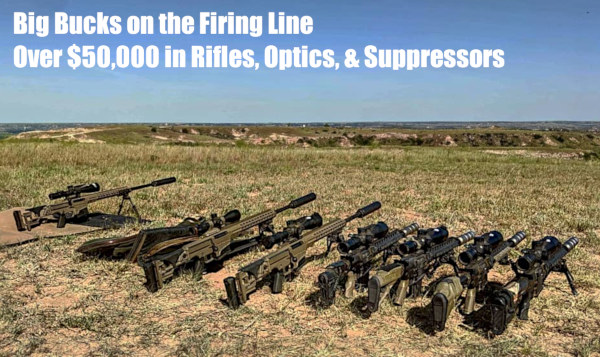
The three rifles on the left are Barrett MRADS, $6000-$6154 MSRP, before optics.
NOTE to Readers — Check back at the end of the day. We will have more technical information from Bryan Litz and the Applied Ballistics team…
The .375 EnABELR cartridge was developed to offer magazine feeding capabilities with the highest-BC solid bullets available. Applied Ballistics observes: “The best magazine is one that retains the cartridge shoulder and doesn’t allow the tip of the bullet to impact the front of the magazine during recoil.” Cadex Defense has designed magazines that fit Cadex’s bottom metal and chassis for the EnABELR line of cartridges which allows for maximum magazine fed performance. These mags are beautifully made, but they will be very EXPENSIVE. Expect to pay about $275 per magazine — what the Cadex 375/408 CheyTac magazine currently costs (Product Code: MAG4300, USD $273.95).
Q: Is this different than Cadex’s regular CheyTac magazine?
A: Mitchell Fitzpatrick of Applied Ballistics Weapons Division replied: “Yes, the ribs that retain the shoulder are moved back to hold the case back and prevent the bullet tip from hitting the front of the magazine. We had been playing with inserts welded into place, which worked great, but dedicated mags directly from Cadex was the ultimate goal.”
Here is Mitchell Fitzpatrick, shooting the .375 EnABELR in an ELR Competition.
“CADEX and Applied Ballistics. Two companies taking ELR seriously and trying to get that last 1-2% of performance out of the system. Keep up the good work!” — Mark N.
The .375 EnABELR Cartridge — Big and Fast
The .375 EnABELR cartridge is slightly shorter than a .375 CheyTac so it allows the round to mag-feed. Applied Ballistics is currently using brass made by Peterson. The .375 EnABELR has achieved impressive velocities — 2990 FPS — with prototype Berger 379-grain solid bullets fired from a 1:7″-twist 30″ barrel. Applied Ballistics may also test 1:8″-twist and 1:9″-twist barrels. READ Bullet Testing Report.
The .375 EnABELR cartridge was designed to offer .375 CheyTac performance in a slightly shorter package: “The problem with the .375 CheyTac is that, when loaded with the highest performance .375 caliber bullets (379-407 gr Berger Solids, and the 400-425 grain Cutting Edge Lazers) the round is not magazine feed-able in any action that’s sized for CheyTac cartridges.
“Knowing the .375 CheyTac produced substantial performance, and that it was just too long for magazine feeding, made it easy to converge on a design for the .375 EnABELR. We just had to make the case short enough to achieve magazine length with the desired bullets, while adding a little more diameter to keep the case capacity similar to the .375 CheyTac. The resulting basic shape is quite similar in proportions to the successful .338 Norma Magnum Cartridge which, interestingly, was selected as the cartridge for General Dynamics Lightweight Medium Machine Gun (LWMMG).”
Berger Twist-Rate Stability Calculator
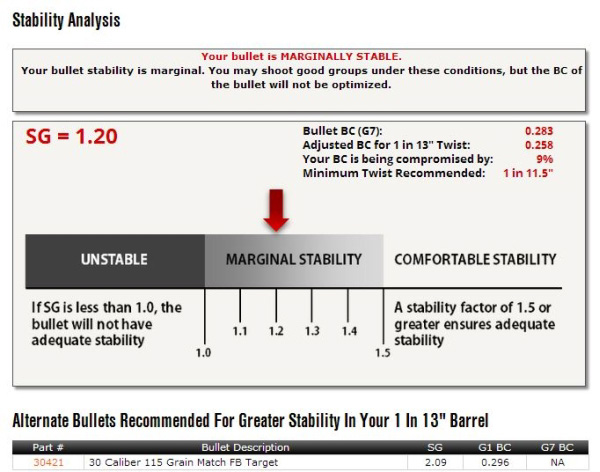
On the Berger Bullets website you’ll find a handy Twist-Rate Stability Calculator that predicts your gyroscopic stability factor (SG) based on mulitiple variables: velocity, bullet length, bullet weight, barrel twist rate, ambient temperature, and altitude. This cool tool tells you if your chosen bullet will really stabilize in your barrel.
How to Use Berger’s Twist Rate Calculator
Using the Twist Rate Calculator is simple. Just enter the bullet DIAMETER (e.g. .264), bullet WEIGHT (in grains), and bullet overall LENGTH (in inches). On its website, Berger conveniently provides this info for all its bullet types. For other brands, we suggest you weigh three examples of your chosen bullet, and also measure the length on three samples. Then use the average weight and length of the three. To calculate bullet stability, simply enter your bullet data (along with observed Muzzle Velocity, outside Temperature, and Altitude) and click “Calculate SG”. Try different twist rate numbers (and recalculate) until you get an SG value of 1.4 (or higher).
Gyroscopic Stability (SG) and Twist Rate
Berger’s Twist Rate Calculator provides a predicted stability value called “SG” (for “Gyroscopic Stability”). This indicates the Gyroscopic Stability applied to the bullet by spin. This number is derived from the basic equation: SG = (rigidity of the spinning mass)/(overturning aerodynamic torque).
If you have an SG under 1.0, your bullet is predicted not to stabilize. If you have between 1.0 and 1.1 SG, your bullet may or may not stabilize. If you have an SG greater than 1.1, your bullet should stabilize under optimal conditions, but stabilization might not be adequate when temperature, altitude, or other variables are less-than-optimal. That’s why Berger normally recommends at least 1.5 SG to get out of the “Marginal Stability” zone.
In his book Applied Ballistics For Long-Range Shooting, Bryan Litz (Berger Ballistician) recommends at least a 1.4 SG rating when selecting a barrel twist for a particular bullet. This gives you a safety margin for shooting under various conditions, such as higher or lower altitudes or temperatures.
Story idea from EdLongrange. We welcome reader submissions.
Hail the King — Paul Phillips wears crown as the new 2019 King of Two Miles.
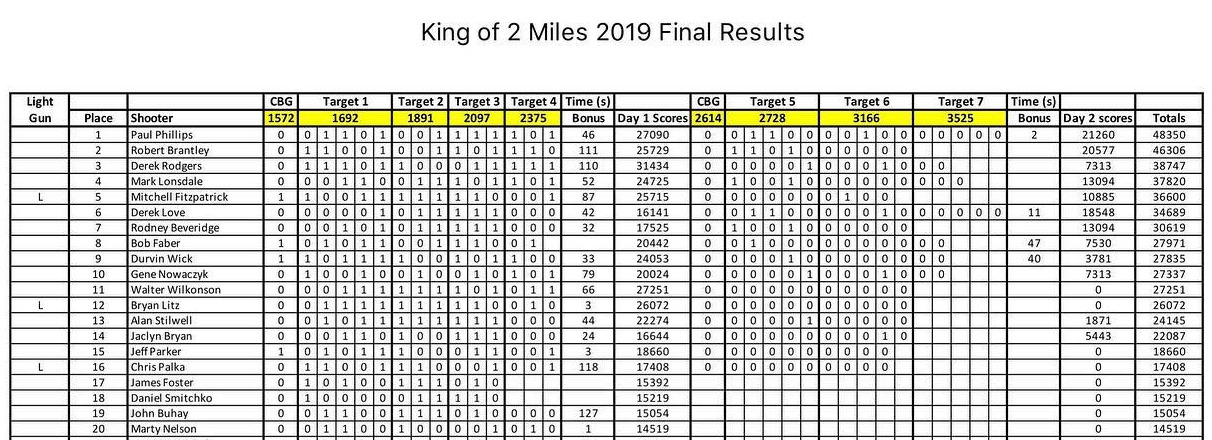
Paul Phillips, Captain of Team Global Precision Group (GPG), is the 2019 King of 2 Miles. Hail the new King! Paul won the event with a score of 48350, beating runner-up Robert Brantley who scored 46306. Fellow GPG shooter and 2017 K02M winner Derek Rodgers finished third with 38747. Phillips secured his K02M crown with good shooting in Raton, NM on both Day 1 and Day 2. On the final day, Paul had two hits at 2728 yards and one at 3166 yards. No competitor scored more than one hit at 3166 yards (1.799 miles), and no competitor scored even a single hit at the farthest target, placed at 3525 yards (2.0028 miles). So the actual 2-Mile target was never hit during the event.
Here are the target locations and yardages for K02M Day 2 Finals.
Team GPG members Derek Rodgers, Paul Phillips (center), and Mark Lonsdale with KO2M-winning rifle, K02M Trophy, $5000 Winner’s Prize from McMillan, and Nightforce Certificate.
Team Global Precision Dominates with Three of Top Four Places
Team Global Precision Group was top team overall with Paul Phillips in First Place, Derek Rodgers in Third, and Mark Lonsdale in Fourth. Team GPG, in its first world-level match together, dominated the field of 80 of the best ELR shooters in the world. First, Third, and Fourth — that’s mighty impressive gentlemen!
2019 KO2M Top 20 Results. Click on the table to see full-screen version:
Paul Phillips, who recently competed in the European K02M match in France, gave credit to his sponsors and team-mates: “Team GPG is honored to be … King of 2 Mile Champions. I’ve always wondered what it would feel like to be carried around on the King chair. I am humbled to be added to the list of great shooters that have been crowned before me.”
Paul added: “Big shout-out to all our sponsors, the match organizers, Eduardo, FCSA, and the volunteers who work so hard to make these ELR matches a major success. We’ll definitely be back in 2020!”
“Paul Phillips your win in this match is yet another example of the value of hard work paying off. I can honestly say that I don’t know anyone who works harder at ELR competition and promotion than you do. You deserve this win!” — Bryan Litz, Applied Ballistics
Equipment List for .416 Barrett 2019 KO2M-Winning Rifle
Paul’s massive KO2M rig features a BAT EX .50-Cal action with a 38″ Bartlein 1:9″-twist 5R barrel chambered for the standard .416 Barrett cartridge. The stock is a McMillan Beast One model. To tame recoil, Paul runs a T5 Terminator muzzle brake. The scope is a Nightforce 7-35x56mm ATACR F1 with MOAR Reticle. Up front is a Phoenix Precision Bipod, with an Edgewood Mini-Gator Bag in the rear. Paul is running a Bix’N Andy Comp Trigger with a 4-ounce, single-stage pull.
The complete rifle weighs 40 pounds. Bartlein did the .416 Barrett chambering using a Dave Manson reamer. Alex Sitman bedded the action in the McMillan stock as he did for the other GPG rifles. In fact, all three Team GPG rifles are essentially identical.
Load Details: Standard .416 Barrett cartridge, running .416 Caliber 550gr solid Cutting Edge Bullets at 3000 fps. The powder is Vihtavuori 20N29 ignited by RWS .50 Caliber primers. The cartridge brass is Barrett brand, produced by RUAG.
Support Gear: Ballistics are calculated with Applied Ballistics Software using velocity data from a LabRadar chronograph. Swarovski provided Team GPG with two big BTX 95 binocular spotting scopes. Phillips says “these BTX 95s really help us follow trace, spot impacts, and get on target quickly.”
Here are Team Applied Ballistics competitors at the 2019 KO2M event in Raton, NM. Applied Ballistics’ Mitchell Fitzpatrick posted: “[There were] some unique challenges this year, but I managed to finish in 5th place running a sub-25 pound rifle. That’s the result of a lot of our ESSO research.”
$5000 KO2M Winner’s Prize from McMillan Fiberglass Stocks
McMillan Fiberglass Stocks is a strong supporter of the shooting sports. Here Kelly McMillan presents Paul Phillips with a $5,000 check from McMillan Fiberglass Stocks for winning the 2019 King of 2 Mile while shooting a McMillan stock. Teammates Derek Rodgers and Mark Lonsdale also used McMillan stocks in the 2019 K02M Finals. Along with the McMillan check, Paul Phillips received $5000 from Nightforce Optics, and $1200 from Cutting Edge Bullets. Paul told us he will divide all the winnings with his team-mates because: “I won with my team — we won together.”


 The better, up-to-date ballistics programs let you select either G1 or G7 Ballistic Coefficient (BC) values when calculating a trajectory. The ballistic coefficient (BC) of a body is a measure of its ability to overcome air resistance in flight. You’ve probably seen that G7 values are numerically lower than G1 values for the same bullet (typically). But that doesn’t mean you should select a G1 value simply because it is higher.
 Drag Models — G7 is better than G1 for Long-Range Bullets




 The
The