There’s a new effort underway to support the Michigan Junior Shooters. The fund-raising campaign hopes to raise $500.00 by Christmas time. Bryan Litz is helping with the effort, donating $4.00 from the purchase price of copies of his book, Applied Ballistics for Long Range Shooting.
Bryan explains: “Funds raised in this campaign will be used to support all disciplines of rifle shooting for Michigan juniors including High Power, Long Range, and Smallbore. Funds will be used to offset costs of team T-shirts, entry fees, travel, housing, and so on. Basically, we are hoping to defray the expenses of competing at a higher level — costs which juniors often cannot cover on their own. I’ll be updating the ‘thermometer’ image as we approach our goal of $500.” Visit the Michigan Rifle and Pistol Association – Juniors WebLog to learn about the juniors’ participation in recent competitions.
The $4 donation per book applies for books sold directly from the Applied Ballistics website. Ordering direct is also the only way to order ‘autographed’ copies of the book.
Bryan adds: “Please consider this as a gift option for a fellow shooter, and to help support young people involved in the shooting sports.”
One of the most prestigious rifle competitions in the world is underway right now at the Belmont Shooting Facility, near Brisbane, Australia. Many of the best sling and irons marksmen (and women) in the world are competing for individual and team honors. American aces such as SGT Sherri Gallagher, Noma Mayo, Trudie Fay, Nancy Tompkins, Bob Gamboa, Bryan Litz, Robert Mead, and John Whidden are representing the Red, White, and Blue down-under, but they and their American teammates are facing stiff opposition from the Brits, South Africans, Canadians, New Zealanders, and the host Australians.
One of the best performances so far was turned in by Bryan Litz, Berger Bullets’ Ballistician. In the Senior Australia Team match last week, Bryan outshot every other individual on the course, nailing a perfect 200-26V to tie the Championship Record. This was a brilliant display of marksmanship by Bryan. At the Awards Ceremony after the match, Bryan received a long standing ovation from his fellow competitors.
You’ll find lots of match photos in the official match Photo Gallery. Plus, Facebook users can access hundreds of photos uploaded by members of the USA Young Eagles Team. Young American shooters have been performing well. Russ Theurer reports: “Team USA Red won the Under 25 Australia Team Match, while Team USA Blue came from behind at 1000 to place third. Young Eagle Joshua Lehn was high score shooter of the team match of all teams combined.” Below are photos of the Young Eagles from Day 5, the Under 25 match:
by Robert Whitley
I recently received some of the new Berger 6mm 105gr Hybrid Match Bullets for testing. There is much interest in these new 6mm Hybrids, so I thought I’d share my initial observations. A couple of things are very striking about these new bullets:
1. They appear to be very long, sleek and aerodynamic, while they still maintain a good bearing surface length (full-diameter shank). I like bullets with a sufficient bearing surface length because I find that it makes for bullets that are easier to shoot and tune. I also feel a good bearing surface length makes for a bullet that has a better potential for consistent performance over bullets with a short bearing surface.
2. The published ballistic coefficient (BC) numbers on these bullets are quite high. They have a stated G1 BC of .547 and a G7 BC of .278. Looking at the bullets themselves it’s easy to see why these BC numbers are so high. The front end of the projectile is quite long and similar to what you see on long-range VLDs, but the transition to the bearing surface has a blended appearance (the Hybrid part) vs. the sharp transition you typically see with most VLDs and secant ogive bullets. The 105gr Hybrid bullets also have a long boat-tail.
3. The new Berger 105gr Hybrid bullets measure right around 1.261″ OAL. By comparison, the many other 105gr to 108gr bullets I’ve measured all seem to run in the range of 1.210″ to 1.225″ OAL. The Berger 105gr Hybrid bullets are thus a fair bit longer than the others, which is why a true 1:8″ or faster twist is recommended for them. The bearing surface diameter of the new Hybrids was dead on at 0.243″. So these bullets are neither “fat” nor “skinny”.
4. The tips on these bullets are quite uniform, with the meplats closed up nicely. The Hybrids have nice small tips similar those on the Berger 108s (reasonably tight in diameter). While I sometimes like to point my match bullets, I like to shoot bullets that are ready to go “out of the box”, and these are just that. I’m hoping they will perform very well without meplat trimming or pointing.
Berger’s 6mm 105gr Hybrids Slated to Go on Sale in Late October
Berger has done its own in-house testing on these bullets and found them to be accurate and appropriate for release for additional testing by shooters out in the field. Unless this additional field testing reveals something that no one anticipated (which I doubt), I suspect these new projectiles will be one of Berger’s most popular bullet offerings. The planned official release date for the new 6mm, 105gr Hybrids has been tentatively set for mid- to late-October of 2011. So, barring some last minute changes, these 105s should be on dealers’ shelves before Thanksgiving.
September 11-17, the Bald Eagles Rifle Club hosted the 2011 Spirit Of America rifle match, at the NRA Whittington Center in Raton, NM. This match serves as U.S. National Fullbore Championships, but there are also F-Class divisions. The match consists of conventional sling (TR) class, as well as F-Open and F-TR, and the event is shot at distances of 300, 500, 600, 800, 900 and 1000 yards. Approximately 80 shooters, including about 20 F-classer attended the event.
Bryan Litz won the Fullbore TR (sling) competition with a 1782-105X overall score, with runner-up Andrew Wilde (1780-101X), just two points behind. Sean Morris finished third with 1776-85X, and Jim O’Connell shot 1772-81X to claim the High Senior title.
Photo by Randy Pike
In F-Open Class, familiar names topped the leaderboard. Larry Bartholome earned his chair ride as F-Open winner, shooting an impressive 1776-98X. Second in F-Open, five points back at 1771-96X, was past F-Class National Champion Danny Biggs. In the F-TR division, Michael Smith topped the field with a 1738-69X, followed by John Killen, who shot a 1720-52X. NOTE: F-Open and F-TR competitors shoot a target with smaller-diameter scoring rings than the Fullbore Target.
Conditions Were Mild… Then Wild
Bryan Litz tells us the conditions weren’t so bad … until the final day: “We dodged some rain throughout the week, but wind conditions were easy to moderate for the most part. That is until the last 1000-yard string of the last day when Raton finally showed its evil side! The most wind I had used all week was just over 3 MOA. That last relay on Saturday, it was running between 7 and 12 MOA with very quick changes. There were many misses, and just keeping all shots in the black was an accomplishment.” Rick Hunt concurred that the conditions were arduous on the final 1K stage: “At 1000 yards, there was a 9:00 o’clock wind running between 9 1/2 and 13 1/2 MOA. As seen by the scores, two shooters really nailed it. Other than that, it was pretty disastrous for most shooters with the really fast velocity changes.”
When the smoke had cleared, the standings were all jumbled up compared to what they were the rest of the week. Litz added: “An experience like that really drives home the importance of wind shooting skills. To be honest, I had no particular strategy going in other than to stay calm and positive no matter what. A big part of shooting in adverse conditions is managing yourself mentally. I dropped 10 points that last relay, more than I’d lost in the entire tournament up to that point. But given the conditions, I felt good about it, knowing I’d done my best.”
Berger 155gr Hybrids Work Well in Fullbore Competition
Bryan Litz credits his 155gr Berger .308-cal Hybrids for his strong performance: “I was shooting the new Berger 155 grain Hybrid bullets which played a part in saving some points in that nasty wind (on the last day). Due to their length, these bullets require a 1:12″ twist to stabilize and have a higher BC than any other .30 caliber 155 grain bullet. The hybrid ogive makes them length tolerant (insensitive to seating depth) and as the results of this tournament show, they are very effective”.
Complete Final Scores On SOA Blog
You’ll find complete interim and final SOA Match Scores linked from the Bald Eagles Match Blog.
At the match the USA Young Eagles unveiled the new uniforms the American team will wear at the World Fullbore Championships in Australia next month. On opposite sleeves, the uniforms feature logos from both major bullet sponsors — Berger and Sierra. Bryan Litz observerd: “Historically teams have been sponsored by ‘one or the other’, but there’s no reason a team can’t enjoy sponsorship by multiple brands, and this is a very positive step in that direction.”
Eric Stecker of Berger Bullets just revealed some details on Berger’s new 6mm 105gr Hybrid bullet. This projectile is now in the final stage of testing. Here are comparative ballistics for the new 6mm Hybrid vs. Berger’s popular 105gr VLD bullet:
6mm 105 gr Hybrid Target
Original 6mm 105 gr VLD (Now is Berger’s hunting version)
Averaged G1 BC = 0.547 G7 BC = 0.278
Averaged G1 BC = 0.532 G7 BC = 0.272
Longer Bullet Requires 1:8″ Twist
The new 105gr Hybrid Target is slightly longer than the original 105-grainer so a true 1:8″ is strongly recommended. The new bullet is made with the thicker Target jacket to withstand match shooting conditions. The Hybrid ogive is designed to be less sensitive to seating depth and has been working well in other calibers and sizes. This bullet can take all the 6mm cases can dish out and it has a BC equal to our own 6mm 115 gr VLD.
Eric Stecker tells us: “The moment we knew that we had to modify the 6mm 105gr VLD Target with a larger meplat, the need for this bullet was born. We’ve been working on it ever since. Bryan Litz has done an exceptional job with this design. I am very eager to see how they do in many rifles since I regard the 105gr class of bullets as key in Berger’s line. Between the 68gr, the 80gr and the 105gr (among other weights) we have been especially blessed with our 6mm offerings.” Eric is quite right — all those bullets shoot exceptionally well and the 105gr VLD holds many records. If the new 105gr Hybrid can come close to the accuracy of the 105gr VLD, it should be very successful.
Ultra-Long-Range Shooting by Bryan Litz
We recently did some extended long range shooting with several rifles at a “secret range” where we could shoot out to one mile. I teamed up with Paul Philips, a highly successful National and International F-TR shooter with several National records. We started out shooting a Sako TRG-42 at 1200 yards. This is the same rifle I shot in Wyoming last year at distances out to 2400 yards. This rifle shoots the new Berger 300gr Hybrids, at 2700 fps. We were pleased to find that the Nightforce NXS 5.5-22x56mm scope has plenty of elevation to get to 1200 yards with this bullet, especially when mounted on a Near Mfg. +45 MOA rail. The drop from a 100-yard zero to 1200 yards was predicted to be 34.75 MOA. The size of that 5-shot group was nothing to brag about (1.5 MOA), but what I found satisfying is that the group center was exactly centered for vertical on the target. That means the calculated .418 G7 BC and all of the other variables that went into this trajectory prediction were spot on.
New .30-Cal Tactical Bullets
Next, we shot the LaRue 7.62 OBR rifle at 1200 yards. This rifle produced a 5-shot group of 9.7″ (.85 MOA) with off-the-shelf Applied Ballistics Tactical ammo loaded with .30-cal 175gr Berger Tactical bullets. These bullets only have a muzzle velocity of 2572 fps from this short barrel, which means that in our conditions they were subsonic past 1000 yards, running 1080 fps at 1200 yard. Going subsonic didn’t prevent the 175gr bullets from shooting a sub-MOA group.
However, I was a little disappointed that the group center was 9″ high (0.8 MOA) compared to the predicted trajectory (657″ drop from a 100-yard zero). Note this 9″ error in predicted drop could be produced by small variances. The 9″ shift could be explained by a 14 fps error in muzzle velocity, or a 2% error in bullet BC, or a 5-yard error in range measurement.
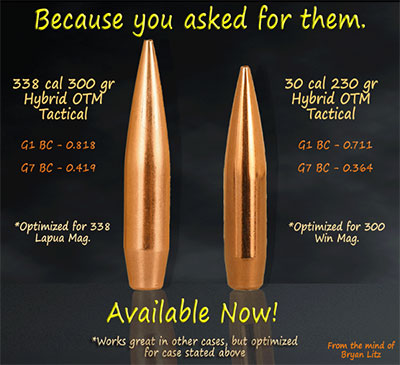
For our final test, I shot Berger’s newest Tactical bullet; the .30-caliber 230gr OTM projectile. This bullet has a tested G7 BC of .368, and a G1 BC of .719. Now this isn’t my most accurate rifle and I haven’t had an opportunity to really work up a good load. As a result, I shot an unimpressive 20″ group (1.8 MOA). But the predicted drop was only off by 2″ (less than 1 click) based on the BC’s listed above.
Shooting .338 Lapua Magnums at One Mile
After shooting at 1200, we lobbed some bullets on an 8’x8′ target at 1760 yards (1 mile). At this range, the TRG-42 put the 300gr Bergers on target with four of five shots in 1/2 MOA with a flyer to make the total group 21″. At this range my group center was 18.5″ (1.1 MOA) higher than predicted. Paul Philips* shot his custom .338 Lapua Magnum rifle. This is a Dave Tooley-built Tac-338 with 30″ Brux barrel, Stiller action, McMillan A-5 stock, and Nightforce NXS 12-42×56. Paul shot at the same target and was able to hold between 1/2 and 1 MOA groups with the same 300gr Berger Hybrid bullets. Paul’s group centers were also about 1 MOA higher than predicted. This small error in prediction isn’t very troubling though, as we’re not entirely confident in the range measurement. As 1760 yards (one mile) is too far for a direct laser rangefinder measurement, the distance was determined with a combination of GPS and Google maps. At that distance, a range error of just 15 yards (out of 1760) could cause the percieved 1 MOA error in predicted drop. So, if the target were really at 1745 yards, instead of 1760 yards, it would explain why we were hitting 1 MOA high. Alternatively, if BC error were the reason for hitting high, it would suggest the G7 BC for the .338-cal 300gr Berger Hybrid is .427, as opposed to the currently advertised .418; a 2% difference.
The Joy of Ultra-Long-Range Shooting
For me, the thrill of shooting these extreme long ranges isn’t just about the group sizes, but the accuracy with which the trajectory can be predicted. The shooter who understands ballistics and inputs the right variables should be able to center a 1.5 MOA group well past 1000 yards. He can be more effective, on targets at extreme ranges, than someone who can shoot an 0.5 MOA group but can’t keep it centered. Of course the most impressive of all is the shooter who can combine precision with accuracy and center the 0.5 MOA group at extreme distances!
Bryan Litz, Ballistician for Berger Bullets and author of Applied Ballistics for Long Range Shooting, has tested the latest version of the Shooter Ballistics Calculator for Android™ OS Smartphones and portable devices. This is a very sophisticated, full featured App that incorporates the latest bullet databases with Litz G7 BCs as well as a wealth of other information. It provides extremely reliable ballistics solutions at all ranges, and in all atmospheric conditions.
Bryan tells us: “The Shooter App has been improving steadily since it was first released and there are many new capabilities now. One of the cool new features is a wireless Bluetooth link to Kestrel Weather Trackers. This can automatically provide the exact atmospherics at your location.”
Bryan used the Shooter App on a trip to Wyoming: “I shot a Sako TRG42 in .338 Lapua Mag to 2400 yards with Berger’s new 300gr hybrids. The dope from the Shooter App was spot on up to 103 MOA of drop using the G7 BC of .419 for that bullet! At 2400 yards, even at 6,000 ft+ elevation, the bullet is subsonic but remained stable and tracked perfectly with the predicted trajectory from Shooter. I don’t know if the same bullet would be stable at sea level when fired at that range or not but it worked well at 6,500 feet.”
Litz Says Shooter App Offers Very Sophisticated Ballistics Solutions
Bryan thinks the Shooter App is extremely accurate: “I consulted on the solver development for Shooter so I can personally vouch for the accuracy of this program. You can set up profiles for rifles and ammo types including calibration factors for scope adjustments, temperature affects on powder burn rate / muzzle velocity, and of course G1 and G7 referenced BCs (you can define a ‘stepped’ BC for both as well). You can set preferences for units, atmospherics, station pressure or altitude, and more. It can calculate spin drift and Coriolis effect, or those features can be disabled. If your smartphone has GPS, the program can automatically populate the latitude for Coriolis calculations.”
Shooter App is just $9.99 — A Bargain Given Its Capabilities
The full-featured Shooter App sells for $9.99 in the Android Apps Marketplace. Visit the Shooter App Website to preview the program’s functions and see how the entry screens work. The App is easy to install and run. There is a also a ‘Lite’ version of SHOOTER that you can download for free.
Bryan Litz, author of Applied Ballistics for Long Range Shooting, is releasing a Second Edition of his highly respected treatise on Ballistics. The new book is complete, and Bryan Litz is currently taking orders through his AppliedBallisticsLLC.com website. Bryan plans to start shipping Second Editions on April 18, 2011. The Applied Ballistics (2d. Edition) book and CD, as a package, sell for $49.95 plus shipping.
New Edition is Bigger and Better
Along with all the impressive content from the original book, the Second Edition of Applied Ballistics contains more chapters, more pages, more test-derived bullet data, plus the updated Version 2.0 of the Point Mass Ballistics Solver software (on CD). The Second Edition is even physically bigger — Bryan has bumped up the size to a larger, easier-to-read 7″ x 10″ format. In the bigger book you’ll find two completely new chapters, plus updates of existing chapters. The Second Edition contains new experimental test data on 61 additional bullets, and bullet data pages now include complete stability data. Bryan has also included ballistic performance analysis for both long range hunting and long range target shooting.
A Gold-Mine of Information
If you’ve seen a copy of the First Edition, you’ll know that Bryan has assembled the “mother lode” of ballistics information, much of which is hard to find anywhere else. Heck, just getting Bryan’s field-test-derived bullet data may be worth the “price of admission” for many shooters. While the book goes into many advanced aspects of ballistics, this is not a graduate-level treatise. Bryan successfully created a book that can benefit any serious shooter, not just math wizards or college professors. Here are some of the many topics covered by Applied Ballistics (2d. Edition):
The Ballistic Coefficient
G1 vs. G7 BC Models
Bullet Shapes (Tangent vs. Secant)
Gravity Drop
Uphill/Downhill Shooting
Wind Deflection
Temperature/Pressure Effects
Monolithic Bullets (NEW)
Gyroscopic (Spin) Drift
The Coriolis Effect
Using Ballistics Programs
Getting Control of Sights
Bullet Stability
Extended Long Range Shooting
CD Provides Significantly Enhanced Software With each copy of Applied Ballistics For Long Range Shooting (2d. Ed.), Bryan includes a CD containing Version 2.0 of the Point Mass Ballistics Solver. Combined with experimentally-measured BCs, this program can deliver extremely accurate trajectories and even calculate spin drift. In response to user requests, this 2.0 software update provides valuable new capabilities. First, now you can output trajectories in inches, centimeters, MOA or MILS. Take your pick — whichever you prefer. Second, the new software now provides bullet kinetic energy at all ranges. Last but not least, you can now easily print out your ballistics as a text file.
DEALER ORDERS: If you are interested in becoming a dealer, please email bryan.litz [at] appliedballisticsllc.com for information on bulk-order discounts.
Disclosure: Applied Ballistics LLC Advertises with AccurateShooter.com.
Applied Balllistics LLC, run by Bryan Litz, has just released new .308 Winchester Tactical Ammunition. This new ammo employs a brand-new 175gr “Tactical OTM” bullet from Berger Bullets. This new projectile is unique in that it was designed to “fly right” even at transonic and subsonic speeds. The new 175gr bullets are loaded to magazine length (2.800″) in new Lapua brass, so the ammo will fit all popular detachable box magazines in tactical bolt guns and gas guns. Bryan recommends a 1:13″ (or faster) twist barrel.
New Tactical Ammo Has Individually-Weighed Charges and Low ES
Unlike most “factory ammo”, Bryan’s new Tactical Ammo features individually weighed charges. That’s right — the charge for each and every round is weighed before it goes in the case. As a result, the new ammo typically delivers Muzzle Velocity (MV) Standard Deviation (SD) under 10 FPS (for 10 shots). That’s a low number, on a par with quality handloads. Bryan has shot this ammo at 1000 yards through a LaRue OBR AR10-type rifle. The ammo shot under one MOA at 1000 yards. Another benefit of the weighed charges is that this allows the use of high-quality extruded (stick) powders. The stick powders are known to deliver great accuracy while being consistent through a wide temperature range.
Berger’s NEW .30 Caliber 175gr Tactical OTM Bullet
This bullet was designed by Berger Ballistician Bryan Litz specifically to optimize performance of the M118LR class of ammunition. The design objectives were to maximize BC while staying within the 2.800” COAL for magazine feeding, and the requirement for the bullet to remain stable through transonic speeds. All of these design objectives were achieved, according to Bryan. The bullet has a length-tolerant tangent ogive shape, so it is less sensitive to seating depth than secant-ogive bullets.
The BC of this bullet is 7% higher than the 175 grain Sierra MatchKing currently used in most M118LR ammunition, and 2% higher than the Hornady 178 grain option. The average G1 BC of the Berger 175gr Tactical bullet is 0.510 from 3000 to 1500 fps. The G7 BC is 0.259, and is a more accurate representation of this bullets performance over a wide range of speeds. (CLICK HERE to read about G1 vs. G7 BC.)
The Berger 175gr Tactical OTM bullet requires a minimum twist rate of 1:13″ to be stable from the muzzle. Transonic stability was verified from a 20″-barreled LaRue OBR with a 1:11.25″ twist.
Early Tests Show Bullet Shoots Great — Report by Robert Whitley
Robert Whitley got a box of early-run 175gr Tactical bullets. He says they shoot great in his own handloads: “I just received some of the new Berger .30 cal 175gr Tactical OTM (Open Tip Match) bullets. Wow — what great bullets for the .308 Winchester! I did some range testing and these things really shoot! As you can see below, I had a 5-shot group around 0.2″ and, then, shooting prone, I produced a 20-shot group that just tore out the X-Ring.” (NOTE: these targets were shot with Robert’s handloads, not the Applied Ballistics pre-loaded ammo.)
While the words “Open Tip Match” might lead one to believe it has a large open tip, this BTHP bullet actually has a small meplat. Robert suspects that, for this bullet’s potential tactical and military applications, it was felt the words “hollow point” should be avoided in favor of “open tip”.
Bullets Are Positioned Optimally When Loaded at 2.800″ Mag Length
These bullets were also made to be loaded at magazine feeding length in the .308 Winchester (2.800″ OAL). Robert reports: “When loaded at a 2.800″ OAL length, the bullets sit perfectly in the neck of the .308 Winchester, with the full bearing surface of the bullet up in the neck of the case, and the junction of the boat tail and bearing surface of the bullet just forward of the junction of the neck and shoulder of the case.”
If you are going to shoot these bullets and expect them to be supersonic the whole way, a 1:13″ or faster twist is recommended, and if you are going to run them at velocities where they might be subsonic/transonic, Bryan confirmed they’ll work in 1:11.25″ twist barrels. Robert notes that his company, AR-X Enterprises, carries 1:11.25″ twist Bartlein .30 Cal barrels as a regularly-stocked item in both the M24/M40/Rem Tactical contour and the Remington Heavy Varmint/Sendero contour.
Whitley concludes “This is a great offering by Berger Bullets”. While the bullets can be purchased through Berger or Berger’s dealers, the new Applied Ballistics’ loaded ammo should be ordered through Bryan’s website. The price is $40 (plus shipping) for 20 rounds.
CLICK HERE to order through the Applied Ballistics secure shopping cart.
Disclosure: Applied Ballistics LLC advertises Bryan Litz’s Ballisitics Book on this site.
In discussions of ballistics, you’ll see references to “tangent” and “secant” bullet shapes. We know that, for many readers, these terms can be confusing. To add to the confusion, bullet makers don’t always identify their projectiles as secant or tangent designs. This article provides a basic explanation of tangent and secant designs, to help you understand the characteristics of both bullet shapes.
Tangent Ogive vs. Secant Ogive vs. Hybrid
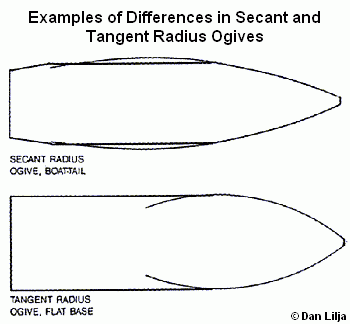
Most match bullets produced today use a tangent ogive profile, but the modern VLD-style bullets employ a secant profile. To further complicate matters, the latest generation of “Hybrid” projectiles from Berger Bullets feature a blended secant + tangent profile to combine the best qualities of both nose shapes. The secant section provides reduced drag, while the tangent section makes the bullet easier to tune, i.e. less sensitive to seating depth position.
Berger Bullets ballistician Bryan Litz explains tangent and secant bullet ogive designs in a glossary section of his Applied Ballistics website, which we reprint below. Bryan then explains how tangent and secant profiles can be combined in a “hybrid” design.
How Bullet Ogive Curves are Defined
While the term “ogive” is often used to describe the particular point on the bullet where the curve reaches full bullet diameter, in fact the “ogive” properly refers to the entire curve of the bullet from the tip to the full-diameter straight section — the shank. Understanding then, that the ogive is a curve, how is that curve described?
LITZ: The ogive of a bullet is usually characterized by the length of its radius. This radius is often given in calibers instead of inches. For example, an 8 ogive 6mm bullet has an ogive that is a segment of a circular arc with a radius of 8*.243 = 1.952”. A .30-caliber bullet with an 8 ogive will be proportionally the same as the 8 ogive 6mm bullet, but the actual radius will be 2.464” for the .30 caliber bullet.
For a given nose length, if an ogive is perfectly tangent, it will have a very specific radius. Any radius longer than that will cause the ogive to be secant. Secant ogives can range from very mild (short radius) to very aggressive (long radius). The drag of a secant ogive is minimized when its radius is twice as long as a tangent ogive radius. In other words, if a tangent ogive has an 8 caliber radius, then the longest practical secant ogive radius is 16 calibers long for a given nose length.”
Secant Ogive vs. Tangent Ogive
Ogive metrics, and Rt/R
LITZ: There is a number that’s used to quantify how secant an ogive is. The metric is known as the Rt/R ratio and it’s the ratio of the tangent ogive radius to the actual ogive radius for a given bullet. In the above example, the 16 caliber ogive would have an Rt/R ratio of 0.5. The number 0.5 is therefore the lowest practical value for the Rt/R ratio, and represents the minimum drag ogive for a given length. An ogive that’s perfectly tangent will have an Rt/R ratio of 1.0. Most ogives are in between an Rt/R of 1.0 and 0.5. The dimensioned drawings at the end of my Applied Ballistics book provide the bullets ogive radius in calibers, as well as the Rt/R ratio. In short, the Rt/R ratio is simply a measure of how secant an ogive is. 1.0 is not secant at all, 0.5 is as secant as it gets.
Hybrid Bullet Design — Best of Both Worlds?
Bryan Litz has been developing a number of modern “Hybrid” design bullets for Berger. The objective of Bryan’s design work has been to achieve a very low drag design that is also “not finicky”. Normal (non-hybrid) secant designs, such as the Berger 105gr VLD, deliver very impressive BC values, but the bullets can be sensitive to seating depth. Montana’s Tom Mousel has set world records with the Berger 105gr VLD in his 6mm Dasher, but he tells us “seating depth is critical to the best accuracy”. Tom says a change of .005″ in seating depth “can cause the group size to increase substantially”. In an effort to produce more forgiving high-BC bullets, Bryan Litz has developed a hybrid tangent/secant bullet shape. This is explained in the illustration below.


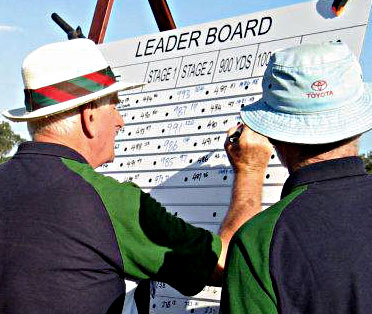 One of the best performances so far was turned in by Bryan Litz, Berger Bullets’ Ballistician. In the Senior Australia Team match last week, Bryan outshot every other individual on the course, nailing a perfect 200-26V to tie the Championship Record. This was a brilliant display of marksmanship by Bryan. At the Awards Ceremony after the match, Bryan received a long standing ovation from his fellow competitors.



 Longer Bullet Requires 1:8″ Twist
 New .30-Cal Tactical Bullets

 Bryan tells us: “The

 Bryan Litz, author of
  New Edition is Bigger and Better
 With each copy of Applied Ballistics For Long Range Shooting (2d. Ed.), Bryan includes a CD containing Version 2.0 of the Point Mass Ballistics Solver. Combined with experimentally-measured BCs, this program can deliver extremely accurate trajectories and even calculate spin drift. In response to user requests, this 2.0 software update provides valuable new capabilities. First, now you can output trajectories in inches, centimeters, MOA or MILS. Take your pick — whichever you prefer. Second, the new software now provides bullet kinetic energy at all ranges. Last but not least, you can now easily print out your ballistics as a text file.