Utah Monument photo by DOI. Inset graphic from Ammoland.com, DOI source.
U.S. Secretary of the Interior Ryan Zinke has announced the newly-appointed members of the Hunting and Shooting Sports Conservation Council (HSSCC). The Council, established on January 9, 2018, is intended to provide the Secretary of the Interior and the Secretary of Agriculture with advice regarding the establishment and implementation of existing and proposed policies and authorities with regard to wildlife and habitat conservation. The Advisory Council will meet at least twice a year.
The Council will also examine ways to benefit wildlife resources; encourage partnership among the public, the sporting conservation organizations, state, tribal, territorial, and federal government; and benefit recreational hunting and recreational shooting sports.
“We have assembled here some of the best conservationists in America,” Secretary Zinke said. “Over a century ago, Teddy Roosevelt established the American conservation ethic — best science, best practices, greatest good, longest term. These sportsmen carry on the American conservation ethic in the modern day. Bringing these experts together will be key to ensuring the American tradition of hunting and shooting, as well as the conservation benefits of these practices, carries on.”
Secretary Ryan Zinke (left) believes we can learn important conservation lessons from President Theodore Roosevelt (right), an avid hunter.
“America’s hunters and recreational shooters have a champion in Secretary Ryan Zinke,” said Chris W. Cox, executive director of the NRA’s Institute for Legislative Action. “Zinke is fighting for our sportsmen and women to have greater access to our public lands. I am pleased to work with the Trump Administration’s new Hunting and Shooting Sports Conservation Council to make it easier for Americans to enjoy our public lands.”
“Comprised of national leaders throughout the hunting and recreational shooting communities, the HSSCC is widely regarded as one of the most effective and productive federal advisory committees across the federal government,” said Lawrence Keane, NSSF Senior V.P. and General Counsel.
“What an exciting time for our hunting and shooting sports! This Shooting Sports Council is yet another way Secretary Zinke and staff is making the expansion of our great American heritage a priority,” said Smith & Wesson Pro Shooter Julie Golob.
“President Trump and Sec Zinke continue to make major positive structural changes to America’s land and wildlife conservation systems,” said Sportsmen for Fish and Wildlife Founder Don Peay. “This new Council, made up of the most accomplished hunter/conservationists in North America, will assist in revitalizing conservation of our nation’s natural treasures for generations!”
“I am very pleased and honored to be appointed to this Council by Secretary Zinke,” said Rocky Mountain Elk Foundation Chief Conservation Officer Blake Henning. “I look forward to representing the interests of big game and big game hunters as this Council does important work.”
“I am honored to be asked by Secretary Zinke to serve on the federal advisory council,” said Bob Model, Chairman of the Boone and Crockett Club. “Sportsmen and women are vital stakeholders in federal land management.”
Members of the Hunting and Shooting Sports Conservation Council are listed below
MEMBER NAME
ORGANIZATION
Mike Budzik
Retired Chief of the Ohio Department of Natural Resources
Chris Cox
Executive Director of the NRA’s Institute for Legislative Action (NRA-ILA)
Jeff Crane
President of Congressional Sportsmen’s Foundation (CSF)
John Devney
Vice President of U.S. Policy for Delta Waterfowl
Dan Forester
Vice President and Chief Conservation Officer, Archery Trade Association
Ward “Trig” French
Chairman of the Hunter’s Leadership Forum
Julie Golob
World and National Shooting Champion, Team Smith & Wesson
John Green
CEO of Crossroads Strategies and Board Member of the Congressional Sportsmen’s Foundation
Dale Hall
CEO of Ducks Unlimited and former Director of the USFWS
Blake Henning
Chief Conservation Officer for the Rocky Mountain Elk Foundation
Graham Hill
Principal and Founding Partner, Ice Miller Strategies LLC. NRA Board of Directors member
Larry Keane
Senior V.P. for Governmental and Public Affairs, Asst. Sec. and General Counsel for National Shooting Sports Foundation (NSSF); General Counsel, Sporting Arms and Ammunition Manufacturers Institutes (SAAMI)
Bob Model
Former President of the Boone & Crockett Club; President/CEO of Mule Deer Foundation; previous Deputy Director of Utah’s Div. of Wildlife Resources
Collin O’Mara
President and CEO of the National Wildlife Federation
Donald Peay
Founder and Former CEO of Sportsmen for Fish and Wildlife (SFW)
Eva Shockey
Co-Host of Jim Shockey’s Hunting Adventures on Outdoor Channel
David Spady
President of the Liberty and Property Rights Coalition
Report based on Press Release from U.S. Department of Interior
Continuing his efforts to increase access to public lands, U.S. Secretary of the Interior Ryan Zinke has proposed opening more than 248,000 acres to new or expanded hunting and fishing opportunities at 30 National Wildlife Refuges.
Opportunities include places like Hackmatack National Wildlife Refuge in Illinois and Wisconsin, and deer hunting in Philadelphia at John Heinz National Wildlife Refuge being proposed for the first time. The proposal also outlines expanded hunting and fishing opportunities at 136 national wildlife refuges. If finalized, this would bring the number of units of the National Wildlife Refuge System where the public may hunt to 377, and the number where fishing would be permitted to 312.
“As stewards of our public lands, Interior is committed to opening access wherever possible for hunting and fishing so that more families have the opportunity to pass down this American heritage,” Zinke said. “These 30 refuges will provide incredible opportunities for American sportsmen and women across the country to access the land and connect with wildlife.”
The U.S. Fish and Wildlife Service’s (USFWS) proposal would open more new acres to hunting and fishing than in the past and takes steps to simplify regulations to more closely match state hunting and fishing regulations. The changes would be implemented in time for the upcoming 2018-2019 hunting seasons.
Hunting, fishing and other outdoor activities contributed more than $156 billion in economic activity in communities across the United States in 2016 according to the USFWS’s National Survey of Fishing, Hunting and Wildlife-Associated Recreation, published every five years. More than 101 million Americans pursue wildlife-related recreation — such as hunting, fishing and birding. The Refuge System is an unparalleled network of 566 national wildlife refuges and 38 wetland management districts. There is a national wildlife refuge within an hour’s drive of most major metropolitan areas.
“Ensuring public lands are open for multiple uses supports local economies and provides important opportunities for recreation. Further, this proposal means that families and individuals across our nation will be better able to participate in our nation’s tradition of hunting and fishing. We appreciate Secretary Zinke and the Interior Department for advancing this priority, and we will continue to work to improve access to public lands for our sportsmen,” said Senator John Hoeven.
“Hunters, anglers and shooting sports enthusiasts play a crucial role in funding the management and conservation of North America’s wildlife,” said USFWS Principal Deputy Director Greg Sheehan. “We are providing sportsmen and women with more access to our national wildlife refuges and streamlining regulations to more closely align with our state partners. And that’s good news for our customers.”
Here’s a simple procedure that lets you get a solid zero for a hunting rifle in just four shots. Of course you probably want to fire a few more rounds to confirm your zero before you head off to your hunting grounds, but this will let you get on-target with a minimum amount of time and ammo expended. (This assumes your scope is securely mounted, and the bases are not drastically out of alignment.)
QUICK-TIP: The Key to this procedure is Dialing to Shot One Point of Impact (POI). Re-aim at center of target after SHOT ONE. Then with the rifle motionless, use the turrets to put the middle of the cross-hair on the first shot location.
1. First, remove the bolt and boresight the rifle. Adjust the position of the rifle so that, looking through the bore, you can see the center of the target with your eyes. Secure the rifle in the rests to maintain its position as boresighted. Then, without moving the rifle, center the reticle. That should get you on paper. With the rifle solidly secured in front and rear rests or sandbags, aim at the center of a target placed at your zeroing distance (50 or 100 yards). Confirm there are no obstructions in the barrel! Then load and fire SHOT ONE. Then, return the gun to the exact position it was when you pulled the trigger, with the cross-hair centered on the target as before.
2. Locate, in the scope, where your first bullet landed on the target. Now, while you grip the rifle firmly so it doesn’t move, have a friend adjust the turrets on your scope. While you look through the scope, have your friend turn the windage and elevation turrets until the cross-hairs, as viewed through the scope, bisect the first bullet hole on the target. In other words, use the turrets to move the center of the reticle to the actual position of shot number one. IMPORTANT: Dial the crosshairs to the hole — don’t move the rifle.
3. After you’ve adjusted the turrets, now re-aim the rifle so the cross-hairs are, once again, positioned on the target center. Keep the rifle firmly supported by your rest or sandbag. Take the SECOND SHOT. You should find that the bullet now strikes in the center of the target.
4. Take a THIRD SHOT with the cross-hairs aligned in the center of the target to confirm your zero. Make minor modifications to the windage and elevation as necessary.
5. Finally, shoot the rifle from a field rest (shooting sticks, bipod, or rucksack) as you would use when actually hunting. Confirm, with SHOT FOUR, that your zero is unchanged. You may need to make slight adjustments. Some rifles, particularly those with flexy fore-arms, exhibit a different POI (point of impact) when fired from a bipod or ruck vs. a sandbag rest.
If you recently cleaned your rifle, you may want to fire two or three fouling shots before you start this procedure. But keep in mind that you want to duplicate the typical cold bore conditions that you’ll experience during the hunt. If you set your zero after three fouling shots, then make sure the bore is in a similar condition when you actually go out hunting.
Kirstie Pike of Próis Hunting Apparel for Women created Mossberg’s wild game cookbook. Kirstie walks you through everything you need to know with 10 easy-to-follow recipes that even non-expert guy cooks can handle. Kirstie is not only passionate about her hunting, but also her cooking, “There is nothing like harvesting your own game and creating fabulous food that is healthy and organic. I love to create recipes that are not only flavorful, but also easy enough for any night of the week.”
The Wild Game Gourmet Cookbook includes:
— Ten easy-to-follow recipes
— In-depth preparation detail for each recipe
— High resolution photos to accompany each recipe
— Suggestions on altering recipes to suit the game you have on hand
— Tips on meat storage, general food preparation, and more…
Thomas Haugland, a Shooters’ Forum member from Norway, is a long-range target shooter and hunter. He has created an interesting video showing how to gauge wind velocities by watching trees, grass, and other natural vegetation. The video commentary is in English, but the units of wind speed (and distance) are metric. Haugland explains: “This is not a full tutorial, but rather a short heads-up to make you draw the lines between the dots yourself”. Here are some conversions that will help when watching the video:
.5 m/s = 1.1 mph | 1 m/s = 2.2 mph | 2 m/s = 4.5 mph
3 m/s = 6.7 mph | 4 m/s = 8.9 mph | 5 m/s =11.2 mph
We like to see innovation in rifle design. One of the more interesting designs on the market is the Strasser RS14, an Austrian-engineered rifle featuring a slick, straight-pull bolt. With a quick rearward pull, the bolt cycles back. You may be familiar with the Blaser rifle — that requires the bolt handle to be moved in an arc. By contrast, with the Strasser, you literally pull straight back on the short-stroke bolt handle. After the handle moves about 60 degrees rearward, the bolt unlocks and then you can move the entire bolt assembly rearwards through its full motion, cycling the cartridge. The action is very smooth and very fast. Check it out in this video, at the 40-second time-mark:
The action is ambidextrous. The manufacturer can supply either a right-hand bolt or a left-hand bolt. That’s correct — you can switch from righty to lefty simply by swapping the bolt. Very clever.
Again, you can see the smooth, straight-pull bolt in the video below. The Strasser also offers a simple system to change barrels with just an allen key and another simple tool that nests in the fore-arm. The barrel-swap process is shown in this video starting at 1-minute mark:
One of most impressive features of the Strasser is the ease with which you can change chamberings — from small cartridges all the way to to full-size magnums. The owner can swap barrels in a few minutes. What’s more, the Stasser’s quick-change bolt face allows users to quickly and easily switch between small, standard, and magnum bolt face. That way you can shoot anything from .222 Rem up to .375 Ruger with the same RS-14 rifle. Here are the chambering options offered by Stasser (with Walther-made barrels):
The latest RS14 Evolution features a Picatinny rail on the receiver. USA buyers can choose between an RS14 with high-grade Walnut stock or the Tahr model with a grey, laminate stock. Both types have a detachable trigger module, that allows easy adjustment of pull weight.
This rifle is a premium product, priced accordingly. For orders and inquiries, contact the U.S. importer, International Firearm Corporation. You can also email info@internationalfirearmcorporation.com , or call 1 (844) IFC-GUNS (432-4867).
Click Here for review of less expensive Strasser Solo Model. This has a good video showing how the straight-pull action works: “Locking is by four quadrants around the bolt head, which are forced out into a ring in the chamber extension similar to the Blaser’s multi-collet system. When cocked and locked the bolt handle sits forward at an angle and pulling it back allows the lugs to contract so the action can be opened. The head is fully supported and shows a plunger-type ejector.”
Derek Rodgers is the current F-TR World Champion AND the reigning King of 2 Miles. He’s also a member of the Berger SWN-winning McMillan F-TR team. But when it comes to rifles, competition is only one of Derek’s interests. He’s also an avid hunter. He enjoys getting out in the back-country in his home state of New Mexico.
Recently Derek went coyote hunting with his daughter, Dereka. They spotted some ‘yotes, but the real treat was seeing Oryx, a long-horned species native to Africa. Some time ago, a herd of Oryx was transplanted to a “secret spot” in New Mexico not too far from Albuquerque. Permission to hunt the Oryx is hard to obtain, but possible.
Derek and his daughter could not shoot Oryx on this occasion because the timing wasn’t right. But he noted: “Calling for coyotes can get exciting when your daughter has an oryx hunt just weeks away.” You can see the animals in the video below. Derek says: “It would have been a successful morning if this was March 1st [when Oryx hunting would be allowed with her tag].” Derek’s wife Hope tells us that “Oryx meat is delicious — much better than deer or elk.” Good luck to Dereka and her famous father next month.
Derek’s Coyote rifle (for this trip) was an AR-platform rig. Despite being a world-champion F-Class shooter, Derek had a number of coyote misses on this trip, which did NOT impress young Miss Dereka. It just shows that even the best can easily miss on a moving target.
Hunters, here’s a great FREE mobile APP for Apple and Android devices. The new ZEISS Hunting App offers many practical functions: full-featured ballistics calculator, field notes with photo archive, compass function, GPS tagging for documentation of hunting experiences, and a detailed weather forecast service. The Hunting App is offered as a FREE download, in both English and German versions.
We are impressed at how this new App integrates multiple useful features — ballistics solver, compass, GPS tagging, hunt history. The “Field Notes” function can record a wide variety of info — you can save photos, record your shots and hits, log animal sightings during the hunt, and even plot game locations on a map. Zeiss explains: “This allows users to optimally record events, the game population in the hunting territory, and their own hunting experiences.” Shots can be tagged via GPS through the shooter’s and the target’s position, and then displayed on a map. The Field Notes hunt diary shows all entries in chronological order.
KEY FEATURES: Ballistics Solver, GPS Tagging, Weather Forecast, Field Notes with Photos
Full-Featured Ballistics Solver
The integrated ballistic calculator allows hunters to easily customize the settings to suit their favorite cartridges. You can enter your own data, or choose bullet/cartridge info from a database containing over 7000 ammunition types from a variety of manufacturers. The ballistics solver can be programmed for for current weather conditions (temp/humidity), and the angle (inclination) of the shot.
Weather Functions
The weather tool offers a Five-Day Forecast, and you can choose multiple locations. In addition to the current location, users can also display the weather for their hunting areas of choice. The weather forecast includes temperature, precipitation, wind direction, wind speed, humidity, and air pressure. (Note: For precise ballistics solutions, you must input the ACTUAL conditions at your shooting location).
Hunt Log and Photos
The Field Notes function can do many things. You can log all your shots and hits, and you can plot game sightings during the hunt. Events can be augmented with photos and GPS data. With the Field Notes mapping function, you can even locate game populations in the hunting territory. A compass and automatic night mode round off the list of smart features.
Product Tip from EdLongrange. We welcome reader submissions.
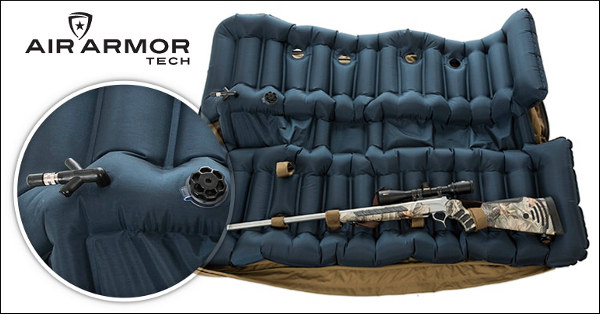
The Air Armor Tech Long Gun Case (LGC) holds multiple firearms up to 52″ OAL. When deflated, the 8-lb LGC stows in a 18″ x 9″ diameter roll. The LGC easily holds two long rifles with optics. The LGC comes complete with internal tie-downs for rifle and pistol, plus external shoulder straps for field carry.
Here’s something new and clever — a gun case with inflatable air chambers to protect the rifle. This definitely could have benefits for hunters and tactical shooters. This new Air Armor Tech military-grade gun case was recently tested by American Rifleman magazine. This gun case was developed by Blaine “Rock” Tompkins, a retired fighter pilot.
American Rifleman’s tester liked the product: “Typical foam-filled soft cases are inexpensive but don’t offer all that much padding. While hard cases provide more protection, they are bulky and take up a lot of storage space. Air Armor Tech’s inflatable gun cases … provide plenty of padding while being lightweight and easy to store. The three-pipe inflation system allows both of the 3-inch-thick (when fully inflated) air bladders to be quickly inflated.” Air Armor Tech offers two sizes, the Long Gun Case (LGC) that holds guns up to 52″ OAL, and the Mid-Length Gun Case (MLGC) that holds firearms up to 42″ OAL.
Air Armor Tech’s cases aren’t cheap — the LGC is $549 while the smaller MLGC is $499 — but when you consider your investment in rifle and optics, maybe this makes sense, particularly for hunters. Inside the bag are twin air bladders (see photo above) that cushion your guns. When deflated, the Air Armor Tech case can be rolled into a something the size of a sleeping bag.
Here are three videos that show the Air Armor Tech case works — and how it even floats. This air-cushioned bag definitely offers added protection for expensive firearms and optics.
Air Armor Tech Gun Case Features
Air Armor Tech Case on River Trip
Air Armor Tech Extended Field Test Report
“Air Armor Tech sent me a military grade inflatable rifle case to review. I’ve been using it for a couple of months on hunting trips, trips to the range and just about anything else I take a rifle or shotgun to. After using it for months, I can state without hesitation that the Air Armor Tech rifle and shotgun case is the toughest, lightest, handiest and best-made rifle case I have ever owned. It also protects my long guns better than anything I have ever tried. Besides, it even floats.” — Gun Guy, 09/25/17
Looking for culinary inspiration for your holiday gatherings? The NRA Blog offers three special (and delicious) Wild Game Recipes for your family feasts: Honey Mustard Planked Wild Turkey Breast, Mushroom-Stuffed Wild Boar Roast with Black Truffle Sauce, and BBQ Brined Pigeon. These recipes come from some of the country’s best chefs, and they all seem mouth-watering. You’ll find a full list of ingredients plus step-by-step cooking tips.
One of the many advantages to hunting is the assortment of game you can gather that lasts for an extended period of time. Just because it’s Thanksgiving doesn’t mean you have to stick with a whole turkey from the store and a ham hock.
We have three unique spins on wild game recipes that will suit your dining table perfectly. Even if you’re one of those hunters who enjoys a quick hunt the morning of Thanksgiving, these recipes will make your holiday more delicious than ever. — NRABlog.com