|
|
April 24th, 2010
 Sporting Classics, a specialty publisher, has released a new edition of 45 true-to-life Jack O’Connor stories from the pages of Outdoor Life, Field & Stream, Petersen’s Hunting and other popular magazines of his day. The new book, Classic O’Connor, is a sequel of sorts to Sporting Classics’ popular compendium, The Lost Classics of Jack O’Connor. Sporting Classics, a specialty publisher, has released a new edition of 45 true-to-life Jack O’Connor stories from the pages of Outdoor Life, Field & Stream, Petersen’s Hunting and other popular magazines of his day. The new book, Classic O’Connor, is a sequel of sorts to Sporting Classics’ popular compendium, The Lost Classics of Jack O’Connor.
In the new 440-page book, Jack O’Connor recounts his worldwide hunting adventures, during which he pursued everything from ducks to grizzlies, pheasants to kudu. Classic O’Connor presents several of the author’s greatest gun stories and a large selection of never-before-published photographs of the celebrated sportsman and his family on hunting adventures around the world. The book is illustrated with 40+ drawings by acclaimed artist Ron Van Gilder. Hardcover with dust jacket, the book lists for $35, but it can be pre-ordered on Amazon.com for just $23.10, with an August 1st delivery date. To get the book a soon as possible, call Sporting Classics at (800) 849-1004 or visit www.sportingclassics.com.
Another O’Connor title worth reading is The Hunting Rifle, still considered one of the definitive works on selecting a hunting rifle and cartridge. One owner of The Hunting Rifle explains: “It would benefit every hunter to take the time and read this book. It offers a corrective to the spirit of things that have gripped the hunting scene lately. Today, if one reads a hunting magazine, [one is] offered the view that you need the fastest and loudest cartridges, rifles with special finishes and the most expensive of anything. Ole Jack reminds us that many have killed game with ‘lesser’ guns for a very long time, and that these new gimmicks will not make you a more lethal hunter.”
April 1st, 2010
In recent years, environmental concerns over lead toxicity have inspired efforts to eliminate conventional lead-based ammunition. To protect endangered species from lead poisoning, California has banned hunting altogether on huge tracts of public land. In other areas which harbor protected species, hunters are forbidden to use lead-core or solid lead bullets. There is an ongoing FDA investigation into the health of venison taken with lead-core bullets. Responding to such concerns, in 2008, Barnes Bullets (now part of the Freedom Group), introduced its MPG™ (Multi-Purpose Green) lead-free bullets. These bullets are intended for hunting and for rifle training in locations where lead is restricted.
 Following Barnes’ lead, BIO-Bullets, a small company in Wanganui, New Zealand has invented a jacketless bullet that is not only lead-free, but is also 100% non-toxic, and bio-degradable. The new bullets have zero lead content and are made from “all-natural”, organic compounds. Unlike conventional bullets formed in a die, the new BIO-Bullets are pressure-molded from a proprietary composite, using sintered mineral compounds in a silica matrix. The mineral compounds, interestingly enough, not only bind the bio-degradable bullet together, but they provide nutritional benefits for any game that might ingest the projectiles. If an animal eats the bullet, it won’t get sick — it will actually get healthier. Following Barnes’ lead, BIO-Bullets, a small company in Wanganui, New Zealand has invented a jacketless bullet that is not only lead-free, but is also 100% non-toxic, and bio-degradable. The new bullets have zero lead content and are made from “all-natural”, organic compounds. Unlike conventional bullets formed in a die, the new BIO-Bullets are pressure-molded from a proprietary composite, using sintered mineral compounds in a silica matrix. The mineral compounds, interestingly enough, not only bind the bio-degradable bullet together, but they provide nutritional benefits for any game that might ingest the projectiles. If an animal eats the bullet, it won’t get sick — it will actually get healthier.
That’s right — these edible BIO-Bullets are not only non-toxic, they are actually nutritious. “When we came up with a non-toxic component mix, we realized we could actually provide a blend of flavorful nutrients in the matrix.” Said Trevor MacDiarmid, BIO-Bullets’ chief bullet designer. “It may seem far-fetched but just look at the label on a typical multi-vitamin supplement. You’ll see iron, chromium, magnesium, potassium, and zinc, among other minerals. These are all elements that can be combined into a durable bullet form that is actually healthy when ingested by an animal.” MacDiarmid, who holds a Ph.D in chemical engineering, explains that the health benefits of the BIO-Bullet came as an unexpected bonus: “Our first goal was simply to create a shootable, lead-free bullet that was non-toxic. But when our silica matrix proved more than hard enough to survive the friction, heat, and pressure of a 3500 fps trip through a rifle bore, we realized we could add additional minerals into the mix that would have a salutary effect on wildlife health.”
 BIO-Bullet’s founder, Steven Williams, is a gregarious 45-year entrepreneur who earned his first millions promoting dietary supplements in his native New Zealand. Noting the growing interest in “eco-friendly” ammunition components, Williams expects a huge demand for his new BIO-Bullets. “Globally, the annual sales of hunting bullets exceed €500 million in value. And the military bullet market may be triple that number — as long as you Yanks keep fighting wars”, he joked. Williams believes his new company is in the right place at the right time: “Being based in eco-aware New Zealand gives us a strong marketing advantage in launching this new product.” Williams’ company has earned the coveted “100% Pure New Zealand” certification, signifying that Bio-Bullets are “all-natural” and organic. BIO-Bullet’s founder, Steven Williams, is a gregarious 45-year entrepreneur who earned his first millions promoting dietary supplements in his native New Zealand. Noting the growing interest in “eco-friendly” ammunition components, Williams expects a huge demand for his new BIO-Bullets. “Globally, the annual sales of hunting bullets exceed €500 million in value. And the military bullet market may be triple that number — as long as you Yanks keep fighting wars”, he joked. Williams believes his new company is in the right place at the right time: “Being based in eco-aware New Zealand gives us a strong marketing advantage in launching this new product.” Williams’ company has earned the coveted “100% Pure New Zealand” certification, signifying that Bio-Bullets are “all-natural” and organic.
A select group of New Zealand hunting guides has already been using prototype BIO-Bullets in the field. The new eco-friendly bullets have earned high praise from these tough-to-please outdoorsmen. “In terms of ballistics and knock-down power, I reckon the ‘greenies’ are as good as anything on the market”, reports veteran outfitter Bart Coutts. South Island guide and deer farmer Dennis Amon said, “I’ve used them for predator control, and, as a test I even fed them to some of our captive Red Deer. The Reds ate them up like they were candy. Ever since then we’ve been calling these BIO-bullets the ‘incredible edibles’.”
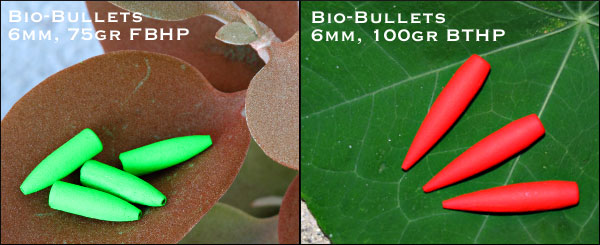
BIO-Bullets will initially be available in .224, 6mm, and .308 calibers starting at $40 (NZ) per box of 100. The varmint-grade, flat-based bullets will be finished with a day-glo green outer coating, while the longer, boat-tail match bullets will be fluorescent red. Said designer MacDiarmid: “Since our BIO-Bullets don’t use a conventional jacket, we can finish them in any color by adding non-toxic dyes to the silica matrix. It’s sort of like putting the colored shell on a jelly bean. I favored a more sedate color, but the boss wanted something bold and eye-catching. Steven’s the marketing guru, and he writes the checks, so we went with fluorescent colors. But any exterior color scheme is possible, even digital camo.”
BIO-Bullets is currently finalizing arrangements with North American distributors. The company expects its eco-friendly bullets to appear on American and Canadian store shelves in time for the traditional fall hunting season.
March 31st, 2010
Savage Arms has released a new line of Savage EDGE centerfire rifles. This new platform was built from the ground up as an affordable entry-level rifle. The EDGE features a new modern look, and while it shares key features with its older brother the Model 110, it has a different receiver design.

Though the basic model has a low, $329.00 MSRP, the EDGE includes some nice features: detachable box magazine, pillar bedding, and 2-position safety. For $379.00, you can get the EDGE XP, which includes a 3-9×40 scope (mounted and bore-sighted). Factory camo versions are also offered in both basic and XP configurations.

The EDGE action is apparently long enough to handle both short and long cartridges. This “one size fits all” approach has been used on some recent European rifles as well. We were pleased to see that Savage is offering a wide variety of chamberings: 223 Rem, 22-250, 243 Win, 25-06, 270 Win, 7mm-08, 308 Win, 30-06 Springfield.
An Affordable Gun for a Tough Economy
The EDGE was conceived in January of 2009. At the time, Savage observed heavy activity at the entry level pricepoint from consumers as well as manufacturers. The poor economy created more interest in pricepoint hunting guns and key manufacturers were cutting already low prices even lower.
“We wanted to not only maintain our market share, but to grow it,” Savage VP of Sales & Marketing Brian Herrick said. “We felt the only way to accomplish this was to develop a new rifle designed for this segment, rather than discount current models. We wanted a rifle that not only had a lower price, but one that had better features and was more aesthetically appealing than what was out there at the time.”
March 4th, 2010
Southwick Associates compiles statistics for the hunting/shooting industry and public wildlife agencies. Based on 2009 survey results, Southwick has ranked the most popular shooting/hunting brands and products. These rankings were based on HunterSurvey.com and TargetshootingSurvey.com online polls completed by nearly 45,000 hunters and shooters. The polls asked the hunters and shooters to list the outdoor products they purchased most often.
 There were some interesting results among rifle shooters. Remington is still the #1 rifle-maker, and Remington also leads the way in rifle ammunition. Hodgdon is the top reloading powder vendor with 36.5% of reported purchases. Top bullet-maker is Hornady with 30%, but remember this is for hunting AND target shooting. CCI makes the most popular rifle primers. We were somewhat surprised to see that the top scope brand for all firearms was Bushnell, which held a 17.3% share. There were some interesting results among rifle shooters. Remington is still the #1 rifle-maker, and Remington also leads the way in rifle ammunition. Hodgdon is the top reloading powder vendor with 36.5% of reported purchases. Top bullet-maker is Hornady with 30%, but remember this is for hunting AND target shooting. CCI makes the most popular rifle primers. We were somewhat surprised to see that the top scope brand for all firearms was Bushnell, which held a 17.3% share.
Southwick Associates’ HunterSurvey.com also measured buying activities over time. As you might expect, hunters spent the most money on gear in November. However the peak month for target shooters was June. We would have figured most of the spending would have taken place earlier in the spring — at least for rifle shooters who reload.

Rifle Shooting & Hunting
• Top rifle brand: Remington (16.5% of all purchases)
• Top muzzleloader brand: Thompson Center (29.5% of all purchases)
• Top scope for firearms: Bushnell (17.3% of all purchases)
• Top rifle ammunition brand: Remington (28.8% of all purchases)
• Top reloading bullet brand: Hornady (30.2% of all purchases)
• Top reloading powder brand: Hodgdon (36.5% of all purchases)
• Top reloading primer brand: CCI (36.0% of all purchases)
• Top shooting target brand: Shoot-N-C (38.9% of all purchases)
Shotguns
• Top shotgun brand: Remington (22% of all purchases)
• Top shotgun ammunition brand: Winchester (32.0% of all purchases)
• Top clay brand: White Flyer (34.3% of all purchases)
• Top balls, bullets, or shot brand: Hornady (26.2% of all purchases)
Handguns
• Top handgun brand: Sturm Ruger (16.6% of all purchases)
• Top handgun ammunition brand: Winchester (22.0% of all purchases)
• Top holster brand: Uncle Mike’s (21.4% of all purchases)
• Top blackpowder brand: Pyrodex (51.5% of all purchases)
Hunting Gear
• Top binocular brand: Bushnell (19.5% of all purchases)
• Top knife brand: Buck (16.7% of all purchases)
• Top scent or scent covering brand: Scent-A-Way (24.5% of all purchases)
• Top game call brand: Primos (34.8% of all purchases)
February 26th, 2010
The basic AR15, with upgrades to barrel, trigger, optics and “furniture” has evolved into an extremely effective varminter, chambered in .223 Rem, or a .20-caliber such as the 20 Practical. Hunters have also adapted the AR10 platform, with its ability to fire a .308 Winchester-sized cartridge, for use on deer and Elk. Now ArmaLite has “re-introduced” a handy, compact AR10 carbine that should be ideal for hog hunters.
The folks at ArmaLite received many requests for a lighter, more compact version of the AR10. Armalite responded: “We did a small limited run and we’re pushing its use as a varmint hunter… especially good against wild boars. One of our ArmaLite gunsmiths got the idea from some buddies in Texas who are using their Ts against the wild hogs. This AR-10(T) Carbine combines the light weight and compact size of the carbine with the accuracy of the Target Model.” This AR10(T) carbine features a 16″, 1:11.25″ twist barrel, fitted to a forged, flat-top receiver with built-in Picatinny rail. With a compact 37.5″ length, the gun weighs 8.6 pounds (3.9 kg). Included with the rifle are one 10-round mag, and one 20-round mag. MSRP is $1892.00.

February 10th, 2010

Right now Cabela’s.com is running a major Hunting Gear SALE with some popular items discounted 30% or more. You’ll find great deals on Bushnell, Leupold, and Nikon optics. Rifle ammo for a wide variety of calibers is on sale, and you’ll find good deals on knives and hunting accessories.
To make this sale even more attractive, Cabela’s is offering $5 flat-rate shipping, now through February 16, 2010. To qualify, your order must total AT LEAST $150.00, and you need to use Promo Code 2XFLAT when checking out.

January 26th, 2010
Though the use of high-tech materials, such as carbon fiber and kevlar, modern riflestocks have become stiffer, stronger, and lighter. Wild Dog, a small company in Queensland, Australia, is producing some of the nicest carbon-reinforced hunting and tactical stocks you can buy. Wild Dog stocks sport innovative features, such as a trap door for ammo storage in the side of the buttstock. Wild Dog’s hunting stocks are sized right and comfortable to hold — the comb height and drop angles are “just right” for a classic sporter.

And when Wild Dog says they can build a stock that’s “ultra-light”, they aren’t kidding. Wild Dog’s Bruce Simms showed us a lightweight sporter stock that weighed just 20 ounces! We were sufficiently impressed that we may choose a Wild Dog stock for an ultra-light, walk-around varminter project AccurateShooter.com has in the works.

This Editor was also very impressed by Wild Dog’s tactical stocks. The Wild Dog thumbhole will work for shooters with any hand size. The grip section of some other thumbhole stocks (notably the Accuracy Int’l) is very thick and fat (way too fat for this Editor’s hands). By contrast, you’ll find the Wild Dog thumbhole is comfortable and controllable even for shooters with medium to small hands. Wild Dog’s adjustable cheekpiece system on the tactical stocks is better than most — the hardware is simple but sturdy and the cheekpiece fits flush when retracted.


Overall, the Wild Dog stock designs — both hunting and tactical, are carefully crafted and very well thought out. The tactical stocks feel right in both offhand and prone positions. The hunting stocks are easy to handle and the hand-painted camo finishes really do work in the field, as you can see in the photo below.

January 21st, 2010
 We had a long chat with Eric Stecker, Berger Bullet’s Master Bulletsmith. Eric had some interesting revelations. First he noted that Berger’s production in 2009 was up 50% compared to the previous year. Berger is now running 24-hour shifts to meet demand. And Berger isn’t resting on its laurels. A new .338 bullet is going into production, and Berger now has the means to produce .416s and even 50-caliber bullets. Berger also has multiple new prototype long-range bullets in development. Eric let me look at them and hold them but he requested that we NOT publish photos as the bullet profiles are somewhat radical. Eric revealed that a new series of short-range 6mm bullets in the 60-grain range are probably going to be released later this year. These borrow some design ideas from the successful Euber FB bullets, with refinements to improve ballistics. We had a long chat with Eric Stecker, Berger Bullet’s Master Bulletsmith. Eric had some interesting revelations. First he noted that Berger’s production in 2009 was up 50% compared to the previous year. Berger is now running 24-hour shifts to meet demand. And Berger isn’t resting on its laurels. A new .338 bullet is going into production, and Berger now has the means to produce .416s and even 50-caliber bullets. Berger also has multiple new prototype long-range bullets in development. Eric let me look at them and hold them but he requested that we NOT publish photos as the bullet profiles are somewhat radical. Eric revealed that a new series of short-range 6mm bullets in the 60-grain range are probably going to be released later this year. These borrow some design ideas from the successful Euber FB bullets, with refinements to improve ballistics.
We covered many other topics during our interview, including the status of the new Berger Reloading handbook, and the differences between the G1 vs. G7 Ballistics models. Click on the video link below to learn all the latest info from Berger.

January 10th, 2010
30-caliber magnums are the chamberings of choice for North American big game hunters. Although the venerable .30-06 and .270 remain popular, Boone and Crockett Club records show that the 30-caliber magnums (of one variety or another) take more North American trophies than any other caliber/chambering. (Note: “30-caliber magnum” includes .300 Win Mag, .300 WSM, .300 Wby. Mag, 300 Ultra mag. Records do not distinguish specific 30-cal magnum chamberings.) Boone and Crockett compiled the data from records-book entries from 2007 through 2009. Surprisingly, the second most popular trophy-taker isn’t a firearm—it’s a bow.

Here are the most commonly used calibers across all Boone and Crockett categories over the past three years, along with percentages of trophy entries credited to each:
30-cal Magnum (all types)—18 percent
Bow/crossbow—16 percent
.270—12 percent
.30-06—11 percent
7mm Magnum—11 percent
Muzzleloader/shotgun—10 percent
6mm—3 percent
.338 Magnum—3 percent
.257—2 percent
.30-30—2 percent
.308—2 percent
.375 Magnum—2 percent
Other—8 percent |
 |
30-caliber magnum cartridges appear among the top three calibers for 11 of the 15 species recognized in Boone and Crockett trophy records. Species for which records are kept include: Whitetail deer, Coues’ whitetail deer, Blacktail deer, Mule deer, Black bear, Brown Bear/Grizzly, Pronghorn, Elk, Moose, Caribou, Bison, Muskox, Cougar, Rocky Mtn. Goat, Sheep (Bighorn, Dall’s, Desert, Stone’s).
January 2nd, 2010
Here’s a simple procedure that lets you get a solid zero for a hunting rifle in just four shots. Of course you probably want to fire a few more rounds to confirm your zero before you head off to your hunting grounds, but this will let you get on-target with a minimum amount of time and ammo expended. (This assumes your scope is securely mounted, and the bases are not drastically out of alignment.)
1. First, remove the bolt and boresight the rifle. Adjust the position of the rifle so that, looking through the bore, you can see the center of the target with your eyes. Secure the rifle in the rests to maintain its position as boresighted. Then, without moving the rifle, center the reticle. That should get you on paper. With the rifle solidly secured in front and rear rests or sandbags, aim at the center of a target placed at your zeroing distance (50 or 100 yards). Confirm there are no obstructions in the barrel! Then load and fire one shot. Then, return the gun to the exact position it was when you pulled the trigger, with the cross-hair centered on the target as before.
2. Locate, in the scope, where your first bullet landed on the target. Now, while you grip the rifle firmly so it doesn’t move, have a friend adjust the turrets on your scope. While you look through the scope, have your friend turn the windage and elevation turrets until the cross-hairs, as viewed through the scope, bisect the first bullet hole on the target. In other words, you use the turrets to move the center of the reticle to the actual position of shot number one. Dial the crosshairs to the hole — don’t move the rifle.
3. After you’ve adjusted the turrets, now re-aim the rifle so the cross-hairs are, once again, positioned on the target center. Keep the rifle firmly supported by your rest or sandbag. Take the second shot. You should find that the bullet now strikes in the center of the target.

4. Take a third shot with the cross-hairs aligned in the center of the target to confirm your zero. Make minor modifications to the windage and elevation as necessary.
5. Now shoot the rifle from a field rest (shooting sticks, bipod, or rucksack) as you would use when actually hunting. Confirm that your zero is unchanged. You may need to make slight adjustments. Some rifles, particularly those with flexy fore-arms, exhibit a different POI (point of impact) when fired from a bipod or ruck vs. a sandbag rest.
If you recently cleaned your rifle, you may want to fire two or three fouling shots before you start this procedure. But keep in mind that you want to duplicate the typical cold bore conditions that you’ll experience during the hunt. If you set your zero after three fouling shots, then make sure the bore is in a similar condition when you actually go out hunting.
|


