Jerry Miculek is the best action revolver shooter who has ever lived. Miculek is also a true master with rifle and shotgun. This guy shoots hundreds of thousands of rounds every year in all types of firearms. Through that process, he has discovered common mistakes many shooters make. Those mistakes can harm the guns, or threaten the safety of the operator. Here Jerry offers some vital gun handling and safety advice in his “Never Do This” video series.
Jerry Miculek has won multiple revolvers championships, and has set amazing records for revolver speed shooting (with reloads). Yes Jerry, “Mr. Revolver”, knows a thing or two about wheelguns. In this video, Jerry explains how you can damage your revolver by using the wrong methods to open and close the cylinder and extract ammo. Jerry shows what NOT to do, and then he very carefully explains the proper procedure to release the cylinder, and swing it out of the frame. In addition, Jerry shows how best to swing a loaded cyclinder back into place. If you own a revolver, ANY revolver, you should definitely watch this video.
In this second video, Jerry explains common mistakes people make when handling and shooting three classic, semi-auto firearm types — the M1 Garand, the SKS carbine, and the M1911 pistol. Jerry shows handling faults that can cause out-of-battery detonation or early primer strikes, or cause jams in the Garand and SKS. Then Jerry explains why you should never release the slide on a M1911 pistol with a round already in the chamber. This is a must-watch video for Garand owners.
Here Jerry demonstrates of the most common jams that can happen with AR-platform rifles. Miculek reveals the cause of the issue and then shows how to prevent it. Jerry notes: “This is one of those malfunctions that you won’t see coming! I’ve seen it … on the range and it can be devastating to your time in a match. All ammo used in the video were dummy rounds and intentionally loaded for training without powder or primers.”
The U.S. Supreme Court has issued a unanimous 9-0 decision holding that the Protection of Lawful Commerce in Arms Act (PCLAA) bars Mexico’s claims that firearm manufacturers “aided and abetted” illegal firearms trafficking to narco-terrorist drug cartels in Mexico. In the case of Smith & Wesson Brands, Inc. v. Estados Unidos Mexicanos, Mexico sought $10 billion in damages against several U.S. firearm manufacturers and distributors.
In its unanimous decision the Supreme Court stated: “Recall that Congress enacted the [PCLAA] statute to halt a flurry of lawsuits attempting to make gun manufacturers pay for the downstream harms resulting from misuse of their products. In a ‘findings’ and ‘purposes’ section, Congress explained that PLCAA was meant to stop those suits — to prevent manufacturers (and sellers) from being held ‘liable for the harm caused by those who criminally or unlawfully misuse firearm[s].’ Mexico’s suit closely resembles the ones Congress had in mind: It seeks to recover from American firearms manufacturers for the downstream damage Mexican cartel members wreak with their guns.”
Smith & Wesson Pres./CEO Mark Smith posted: “Today’s unanimous Supreme Court decision… represents not only a big win for Smith & Wesson, but our industry, American sovereignty and, most importantly, every American who wishes to exercise his or her Second Amendment rights. This suit, brought by Mexico in collaboration with U.S.-based anti-Second Amendment activist groups, was an affront to our nation’s sovereignty and a direct attack on the Constitutional rights of law-abiding Americans. It [was] a blatant abuse of our legal system to advance their anti-Constitutional agenda.”
NSSF filed an amicus brief supporting Smith & Wesson in its petition to dismiss Mexico’s claim for $10 billion in damages. NSSF’s Lawrence G. Keane, Senior V.P. and General Counsel stated: “This is a tremendous victory for the firearm industry and the rule of law. For too long, gun control activists have attempted to twist basic tort law to malign the highly-regulated U.S. firearm industry with the criminal actions of violent organized crime, both here in the United States and abroad. The firearm industry is sympathetic to plight of those in Mexico who are victims of rampant and uncontrolled violence at the hands of narco-terrorist drug cartels. The firearm industry works closely with the Bureau of Alcohol, Tobacco, Firearms and Explosives (ATF) to prevent the illegal straw purchasing of firearms and the illegal transnational smuggling of firearms. This unequivocal decision by the Supreme Court that PLCAA applies and there is no evidence whatsoever that U.S. manufacturers are in any way responsible is verification of commitment to responsible firearm ownership.”
The NRA also filed an amicus brief urging the Court to take the case and then filed a subsequent brief arguing for the outcome decided by the Court. Doug Hamlin, NRA Executive V.P. and CEO, stated: “The U.S. Supreme Court correctly renounced the tactics Mexico and its American collaborators used to try to extort and impoverish America’s firearms industry. The Protection of Lawful Commerce in Arms Act is clear – firearm manufacturers are not liable for the criminal misuse of their products, and this doesn’t change just because gun control activists disapprove of their lawful business practices and products. PLCAA is the law of the land today due to the work of NRA-ILA and NRA members in the early 2000s.”
Mexico filed its claim in a U.S. District Court in Boston in 2021, which was dismissed by that district court based on the bipartisan PLCAA that prohibits frivolous lawsuits against the firearm industry for the criminal misuse by remote third parties.
Mexico appealed to the U.S. Court of Appeals for the First Circuit, which revived the lawsuit holding that Mexico’s “aiding and abetting” theory fit within one of the PLCAA’s narrow exceptions. Smith & Wesson Brands, Inc., et al., successfully petitioned the Supreme Court last year. The case was argued before the Supreme Court in March of this year.
Could you hit an 18″ x 24″ target at a distance of 400 meters (437 yards)? Sure, you’re thinking, that would be easy with a good rifle fired from the bench or prone position. OK, now think about making that shot, OFF-HAND with a pistol. That’s something entirely different. We doubt many marksman would wager they could hit a plate 400 meters away with a handgun.
That’s exactly the challenge legendary shooter Jerry Miculek undertakes in this interesting video. Shooting a Smith & Wesson 9mm M&P pistol with a red-dot optic, Jerry makes the 400m shot look easy, hitting the steel plate with his first shot. This takes good eyes, a solid grip, perfect trigger control (and a bit of luck). Jerry was shooting 115gr Hornady HAP® ammunition.
25 Feet Hold-over to Make Shot at 437 yards!
The shot wasn’t dead center, but Miculek still hit the steel plate on the first try. This is doubly impressive because Miculek had to hold well over the target. In fact Jerry figured he was aiming “25 feet over [the target]”. The lesson to be learned here is that a good pistol, in the hands of a master, may be capable of astonishing long-range accuracy — as long as you work out the ballistics in advance. Jerry knew that he had to hold high to arc the bullet into the target.
OK this is no novice. But even champion pistol shooter Jessie Harrison, Captain of Team Taurus, had to start with the basics. Jessie says that safety should always be your number one priority.
At AccurateShooter.com, our primary focus is precision target shooting with rifles. But it’s definitely fun to shoot pistols too, and we bet most of our regular readers own handguns. Here are six tips for shooting safely and accurately with handguns. These pointers will help you advance your skills and have more fun with your pistols and revolvers.
1. Make Sure Safety Is Number One
Whether you own one gun or one hundred, gun safety must always be your main priority. In this video, Smith & Wesson Team Captain Julie Golob covers the basics of gun safety.
2. Start with a .22 LR Handgun
We strongly recommend that new pistol shooters start off with a .22 LR rimfire handgun. The .22 LR cartridge is accurate but has very low recoil, less “bark” than a centerfire, and very little smoke and muzzle flash. New shooters won’t have to fight muzzle flip, and won’t develop a flinch from the sharp recoil and muzzle blast common to larger calibers. With the .22 LR, the trainee can focus on sight alignment, breathing, and trigger pull. When he or she has mastered those skills, move on to a .38 Special or 9mm Luger (9x19mm).
What gun to use? We recommend the 10-shot Smith & Wesson Model 617. Shooting single action, slow-fire, this is ideal for training. Shown above is the 4″-barrel Model 617version which balances well. There is also a 6″-barrel version. It has a longer sight radius, but is a little nose-heavy. Both are great choices. They are extremely accurate and they boast a very clean, precise trigger.
If you prefer a semi-auto .22 LR pistol, we recommend the Browning Buck Mark series. Buck Marks are very accurate and very reliable. This rimfire pistol is available in a variety of models starting at under $350.00. Like the S&W Model 617, a good Buck Mark will serve you for a lifetime.
5. Use Quality Targets with Multiple Aim Points
It’s common for new pistoleros to start shooting at cans or clay birds at a public range. That can be fun, but it’s better to start with proper targets, placed at eye level, at 7-10 yards. We like to use targets with large, brightly colored circles. Focus on putting 5 shots in a circle. We recommend targets that have multiple bullseyes or aiming points — that way you don’t have to constantly change your target. There are also special paper targets that can help you diagnose common shooting problems, such as anticipating recoil. EZ2C makes very good targets with bright, red-orange aim points. You can also use the bright orange Birchwood Casey stick-on Target Dots (right). These come in a variety of diameters. We like the 2″ dot at 10 yards.
3. Shoot Outdoors If You Can
We recommend that new pistol shooters begin their training at an outdoor range. There are many reasons. First, the light is better outdoors. Indoor ranges can be dark with lots of shadows, making it harder to see your target. Second, sound dissipates better outdoors. The sound of gunfire echoes and bounces off walls indoors. Third, an outdoor range is a more comfortable environment, particularly if you can get out on a weekday morning. Indoor ranges, at least in urban areas, tend to be crowded. Many also have poor ventilation. If you can make it to an outdoor range, you’ll be happy. Many outdoor ranges also have some steel pistol targets, which offer a fun alternative to paper. When shooting steel however, we recommend polymer encased or lead bullets to avoid ricochets.
Too many new pistol shooters try to move right to rapid fire drills. It’s better to start slow, practicing the basics, under the guidance of a good mentor. If you belong to a club, ask if there are certified instructors who will help out. This Editor learn pistol shooting from a seasoned bullseye shooter, who got me started with a .22 LR revolver and very close targets. Over the course of a few range sessions we progressed to farther targets and faster pace. But the fundamentals were never forgotten. When starting your pistol training, it’s wise to view some instructional videos. Top Shot Champion Chris Cheng hosts an excellent Handgun 101 Series produced by the NSSF. We’ve linked one of these Handgun 101 videos for Tip #6.
6. SLOW DOWN — This Is Not a Race
When you learned to ride a bicycle, you started slow — maybe even with training wheels. The same principle applies to pistol shooting. When you get started with handguns, we recommend you shoot slowly and deliberately. Start with the handgun unloaded — just work on your sight alignment and breathing. With snap caps in place, try some dry-firing drills. Then progress to live fire. But be deliberate and slow. With the target at 20 feet, see if you can get three successive shot-holes to touch. Believe it or not, many common pistols are capable of this kind of accuracy (but you won’t see many shooters at indoor ranges who pursue that kind of precision). Once you master your form and accuracy, then you can work on your speed.
S&W Model 617 now has a 10-round cylinder, but early models were six-shooters.
In recent years, the ranks of first-time gun buyers have grown dramatically. Millions of Americans have purchased their first-ever handgun. With so many handgun options (from derringers to Desert Eagles) many first-time buyers have trouble making a choice. What should those millions of new gun buyers have acquired first? Perhaps it should have been a rimfire revolver. Here is why…
The Argument for a Rimfire Revolver
Some years back, a close relative contacted this Editor. Wanting to get started in handgunning, he sought my advice on purchasing his very first handgun. “Should I get a Glock?”, he asked. “No” was my response. “Well how about an M&P?” he inquired. “Better ergos” I said, “but ‘No’ is still my reply.” “OK, how about a KelTec, they’re cheap…” “Absolutely not”, I replied.
I could tell he was getting annoyed, when he said “OK, Mr. know-it-all, so what handgun should I get?” Calmly, I replied: “Get a .22-caliber rimfire revolver. You will never out-grow it. You will learn sight alignment and trigger control. You can practice with inexpensive ammunition. A good .22 revolver will be considerably more accurate than 90% of the self-loading pistols you could buy. If you get a Smith & Wesson, you will keep the gun for the rest of your life and pass it on to your kids. If you or your heirs ever wear out the barrel or cylinder, Smith & Wesson will replace the parts for free, forever.”
First Handgun Choice — Consider a .22 LR Wheelgun
A very good choice for a first handgun is a Smith & Wesson .22 LR revolver, such as the S&W Model 617. The model 617 is extremely accurate, with a crisp trigger and good sights. Choose either a 4″ or 6″ barrel. The current model has a handy, 10-round cylinder.
This Editor’s first really accurate handgun was a .22 LR Smith & Wesson Model 617 that could easily stack ten shots in a dime at 10 yards. It remains my favorite and most-used handgun. What can we say about the Model 617? The single-action trigger pull is superb, and the accuracy surpasses most any semi-auto rimfire pistol, except for a few, very expensive target pistols. We like the 6″ version for the longer sight radius, but the 4″-barrel 617 is also very accurate, and it balances better.
You can learn all the fundamentals with this ultra-reliable handgun, shooting inexpensive .22 LR ammo. The model 617 is rugged, durable, and can give you a lifetime of shooting fun. Once you have mastered the basics of shooting with a .22 LR, you can move on to larger caliber handguns suitable for self-defense. Below is a slide-show illustrating a S&W model 617 ten-shot, with 6″ barrel. S&W also makes a 4″-barrel version of this revolver. (See: Shooting Demo Video with 4″ model 617.)
Another .22 Revolver Option, the Smith & Wesson Model 63
The current S&W Model 63 is a J-Frame .22 LR with 3″ barrel and fiber optic front sight. The Model 63 is compact enough for comfortable carry and well-balanced. The older Model 63, aka the “Kit Gun”, is an appreciating classic.
Team Smith & Wesson shooter Julie Golob has a message for Mother’s Day (Sunday, May 12th). Julie writes: “While some are using Mother’s Day week to push a gun control agenda, I’d like to encourage moms to ‘Take a Moment’. Talk to your kids about firearms safety. Help them learn what to do around firearms and have an open, honest discussion about guns and gun safety.
I truly believe that, no matter if you are pro-gun or anti-gun, everyone should know and understand the basic rules of firearm safety. It is equally important for parents to have the discussion about guns and what to do if your child finds one. Both the NSSF’s Project ChildSafe and the NRA’s Eddie Eagle GunSafe® Program are excellent. They offer resources for parents, educators, and child care providers to help ensure kids stay safe.
In this video, Julie encourages parents to have “the talk” about firearm safety with their kids sooner rather than later, and provides tips for how to have a helpful discussion. Sherra Scott, a mom and a certified NRA instructor, agrees with Julie: “Whether you have firearms in your home or not, if you have children in your life, please watch this video and talk WITH them about firearm safety and what to do if they come into contact with a firearm.”
Hornady sponsored shooter Jerry Miculek — Yamil Sued Photo.
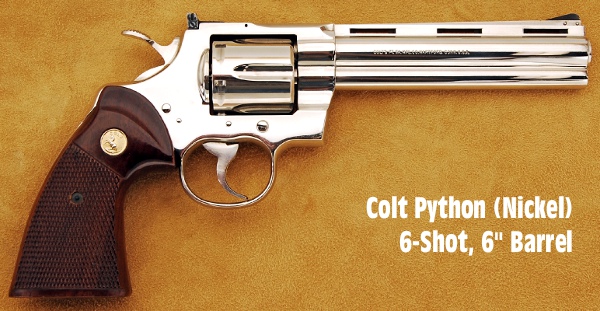
If you are considering acquiring a revolver for fun shooting, self-defense, or competition, you should definitely watch this YouTube video. In this 23-minute presentation, legendary shooter Jerry Miculek puts three .357/.38 SPL wheelguns through their paces. Jerry, one of the greatest revolver shooters in history, hosts a “Revolver Showdown” with three popular wheelguns: 1) S&W L frame (3″ bbl); 2) Colt Python (6″ bbl); and 3) Ruger Speed Six (2.75″ bbl).
Smith & Wesson Model 686 Plus, L-Frame, 7-rd .357 Magnum/38 SPL, 3″ Barrel.
Testing at 10 Yards and 50 Yards
In the video, Jerry shoots all three revolvers rapid-fire, double-action at 10 yards. Then he shoots the three guns single-action, slow-fire at 50 yards (starting at time mark 7:19).
After his range session, Jerry examines nine medium frame revolvers, comparing and contrasting design features. Jerry considers these factors:
1. Accuracy
2. Balance and Handling
3. Speed and Sureness of Trigger Return (watch video at 3:45″ re Colt.)
4. Reliability
5. Barrel Twist Rate
6. Strength of Construction/Durability
If you are looking for a modern, extremely powerful semi-auto pistol, you may want to consider the impressive S&W Performance Center M&P 10mm M2.0 pistol. This boasts a long 5.6″ barrel for extra velocity. The barrel is also ported for reduced muzzle flip and less perceived recoil. The gun would be a very powerful defensive pistol and S&W says it can also serve for hunting.
Smith & Wesson states: “The new Performance Center 10mm was conceived with both the hunter and target shooter in mind. The goal was to build upon the M2.0 10mm series, with the intention of having reduced felt recoil and quicker follow-up shots. Popular features previously seen on other 5.6-inch PC pistols are present in this design and, when paired with the flat-shooting 10mm Auto cartridge, provide the end user a total package for hunting, self-defense, or at the range.”
Building off the success of the M&P 10mm M2.0, Smith & Wesson incorporated new features designed to increase the new Performance Center 10mm pistol’s performance. Chambered in 10mm Auto, this full-size polymer handgun boasts a ported 5.6-inch barrel to reduce muzzle rise, optic-height tritium night sights for a clear sight picture in low-light conditions, and a Performance Center-tuned flat M2.0 trigger with a crisp break and audible reset.
The Performance Center 10mm slide is cut for optics and ships with Smith & Wesson’s C.O.R.E. plate system, two 15-round magazines, and four interchangeable palmswell grip inserts. This 10mm pistol is made in the U.S.A. and has an MSRP of $749.00.
Smith & Wesson is releasing its new CSX E-Series optics-ready CCW pistols. This is an update of the CSX model, a micro-compact aluminum pistol first introduced in 2022. The new CSX E-Series has many notable new features, including two barrel length choices, modular grips, interchangeable backstraps, and various magazine options. The ergonomic upgrades are designed for “instinctive control” and “comfortable fit for any shooter right out of the box”.
The new CSX E-Series pistols boast enhanced triggers, improved grip texture coverage, and modular grip adapters with new 15- and 17-round magazines.
These aluminum-framed micro-compact pistols feature significant design upgrades. Consumers can choose a 3.1-inch or 3.6-inch barrel, with models that include 12, 15, and 17-round magazines. There are also two 10-round compliant variants. CSX E-Series pistols are optics-ready with an RMS-C/507K footprint and Smith & Wesson’s ClearSight™ cut, designed to strategically divert gasses away from the optic lens, leaving an unobstructed view.
The CSX E-Series pistols boast a modular grip adapter that allows the user to size down the frame for concealment or size up for better handling and increased capacity. These pistols also have an enhanced trigger with a clean break, improved reset, and straighter pull. Additional features include interchangeable backstraps, ambidextrous controls, standard white-dot sights, and flat-black frame.
CLICK HERE for more INFO on the new S&W CSX E-Series 9mm carry pistols plus full specifications.
Hornady sponsored shooter Jerry Miculek — Yamil Sued Photo.
If you are considering acquiring a revolver for fun shooting, self-defense, or competition, you should definitely watch this YouTube video. In this 23-minute presentation, legendary wheelgun ace shooter Jerry Miculek puts three .357/.38 SPL wheelguns through their paces. Jerry, one of the greatest revolver shooters in history, hosts a “Revolver Showdown” with three popular wheelguns: 1) S&W L frame (3″ bbl); 2) Colt Python (6″ bbl); and 3) Ruger Speed Six (2.75″ bbl).
Smith & Wesson Model 686 Plus, L-Frame, 7-rd .357 Magnum/38 SPL, 3″ Barrel.
Testing at 10 Yards and 50 Yards
In the video, Jerry shoots all three revolvers rapid-fire, double-action at 10 yards. Then he shoots the three guns single-action, slow-fire at 50 yards (starting at time mark 7:19).
After his range session, Jerry examines nine medium frame revolvers, comparing and contrasting design features. Jerry considers these factors:
1. Accuracy
2. Balance and Handling
3. Speed and Sureness of Trigger Return (watch video at 3:45″ re Colt.)
4. Reliability
5. Barrel Twist Rate
6. Strength of Construction/Durability


 It’s common for new pistoleros to start shooting at cans or clay birds at a public range. That can be fun, but it’s better to start with proper targets, placed at eye level, at 7-10 yards. We like to use targets with large, brightly colored circles. Focus on putting 5 shots in a circle. We recommend targets that have multiple bullseyes or aiming points — that way you don’t have to constantly change your target. There are also special paper targets that can help you diagnose common shooting problems, such as anticipating recoil. EZ2C makes very good targets with bright, red-orange aim points. You can also use the bright orange Birchwood Casey stick-on Target Dots (right). These come in a variety of diameters. We like the 2″ dot at 10 yards.


 Team Smith & Wesson shooter



 Testing at 10 Yards and 50 Yards


 Testing at 10 Yards and 50 Yards


