|
|
April 25th, 2008
Leupold & Stevens, Inc. has acquired the Redfield brand of optics from Meade Instruments. Founded in 1909, Redfield was a leading U.S. producer of riflescopes, spotting scopes, and binoculars for many decades until it closed in 1998. In recent years, the Redfield brand changed hands several times, before being acquired by Meade Instruments, which sold the Redfield brand to Leupold.

Presumably, Leupold plans to develop and market a lower-cost line of riflescopes, binoculars, and spotting scopes to wear the Redfield name. We wouldn’t be surprised if some of these Redfield-branded optics are produced overseas, most likely in Asia — but we have not been able to confirm or deny that possibility.
Tom Fruechtel, President and CEO of Leupold & Stevens, declined to discuss the plans for Redfield under Leupold ownership, but did state: “For half a century, Leupold respected Redfield as a leading innovator and competitor in the sports optics industry. The opportunity… to rescue this American brand from dormancy could not be missed.”

Leupold & Stevens, Inc., a fifth-generation, American family-owned company, employs more than 650 people in its Beaverton, Oregon facility. Leupold’s product line includes rifle, handgun and spotting scopes; binoculars; rangefinders; and optical tools and accessories.
April 24th, 2008
Forum member Skeeter has put together a new 6mm Dasher falling block varmint rifle. The Dasher case is based on the 6mm BR Norma cartridge with the shoulder blown forward about 0.100″ and out to 40°. This gives the Dasher roughly 3.5 grains added capacity compared to the standard 6BR.
Skeeter needed to form 300 cases for an upcoming varmint holiday. Skeeter decided to fire-form his brass without bullets. This method avoids barrel wear* and saves on components. There are various ways to do this, but Skeeter chose a method using pistol/shotgun powder, some tissue to hold the powder in place, Cream of Wheat filled to within an 1/8″ of top of the neck, and a “plug” of tissue paper to hold it all in place. Shown below are cases filled with a pistol/shotgun powder charge topped with Cream of Wheat and then a tissue paper plug.


To ensure the case headspaced firmly in his Dasher chamber, Skeeter created a “false shoulder” where the new neck-shoulder junction would be after fire-forming. After chamfering his case mouths, Skeeter necked up all his cases with a 0.257″ mandrel (one caliber oversized). Then he used a bushing neck-sizing die to bring the top half of the neck back down to 0.267″ to fit his 0.269″ chamber. The photo below shows how the false shoulder is created.

After creating the false shoulder, Skeeter chambered the cases in his rifle to ensure he could close the bolt and that he had a good “crush fit” on the false shoulder, ensuring proper headspace. All went well.

The next step was determining the optimal load of pistol powder. Among a variety of powders available, Skeeter chose Hodgdon Titewad as it is relatively inexpensive and burns clean. The goal was to find just the right amount of Titewad that would blow the shoulder forward sufficiently. Skeeter wanted to minimize the amount of powder used and work at a pressure that was safe for his falling block action.
Working incrementally, Skeeter started at 5.0 grains of Titewad, working up in 0.5 grain increments. As you can see, the 5.0 grain charge blew the shoulder forward, but left it a hemispherical shape. At about 7.0 grains of Titewad, the edge of the shoulder and case body was shaping up. Skeeter decided that 8.5 grains of Titewad was the “sweet spot”. He tried higher charges, but the shoulder didn’t really form up any better. It will take another firing or two, with a normal match load of rifle powder and a bullet seated, to really sharpen up the shoulders. Be sure to click on the “View Larger Image” link to get a good view of the cases.


The process proved to be a success. Skeeter now has hundreds of fire-formed Dasher cases and he hasn’t had to put one bullet through his nice, new match-grade barrel. The “bulletless” Cream of Wheat method allowed him to fire-form in a tight-necked barrel without neck-turning the brass first. The only step now remaining is to turn the newly Dasher-length necks down about .0025″ to fit his 0.269″ chamber. (To have no-turn necks he would need an 0.271″ or 0.272″ chamber).
Skeeter didn’t lose a single case: “As for the fire-forming loads, I had zero split cases and no signs of pressure in 325 cases fire-formed. Nor did I have any misfires or any that disbursed COW into the action of the firearm. So the COW method really worked out great for me and saved me a lot of money in powder and bullets.” To learn more about Skeeter’s fire-forming process, read this Dasher Fire-Forming Forum Thread.
*Skeeter did have a fire-forming barrel, but it was reamed with a .269 chamber like his 10-twist Krieger “good” barrel. If he fire-formed with bullets, he would have to turn all 300 necks to .267″ BEFORE fire-forming so that loaded rounds would fit in the chamber. Judging just how far to turn is problematic. There’s no need to turn the lower part of the neck that will eventually become shoulder–but how far down the neck to turn is the issue. By fire-forming without bullets now he only has to turn about half the original neck length, and he knows exactly how far to go.
April 24th, 2008
Many of America’s top shooters will compete this weekend at the NBRSA 600-Yard Nationals (Sloughhouse 600) held April 25 – 27, 2008 in Sacramento. This 3-day Match is hosted by the Folsom Shooting Club, at the Sacramento Valley Shooting Center in Sloughhouse, California.
Among the “top guns” expected to attend are last year’s winner, Don Nielson, 2005 NBRSA 1000-yard champ Jerry Tierney, and Robert Hoppe. At the same Sloughhouse range last October, Robert shot a spectacular 0.5823″ 5-shot group with his 6mm Dasher, using Hodgdon Varget powder and 105gr A-Max™ bullets. Now certified as a NBRSA record, Hoppe’s group is the smallest 5-shot group ever recorded in registered 600-yard benchrest competition. Below is Robert’s amazing target. The 0.5823″ group is the equivalent of 0.09705″ at 100 yards. That’s right, less than 1/10th of an inch at 100. Given the accuracy of modern 600-yard BR guns, we expect other sub-inch groups to be shot at this weekend’s Sloughhouse 600 match.

NBRSA 600 Nationals Match INFO
Match fees are $65.00 per class (light gun and heavy gun). If you have further questions, or need forms mailed to you, contact match Director Ed Eckhoff via email: eckran [at] yahoo.com. Ed tells us that “good weather is predicted for all three days, and there is plenty of room for more entries, so come out and shoot with us.”

April 23rd, 2008
There’s been some controversy surrounding the “ideal” 6mm bullet diameter. This is compounded by the fact that 6mm match barrels are available with both .236″ and .237″ land diameters. It has become quite clear to us that bullet diameter is an important variable to consider when choosing the best projectile for your particular barrel. Some barrels prefer “fat” bullets while other barrels prefer “skinny” bullets.
Jason Baney measured 12 different sets of 6mm Match Bullets, including a couple different lots of the same bullet design. Interestingly, Jason did measure the “old” Berger 105 VLD, the “new” Berger 105 VLD (first lot from the new die), and the “new, improved” Berger 105 VLD from the new die, after it was polished. Ten (10) Bullets were measured per type. Each bullet was measured three times (3X) around the largest circumference, normally where a pressure ring would be located (some bullets have a pronounced pressure ring, others do not).

Download this CHART as an MS Word Document.
Columns one and two of the chart show the smallest and largest bullet diameters measured for each 10-bullet sample. The third column shows the extreme spread over each 10-bullet set. Note, these numbers are NOT averages, but represent the “low” and “high” diameters for each set. (FYI: Jason noted that while the Lapua Scenars measured very consistently the earlier 2005 “JEVDAK” lot had noticeably smaller meplats than 2007 and 2008 lots.) A Mitutoyo Micrometer was used, zero-checked for each bullet.
April 23rd, 2008
Now through April 30, 2008, MidwayUSA has H-S Precision stocks on sale for $259.99. These stocks regularly sell for $307.99 at MidwayUSA, and are priced at $350.00-$370.00 on the H-S Precision website. These H-S Precision stocks feature Kevlar- or carbon fiber-reinforced shells, plus a CNC-milled aluminum bedding block. The integral aluminum block provides a solid attachment for the action. Many shooters report that the H-S stock, even without conventional bedding, delivers better accuracy than a typical factory Remington stock. Most smiths, however, believe that the H-S aluminum bedding block works even better when skim-bedded.

Six different H&S stocks are available for $259.99: the sporter-style model PSS003 (short) or PSS010 (long) for Rem 700s, tactical-style model PST012 (short) or PST087 (long) for Rem 700 actions with varmint contour barrels, the PSC100 benchrest style with 3″-wide fore-end for Rem 700 short actions, and the sporter-style PSS021 for post-64 Winchester Model 70 actions. In addition, the PSC027 Silhouette Thumbhole stock for Rem 700 short actions is offered for $269.99. All H&S sale stocks come in black only, glossy black for the PSC100 and matte black for everything else.


M. Weaver of Chandler, OK, who purchased the model PST087 stock (tactical long action), gave this review: “Great stock. Easy to change out. The aluminum full length bedding block takes away the need for any gunsmithing and allows the action to be torqued to proper specifications[.]”
April 22nd, 2008
George Gardner of GA Precision has started building custom rifles with a new action designed and crafted by Glen Harrison of Phoenix Machine LLC, in Montana. Harrison, the founder of Nesika Bay, is highly regarded as an action designer and machinist. His new actions are built with state-of-the-art methods, including EDM machining. GA Precision will not be selling the actions separately to customers, but will offer them in rifle upgrades and complete rifle builds.

Gardner notes: “The new GAP ‘Templar’ Short and Long actions will be replacing our GA 7000 action. The specs are generally the same as the former action however the new ‘Templar’ actions feature various upgrades and design improvements”:
● The tang is thicker but radiused so it still fits a Model 700 style stock.
● There is 20% more engagement for camming and unlocking.
● The bolt raceway is EDM-machined rather than broached.
● The recoil lug is double-pinned.
● The bolt stop has been changed to the GAP/Nesika Style.

Later in the year, George says, GA Precision plans to offer a 100% one-piece bolt with the new Templar actions. How do the new Harrison-built actions perform? Glen Seekins of SeekinsPrecision.com reports: “I just built a rifle with one of Glen’s actions (virtually the same as the GA Precision Templar) and they are very, very nice.”
GA Precision offers both custom rifle building services as well as complete rifles. GA Precision has already shipped a few “Crusader” tactical rifles, shown below, built with the new Templar action, with a durable CeraKote finish. The complete rifle costs $3525.00 including Badger rings, scope base, and detachable mag system, but without optics.

April 22nd, 2008
 Many readers have asked where they can find a high-quality, extremely light-weight hunting stock suitable for a “walk-around” varminter. One impressive option is Tom Manners’ Carbon Fiber MCS-UL (UltraLight). Weighing just 1.55 pounds, the Manners’ UltraLight is built to Benchrest standards. Despite its minimal weight, the stock is strong and very rigid–because it is basically a seamless shell. The only cuts in the shell are for the action pillars and bolt handle. Both the 1.75″-wide fore-arm and pistol grip area have a molded-in textured surface for better grip. Many readers have asked where they can find a high-quality, extremely light-weight hunting stock suitable for a “walk-around” varminter. One impressive option is Tom Manners’ Carbon Fiber MCS-UL (UltraLight). Weighing just 1.55 pounds, the Manners’ UltraLight is built to Benchrest standards. Despite its minimal weight, the stock is strong and very rigid–because it is basically a seamless shell. The only cuts in the shell are for the action pillars and bolt handle. Both the 1.75″-wide fore-arm and pistol grip area have a molded-in textured surface for better grip.

The MCS-UL is priced at $495 (before options), and is currently available only with a Rem 700 inlet. This will fit Rem 700 actions or clones such as the Lawton 7000 and Stiller Predator. Available finishes include clear-coat or polyurethane paint in black, gray, or olive. If you want to “show off” that handsome carbon shell, go with the clear-coat. For more details, contact Manners Composite Stocks, (816) 210-8108.
April 22nd, 2008
Through its Shooting Range Program, the Washington Department of Fish and Wildlife (WDFW) offers supplemental funding to shooting facilities. Approximately $50,000 in competitive grants are expected to be awarded this year (2008), with individual awards ranging from $5,000 to $25,000. Shooting clubs and range operators have until June 30, 2008 to apply for federally-funded grants that can be used to construct, maintain, or expand public shooting-range facilities in Washington state.

The Shooting Range Program, established in 2002, supports development of not-for-profit shooting ranges with proceeds from the federal excise tax on archery equipment and firearms. Designed to help shooting ranges pay for construction or other building expenses, the program is managed on a reimbursement basis. Successful applicants are required to pay for construction and materials and are then reimbursed for up to 75% of the cost. The remaining 25% requires local matching money.
Applicants must complete a detailed application, including information on public range use, an environmental review, program narrative, user fees and charges. Information and applications for the grants are available through the WDFW website, or by contacting the Hunter Education program at (360) 902-8111,or huntered@dfw.wa.gov.
April 21st, 2008
 Leica Sport Optics announces a new improved warranty program for Leica binoculars and spotting scopes. Effective immediately, Leica will offer a Limited Lifetime Warranty for defects in materials or workmanship for all LEICA Ultravid HD, Ultravid BL, Duovid, Trinovid compact, Ultravid Compact binoculars, and the new Televid Spotting Scopes. In addition, owners of these products who register will be eligible for a 3-year “Passport Protection” policy (registration is mandatory for Passport coverage). “Passport Protection” covers functional failures, or any accidental damage to the covered equipment, including breakage, water damage or any accident (but not fire, theft, or loss.) Leica’s representatives claim that the new Leica Limited Lifetime Warranty Program, combined with 3-year Passport Protection, is the strongest warranty from any European manufacturer. Leica Sport Optics announces a new improved warranty program for Leica binoculars and spotting scopes. Effective immediately, Leica will offer a Limited Lifetime Warranty for defects in materials or workmanship for all LEICA Ultravid HD, Ultravid BL, Duovid, Trinovid compact, Ultravid Compact binoculars, and the new Televid Spotting Scopes. In addition, owners of these products who register will be eligible for a 3-year “Passport Protection” policy (registration is mandatory for Passport coverage). “Passport Protection” covers functional failures, or any accidental damage to the covered equipment, including breakage, water damage or any accident (but not fire, theft, or loss.) Leica’s representatives claim that the new Leica Limited Lifetime Warranty Program, combined with 3-year Passport Protection, is the strongest warranty from any European manufacturer.

Enhanced Warranty Retroactive to 11/1/2007
It’s nice to know that the warranty provisions will extend backwards in time. This new warranty program is retroactive to all applicable products sold to dealers or purchased by consumers since November 1, 2007. Consumers will continue to be required to register product purchases to gain the advantage of the 3-Year Passport Protection Plan.
Laser RangeFinders and Geovids NOT Included
Warranties on the Leica Geovid products will remain a Limited 5 Year warranty for defects in materials and workmanship and CRF laser rangefinder will continue to have a Limited 2 Year Warranty.
April 20th, 2008
Readers often ask: “What priming tool should I use?” There is no simple, clear-cut answer. Different tools have different advantages and disadvantages. Many short-range benchresters like the Sinclair one-at-a-time priming tool. They believe this unit has the best “feel” for seating primers.
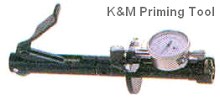 Others prefer the K&M tool, another “single-loader”, because it can be fitted with a seating depth gauge, for the ultimate in precision. On the other hand, one top shooter with a couple National Championships under his belt favors the modest $19.00 Lee Autoprime tool: “It’s simple, efficient and has served me well for years–I’m not convinced the fancy, expensive tools do a better job.” Others prefer the K&M tool, another “single-loader”, because it can be fitted with a seating depth gauge, for the ultimate in precision. On the other hand, one top shooter with a couple National Championships under his belt favors the modest $19.00 Lee Autoprime tool: “It’s simple, efficient and has served me well for years–I’m not convinced the fancy, expensive tools do a better job.”
This editor has tried all of these tools, and personally I favor the RCBS APS hand priming tool. It has two important advantages. Number one, primers are held in color-coded plastic strips so you never have to touch the primers. If you buy the pre-loaded strips, there is no chance of getting an upside-down primer, and you never have to fool with flipping primers in a tray. Second, the APS tool has a “universal” shell-holder. This employs spring-loaded jaws so it can fit any size cartridge, from a 17 Fireball to large magnums. The unit has a comfortable grip and plenty of leverage. Each time you seat a primer, the strip automatically advances.

Currently, only CCI primers can be purchased pre-loaded into strips. But there is an inexpensive tool that allows you to load Federal, Winchester, or Wolf primers into the strips. The strips come in a variety of colors (Red, White, Blue, Orange, Yellow, and Black), so you can sort your primers by color.

The RCBS APS hand primer is ideal when doing primer comparison testing. You can slide one strip of 25 primers in the tool, seat 5 or 10, then easily remove the strip with the remaining primers, and slide in a second strip with another primer type. You can slip the first strip back in a storage box and the primers remain ready to use.
As contained in the strips, primers can also be used in an RCBS 2000 progressive press, a bench-mounted priming unit, and a special device that fits into the top of a Rockchucker or similar press. I have loaded over 20,000 pistol rounds with an RCBS progressive press and I have had not a single flipped primer. Not one. The strip-priming system also makes it easy to switch from small to large primers on the progressive–this can literally be done in under 20 seconds.

The bench-mounted unit is ideal for priming large quantities of cases. The long handle provides plenty of leverage, and you can work fast, as the primers automatically feed through the system. When I load large quantities of varmint rounds, I use the bench-mounted APS system.
|


