Applied Ballistics has created a new series of YouTube videos about precision long range shooting. Featuring ace long-range shooter and professional ballistician Bryan Litz, these videos address various topics of interest to long-range marksmen. In this week’s video, the second in the series, Bryan Litz examines the most common causes of ballistics shooting errors at Long Range.
Watch Applied Ballistics Video about Common Mistakes in Long Range Shooting:
Bryan Litz of Applied Ballistics often hears the question: “What are the main reasons people miss their target at long range?” To answer that question, in this video, Bryan explains the most important variables in Long Range shooting. Bryan says: “Probably the number one thing is range — you have to have a [precise] range to your target because your bullet is dropping, and to hit the target you need to correct for bullet drop.” Distance may be indicated on the target bay (or berm), but for open ranges you should ascertain distance-to-target with a quality laser rangefinder. Even when the distance to target is shown with a sign or marker, you may want to confirm the distance with your rangefinder. (You may be surprised — we’ve seen marked target distances at commercial ranges off by 25+ yards!) Bryan says: “Get a good laser range to the target and you’ll be within a couple yards”.
After distance to target, the most important variable is the wind. This is the most challenging factor because the wind is constantly changing. Bryan explains: “After 300 or 400 yards, the wind [will] move your shots off the target if you don’t correct for it. The best way to account for the wind is to measure it at your location with a Kestrel. The Kestrel can give you the speed and direction of the wind at your location, which can baseline your wind call for your long-range shot.” Bryan acknowledges that there will still be variables: “The wind isn’t always blowing the same downrange as at your location… and the wind is always changing”. Bryan notes that you need to account for variances in wind between the time you gauge the wind angle and velocity and the time you actually you take your shot.
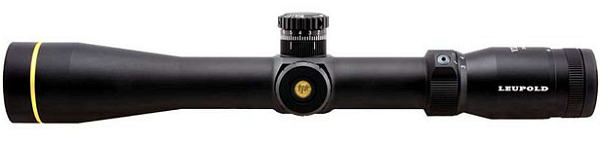
New S1 and S5 Knurled Dials can be user-installed in place of older Leupold turret caps.
Leupold & Stevens makes good scopes, but the standard turrets with screw-on caps are inconvenient for some users. It’s too easy to misplace the caps. Also the standard turrets are not the easiest to grip, particularly with gloved hands. To improve the “gripability” of its scope turrets, Leupold now offers new S1 and S5 screw-on knurled dials that fit in place of the cap covers. These aluminum dials offer large, knurled surfaces that are easy to grip, even when wearing gloves. “These screw-on dials mean no more lost caps or the need for a coin to make adjustments in the field,” said Tim Lesser, Leupold’s Product Development Director. The S1 is for MOA scopes while the S5 is for MIL scopes.
The S1 and S5 dials simply replace Leupold’s screw-on turret caps, so the user can install these easily without tools. It is NOT necessary to send your scope(s) back to the factory. Just remove the caps on your windage and elevation turrets, and screw the knurled dials in their place. The S1/S5 dials automatically align with the adjustment slot and securely tighten down. These dials are interchangeable between different riflescopes in the field. MSRP is $50 per dial set (either S1 or S5).
The S1 dial is engraved in ¼-MOA increments while the S5 (for mil-based turrets) is marked in 0.1 MIL. Both come with a locking zero stop and can be equipped with the Custom Dial System® (CDS) through the Leupold Custom Shop. The Leupold S1 and S5 dials are compatible with most Leupold riflescopes with click adjustments, with the exception of the VX-1 series and older riflescopes with friction adjustments. For those with bullet-drop-compensating reticles, the S1 and S5 are completely compatible. The screw on dials are covered by Leupold’s full lifetime guarantee.
Lapua, the Finnish maker of premium cartridge brass, bullets, and ammunition, has created a new Lapua Club for Lapua’s customers and product users. By signing up for the Lapua Club, you can get access to “members-only” data. In addition, by registering multiple products, you can get rewards such as Lapua hats and holsters. For each product registered you’ll also get a chance to win instant prizes or a Grand Prize Whitetail Hunt.
How to Sign Up for the Lapua Club
Join the Lapua Club by scanning the QR code on your 2015 Lapua ammunition box, Lapua cartridge case box, or Lapua bullet package. Use your mobile phone to read the QR code on your Lapua package(s), or go to http://www.club.lapua.com/en/campaign/lapua-club/ and directly type in the code. (NOTE: Packages that do not have a QR code may have a card in the box with the QR code.) By registering your package(s) you become entitled to exclusive Lapua Club member benefits.
NOTE: Lapua recommends that customers register each cartridge package separately. The more products you register, the more Lapua gear you can get:
By registering 5 products or more you can qualify for a Lapua Cap.
By registering 10 products or more you can qualify for a Lapua Holster.
Lapua notes: “If you have purchased multiple cartridge packages, you should register all of them separately. Each package code … gives you a chance to win instant prizes and take part in our main [contest]. Whether or not your package codes won an instant prize, each of them will also compete for the grand prize: a ticket to the Lapua White Tail Hunt 2015 event.”
Register your Lapua Products by entering the QR code on Lapua product packages.
A quarter million bucks in cash and prizes — that’s what’s up for grabs at the NRA’s World Shooting Championship (WSC) next month. This unique, multi-discipline event is the world’s richest shooting match, with $50,000 worth of cash awards ($25K to the winner) plus a monster $200,000 prize table. Competitors don’t even have to bring their own firearms — sponsors provide ALL guns and ammo.
The WSC, slated for September 24-26, at the Peacemaker National Training Center in Glengary, WV, is a multi-stage match involving 12 shooting disciplines over three days. Nearly all the firearms shooting sports (except benchrest and air rifle) will be showcased, so competitors must be skilled with rifle, pistol and shotgun. Speed is paramount. Although there are some accuracy-oriented stages, this is predominantly a multi-gun action match “on the clock” with relatively large, close targets.
The top WSC pro shooters, such as last year’s WSC winner SFC Dan Horner of the USAMU, are all seasoned 3-Gun competitors with blazing shot-to-shot speed and the ability to make rapid transitions from one gun to the next.
Reigning WSC Champion SFC Dan Horner is wicked fast. (File Photo, not from WSC).
All firearms and ammunition will be provided. This alleviates the need for shooters to purchase expensive new equipment and competitor travel costs are greatly reduced (since shooters won’t have to haul an arsenal of arms plus ammo). Think you’ve got what it takes to win? Then you can still register by visiting the World Shooting Championship Registration Page.
Here are the stages at the NRA World Shooting Championship:
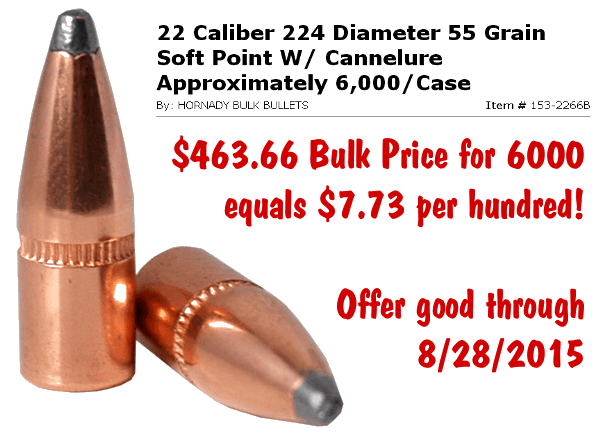
Need a boatload of bullets for varmint safaris, or high-volume AR-platform training sessions? Then check out this deal from Midsouth Shooters Supply. Right now you can get six THOUSAND .22-Cal 55gr softpoint bullets for $463.66 delivered. That works out to just $7.73 per 100 bullets. And yes, for a limited time, that price includes FREE Shipping (through August 28, 2015). If you have high-volume applications for .224-diameter projectiles, this deal is hard to beat. You could easily pay two to three tiems as much (per hundred) for similar bullets elsewhere. Buying in bulk saves big bucks.
These 55g Soft Point bullets are made by Hornady. The G1 Ballistic Coefficient (BC) is 0.243. Hornady says these bullets have a “match-grade jacket design” and offer “explosive expansion, even at low velocities”. NOTE: Midsouth also offers Hornady FMJ 55gr 22-cal bullets at low bulk prices.
Do you have some old, tired brass that needs a thorough cleaning — inside and out? Consider using an ultrasonic cleaning machine. When used with the proper solution, a good ultrasonic cleaning machine can quickly remove remove dust, carbon, oil, and powder residue from your cartridge brass. The ultrasonic process will clean the inside of the cases, and even the primer pockets. Tumbling works well too, but for really dirty brass, ultrasonic cleaning may be a wise choice.
Our friend Gavin Gear recently put an RCBS Ultrasonic cleaning machine through its paces using RCBS Ultrasonic Case Cleaning Solution (RCBS #87058). To provide a real challenge, Gavin used some very dull and greasy milsurp brass: “I bought a huge lot of military once-fired 7.52x51mm brass (fired in a machine gun) that I’ve been slowly prepping for my DPMS LR-308B AR-10 style rifle. Some of this brass was fully prepped (sized/de-primed, trimmed, case mouths chamfered, primer pockets reamed) but it was gunked up with lube and looking dingy.”
UltimateReloader.com Case Cleaning Video (7.5 minutes):
Gavin describes the cleaning exercise step-by-step on UltimateReloader.com. Read Gavin’s Cartridge Cleaning Article to learn how he mixed the solution, activated the heater, and cycled the machine for 30 minutes. As you can see in the video above, the results were impressive. If you have never cleaned brass with ultrasound before, you should definitely watch Gavin’s 7.5-minute video — it provides many useful tips and shows the cleaning operation in progress from start to finish.
The RCBS ultrasonic cleaning machine features a large 3-liter capacity, 60 watt transducer, and 100 watt ceramic heater. The RCBS ultrasonic machine can be found under $140.00, and this unit qualifies for RCBS Rebates ($10 off $50 purchase or $50 off $300.00 purchase). RCBS also sells 32 oz. bottles of cleaning concentrate that will make up to 10 gallons of Ultrasonic Solution.
Congratulations to Canada’s combined F-TR and F-Open squad for winning the 8-man National Team Match at the 2015 Canadian National F-Class Championships. Held recently at the Connaught Ranges in Ottawa, Ontario, this year’s F-Class Championship events were heavily attended by American and British shooters as Connaught will be the site of the 2017 World F-Class Championships.
At this year’s F-Class Championships at Connaught, there was a special eight-shooter International team event. Canada, Great Britain, and the United States each fielded 8-man National teams, with four F-TR shooters and four F-Open shooters. The course of fire consisted of three matches at 700, 800 and 900 meters, respectively.
The day started out with unusually low winds, but as the match progressed, mirage became heavy with tricky winds. When the dust settled, Canada was declared the winner with a score of 1743 with 159 V-Bulls, eleven points ahead of runner-up Great Britain and 13 points in front of third place Team USA. Canada deserves praise for its win, considering the strength of the American and British squads.
Canada’s Winning Team Personnel:
F-TR shooters: Bob Galloway, Dave Harry, Mark Iwanochko, and Paul Kahnert.
F-Open shooters: Jim Farrell, Barry Price, Alex Tkalitch, and Cal Waldner
Captain: Eric Bisson
Head Coaches: Kevin and Will Chou
Line coaches: Jonathan Laître and Richard Dreger
Here are impressive scores from the F-TR Shooters on the Canadian Team:
Line coach Jonathan Laître says that his fellow Canadian shooters are very proud of this team victory, which bodes well for the 2017 World F-Class Championships: “Team shooting in Canada looks promising for years to come with the dedication of all Team members. As our development Team also looks outstanding, we can’t wait for next season to come.”
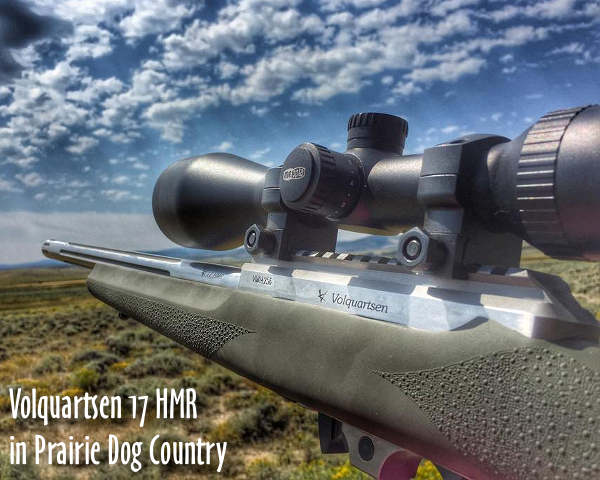
Top Shot Champion Dustin Ellermann has been busy up in Wyoming slaying varmints. On his Facebook Page, Dustin wrote: “I’ve been helping some ranchers out with their prairie dog infestation in Wyoming. The 17 HMR Volquartsen Custom is amazing! The Meopta Sports Optics R1r is super nice as well. Can you guess how many prairie dogs I eliminated in two days?” (Facebook users post guesses HERE.)
Dustin says the effective range of the 17 HMR is farther than one might expect: “I made hits out to 300 yards. 200 yards was easy as long as the wind wasn’t too bad.”
Dustin was very impressed with the 17 HMR cartridge: “Never paid it much attention before now because the ammo is five times more expensive than .22 LR and I mostly target shoot. However, for prairie dogs, the 17 HMR is amazing!” Dustin is now a fan of the speedy rimfire round. Consider this — Hornady’s 17 HMR ammo pushes a 17gr V-Max bullet at 2550 fps, twice as fast as typical .22 LR rounds.
Every week Brownells Merchandise Manager Paul Levy hosts a video featuring new products. We’ve seen these vid clips before, but three products in this week’s video really caught our attention. We like the new MTM Ammo Crate, and the new Durablue coating offers a great option for gun-owners who want a traditional-looking finish that is also durable. And for AR-10 owners, the gold-tone Titanium Nitride Bolt Carrier group promises smoother running with easier cleaning.
Products featured in this week’s video include:
MTM Ammo Crate. Wide, flat polymer box features O-ring seal for water resistance, and stackable shape for convenient storage. Integral handle makes for easy transport. Holds up to 85 lbs. of ammo, magazines, and any other type of supplies or gear. Available in 4½”- and 7¼”-deep models.
Titanium Nitride is an extremely robust, durable coating, and now it’s available on an AR-10 bolt carrier group. The new Prime Weaponry .308AR Titanium Nitride Bolt Carrier Group drops into AR-10 type .308 AR uppers. The tough gold-tone finish resists wear and corrosion, plus the slick surface speeds up the cleaning process.
Duracoat DuraBlue is a new spray-on coating that provides a deep, glossy finish like traditional bluing but without the worry of rust, scratches, or high cost. DuraBlue comes in an aerosol can or liquid form (for application with sprayer) in both glossy black and traditional blue. DuraBlue can be used on on all kinds of metal, even stainless steel and aluminum.
Believe it or not, legendary German gun-maker Walther Arms has never produced a .45 ACP pistol. Until now that is. You see Walther just announced that it will (finally) build a handgun, the .45 ACP PPQ, chambered for the classic .45 ACP cartridge. John Moses Browning would approve.
The striker-fired, polymer-framed .45 ACP PPQ boasts a smooth, 5.6-lb trigger with a 0.4″ normal travel and a 0.1″ reset. The 4.25-inch barrel features polygonal rifling (like HK barrels). Both slide and barrel have a hard Tenifer finish (like Glocks). The new .45 ACP PPQ includes ambidextrous controls, slide serrations, and front Picatinny rail for mounting accessories. The pistol holds 12 rounds and is equipped with three internal safeties. Overall length is 7.4 inches, and width is 1.3 inches.
Walther Arms’ VP of Sales and Marketing, Cyndi Flannigan, states: “This new caliber and product offering is a benchmark for Walther and the PPQ. We have built it to the same exacting German standards that deliver the ultimate home defense and personal protection firearm.” The new M2 .45 ACP PPQ pistol is expected to ship to dealers in early October, 2015.








 Top Shot Champion Dustin Ellermann has been busy up in Wyoming slaying varmints. On his


