Eurooptic vortex burris nightforce sale


teslong borescope digital camera barrel monitor


As an Amazon Associate, this site earns a commission from Amazon sales.


May 2nd, 2022

SMT Electronic Targets at NRA High Power National Matches

NRA High Power National Matches Camp Atterbury Silver Mountain electronic Targets

Big news for High Power rifle shooters — Electronic Targets will be employed at the 2022 High Power Rifle National Matches at Camp Atterbury, Indiana. That means faster relays, quicker scoring, and NO PIT DUTY!

The 2022 NRA High Power National Matches will run at Camp Atterbury from July 8-28, 2022. Registration is now open. Click HERE to Register.

Silver Mountain Targets Electronic Targets at Camp Atterbury This Summer
The NRA has confirmed that the Silver Mountain Targets electronic target system will be deployed for the High Power Rifle phases of the 2022 National Matches at Camp Atterbury, Indiana. The Silver Mountain Targets (SMT) technology, the “fourth generation of Electronic Target System”, is an OPEN SENSOR system fitted to conventional wood target frames. It uses four sensors to plot shot location (and score value) with great precision. Scores are transmitted via a WiFi network to mobile devices placed at each shooting station. Along with shot location, the score values are listed and recorded on the receiving devices.

“The NRA has been working with the Indiana State Rifle and Pistol Association (ISRPA), as well as the Central Indiana High Power Rifle Shooters (CIHPRS) in order to bring electronic targets to the NRA National Matches”, said Joseph P. De Bergalis, Jr., Executive Director of NRA General Operations.

Camp Atterbury SMT electronic targets silver mountain

Over the past three years, the NRA has confirmed that Silver Mountain Targets systems have worked very effectively in rifle competition. The SMT sensor technology is now proven in competition: “In 2019, the ISRPA chose Silver Mountain Targets for our High Power matches including the ISRPA Across the Course State Championships and the Governor’s Cup match in 2019″, said ISRPA President Charles Hiltunen. “We did an extensive comparison of alternatives and Silver Mountain Targets best fit our needs. Since then we have been very happy with the targets.”

NRA High Power National Matches Camp Atterbury Silver Mountain electronic Targets

“Silver Mountain Targets is very excited to be chosen for the very first deployment of this technology at the NRA National Matches. Our advanced modular architecture represents the latest in electronic target technology,” said SMT’s David Schnelle. “The system is designed to be easily expandable and provide a high level of reliability. System components are battery-powered to simplify deployment on a military range and allows the system to even operate if there is a power outage. Communications between targets and the firing line is a highly reliable WiFi connection, utilizing any WiFi-capable device to display competitors’ shots.”

“The National Rifle Association is pleased to continue our improvements at Camp Atterbury in order to better serve the competitive shooting community and further promote the shooting sports”, said Cole McCulloch, Director of NRA Competitive Shooting.

“With the Silver Mountain Target system, we will be able to run more relays in less time and reduce demands on competitors and staff. We are also very pleased that technical representatives from Silver Mountain Targets will be on-site for the entire championship to ensure optimum performance and to train NRA staff and volunteers on the technology.”

Permalink - Videos, Competition, News No Comments »
May 2nd, 2022

Do Chron Your Factory Ammo — Stated Velocities May Be Wrong

muzzle velocity applied Ballistics MV chronograph

Why You CANNOT Rely on the MV Printed on the Ammo Box!
When figuring out your come-ups with a ballistics solver or drop chart it’s “mission critical” to have an accurate muzzle velocity (MV). When shooting factory ammo, it’s tempting to use the manufacturer-provided MV which may be printed on the package. That’s not such a great idea says Bryan Litz of Applied Ballistics. Don’t rely on the MV on the box, Bryan advises — you should take out your chrono and run your own velocity tests. There are a number of reasons why the MV values on ammo packaging may be inaccurate. Below is a discussion of factory ammo MV from the Applied Ballistics Facebook Page.

Five Reasons You Cannot Trust the Velocity on a Box of Ammo:

1. You have no idea about the rifle used for the MV test.

2. You have no idea what atmospheric conditions were during testing, and yes it matters a lot.

3. You have no idea of the SD for the factory ammo, and how the manufacturer derived the MV from that SD. (Marketing plays a role here).

4. You have no idea of the precision and quality of chronograph(s) used for velocity testing.

5. You have no idea if the manufacturer used the raw velocity, or back-calculated the MV. The BC used to back track that data is also unknown.

1. The factory test rifle and your rifle are not the same. Aside from having a different chamber, and possibly barrel length some other things are important too like the barrel twist rate, and how much wear was in the barrel. Was it just recently cleaned, has it ever been cleaned? You simply don’t know anything about the rifle used in testing.

2. Temperature and Humidity conditions may be quite different (than during testing). Temperature has a physical effect on powder, which changes how it burns. Couple this with the fact that different powders can vary in temp-stability quite a bit. You just don’t know what the conditions at the time of testing were. Also a lot of factory ammunition is loaded with powder that is meter friendly. Meter friendly can often times be ball powder, which is less temperature stable than stick powder often times.

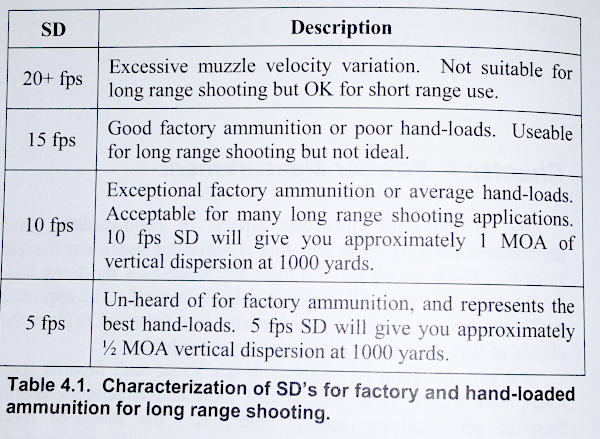
3. The ammo’s Standard Deviation (SD) is unknown. You will often notice that while MV is often listed on ammo packages, Standard Deviation (normally) is not. It is not uncommon for factory ammunition to have an SD of 18 or higher. Sometimes as high as 40+. As such is the nature of metering powder. With marketing in mind, did they pick the high, low, or average end of the SD? We really don’t know. You won’t either until you test it for yourself. For hand-loaded ammo, to be considered around 10 fps or less. Having a high SD is often the nature of metered powder and factory loads. The image below is from Modern Advancements in Long Range Shooting: Volume II.

muzzle velocity applied Ballistics MV chronograph

4. You don’t know how MV was measured. What chronograph system did the manufacturer use, and how did they back track to a muzzle velocity? A chronograph does not measure true velocity at the muzzle; it simply measures velocity at the location it is sitting. So you need to back-calculate the distance from the chrono to the end of the barrel. This calculation requires a semi-accurate BC. So whose BC was used to back track to the muzzle or did the manufacturer even do that? Did they simply print the numbers displayed by the chronograph? What kind of chronograph setup did they use? We know from our Lab Testing that not all chronographs are created equal. Without knowing what chronograph was used, you have no idea the quality of the measurement. See: Applied Ballistics Chronograph Chapter Excerpt.

5. The MV data may not be current. Does the manufacturer update that data for every lot? Or is it the same data from years ago? Some manufacturers rarely if ever re-test and update information. Some update it every lot (ABM Ammo is actually tested every single lot for 1% consistency). Without knowing this information, you could be using data for years ago.

CONCLUSION: Never use the printed MV off a box of ammo as anything more than a starting point, there are too many factors to account for. You must always either test for the MV with a chronograph, or use carefully obtained, live fire data. When you are using a Ballistic Solver such as the AB Apps or Devices integrated with AB, you need to know the MV to an accuracy down to 5 fps. The more reliable the MV number, the better your ballistics solutions.

Permalink Bullets, Brass, Ammo, Reloading, Tech Tip 1 Comment »
May 1st, 2022

Sunday GunDay: Falling-Block .50 BMG — Beauty of a Beast

.50 BMG J.T. 50-caliber Smith breech block falling block custom rifle

This is one amazing .50-caliber rifle. Along with the lever-actuated falling block, it has a massive swing-out breech block like you’d find on a field artillery piece. The action is so wide that the sights and scope are offset. You’ve heard of the “Beauty and the Beast”? Well here the Beast IS a Beauty….

View looking down at the action from above. Note the hinged Breech-Block.
.50 BMG J.T. 50-caliber Smith breech block falling block custom rifle

This extraordinary example of gunsmithing art was crafted by the late J.T. (Jack) Smith of Sudbury, Massachusetts. This unique .50-caliber rifle features an aircraft machine gun barrel cut down to 38-1/4″, and turned octagon to round (in the style of Schuetzen rifles). The round portion of the barrel is tapered with a heavy boss at the muzzle. The barrel is inlaid in gold on both left and right side top flats. Custom scope bases are fitted to the receiver and to the top of the barrel. These hold an externally adjusting Unertl 15X target scope in offset scope mounts.

.50 BMG J.T. 50-caliber Smith breech block falling block custom rifle

Huge Falling Block Receiver
The massive receiver (8″ long x 2-3/4″ wide x 3″ deep) is remarkable in design and construction. Machined from solid steel, the action incorporates several unique features. Note the hinged Howitzer-style breech block which swings to the right and mortises into the back of the receiver in the loading slot, providing a back-up for the falling block. We’ve never seen anything like that on any rifle. The one-piece floorplate/lever incorporates a Ruger No. 1-style latch which locks into the bottom of the trigger guard. The entire floorplate and lever retract downward. Firing is accomplished by means of a striker mounted in the hinged (swing-out) breech block. This is manually cocked with another lever on top of the breech block. Dropping the falling block activates the extractor which removes the spent case.

Offset Sights
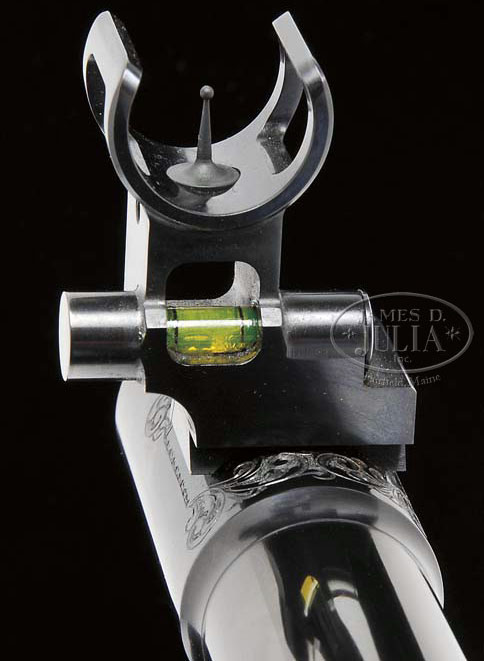
This rifle features a custom-built, windage-adjustable offset front sight plus a custom-built vernier tang sight with aperture offset to the left side. The sights are offset to the left for a right-handed shooter, to correct for the extreme width of the receiver, allowing a more comfortable head position.

.50 BMG J.T. 50-caliber Smith breech block falling block custom rifle

(more…)

Permalink Gear Review, Gunsmithing No Comments »
May 1st, 2022

Bio-Mechanics of Marksmanship — Skeletal Support

Science Shooting 3P Position Jamie Gray

Have you ever wondered how Olympic-class position shooters hold their aim so steady? Those bulky shooting coats help, but there is a lot of bio-mechanics involved also. Top shooters employ their body structure to help support the weight of their rifles, and to steady their aim. This interesting video, produced by GOnra Media, demonstrates rifle hold and body alignment for prone, standing, sitting, and kneeling positions. Olympic Gold Medalist Jamie Corkish (formerly Jamie Gray) demonstrates the proper stance and position of arms and legs for each of the positions.

Olympic Gold Medalist Jamie Corkish Demonstrates Shooting Positions

Ideally, in all of the shooting positions, the shooter takes advantage of skeletal support. The shooter should align the bones of his/her arms and legs to provide a solid foundation. A shooter’s legs and arms form vertical planes helping the body remain stable in the shooting position.

Science Shooting 3P Position Jamie Gray

Science Shooting 3P Position Jamie Gray

Science Shooting 3P Position Jamie Gray

Jamie Corkish, London 2012 Gold Medalist in Women’s 3 X 20, has retired from top-level competitive shooting. However, Jamie remains involved in the shooting sports as a Public Relations/Marketing representative for ELEY, a leading maker of rimfire ammunition. Jamie also works with shooting clubs and educational institutions to promote smallbore target shooting.

Images are stills from GOnraMedia video linked above.
Permalink - Articles, - Videos, Shooting Skills 1 Comment »