


Suppressor Basics — How to Acquire One and How They Work

Map courtesy SilencerShop.com.
Q & A: TOP TEN Questions about Suppressors Answered HERE »
 You’d like to protect your hearing, and maybe you’re a little curious about how your rifle might shoot suppressed. So you’re thinking of buying a suppressor (aka “can”, “moderator”, “silencer”). The good news is that suppressor ownership is now legal in 42 of the 50 American states — that’s 84%! And 41 states allow their use for hunting. So for most American adults, getting a suppressor is legal, provided the owner passes required background checks. But you can’t just get one off the shelf at Walmart. Acquiring a suppressor still requires filling out ATF paperwork. Plus there is typically a pretty long wait. But, thankfully, you no longer have to pay for a $200 Federal Tax Stamp (thanks to recent Federal legislation).
States Where Suppressors Are Allowed
Currently, these 42 states allow private ownership of suppressors/silencers: AL, AK, AZ, AR, CO, CT, FL, GA, ID, IN, IA, KS, KY, LA, ME, MD, MI, MN, MS, MO, MT, NE, NV, NH, NM, NC, ND, OH, OK, OR, PA, SC, SD, TN, TX, UT, VT, VA, WA, WV, WI, WY.
Note: Even if you live in one of the states listed, you should still verify that owning a suppressor is legal in your area. Some states may have municipal- or county-based restrictions.
States Where Suppressor Ownership is Prohibited
Unfortunately, there are still eight (8) States that forbid private ownership of suppressors. The eight No-Go States are: California, Delaware, Hawaii, Illinois, Massachusetts, New Jersey, New York, Rhode Island. In these eight states, private ownership of suppressors (aka “silencers”) is forbidden. Hopefully some of those eight hold-out states will change their laws in the months ahead.
How to Acquire a Suppressor/Silencer
As of January 1, 2026, the federal transfer and manufacturing tax for silencers, short-barreled rifles, and short-barreled shotguns was reduced to $0. While the previous $200 ATF fee is gone, all the underlying regulatory requirements remain fully active.
Still Required When Buying a Suppressor:
— Paperwork: You must still submit an ATF eForm or Form 4 through a licensed dealer.
— Background Check: ATF background check and approval are mandatory before taking possession.
— Identification: Fingerprints and passport-style photos must still be provided with your application.
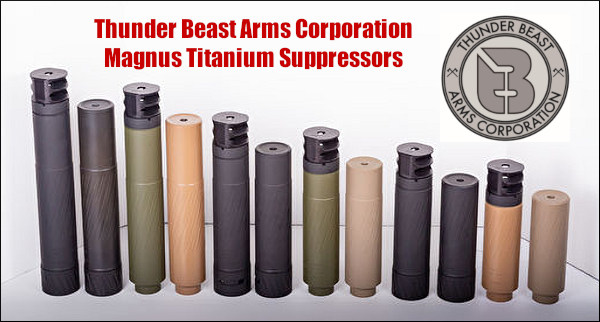
Looking Inside a Suppressor in Action
Popular YouTube Channel Smarter Every Day recently released a cool video featuring rifle suppressors with see-through acrylic sleeves. The team filmed shots through the suppressors using ultra-high-speed (110,000 frame per second) cameras. When played back in super-slow-motion, you can see the flame propagate through the suppressor and the bullet move through each baffle before it exists the muzzle. Watch the results in the video below — it’s mesmerizing:
See Through Suppressor in Super Slow Motion (110,000 fps) — Click Arrow to Watch:
Suppressors, On Average, Reduce Noise Levels about 30 Decibels
In an article for Ammoland, gunwriter Sam Hoober says that you can expect about 30 decibels (dB) of noise reduction from the average suppressor: “Looking at a few different products, SilencerCo attests their suppressors reduce the sound pressure of a 9mm gunshot to anywhere from 125.7 dB to 131.5 dB, depending on the model. Advanced Armament Co, another popular supplier, attests a 23 dB to 33 dB reduction or down to 127 dB. Liberty Suppressors, another manufacturer, attests a reduction of 24 dB to 38 dB, depending on model and other factors. In short, we can presume something on the order of 30 dB of attenuation as an average.”

Using that 30 dB number you can quickly discern that you’ll still need hearing protection — good hearing protection — when shooting any suppressed firearm (even a .22 LR). “Spikes of 130 dB and more can result in permanent hearing damage instantly”. Source: NRA Blog.
Similar Posts:
- Suppressor Basics — How to Obtain Them and How They Work
- Suppressor Facts — How to Get One and How They Work
- Suppressor Basics — How to Get One and How They Work
- Suppressors — How They Work and Where They Are Legal
- Suppressors Are Legal to Own in 42 States Now
Tags: ATF Suppressor, Class III, dB Rating, Noise Suppressor, Silencer, Silencer State Law, Sound Moderator, Suppressor, Tax Stamp


