The Making of MatchKings — How Sierra Produces SMKs
All Sierra bullets begin life as a strip of gilding metal, an alloy consisting of 95% copper and 5% zinc. To meet Sierra’s strict quality requirements, the gilding metal requires three times more dimensional and quality control standards than is considered standard in the copper manufacturing industry.
A blanking press stamps out a uniform disc and forms the cup that will be drawn into the MatchKing jacket. The cup is then polished and sent to a draw press to be drawn into a jacket that is longer than needed for the future MatchKing, thus allowing for the trim process. Press operators constantly check concentricity to ensures jacket quality. The jackets then go to a trimmer where they are visually inspected again.
After being polished a second time, the jacket travels to the bullet press. In the meantime, 80-pound lead billets are being extruded into lead wire for the cores where great care is taken so that the core wire is not stretched. The core wire is lightly oiled before continuing to the bullet press to be swaged.
The lead core wire and trimmed jacket meet at the bullet press where the first stage forms a boattail on the jacket. The lead core is then formed on top of the bullet press and fed down into the jacket. In one stroke of the press, the MatchKing is formed.
Quality control technicians pull samples from each lot of MatchKings to make sure they meet Sierra’s stringent standards. Samples are then sent to Sierra’s 300-meter underground test range (shown below) to be shot for accuracy on mechanical mounts referred to as “unrestricted return to battery rests” that Sierra designed and built in-house.
After inspection, the bullets are placed in the familiar green box along with reloading labels. They are then shrink-wrapped and shipped all over the world.
Virginia Governor Glenn Youngkin has vetoed two dozen anti-gun bills passed by the Democrat-controlled Virginia General Assembly. These bills would have curtailed individual gun rights and attacked gun dealers/manufacturers throughout the Commonwealth. The NRA and NSSF (National Shooting Sports Foundation) praised Governor Youngkin for standing up to those who want to destroy gun rights in Virginia.
The NRA praised Gov. Youngkin for his actions to preserve Second Amendment rights: “[We] thank Governor Youngkin for standing strong in his support for the Second Amendment by vetoing the litany of gun control bills pushed through the General Assembly this year,” said John Commerford, Exec. Director of the NRA Institute for Legislative Action (NRA-ILA). “For the second year in a row, [Virginia] gun control activists tried to enact dozens of radical, California-style laws that would have severely restricted the Second Amendment rights of gun owners in the Commonwealth. The NRA applauds Governor Youngkin for upholding his promise to protect our Constitutional freedoms.”
The bills vetoed by Governor Youngkin came from the long wish list of radical gun control activists. This included attempts to restrict the Constitutional rights of 18- to 20-year-old adults, dramatically expand gun-free zones that would have left law-abiding Virginians defenseless and enact a mandatory waiting period to take possession of a legally-purchased firearm. In addition, the vetoed legislation would have banned a wide range of common firearms used for hunting, competition, and self-defense
Notable anti-gun bills vetoed by Gov. Youngkin this year include:
SB 848 — Remove the right of anybody under 21 years of age to purchase certain semiautomatic rifles mislabeled as “assault weapons.”
SB 891 — Mandates 5-day waiting period of five days for the purchase and transfer of firearms.
SB 1181 and HB 1607 — Bans the sale of many semiautomatic firearms and bans magazines having a capacity of more than 10 rounds.
SB 1329 — Imposes restrictions on concealed carry and storage in vehicles.
SB 1450 and HB 1608 — Creates new civil liabilities for companies engaged in the sale, manufacturing, distribution, or marketing of firearm-related products.
CLICK HERE for the official list of Virginia legislation vetoed by Gov. Youngkin so far this year. This includes the two dozen anti-Second Amendment bills he recently vetoed.
The NSSF notes that the defense of Second Amendment rights by Governor Youngkin proves that Elections DO matter. All gun owners should register and VOTE to ensure that your rights are preserved. Take time to research candidates and support those who will protect your Second Amendment rights.
If you want to stay current with trends in the firearms industry, and see important new product releases before they hit dealers’ shelves, you should check out Shooting Industry magazine. While tailored for firearms/outdoor gear retailers and industry professionals, this monthly journal also provides valuable information for all gun owners. We read Shooting Industry to learn about sales trends, new products, and current gun laws issues.
READ for FREE — Shooting Industry Magazine is available in a digital format for FREE. The archives go back to January 2022 — giving you instant access to 40 FREE issues.
Get FREE Digital Shooting Industry Magazines for the Past 3+ Years
You can access, for free, three years of Shooting Industry back issues (2024, 2023, 2022), PLUS all the latest 2025 issues. CLICK HERE for the 2025 issues along with previous issues back through January 2022.
Below we’ve included quick links to the four most recent Shooting Industry editions — January 2025, February 2025, March 2025, and April 2025. These four monthly magazines can be read online for free. Also, as they are in PDF format you can easily print all or part of these monthly magazines. Simply click each cover to read full issue for FREE:
Along with the four 2025 issues, there are 36 more digital editions of Shooting Industry Magazine available for FREE on the web. Every monthly issue for years 2024, 2023, and 2022 is available online. Simply visit the Magazine Archive Page and scroll down top to bottom.
To access prior year monthly editions, CLICK HERE to access the Shooting Industry Digital Archives page with links for all 2024, 2023, and 2022 monthly issues.
SUMMARY: Powder can have a very long shelf life. You need to watch for changes in smell and color. A reddish tinge, almost like rust on the powder, is a bad sign, as is a foul odor, not to be confused with a normal chemical smell. Either of these signs indicate it is time to dispose of your powder by means other than shooting.
Ever wondered about the stability of the propellants in your reloading room? There are some important things you should know about powder storage, to ensure consistent powder performance and safety. Western Powders (which has been acquired by Hodgdon) published an informative Q & A series entitled Dear Labby: Questions for our Ballistics Lab. Here are some excerpts that pertain to powder storage and shelf life. Worried that your powder may be too old? Western’s experts explain how to check your propellants for warning signs.
Proper Powder Storage
Q: I live in southern Arizona where it is very hot. I am told powders will become unstable if stored in an area not air-conditioned. My wife says no powder or primers in the house. Can powder be stored in a refrigerator? What about using a fireproof safe? I would appreciate your ideas. — M.C.
Lab Answer: SAAMI guidelines are pretty clear on issues of storage. They recommend storing smokeless powder in containers that will not allow pressure to build if the powder is ignited — ruling out gun safes and refrigerators.
In their original containers, the lifespan of smokeless powders is quite long, even in hot, arid climates. In fact the lifespan is typically longer than the average handloader would need to store them. Stored safely in a garage or outbuilding, your powder should last years. If you see the powder developing a reddish tint, or giving off a foul odor, it is time to discard it.
Clumps in Powder Container
Q: I ordered some of your Accurate 1680 powder back about in December. I just now opened it … and it is full of clumps. My knowledge tells me that means moisture. Am I wrong? I just now broke the seal and it has been stored in a ammo can with desiccant packs around it and a dehumidifier running 14-16 hours a day. I can’t imagine this being my fault, if this does indicate moisture. I don’t know if the pink part on the label is suppose to be red or not, but it is definitely pink, so if it was red I am wondering if I was shipped an old container? I hope that this isn’t bad and I am stuck with it…
Lab Answer: All powder contains a certain amount of moisture. When the powder is stored or during shipping, it can go through temperature cycles. During the cycling, the moisture can be pulled to the surface and cause clumping. Clumping can also be caused by static electricity if too dry or the powder has limited graphite content. You can break up the clumps before metering and they shouldn’t be a problem. This will not affect the powder performance, so your product is fine. Accurate 1680 labels are designed in Pink. As a side note, specification for testing powder is at 70° F and 60% humidity.
Shelf Life and Packaging Dates
Q: Does powder ever get to old to use and what identifying marks does your company put on the canister for when it is made, You have helped me out a while ago when I asked about keeping my cowboy shooting under 950 fps and it works great less stress on the hand and the recoil is very minimum. — R.B.
Lab Answer: On one pound bottles, the number is on the corner in a silver box. If the powder was poured today, it would read 012815 followed by a lot number. The whole number would look something like 012815749. Eight pound bottles have a sticker on the bottom with an obvious date code. The lot number appears above the date.
In our Shooters’ Forum there is a popular photography thread. Along with some great nature and hunting images, you’ll find quality photos of handsome firearms. Among the many images were head-turning photos of some very impressive pistols belonging to Forum member Beiruty from Texas. He has some of the most handsome mag-fed handguns we’ve ever seen. Here are six of his favorite semi-auto pistols from his collection. Three of these handguns boast beautiful engraving.
FN Browning High Power Renaissance
This 9mm hand-engraved High Power with silver finish was made in Belgium in 1971:
NOTE: This is one of a near-matching pair of FN HP Renaissance pistols featured in the top photo.
Hämmerli .22 LR Model 208, Special Edition
This Special Edition, one of 500, marks 125 years of Hämmerli Sportwaffenfabrik (1863-1988):
The handsome grip is factory carved. This Model 208 pistol shipped in a fitted case, shown below.
Colt .45 ACP 1911 Commander
This 1975-vintage Colt Commander 1911 sports fully-engraved frame and slide:
Smith & Wesson .22 LR Model 41 Long Barrel
This target pistol features a 7-3/8″ barrel with factory compensator. Grip is custom:
Browning .22 LR Medalist Pistol
This handsome Browning Medalist, all factory standard, was made in Belgium in 1964:
The video below shows another Browning Medalist of the same design and relative vintage:
Stoeger Arms American Eagle Navy Model Luger
This stainless Stoeger Navy Model 6″ Luger Pistol is vintage 1978-1980:
One of our Forum members complained that he wasn’t able to set his primers flush to the rim. He tried a variety of primer tools, yet no matter what he used, the primers still didn’t seat deep enough. He measured his primers, and they were the right thickness, but it seemed like his primer pockets just weren’t deep enough. He was mystified as to the cause of the problem.
Well, our friend Boyd Allen diagnosed the problem. It was the decapping rod. If the rod is adjusted too low (screwed in too far), the base of the full-diameter rod shaft (just above the pin) will contact the inside of the case. That shaft is steel whereas your case is brass, a softer, weaker metal. So, when you run the case up into the die, the shaft can actually stretch the base of the primer pocket outward. Most presses have enough leverage to do this. If you bell the base of the primer pocket outwards, you’ve essentially ruined your case, and there is no way a primer can seat correctly.
The fix is simple. Just make sure to adjust the decapping rod so that the base of the rod shaft does NOT bottom out on the inside of the case. The pin only needs to extend through the flash hole far enough to knock the primer out. The photo shows a Lyman Universal decapping die. But the same thing can happen with any die that has a decapping rod, such as bushing neck-sizing dies, and full-length sizing dies.
Whenever you use a die with a decapping pin for the first time, OR when you move the die to a different press, make sure to check the decapping rod length. And it’s a good idea, with full-length sizing dies, to always re-check the height setting when changing presses.
There are a variety of decapping dies currently on the market, with models available from LEE, Lyman, Hornady, RCBS, Redding, and Sinclair Int’l.
LEE Universal Decapping Die Costs Just $11.49
Speaking of decapping tools, Midsouth Shooters Supply sells the LEE Universal Decapping Die for just $11.99 (item 006-90292), a very good deal. There are many situations when you may want to remove primers from fired brass as a separate operation (prior to case sizing). For example, if your rifle brass is dirty, you may want to de-cap before sizing. Or, if you load on a progressive press, things will run much more smoothly if you decap you brass first, in a separate operation.
Decapping Dies for Cases with Smaller Flashholes
TAKE NOTE: Some Euro Small Flash Holes are spec’d at 1.5mm or 0.059″, and max out at about .062″, so these need a smaller die pin.
The low-cost LEE Universal Decapping Die will work with cartridges from 17 Fireball all the way up to big Magnums. However, NOTE that the decapping pin supplied with this Lee die is TOO LARGE for LAPUA 220 Russian, 6mmBR, 6.5×47, 6.5 Creedmoor, .308 Win (Palma) and Norma 6 PPC flash holes. Because the pin diameter is too large for these brass types, you must either turn down the pin, or decap with a different tool for cases with .059-.062″ flash-holes.
Sinclair Int’l offers a Stainless Decapping Die that comes with BOTH .080 and .060 Pins. The $46.99 die ships with three decapping pins for standard .080″ flash holes, and two pins for .060″ flash holes.
Redding makes a Universal Decapping Die with an optional smaller-diameter decapping rod for the smaller .059-.062″ flash holes found on the BR and PPC cases. The use of this die is explained in the video below:
We know that Competition Machine (Gary Eliseo) makes great chassis systems and Pierce Engineering (John Pierce) makes great actions. But sometimes a project comes together even better than one can imagine. The folks at Pierce Engineering crafted an Eliseo Tubegun that displayed some mind-blowing accuracy during initial testing. This was a special rifle built to a client’s spec in .22 PPC.
After his team completed the rifle, John Pierce took the Tubegun to the range to make sure everything was working right. The rifle was chambered for the .22 PPC, a known accuracy cartridge. Would this cartridge shoot in this gun? Heck yeah was the answer! The first two shots out of the gun were touching. That was promising enough. But then John drilled a five-shot group that was basically one hole! Here is that target. First two shots upper left, then the five-shot group below and to the right. Chassis-maker Gary Eliseo commented: “that’ll do just fine…”
Disclaimer: John shot some more groups with this Tubegun that were definitely NOT one-holers. That first five-shot masterpiece could not be duplicated. However, we’re told that the rifle shot other groups in the 2s, 3s, and 4s — impressive performance for a rifle designed for prone and position shooting. This shows how well the Pierce action mates to the Competition Machine chassis.
And if the owner ever wants to show off a “wallet group” for his new rifle — well he’s got that, thanks to John’s great trigger-pulling and rifle-building. Using On-Target software we measured that five-shot group at 0.189″ (see photo at right). That’s crazy small for a new gun with zero load development. That’s also a testimony to the quality of the Norma .22 PPC brass.
Why the .22 PPC Chambering?
The customer owns other Eliseo Tubeguns, but wanted something that combined extreme accuracy with very low recoil. He also wanted to be able to shoot factory brass without fire-forming. Norma makes very high-quality .22 PPC cartridge brass that is an easy load and shoot solution. In fact the folks at Pierce Engineering custom-loaded a quantity of .22 PPC ammo for this Tubegun and shipped it off to the customer along with the new rifle. NOTE: Loading ammo is not something that Pierce normally does, but this was a special client request.
Norma .22 PPC Cartridge Brass is available from Bullet Central for $75.99 for FIFTY (50) cases. That works out to $151.98 per 100. Yep that’s pricey considering that 6 years ago this same Norma brass was just $88.88 per 100 cases. But we have seen significant inflation in nearly all premium brass offerings.
Forum member Kevin (aka “N10Sivern”), revealed he needs some help with a compulsion — a compulsion to keep buying more and more guns and ammo. Particularly ARs, all shapes and sizes of ARs. Way too many ARs. You could say he has an ARdiction….
In a Forum Thread from a few seasons back, Kevin posted:
“I may need an intervention. Trying to clean my office and pulled this stuff out. I’m missing an AR10 lower somewhere and an AR15 upper. I’ll find them before the day is done. I have a big box full of parts as well, and 4 barrels still in the cardboard tubes. Sigh. This is gonna be a lot of Cerakoting for me.”
Another Forum member said: “For the love of God, man. Delete this thread lest you be accused of hoarding!”
Kevin replied: “I guess I am hoarding a little. But it’s good hoarding right?”
And then he posted this “Mail Call” photo:
Kevin’s caption: “It only gets worse. Mail Call today: 20″ .308 Ballistics Advantage barrel, 26″ Savage 25-06 barrel, 700 pieces of .38 special, 300 pieces of .357 magnum, 500 pieces .308 Win, gas tube, Hornady Modified Case Gauge. I have more crap on the way too.”
Forum Member’s Chime In…
Kevin’s “Need Intervention” post drew plenty of comments from other Forum Members:
“God! It is so refreshing to see that my illness is widespread with little hope (or desire) for a cure. I smiled reading each post.” — Gary0529
“You know you have a problem when you open a drawer and find components you forgot you bought.” — JoshB
“It’s not hoarding if you intend to use it. Says he who has 12,000 primers.” — Uthink
“I guess I’ll go ahead and volunteer to help you with your obviously much needed intervention… send me the pictured items and then you’ll no longer have to deal with those nasty temptations. Just think about it, you’ll have less clutter in your office plus you’ll not have to fret over the need for any cerakoting either. I’m just one human being volunteering to help out another fellow human who needs help!” — PikesPG
Ruger Super GP100 Revolver in 9mm Luger (9x19mm)
Wouldn’t it be cool if you could shoot your 9mm semi-auto pistol ammo in an ultra-accurate revolver? Well you can. Ruger adapted its existing Super Redhawk frame to create the Super GP100 9mm Luger (9x19mm) revolver. As you can see, the Super GP100 9mm features a stubby 8-round PVD-coated cylinder to better fit the 9x19mm round. According to Guns.com the 9mm GP100 “uses a cylinder and extractor cut for moon clips to speed up reloading [and] sports a 6-inch half-lug sleeved and shrouded barrel with an 11-degree target crown[.]”
Watch this GunBlast video review to see how this unique Ruger 9x19mm wheelgun performs. Reviewer Boge Quinn said this a “competition grade gun” with nice fit and finish. Out of the box the Super GP100 9mm had a 9.5-lb double-action pull and a 4.5-lb single action trigger pull. It took a while for the pull to smooth out Quinn noted. Also, he said that if you do NOT use the supplied moon-clips it is awkward to remove the spent cartridges: “You don’t have to use a moon clip, but I don’t know why you wouldn’t… it just works great that way.”
The 9×19mm Parabellum (aka 9mm Luger) cartridge was introduced in 1902 by German weapons manufacturer Deutsche Waffen und Munitionsfabriken (DWM) for the Luger semi-auto pistol. Now 120 years later, Ruger brings us a sturdy, 6″-barrel revolver for this popular cartridge. Ruger adapted its existing Super Redhawk frame for this Super GP100 9mm revolver. In this video, Ruger engineer Mark Gurney explains the features of the Super GP100 9mm revolver:
Super GP100 9x19mm Features
Triple-locking cylinder locked into the frame at front, rear and bottom for more positive alignment and dependable operation.
High-strength stainless steel cylinder is fluted and shortened to reduce overall mass and increase rotational speed. Cylinder has PVD finish for durability and ease of extraction.
Polished and optimized internals, a centering boss on the trigger, and centering shims on hammer deliver a smooth double-action trigger pull with crisp/consistent let-off.
Cylinder and extractor are cut for moon clips to speed reloading during intense competition. Ships with three full moon clips and moon clip tool. The ejector and chamber mouths have a light chamfer to aid loading with moon clips.
Hogue hardwood grip is hand-finished for a smooth, polished feel. Grip frame accommodates a wide variety of custom grips.
Transfer bar mechanism provides security against accidental discharge.
Cold hammer-forged barrel has precise rifling for accuracy and longevity.
Barrel features 11° target crown for competitive-level accuracy.
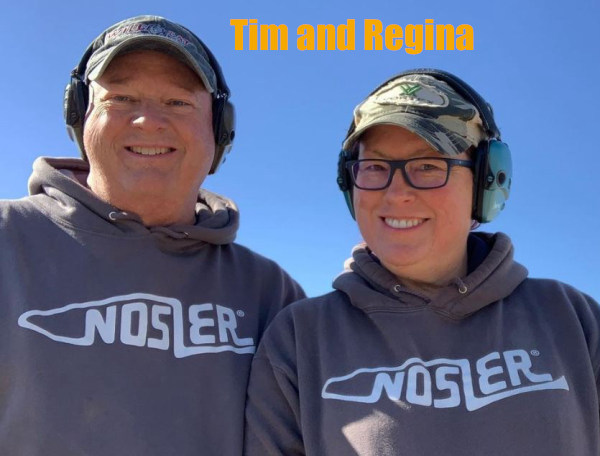
You’ve heard the adage — “The couple that plays together, stays together.” Here’s a story about a talented husband and wife who compete together in precision rifle matches. Shooters Tim and Regina Milkovich have done well in competition, including both placing in the Top 10 at the popular CowTown Accurized AR Match a while back. Regina took third with a nearly-clean run, dropping only one shot on Stage 5 to end with 49 points and an overall time of 49.50. Tim followed closely behind, placing sixth with 48 points and a time of 37.95.
This match, held at the CowTown Range in Peoria, Arizona, is designed to test and build shooters’ long range skills. Shots are taken from normal PRS-style positions and supports. Each match consists of five stages with targets ranging from 100 to 700 yards. Each stage has a 20-round maximum, and the match typically requires 40 to 50 hits.
Tim and Regina, who are both sponsored by Nosler, can often be found competing together at individual and team matches. At this match, both shot ARs chambered in .223 Rem loaded with Nosler .22 caliber 77gr Custom Competition bullets.
This video is from a past Cowtown Accurized AR match.
Regina is a Top Female PRS Shooter
Regina is one of the top female precision rifle competitors in the country. She is one of only two women to ever win a national-level Precision Rifle Series (PRS) match. Just a few years ago Regina was a novice in the PRS/NRL game. Now ranked as a Master Class shooter, today she is a respected, top-level competitor.
Time is a Veteran Who Shoots Many Disciplines
Tim is a military veteran with service in the U.S. Marine Corps, U.S. Army, and U.S. Air Force. He has been shooting competitively since 1986 in multiple disciplines including Pistol Silhouette, Bullseye Pistol, USPSA, IDPA, and 3 Gun. Tim has a Master Class ranking in most of the disciplines he shoots.
Tim also shoots bolt-action rifles. Below are his 6.5×47 Lapua cartridges loaded with Nosler 140gr RDF bullets and Varget powder. Photos from Tim Milkovich Facebook Page.


 Disclaimer: John shot some more groups with this Tubegun that were definitely NOT one-holers. That first five-shot masterpiece could not be duplicated. However, we’re told that the rifle shot other groups in the 2s, 3s, and 4s — impressive performance for a rifle designed for prone and position shooting. This shows how well the Pierce action mates to the Competition Machine chassis.