A carpet is used up front for smoother tracking with the Joy-Pod’s flat, ski-style feet. The arms of the Joy-Pod were painted to match the stock. The rear bag features low-drag material on the ears.
F-Class competition grows in popularity every year. Unlike F-Open, the F-TR (Target Rifle) class is limited to the .223 Remington (5.56×45) or .308 Winchester (7.62×51) chamberings. F-TR rifles also use bipods rather than a front rest. But these are no ordinary Harris-style bipods. Modern F-TR bipods have a wide footprint for added stability and many F-TR shooters favor SEB Co-Axial joystick bipods (aka “Joy-Pods”). Today we are featuring an F-TR rig that showcases the types of components, and accessories used by top F-TR competitors — including a coaxial bipod and Labradar Chronograph. If you’re considering getting started in the F-TR game, take a close look at this modern F-TR build from Forum member DM.Oakes.
Modern F-TR Rig with Borden Action, Krieger Barrel, and SEB Joy-Pod
This handsome .308 Win F-TR rig features a smooth-running Borden BRM action, 30-inch 1:10″-twist Krieger barrel, and an X-Ring Laminated Wood stock. Up front is a coaxial “Joy-Pod” joystick bipod. This is a state-of-the art, wide footprint bipod used by many competitors at the Worlds in Canada. The long joystick allows the “driver” to quickly adjust both elevation and windage in a smooth, continuous motion. The Joy-Pod can be adjusted so it will hold setting during the shot — you don’t have to “hard-hold” the joystick. Many shooters let the joystick slide through their fingers as the rifle moves back on recoil. With a little practice (and careful placement of the rear sand-bag), the tracking is excellent and you can slide the gun right back to point of aim after each shot.
This F-TR rifle is shown during load testing with a LabRadar chronograph.
» Full LabRadar Field Test/Review by Ray Gross
If you are considering purchasing a LabRadar Chronograph system, we strongly suggest you read the very thorough and informative LabRadar Review by Ray Gross, past Captain of the USA F-TR team. Ray notes: “It takes me about 3 minutes to set up [my LabRadar] at the range. Because there are no downrange screens, I do not have to hold up other shooters on the range like I would when setting up a traditional chronograph. The convenience alone will mean that I will use it more often than my old chronograph. Every time I take it out, I enjoy it a little bit more.”
Bang Clang! The 2023 Steel Challenge World Speed Shooting Championship is featured on Shooting USA TV this week. The Shooting USA Steel Challenge episode runs August 23, 2023 on the Outdoor Channel. Show times are: Wednesdays, 9:00 PM Eastern and Pacific, 8:00 PM Central. After those broadcast times, you can watch the show via Vimeo on Demand for $0.99 per episode.
This past April, the fastest speed shooters in the world showcased their skills at the Steel Challenge Championship at the CMP Talladega Marksmanship Complex in Alabama. The Steel Challenge course consists of eight 5-target close-range stages. This discipline has been called “drag racing with guns”. Draw and shoot 5 steel targets with time as your score. The shooter with the lowest overall time wins. This is a very popular event — when registration opened for the 2023 Steel Challenge, more than 700 slots filled in just 12 minutes.
The 2023 Steel Challenge at Talladega was featured this month on the NRA Shooting Sports USA site.
There are multiple pistol and revolver classes, both rimfire and centerfire, iron sights and optics. Increasing in popularity (and speed) are the rimfire rifle and pistol-caliber centerfire rifle classes. There are 13 gun classes in total, the most for any shooting championship. In the centerfire handgun match, the fastest times are posted by competitors using enhanced open guns with compensators and red-dot optics.
Here is a full length Shooting USA Steel Challenge Episode from 2017:
Shooting USA Video covers Course of Fire, Firearms Classes, and Target Layouts (1:20)
Definitely watch the 4-minute video (above) produced by Shooting USA. It explains the classes, shows the stages, and illustrates ALL the different gun classes, pistol AND rifle. You can also see some of the world’s fastest shooters including Jessie Harrison (1:47, 3:44) and Max Michel (3:48). Be amazed by the speed of semi-auto rimfire rifles — five targets hit in under two seconds!
The Steel Challenge was founded in 1981 by Mike Dalton and Mike Fichman, in Southern California. The two Mikes wanted an exciting alternative to paper targets and came up with the all-steel format. The Steel Challenge World Speed Shooting Championships have grown to one of the largest professional pistol competitions in America. In 2022, scores of competitors competed at the Talladega Marksmanship Park for glory and cash prizes. The Steel Challenge is governed by the Steel Challenge Shooting Association (SCSA) that consists of eight standardized stages with three types of steel targets: small circle, big circle, and square. Here is a steel challenge layout in Germany.
CMP Announces Western Fall Classic Event for October 2023
If you missed this year’s Civilian Marksmanship Program (CMP) Western Games and Highpower Matches in March 2023, here’s your second chance to attend. The CMP will be returning to the Ben Avery Shooting Facility October 10-15, 2023, for the Western Fall Classic – a condensed version of the Western CMP Games, CMP Pistol & CMP Highpower (HP) Rifle Matches. Despite the shorter schedule, the event will still offer a wide variety of events for rifle and pistol competitors. Adults and juniors of all experience levels are welcome to attend.
The CMP Western Fall Classic in Arizona will feature three days of popular CMP Games rifle competitions including: Garand/Springfield/Vintage & Modern Military Matches, a Carbine Match, a Rimfire Sporter Match, and the Vintage Sniper Match. In addition, handgun shooters can compete in CMP Match Pistol 2700, EIC Service Pistol, EIC Service Revolver, EIC .22 Rimfire Pistol, Military & Police Service Pistol, and As-Issued Pistol matches.
The Highpower Rifle portion of the Western Fall Classic will include a 2-Man Team Match, two days of CMP 800 Aggregate Matches, a CMP Service Rifle EIC Match and a Mid-Range 3×600 event. For educational purposes, a Rifle & Pistol Marksmanship 101 Classes with introductory EIC Matches are also part of the October lineup.
The Civilian Marksmanship Program is a federally chartered 501 (c) (3) non-profit corporation. It is dedicated to firearm safety and marksmanship training and to the promotion of marksmanship competition for citizens of the United States. For more information about the CMP and its programs, log onto www.TheCMP.org.
The CMP National Rimfire Sporter Match is a fun competition with affordable smallbore rifles with either scopes or iron sights. All you need are a .22 LR rifle, sling, and ammo.
Each year, the Rimfire Sporter Match attracts hundreds of shooters to Camp Perry on the shores of Lake Erie. If there is a single CMP event at Camp Perry that offers the most diverse group of competitors (of all ages), and the lowest cost of entry, that would be the annual Rimfire Sporter Match.
This year’s summer match was held on Saturday, July 8, 2023 at the Viale Range during the first weekend of the National Match Schedule at Camp Perry. One of the most popular annual Camp Perry events, the Rimfire Sporter Rifle match features .22 LR competition in open sights (O-Class), telescopic (T-Class) and tactical/unlimited (TU) classes, fired at 25 and 50 yards. A CMP/AMU Rimfire Sporter Small Arms Firing School was held on July 7, 2023.
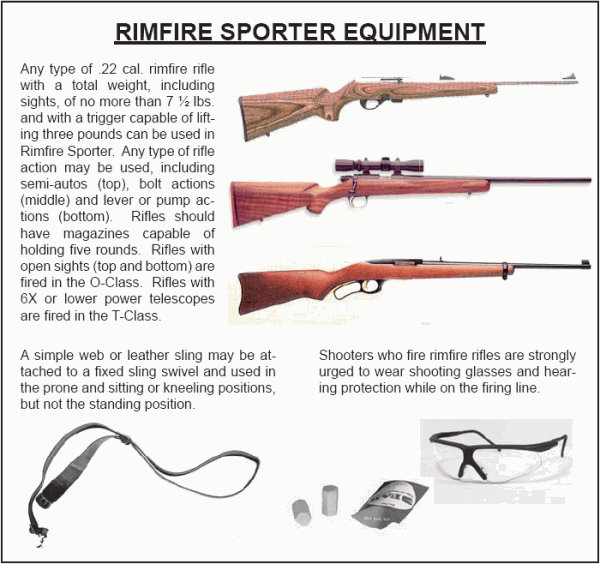
The Rimfire Sporter Match is for smallbore rifles that weigh 7 1/2 pounds or less with sights. Firing is done at 25 and 50 yards in prone, sitting and standing positions, in slow and rapid fire modes. The CMP has a special smart-phone App that will help speed up scoring.
Each year, the Rimfire Sporter Match attracts hundreds of shooters to the shore of Lake Erie at Camp Perry. The CMP National Rimfire Sporter Rifle Match offers shooters a recreation-oriented competition where they use affordable, smallbore sporter rifles with either scopes or iron sights. All you need are a .22 LR rifle, sling, and ammo.
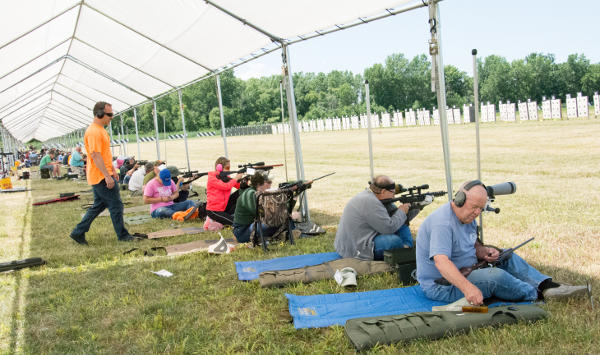
Hundreds of shooters compete in the Rimfire Sporter Match at Camp Perry.
Prior to the match at Camp Perry, Rimfire Sporter competitors check-in, have their rifles weighed, triggers checked, and receive their squad assignments.
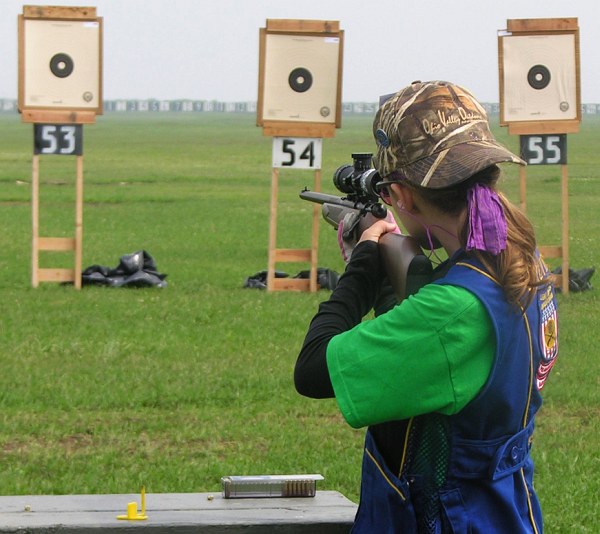
Rifles may be manually operated or semi-automatic, in three classes: the standard “O Class” for open-sighted rifles, “T-Class” for telescope-sighted rifles, and the “Tactical Rimfire” Class. Firing is done at 50 and 25 yards on a target with a 1.78″ ten-ring. The target is simple enough for a beginner to hit, yet challenging enough that only one competitor in the history of the match has ever fired a perfect 600 score.
Rimfire Sporter Course of Fire
At the Rimfire Sporter Match, competitors complete slow fire prone, rapid fire prone, slow fire sitting or kneeling, rapid fire sitting or kneeling, slow fire standing, and rapid fire standing shot sequences.
What is Required for the Camp Perry Rimfire Sporter Match
Competitors need to bring their own .22 cal. Rimfire rifle(s) and ammunition. Special target shooting equipment, shooting jackets, or shooting gloves are not permitted, but you can bring a spotting scope and ground cloth or shooting mat. The firing points have grass (sometimes a bit wet with rain). Competitors are strongly urged to wear hearing and eye protection. Assistance for disabled competitors is provided.
A free Shooters’ Clinic is usually held in connection with the Rimfire Sport match at Camp Perry. The Clinic covers Rimfire Sporter rules, safety instructions, course of fire, and competition procedures. Shooters who have not previously attended a CMP Rimfire Sporter Match are strongly encouraged to attend.
Do you want to see more Rimfire Sporter photos? CLICK HERE to view the CMP Zenfolio Archive with 1200+ photos from Rimfire Sporter Matches at Camp Perry and elsewhere.
From the late ’70s through 1983, a huge, concrete-walled warehouse in Houston was used for benchrest testing. Virgil King and Bob Fisher set up a bullet-catching backstop at the end of a 30-yard-wide, 325-yard-long fire lane that remained unobstructed even when the warehouse was in use. This allowed accuracy tests in virtually perfect “no wind” conditions. Over a six-year period, about 30 shooters were invited to test their rifles. The results were amazing, with numerous “zero groups” being shot in the facility. Many of the lessons learned in the legendary Houston Warehouse still help benchresters achieve better accuracy today.
Dave Scott explains why the Warehouse was so unique:
“Over a period of six years, the levels of accuracy achieved in the Houston Warehouse went beyond what many precision shooters thought possible for lightweight rifles shot from sandbags and aimed shot-to-shot by human eye. For the first time, a handful of gifted, serious experimenters — armed with the very best performing rifles (with notable exceptions) — could boldly venture into the final frontiers of rifle accuracy, a journey made possible by eliminating the baffling uncertainties of conditions arising from wind and mirage. Under these steel skies, a shooter could, without question, confirm the absolute limits of accuracy of his rifle, or isolate the source of a problem. In the flawlessly stable containment of the Houston Warehouse … a very few exceptional rifles would display the real stuff, drilling repeated groups measuring well below the unbelievably tiny .100″ barrier. The bulk of rifles, however, embarrassed their owners.”
Scott’s article also reveals some interesting technical points: “One thing that IS important is that the bullet be precisely seated against the lands. T.J. Jackson reported this fact in the May 1987 issue of Precision Shooting. In a letter to the Editor, T.J. wrote, ‘…in all our testing in that Houston warehouse… and the dozens and dozens of groups that Virgil King shot in there ‘in the zeroes’… he NEVER fired a single official screamer group when he was ‘jumping’ bullets. All his best groups were always seated into the lands, or at the very least… touching the lands. Virgil said his practice was to seat the bullets so the engraving was half as long as the width of the lands. He noticed an interesting phenomenon with rifles that could really shoot: if the bullets were seated a little short and the powder charge was a bit on the light side, the groups formed vertically. As he seated the bullets farther out and increased the powder charge, the groups finally became horizontal. If he went still farther, the groups formed big globs. He said the trick is to find the midway point between vertical and horizontal. That point should be a small hole.”
You should definitely read the complete article, as it provides many more fascinating insights, including shooting technique, barrel cleaning, neck-turning, and case prep.
EDITOR: Will the lessons of the Houston Warehouse work elsewhere? Is this repeatable magic? We remind readers that what T.J. Jackson discovered worked for his barrels, his cartridge type, and his choice of bullets. Jumping bullets can definitely produce good results in other cartridge types with bullets such as Berger Hybrids. Still, the Houston results are intriguing. Any time someone shoots in the “zeros” one should pay attention to how that was achieved.
Emil Kovan is one of the top F-Class shooters in the world. He won the 2014 United States F-Open Championship, finished second at the 2015 USA Nationals, and then finished second at the 2016 Canadian F-Open Nationals. Most recently Emil was a member of the World Championship-winning F-Open Team USA that competed this spring in South Africa. He definitely knows what it takes to build top-tier F-Open rifles. Today’s feature story first ran a few seasons back, and today there are some more stock and optics options, but this is still a very impressive F-Open rig. To learn more about the latest F-0pen Magnum chambering options read Emil Kovan’s recent Daily Bulletin story, Cartridges for F-Class — Rise of the Magnums.
“What are the best components for an F-Open class rifle, and why?” That’s a question that I get asked all the time and will try to answer in this article. Two months ago, I was contacted by Duane, a gentleman I met at the 2015 F-Class Nationals. He was interested in building a rifle with the impressive Master Class Low Profile F-Open Stock, created by Carl Bernosky and Alex Sitman of Master Class Stocks.
I have known Alex Sitman for many years, and use his stocks exclusively, but was not very familiar with his new Low Profile F-Open stock. After a brief conversation with Alex, I placed an order, and had the stock inletted and bedded at my shop in a month. My first impression was “Wow that’s a long stock” — the forearm is significantly longer than on the original Master Class F-Class prone stock. I bolted the barreled action in, and squeezed the end of the forearm and barrel together, the stock flexed a little bit, but not as much as other designs that I have tested. I think that’s due to having “more meat” in the receiver area. The full stock depth continues farther forward that on some other “low profile” designs. That makes the stock stiffer in the vertical plane, reducing the hinging effect forward of the action. The stock was finished in gloss black per the customer’s request. Interestingly, I found that the multiple layers of paint and clearcoat stiffened the stock up quite a bit.
CLICK IMAGE below for full-screen version
Low Center of Gravity Tames Torque
Compared to the original Master Class F-Open stock, the barrel sits about an inch lower. Lower center of gravity equals less torque, and that is very important when shooting heavy bullets in fast twist barrels. Another significant improvement is that the toe of the stock is flat and parallel to the forearm. I added a 3/4″ track rail in the rear, and milled the underside of the fore-end to create two parallel “rails” in the front to help the stock track better.
One of the biggest reasons why I like Master Class stocks, is the pistol grip. I don’t shoot “free recoil” and a comfortable pistol grip is super important to me when selecting a stock. The new Master Class Low Profile stock shares the same grip as the old model. This allows the stock to accommodate either a “hard hold” style or a more free-recoil style of shooting — whatever the rifle’s owner prefers. This design versatility is one reason I recommend Master Class stocks. Shooters may experiment with either shooting style to find what suits them best.
Cartridge Choice — A 40° .284 Win Improved
Duane decided to have the barrel chambered for my 284 KMR IMP (Improved) wildcat. What is .284 KMR IMP and why choose it over the straight .284 Winchester? Improved by definition means “made better”, I took a great cartridge, and modified it to increase capacity, reduce pressure, and increase brass life.
There are many “improved” variants of the original .284 Winchester: 7mm Walker, .284 Shehane, .284 Ackley and so on. My version, the 284 KMR IMP, shares the .010″ blown-out sidewalls of the .284 Shehane, but I have further increased the case capacity by changing the shoulder angle from 35 to 40 degrees. The 284 KMR IMP allows you to almost match magnum cartridge velocity in a standard-bolt-face action. If you want to run 180gr-class 7mm bullets over 2900 FPS, it is cheaper and more convenient to have a barrel chambered in 284 KMR IMP than to spend $650 for a magnum bolt.
Tuning Loads for the .284 Win Improved Cartridges
The 284 KMR IMP seems to have two nodes, one around 2820 fps and other at 2940 fps. My match load clocks at 2935 fps with single-digit ES. Note –I selected that load based on accuracy, NOT raw speed. A lot of novice (or hard-headed) shooters make the mistake to push their cartridges to the max, and disregard more accurate loads at lower velocity.
The sport of F-Class is rapidly growing, and the equipment used is improving constantly. I remember that only few years ago, an F-Open rifle that could shoot sub-one-inch of vertical at 300 yards was considered competitive. Now, we are pursuing sub-one-inch vertical at 600 yards! It takes a great rifle to approach that goal, but it is also up to the shooter to learn and experiment as much as possible in order to achieve success.
Dies for an Improved .284 Win Cartridge
One of the biggest challenges in campaigning a wildcat cartridge has been obtaining great dies. When searching for custom dies, it almost seems like that the odds are stacked against us. The most common problem is wait-time — custom die orders can take months to be completed. Also, most custom die makers want you to send them two or three cases, each fire-formed three times. I find that funny because if could somehow properly size the cases for three fire-forming cycles, I would not need a sizing die.
Custom-made dies should size the case just right, but sometimes the die’s internal dimensions are slightly off, and this leads to problem number two: dies sizing too much (or even worse) too little. I had a one “custom” die that would not size the bottom of the case enough. This made the extraction of fired cases very difficult. I feel that the best option (if available) for shooters interested in wildcat chambers is to have their gunsmiths make the dies. I offer that die-making service in addition to barrel chambering.
BAT Machine “M” Action
Duane decided to use a BAT M action for this rifle, and I think that he could not have made a better choice. We are blessed with many good match-quality receivers: Barnard, BAT, Borden, Kelbly, Nesika, and Stiller just to mention a few. These are all very well-made and suitable for F-Class. Among BAT Machine Co.actions, I like BAT models M, MB, and 3LL best. I prefer these because because of their size (large bedding footprint) smoothness, timing, options available, and last but not least visual appearance.
Trigger: I recommend and use Jewell triggers. Other good options are: Kelbly, CG Jackson (good 2-Stage) Anschutz (best 2-Stage for Bat and Kelbly actions), Bix’N Andy, and David Tubb.
Barrel: Duane made another good choice here. He decided to go with a Brux 1:8.5″-twist, 4-groove cut-rifled barrel. If you look at the F-Class and Long Range benchrest equipment lists, you will see that cut-rifled barrels are currently dominating. Many records have been shot with both button-rifled, and cut-rifled barrels. I have shot both, and prefer cut-rifled barrels. I am not saying that button-rifled barrels are not capable of shooting as well as cut-rifled barrels, but on average, in my experience, four out of five cut-rifled barrels (from top makers) will shoot well, vs. three out of five buttoned barrels. YMMV, but this is what I’ve observed.
Scope: Duane’s rifle was fitted with a Nightforce 15-55x52mm Competition scope with DDR-2 reticle. This optic is ultra clear, reasonably lightweight (28 oz.), super reliable, and has 1/8 MOA clicks — what you want for long range F-Class competition. In this 15-55X NF model, I like the DDR-2 reticle best, because fine cross hairs (FCH) are hard to see in heavy mirage. The DDR-2 has a heavier horizontal line, with a center dot. March scopes are also very popular and very well-made.
Thanks for reading, and keep ‘em in the middle…
About Emil Kovan Along with being a skilled, respected gunsmith, Emil Kovan has been a very successful F-Class competitor. He was U.S. F-Open National Champion in 2014, and finished second at the U.S. F-Open Nationals in 2015. Most recently he was a member of the World Championship-winning F-Open Team USA that competed this spring in South Africa. He definitely knows what it takes to build top-tier F-Open rifles.
– 2014 F-Class Open National Champion
– 2015 F-Class Open National Championship, Silver Medal
– F-Class Open National Championship Teams, 2015, 2014, 2013, Shooting Team Member
– Over 15 wins in Regional and State Championships in Palma, F-TR, F-Open
– 2013 U.S. National Team Member
– 2023 F-Open Gold Medal Team USA Member, 2023 World Championship in South Africa
BONUS Reading: F-Open Magnum Cartridge Options
Thinking about building a new F-Open rifle? Not sure about the chambering choice ? CLICK HERE to read Emil Kovan’s recent July 2023 article outlining the most popular magnum cartridges for F-Open competition. The .284 Win is still a great option, but bigger magnums do have some advantages.
Most bolt-action rifle shooters work the bolt with their trigger-pulling hand. This is because most rifles sold to right-handed shooters come with right-side bolts, while “lefty” rifles come with left-side bolts. This “standard” configuration requires the shooter to take his dominant, trigger-pulling hand off the stock to cycle the bolt, then re-position his hand on the stock, and “re-claim” the trigger. Often the shooter must lift or move his head to work the bolt, and that also requires him to re-establish his cheek weld after each and every shot. Not good.
This really doesn’t make much sense for precision shooting with fore-end support*. There is a better way. If you leave your trigger hand in position and work the bolt (and feed rounds) with the opposite hand, then you don’t need to shift grip and head position with each shot. All this requires is a weakside-placed bolt, i.e. a left bolt for a right-handed shooter or a right bolt for a left-handed shooter. The video below shows a “Lefty” working a right bolt. Note how efficient this is:
As our friend Boyd Allen explains: “If you think about it, if you are going to work with a factory action where your options are left bolt and left port or right bolt and right port, and you are building a rifle that will only be shot from a rest, using the left/left for a RH shooter or using a right/right for a LH shooter works better than the conventional configuration”.
Shoot Like a Champ and Work the Bolt with Your Weakside Hand
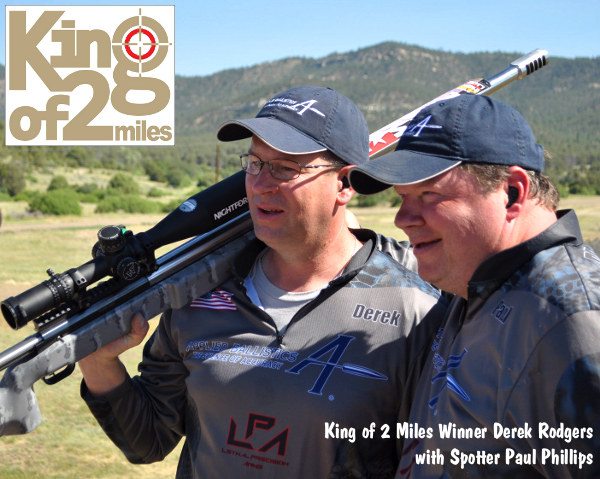
Derek Rodgers is a recent F-TR World Champion, a King of 2 Miles champion, AND is the only person to have won BOTH the U.S. F-Open and the U.S. F-TR National Championships.
And guess what? Derek runs this kind of “opposite” bolt set-up. Yep, Derek shoots right-handed with a left bolt. Though Derek is a right-hander, he shoots with a Left Bolt/Left Port (LBLP) action. He pulls the trigger with his right index finger, while working the left-side bolt with his left (weakside) hand. This allows him to stay in position, and maintain his cheekweld. He places his right hand on the grip, while manipulating the bolt (and feeding rounds) with his non-trigger-pulling hand.
Recent F-TR World Champion and King of 2 Miles Derek Rodgers
This is the rifle with which Derek won the 2013 F-TR National Championship.
*For true standing, off-hand shooting (whether in competition or on a hunt), a conventional strongside bolt placement makes sense, since the non-dominant arm must support the front of the rifle all the time. When shooting from bipod or rest, it’s a different story.
“The pessimist complains about the wind; the optimist expects it to change; the realist adjusts the sails.” — William Arthur Ward
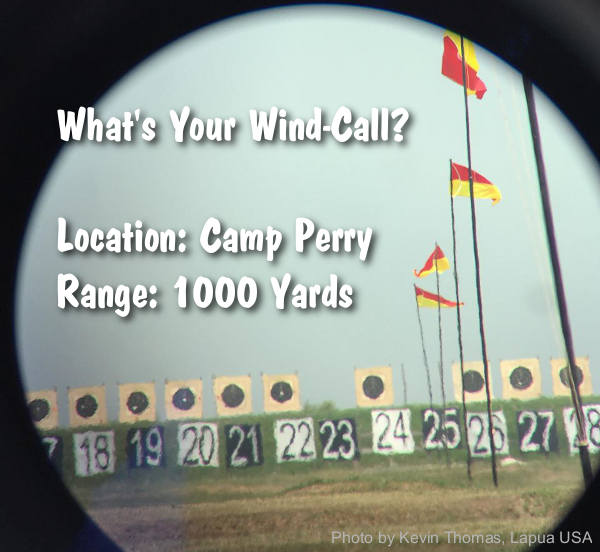
Readers often ask us: “Is there a decent, easy-to-comprehend book that can help my wind-reading?” Many of our Forum members have recommended The Wind Book for Rifle Shooters by Linda Miller and Keith Cunningham.
New Edition — Hardback and eBook
The latest, updated edition of The Wind Book for Rifle Shooters was released in May 2020. This 144-page book, first published in 2007, is a great resource. But you don’t have to take our word for it. If you click this link, you can read book excerpts and decide for yourself. When the Amazon page opens, look below the book cover photo, and click the bar labeled “Read Sample”. This lets you preview chapters from the Wind Book, and view some illustrations. Along with the new hardback edition ($22.99), Amazon offers a Kindle (eBook) edition for $14.99.
Other books cover wind reading in a broader discussion of ballistics or long-range shooting, such as Applied Ballistics for Long-Range Shooting by Bryan Litz. But the Miller & Cunningham book is ALL about wind reading from cover to cover, and that is its strength. The book focuses on real world skills that can help you accurately gauge wind angle, wind velocity, and wind cycles.
All other factors being equal, it is your ability to read the wind that will make the most difference in your shooting accuracy. The better you understand the behavior of the wind, the better you will understand the behavior of your bullet. — The Wind Book for Rifle Shooters
The Wind Book for Rifle Shooters covers techniques and tactics used by expert wind-readers. There are numerous charts and illustrations. The authors show you how to put together a simple wind-reading “toolbox” for calculating wind speed, direction, deflection and drift. Then they explain how to use these tools to read flags and mirage, record and interpret your observations, and time your shots to compensate for wind.
I believe this is a must-have book if you are a long-range sport shooter. I compete in F-Class Open and when I first purchased this book and read it from cover to cover, it helped me understand wind reading and making accurate scope corrections. Buy this book, read it, put into practice what it tells you, you will not be disappointed. — P. Janzso
If you have one book for wind reading, this should be it. Whether you’re a novice or experienced wind shooter this book has something for you. It covers how to get wind speed and direction from flags, mirage, and natural phenomenon. In my opinion this is the best book for learning to read wind speed and direction. — Muddler
2023 Smallbore and Air Rifle Champion: Cecelia Ossi
Story based on article by CMP’s Sheri Trusty
At the 2023 National Matches at Camp Perry this summer, 21-year-old competitor Cecelia Ossi achieved a remarkable double-discipline victory. Ossi placed first in the new Three-position (3P) Smallbore and Air Rifle Aggregate combo event. She did this shooting both outdoors and indoors. This was a great “twin win” by a very talented young lady. A member of the rifle team at the University of Nebraska, Ossi recorded a historically great performance at Camp Perry this summer. Cecelia won the 3P Smallbore and Air Rifle Aggregate with a score of 2421-60X.
For 2023, the CMP created a Three-Position Smallbore and Air Rifle Aggregate Championship for those who competed in both disciplines. Earning the inaugural win in the match was the talented Cecelia Ossi, who shoots for the University of Nebraska rifle team. The CMP had modified the match schedule to allow shooters to compete in Smallbore matches on Camp Perry’s outdoor Petrarca Range as well as in Air Gun events at the Gary Anderson CMP Competition Center located just next door — all during the same day.
The 2023 National Matches marked the first time Ossi shot outdoors at Camp Perry. The unique environment gave her the opportunity to test her skills: “Shooting outdoors created a lot of challenges, which is why I loved Camp Perry. You have to figure out how the wind is affecting your shooting, and it’s very rewarding when you get it right.”
Ossi has one more year at the University of Nebraska-Lincoln, and then she plans to join the Army Marksmanship Unit (USAMU) in Georgia. “I trained with [the USAMU] for a week this summer. I’m really excited about joining them in 2024″, she said. Ossi labels herself a perfectionist, and marksmanship provides a venue to be the best she can be (as the Army would say).
“Marksmanship gives me the opportunity to be a perfectionist. It’s very interesting and mentally challenging to figure out position and challenge myself to be perfect in everything I’m doing.” — Cecelia Ossi
A former gymnastics competitor, Ossi transitioned to marksmanship in her junior year of high school. She is now at the University of Nebraska, where she competes with the rifle team. Ossi is now heading into her senior year at Nebraska. “Marksmanship taught me a lot about the mental side of competing. I think I would have done better in gymnastics had I known all that. The mental side can outweigh the physical side. That’s something that’s overlooked in a lot of sports.”
Ossi said her coaches played a big role in her early, rapid success: “I had phenomenal coaches that helped me progress quickly. They knew my goals and how to help me meet them. They were a huge part of this.” Ossi trained with coaches Tom Fister, Tab Rhode, and Bill Burkert in Pennsylvania and with Peter Fiori (Senior) in New Jersey. Mindy Miles is head coach and J.T. Schneiring is assistant coach at University of Nebraska-Lincoln.
Cecelia Competes with both Air Rifles and Smallbore (.22 LR) Rifles
Ossi shot the air rifle competitions with a Walther Monotec rifle, and she shot smallbore with a Walther KK500 equipped with custom modifications. “My parts are mostly custom built by Peter Fiori, Sr. He played a big part in my marksmanship”, Ossi explained. Both her rifles have very sophisticated stocks that allow precise adjustment of cheekpiece height and buttstock height/length/angle to suit the three different positions that she shoots: standing, kneeling, and prone.
Camp Perry — Shooting Outdoors with Electronic Targets
Camp Perry’s unique shooting environment drew Ossi to the 2023 National Matches. “Camp Perry is the only place I’ve had the chance to shoot team matches. I had never shot team smallbore before. That was very fun. It’s fun to bring the team aspect into shooting and work together”, she said. “Each person shot a different position, so it highlighted each person’s strengths. I was nominated to shoot standing, which is my strength, so that was fun.”
Camp Perry employed electronic targets for the National smallbore matches for the first time this year. Ossi enjoyed this modern technology: “The electronic targets were a big reason why I decided to shoot smallbore at the National Matches. The electronic targets brought a bigger crowd overall for the matches and made the whole experience really great. The staff did really well making the matches run smoothly.”
Path to Success — How Young Shooters Can Win a Spot on College Teams
Ossi’s rushed entrance into competitive marksmanship gives her a unique view into the challenges young college hopefuls face, and she is open to advising young recruits as they maneuver through the college process: “I talk to a lot of recruits and young rifle shooters. The biggest thing, when you’re looking to get into college, is putting yourself out there and introducing yourself. It says a lot about you, and the coaches remember that.”
Ossi said college recruiting rules limit the connections between college hopefuls and coaches, so she encourages young marksmen to talk to college athletes like herself: “Don’t hesitate to reach out to college shooters. I’m always open to answer questions. You can always talk to collegiate shooters when you can’t always talk to coaches.”
From Gymnastics to Competitive Shooting After years of training as a high-level gymnast in her early teens, Cecelia transitioned to marksmanship competition in her junior year of high school. She had little time to perfect the skills necessary to earn a spot on a collegiate team, but she applied the discipline she learned as a gymnast to her new sport and achieved success. Her high school rifle match performances earned Ossie an invitation to join the University of Nebraska-Lincoln rifle team.
“In my junior year of high school, I had to retire from gymnastics due to injuries, and I felt a little lost,” she said. “I had done a lot with 4-H shooting sports — muzzleloader, shotgun, you name it. I did a lot of different disciplines, so I had a little bit of shooting experience.”
When Ossi learned a friend’s sister was a member of a collegiate rifle team, it opened her mind to new possibilities: “I dove right in. The coaches were amazing, and it brought me to the college 1 ½ years later. It was a quick transition from gymnastics to shooting.”
Ossi applied her gymnastics training to marksmanship: “I think all that training as a high-level gymnast played a part. I knew how to train for long hours every day, and I knew how to set goals. Having physical discipline and mental discipline helped. It was just a different sport.”
CMP Online Resources for Junior Competitors and Parents
The CMP has good resources for junior competitors on the CMP Website. There you will find information on youth shooting programs, along with College Connect and Guide to College Recruiting. These are excellent resources for parents and juniors.
Are you looking to get started in tactical/practical competitions? Or perhaps you already have have some PRS/NRL experience but want to upgrade your equipment and enhance your match results. Here are eight videos that can help you improve your game. These videos feature top tactical PRS/NRL competitors and George Gardner of G.A. Precision, considered one of the founding fathers of the PRS game. You’ll find other related videos on the Long Range Precision Shooters YouTube channel.
How Accurate Are The World’s Top PRS Shooters?
In this video, MDT put three top centerfire PRS shooters to the test, running them through some of the most difficult stages. The goal? To showcase the level of accuracy and precision these top shooters can achieve. From shooting off barricades to hitting targets from rooftops and rocks, these shooters demonstrate why they are considered among the best in the world.
Cartridge Choice for PRS and Tactical Competition
This video reviews many of the different cartridge options popular for PRS-style competition. The video examines pros and cons of various cartridge choices, focusing on accuracy, recoil, mag-feeding, and value for money. This segment features G.A. Precision owner/founder George Gardner.
Most top PRS shooters are using 6mm cartridges these days. These deliver excellent accuracy with lower recoil and cheaper bullet cost. Popular choices include 6 Dasher, 6 BRA, 6mm Creedmoor, 6XC, and the new 6GT cartridge, which is sort of a stretched version of a 6mmBR. It has a bit more case length for better feeding, and greater case capacity than a 6BR so you can shoot 105-108 grain bullets at 2950 fps with ease. That’s a popular Dasher accuracy node that the 6GT can achieve at somewhat lower pressures.
CLICK HERE for a full write-up on a 6GT rifle build by Mike McCasland (Texas Precision). This includes load development suggestions and a 6GT reamer print. The popular 0.120″ freebore chamber allows for the majority of high-BC 6mm projectiles. Mike had good luck with the pointed 107gr Sierra Match Kings (SMK), as well as the 110gr Hornady A-Tips in his rifle.
PRS Tactical Division — Rifle, Ammo, Optics, and Set-Up
In this video MDT Shooter Matt Stiner explains the basics of competition in the PRS Tactical division. The video covers rifle, cartridge choice, optics, and key accessories. He also explains how to set up your PRS Tactical rig for best results. In addition Matt talks about bullet and brass options.
PRS Ace Shows Skills Barricade Technique — with POV Video
This video features 2015 PRS Champion David Preston shooting the PRS Skills barricade. Dave Preston has been among the best in the nation running this PRS stage. Dave nearly always shoots 100% with the fastest recorded time. In this video you’ll see him successfully nail all eight shots in under 43 seconds. This includes a POV sequence (4:35 time-mark) showing the actual view through Dave’s scope.
The PRS Skills Barricade is an 8-round, 4-position stage featured at most PRS matches. It’s called a “Skills Stage” as it is run the same way at every national match and gives shooters the ability to compare skill levels based on hit percentage and speed. The target is a 10″ plate at 400 yards. There are four different positions, with two shots each. Most people run this stage in about 70 seconds, while Dave does it in the low 40s!
Know Your Limits PRS Stages — Pro Tips
This video showcases how 2018 Oklahoma PPS Champion Clay Blackketter approaches Know Your Limit Stages. With these particular type of stages you have to make judgment calls about your rifle’s accuracy and your ability to hold on target. You can boost your score by shooting the smallest target(s), but you risk losing points if you miss. Clay explains how best to manage a Know Your Limits stage.
PRS on a Budget — Converting a Basic Rifle for PRS Use
Top of the line rifles for competition are exceedingly expensive, but there is another option if you have a rifle in the safe that doesn’t get much use. Top F-Class shooter and wind coach Keith Glasscock notes: “I converted my .223 Remington varmint rifle into a Tactical class/PRS training rifle to save costs on ammunition and barrels so I can get better, faster.” Keith shows a very logical way to get started in the PRS/NRL game.
Bare Minimum: What You Need To PRS/NRL Competition
Like most shooting sports, PRS/NRL precision rifle competition can seem daunting once you start adding up the costs for the rifle, the optic, and all the important gear. We note the maximum price limit for “factory class” has risen steadily over the years, reaching $3000 currently. So even in the least expensive division, you can expect to put out a serious chunk of cash. This month, Dustin Sanchez talks with Brian Whalen about the minimum gear you need to start shooting long range and still be competitive.
1. Rifle (1 MOA capable)
2. Ammo
3. Bipod
4. Optic
5. Data Management (App, Kestrel, etc.)
“Road to the PRS” Episode One Presented by Kestrel Ballistics
Join Jeremy Flinn, the owner of Stone Road Media, as he begins Precision Rifle Series (PRS) shooting with the help of respected instructors and shooters. Follow along with Jeremy and Katie Godfrey of Kestrel Ballistics as they travel to eastern Pennsylvania to meet instructor Jordan Glassman, a renowned long-range shooting specialist and PRS beginners match instructor. He helps get Jeremy in preparation for an upcoming PRS Beginners Match.
This Saturday Video showcase was suggested by Boyd Allen.









 Dave Scott explains why the Warehouse was so unique:


 Along with being a skilled, respected gunsmith, Emil Kovan has been a very successful F-Class competitor. He was U.S. F-Open National Champion in 2014, and finished second at the U.S. F-Open Nationals in 2015. Most recently he was a member of the World Championship-winning F-Open Team USA that competed this spring in South Africa. He definitely knows what it takes to build top-tier F-Open rifles.




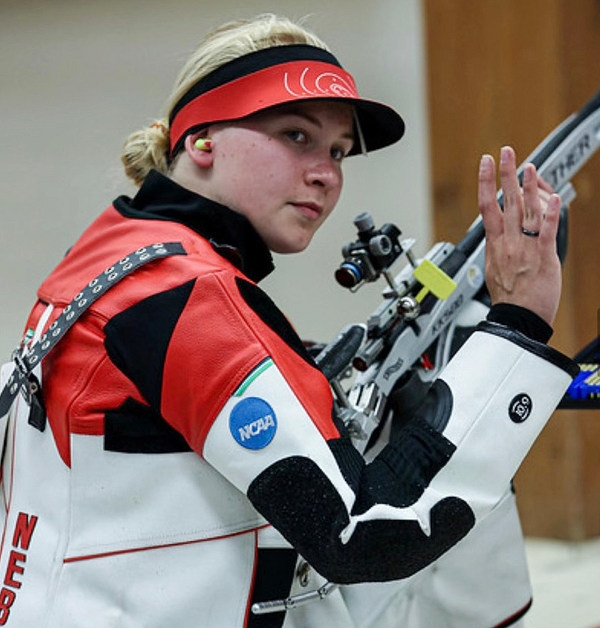
 After years of training as a high-level gymnast in her early teens, Cecelia transitioned to marksmanship competition in her junior year of high school. She had little time to perfect the skills necessary to earn a spot on a collegiate team, but she applied the discipline she learned as a gymnast to her new sport and achieved success. Her high school rifle match performances earned Ossie an invitation to join the University of Nebraska-Lincoln rifle team.


