The 600-yard target has an X-Ring 6 inches (1 MOA) across, while the 10-Ring spans 12 inches (2 MOA).
The following article is about reloading for NRA/CMP Highpower Rifle competition and is geared toward competitors shooting the AR15 Service Rifle. In Highpower Rifle competition, shooters fire in four stages: Standing slow-fire at 200 yards, Sitting rapid-fire at 200 yards, Prone rapid-fire at 300 yards, and Prone slow-fire at 600 yards. Competitors use a sling for support in all positions but standing. A typical AR15 Service Rifle sports a 20″ free-floated barrel and a 4.5-pound trigger. Service Rifle scopes are limited to maximum power of 4.5X.
Thoughts on Loading for Service Rifles, Particularly for 600 Yards
by Danny Arnold, Team CMP Article originally published in CMP Shooting News
Before we get started, I want to stress that all of the information that follows is geared toward the .223/5.56 Service Rifle. That doesn’t mean that there’s nothing here for anyone else, but the .223/5.56 Service Rifle platform is where I’ve spent the majority of my time, so here we go.
There is only one “Perfect” 600–yard load for my rifle, True or False? This example is more anecdotal than scientific, but it provides some food for thought….
Team CMP spent the early part of March competing in the Orange Blossom Regional. As soon as we got on the range, Sara Rozanski (Team CMP member) started having problems with her 600-yard ammunition. Nearly 1/3 of her cases were exiting the chamber minus the primers. I offered to swap my ammunition for hers, suspecting that my Wylde chamber would be more forgiving than her CLE chamber — a solution that seemed to solve the problem. At least neither of us was blowing primers!
Sara’s ammunition was a factory load using a well-known 80+ grain bullet with an unknown primer and powder, using brass from a respected manufacturer. My load was a different brand of 80-grain bullet, with my choice of powder and primer, all in brass made by someone else. Given the color of the primers, the only thing that our ammunition could possibly have had in common was the brand of powder… maybe. So, how did we shoot?
Sara and I shot the two-person team together and the entire 2,400 Aggregate, although on different relays. Sara’s combined 600-yard score was 780-28X (97.5%). Mine was a 783-24X (97.87%). Our scores were never more than two points apart on any of the four days. Keep in mind that we were using each other’s ammunition the entire time.
So, we had different barrels, chambers and ammunition, but similar results. That goes back to the idea that a good load will perform similarly if fired in a good barrel.
Are We Too Focused on Ballistic Coefficients (BCs)?
The revailing wisdom has always trended toward loading the highest-BC bullet we could find and pushing it as fast as possible. Back in the early ’90s when I got started with the AR15, the 80-grain Sierra was state of the art. Actually, I picked up all of my Leg points with it, although today it looks a bit dated — kinda like me.
So, the question I’ll pose is this: Would you rather shoot a high-BC bullet that groups 3/4-MOA (minute of angle) or a lower-BC bullet that groups into one-half-MOA traveling 50 feet-per-second faster? The reason that I posed this question is a situation I found myself in a decade ago. Our coach decided that he wanted us to pair-fire some 600-yard for practice. Unfortunately, I hadn’t gotten the memo and all that I had available was my normal short-line ammunition, loaded with a 77-grain bullet. The shooter I was paired with was using a higher-BC bullet than I was, but in the end, we both shot 198s.
Admittedly, using 77-grainers meant that coach had to work a little harder to keep us together on target, but it was a teaching moment for me. I knew that my upper shot 77s better than the available bullets in the 80-grain range, so I cranked out a windage table for the 77-grain bullet at 600 yards and shot those for the rest of the season. After all, the wind blows ALL bullets around. It’s just a matter of knowing what YOUR bullet is doing.
With the shortages that we’re experiencing right now, a lighter bullet may be all that you have available for the 2021 season. That doesn’t mean that you’re disadvantaged though.
Danny Arnold teaching Highpower Clinic at 2021 CMP Eastern Games
Loading High-BC Bullets
In the past decade, several bullets have appeared that weigh 80-grains or more. One thing that many of them have in common is a very sharp nose profile, whether metal or polymer. The question is: Are you using the right seating stem?
The jacket material in the bullet’s nose is very thin. If you section a bullet, you’ll find that there is a surprising amount of air space in the nose. If you’re using older seating dies, your seating stem may be contacting the bullet nose too close to the tip, where the jacket is the both thinnest and is unsupported by the lead core. This can manifest itself either as a deformation at the very tip of the bullet or as a circular dent around the bullet nose that you can see and feel with your thumbnail. I think we can all agree that denting a bullet is usually considered a bad thing.
One company goes so far as to recommend their proprietary seating stem for use with their high-BC bullets. Other companies leave it up to you to find a seating stem that will allow the bullet nose to go deeper into the seating stem, moving the contact point further down the bullet where the jacket is thicker and supported by the core material.
Seating Depth and Bullet Preferences
Some bullets don’t mind some “jump” into the lands, but some really do. Unfortunately, manufacturers don’t tell you much about that. Your chamber configuration (Wylde, CLE, or some hybrid of the two) and the bullet that you choose will determine your optimal seating depth. Long and short of it, a quality measuring tool to determine seating depth is a necessity these days. Keep in mind that if you’re doing this with a brand new barrel, the throat is likely going to change slightly in the first 200 rounds and may need to be re-measured. Actually, since all of your short range ammunition has to be loaded to magazine length, you’re probably better off developing your short range loads before starting on long range load development. That gives the throat a chance to wear in a bit on a new barrel.
Brass Prep — Why It Is Important
When match-grade AR15s first arrived on the scene, it was amazing how little it took to get them to shoot well. Other than making sure that I had brass from the same lot and running it through a set of match-grade dies, I did nothing. Of course, we were also using a post front sight. Was the occasional bad shot me, the rifle, the load or just an archaic sighting system?
Transitioning to optics has caused me to reconsider how and what I do in my reloading process: That, and having some extra time on my hands to experiment.
A little (or a lot) of time spent with a neck turning tool, a primer-pocket uniformer and a flash-hole reamer will quickly show you how consistent brass is by manufacturer and even by individual lot. That exercise also makes the prices charged for high-quality brass seem ridiculously cheap. That doesn’t mean that I advocate neck-turning or other uniforming practices, nor do I advocate spending scandalous amounts of money on long-range brass. However, our sport is about consistency. The consistency of your brass is a matter of choice, whether you choose to simply segregate cases by weight (cheap option), neck turn (labor intensive) or open your wallet a little wider for premium brass.
Weighing Charges vs. Throwing with Powder Measure
To measure or weigh? For a long time, I used a powder measure to throw all of my 600-yard loads. The powder I was using metered well, and the results downrange didn’t justify the extra time spent with a scale. That was in the day of iron sights though. Nowadays, I’m throwing my charges and trickling up to the desired weight as measured on a scale that weighs to a 100th of a grain.
To quantify the difference between individually weighing each charge versus throwing charges with a powder measure, I weighed six kernels of powder that I trickled into the pan and then dumped them into the hopper. Going through that process 10 times, I came up with an average weight of .08 grains for six kernels. Next, I threw 50 charges for weighing using my powder measure. If I felt the measure hanging up as it cut kernels, I put the charge back into the hopper without weighing it.
That’s six kernels of powder sitting in the pan — average weight .08 grains.
Those 50 smoothly-thrown charges varied .26 grains from lowest to highest, with the majority varying no more than .16 grains from highest to lowest. If the desired weight was exactly in the middle, at worst you’d be .13 grains (9-10 kernels) low or high, with the majority being off no more than .08 grains (6 kernels) above or below the desired charge weight. Is that enough to send a shot outside the 2-MOA 10-Ring? Probably not.
Has more consistent brass and weighing charges to one-hundredth (0.01) of a grain added up to higher scores? Honestly, this question is hard to answer. Looking at the results on paper at 200 yards, using a powder that meters well combined with a consistent touch on the loading lever doesn’t appear measurably different than meticulously weighing each and every powder charge. Looking back over my 600-yard plots however, I can see a trend toward a group that is closer to X-Ring height.
Since the bullseye is widest at the center, shooting groups that are the height of the X-ring gives you more room for error when the wind is blowing. That can translate into higher 600-yard scores.
How You Load Your Ammunition vs. How You Load Your Rifle
The loading/chambering cycle of the AR-15 is, in a word, violent. You have a relatively heavy bolt and carrier assembly under power of a stout buffer spring slamming forward to chamber each round of ammunition. By design, those rounds were supposed to be held securely by the magazine feed lips until the bolt stripped them off the follower. Obviously, due to their overall length, 600-yard loads can’t be chambered that way. Although the barrel extension is funnel-shaped, it’s also got a lot of “teeth” ringing the inside of it (see below).
Whether you’re using a standard magazine or a single-round loading device (SLED), dropping a round in the loading port and releasing the bolt is an act of faith in that you’re trusting the bullet to arrive in the chamber undamaged.
Ask yourself, how many times have you seen someone drop a round on the follower, press the bolt release and watch as the bolt jammed on a cockeyed round? If that happens once every 100 tries, how many times did the bolt close on a scratched, dented, or misaligned bullet? Could that be the cause of the occasional errant shot?
My technique is to drop each round on top of the SLED and then push it slightly forward with my finger, partially chambering it before releasing the bolt. Admittedly, some people may be unable to do this due to body configuration or left-handedness, but why go to all the trouble of loading “perfect” ammunition and then damage it on the way into the chamber?
Now that we’ve covered bullets, brass, and assorted errata we can move on to discussing loads for 600 Yards…
The NRA Highpower 600-yard target has a 6-inch (1 MOA) X-Ring, and a 12-inch (2 MOA) 10-Ring.
Load Development for 600 Yards
Finding a load for 600 yards is a lot like finding a load for short range. Once I decide on a bullet, powder, primer, velocity range and a measured guesstimate of seating depth, I load 10 rounds of each test load, increasing in 0.2 (2/10) grain increments. I test them from the prone position at 200 yards. Ideally, I want to see two loads that are 0.2 (2/10) of a grain apart that shoot almost identical groups. The load that I choose will fall in between the two best shooting loads that I tested. If the first load is XX.2 grains and the second is XX.4 grains, my chosen load will be XX.3 grains.
Why develop loads in 0.2-grain (tenths) increments if I have a scale that measures in 0.01-grain (hundredths) increments? Or, why not test in 0.1-grain increments?
For me, working in 0.2-grain increments gets me to the results quicker. Also, there is a difference between accuracy and consistency in this scenario. Developing loads in 0.2-grain increments gets me to an accurate load. Producing that load using a scale that accurately measures to .01-grain insures a consistent load, assuming that I do my part.
Once I’ve settled on a load, it’s time to play with seating depth, if I choose to. If I’m lucky and the groups are acceptable as-is, I won’t do anything. If I think there’s room for improvement, I’ll experiment a little. Depending on the bullet, changing the seating depth by a couple of thousandths one way or the other may change the group size. During this phase of testing, it’s a good idea to chamber a round and see if the entire round will then extract. If you leave a bullet stuck in the throat, your rounds are too long. Finding that out at a match can ruin an otherwise good day.
Danny Arnold shooting his AR15 Service Rifle, standing position at 2021 CMP Eastern Games.
Another thing to keep in mind is that your barrel is not static. Every round fired has an effect on the throat, vaporizing and scouring away metal until the distance the bullet travels before meeting the rifling measurably increases. If you have chosen a bullet that shoots best when close to the lands, you’ll need to periodically re-measure and possibly change your bullet seating depth to maintain that optimal relationship.
The Elephant in the Room — User Skill Level
There’s really not a delicate way to put this, so I won’t try. There’s little point in spending time and effort developing a load that shoots into half-MOA off the bench if you’re only capable of shooting 2 MOA using a sling right now.
That doesn’t mean that there’s no hope. On the contrary, it just means that your time and effort is better spent practicing with some good short-range ammunition on reduced targets at a 100 or 200-yard range. At that distance, wind is not a factor and your technique can be improved more quickly so you’re in a position to benefit from that ½ MOA ammunition.
About Team CMP
CMP has created a Highpower Team with top competitors. Team CMP competes at several events throughout the year and most importantly, helps to teach Highpower Clinics at CMP Competition Events. Learn from Team CMP at Camp Perry during the Advanced Highpower Clinic, scheduled this year for July 30 through August 1, 2021. Visit the Highpower Clinic Web Page for more information.
The Civilian Marksmanship Program is a federally-chartered 501(c)(3) non-profit corporation. It is dedicated to firearm safety and marksmanship training and to the promotion of marksmanship competition for citizens of the United States. For more information about the CMP and its programs, visit www.TheCMP.org.
The Annual Springfield M1A Match will be held Sunday July 30, 2023 at the Viale Range at Camp Perry.
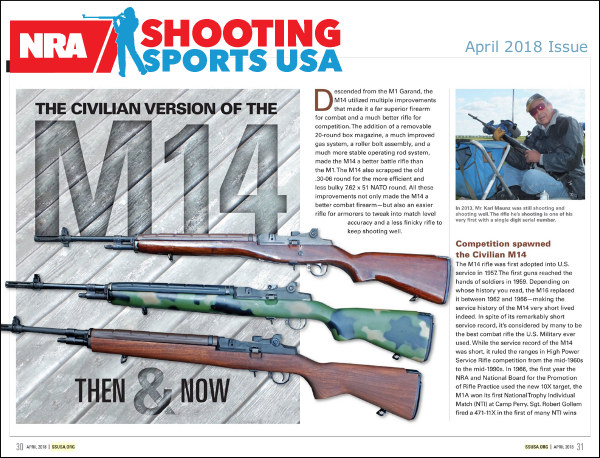
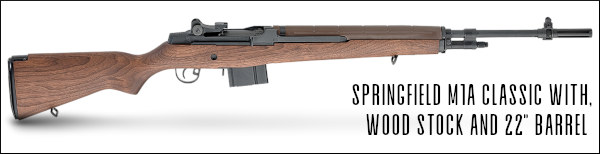
In the April 2018 issue of Shooting Sports USA, you’ll find a good article on the civilian version of the M14, now sold commercially as the Springfield M1A. An evolution of the battle-proven M1 Garand, the M14 was designed to shoot the 7.62×51 (.308 Win) round instead of the larger .30-06 Springfield cartridge used in WWI, WWII and Korea. While the vast majority of today’s M1As are chambered for .308 Win/7.62×51, Springfield Armory also produces a 6.5 Creedmoor version.
“Descended from the M1 Garand, the M14 utilized multiple improvements that made it a far superior firearm for combat and a much better rifle for competition.” — Dick Jones, Shooting Sports USA.
Dick Jones reports that accurized M14/M1As could post remarkable scores: “The accuracy potential of the M14/M1A is unquestionable. During their reign as service rifles, they produced multiple perfect 200 scores at 600 and 1000 yards in the hands of top shooters. This is a difficult feat with a modern, scoped, magnum-caliber rifle and remarkable with an iron-sighted battle rifle. Good competition rifles can group 10 shots under one MOA, and the meticulously-massaged rifles used by the top shooters during my career would consistently put up 10 shots under an inch at 200 yards off a test cradle.”
Springfield M1A at Camp Perry National Matches
The CMP hosts a major M1A Match every year at Camp Perry, sponsored by Springfield Armory. The Annual Springfield M1A Match will be held Sunday July 30, 2023 at the Viale Range at Camp Perry. Significant prizes will be awarded. In past years M1A Match competitors took home over $25,000 worth of cash and merchandise.
For many years, the semi-auto version of the M14 was “top dog” in iron sights Service Rifle competition. Now that discipline is dominated by .223 Rem (5.56×45) AR-type rifles, but the bigger .308-caliber rifle, now sold as the M1A, remains popular. This year’s Springfield M1A match will be held at Camp Perry on August 8, 2021.
In this video, YouTube Reviewer Hickok 45 compares the M1 Garand and the M14/M1A:
See how the modern M1A is built in this Springfield Armory Video:
As racing improves automobiles, competition improves firearms, and the current crop of Springfield M1As, from the Basic to the top-of-the-line Super Match and Loaded models, reflects the years of development. The M14 and its variants are still in service today and it’s still considered by many to be the best battle rifle in the history of the U.S. Military. — Dick Jones, Shooting Sports USA
Some seasons back, before COVID, our friend (and fellow Californian) Dennis Santiago drove across the country, all the way to Ohio. His mission? To attend the CMP National Matches at Camp Perry. For many years, this journey had been an annual pilgrimage for Dennis, who writes: “My goal [was] to spend time with as many of my friends as possible — the friends I’ve known and hang out with throughout the year, the ones I only see once a year at Camp Perry, and the many I’ve only conversed with on social media and will meet in person for the first time. More than anything, Camp Perry is where I come home to my shooting family. My mission is to celebrate my love of this sport with them.”
Here are some photos from Santiago’s successful journey across the USA to Ohio some years ago. After the long cross-country drive, he then headed to the Camp Perry rifle range, with the goal of shooting 10s and Xs across the course.
“Get your kicks on Route 66 — in Manuelito, New Mexico.” — Dennis Santiago
“The heartland is an ocean of corn. It is an amazing thing to see how much food we make.” — Dennis
“Arrived and I’m hungry… at Camp Perry National Rifle Competition, Port Clinton, Ohio.” — Dennis
Advice for First-Time Visitors to Camp Perry
Dennis first competed at Camp Perry in 2016, writing about the experience in his Dennis Talks Guns Blog. Here are some of Santiago’s tips for first-time Perry competitors:
1. Walk the Base. Do not drive around. Get used to walking. Walk from your hut to everything. Walk to the administration buildings. Walk to the ranges. Walk to commercial row. Walk to the CMP North Store. Walk to the CMP or Army trailer to have the triggers of your rifles(s) weighed. Walk. This is your primary mode of transportation while on base.
2. Go Shopping. It’s called Commercial Row. It is the best shopping mall for competitive shooters ever. The sale prices here are Black Friday quality. You stock up on supplies. You can buy elusive powders in quantity with the same lot number. Same with bullets and primers. I stocked up. Everything you need to keep making your pet loads — except brass. This is a service rifle tournament. Pretty much everyone is using LC or WCC cases.
3. Learn about the Perils of Perry. It rains at Camp Perry. Sometimes that rain comes with lightning. When that happens range controls issues an evacuation order. Depending on where you are and how much time you have, you either grab your stuff and make for a sheltered structure or leave your stuff under whatever rain cover you have and leave it there until the storm cell passes.
Coming Soon — The President’s 100 Match
In past years, Dennis has competed in the historic National President’s 100 Match, which takes place on Monday, July 24th this year. This is a huge event — in recent years there were over 1100 ranked competitors from throughout the nation, making this one of the biggest High Power events of the year.
Report based on story by Ashley Dugan, CMP Writer
This summer the Civilian Marksmanship Program (CMP) will celebrate the 25th Anniversary of the John C. Garand Match at the annual National Matches at Camp Perry. The event has been one of the CMP’s most popular competitive shooting events, attracting hundreds of competitors from around the country each year. The John C. Garand match runs July 27-30, 2023, at the Viale Range and Rodriguez Range (Saturday only) at Camp Perry. CLICK HERE for CMP National Games Matches information and full 2023 schedule.
The roots of the John C. Garand Match date back to 1998 when the CMP introduced the competition into its target competition schedule. The Garand Match is a unique event where participants use vintage “as-issued” M1 Garand rifles over a course of fire with 10 shots prone slow-fire, 10 shots prone from standing rapid-fire, and 10 shots standing, all at 200 yards.
In response to the growing popularity of the Garand Match, the CMP went on to establish other rifle events of the same type, including the Springfield, Vintage Military, Rimfire Sporter, M1 Carbine, Vintage Sniper Team, and Modern Military matches. Collectively, these have come to be known as “CMP Games Matches”.
Camp Perry M1 Garand Competition — Vintage Military Rifle
The John C. Garand match is a Camp Perry classic. Note the signature Garand clip in the air.
The unique “Ping” of the ejected en-bloc clip is music to the ears of Garand fans. Some folks own an M1 Garand for the history, while others enjoy competing with this old war-horse. The CMP’s John C. Garand Match is one of the most popular events at Camp Perry every year.
Approximately 40% of each year’s Garand Match competitors receive coveted gold, silver, or bronze Achievement Medals with neck ribbons. Medal presentations are decided by competitors scores. In 2023, competitors who fire 279 x 300 or higher will receive gold medals, scores of 272 to 278 will receive silver medals; 260 to 271 will receive bronze medals. Medal presentations typically take place on the range immediately after competitors finish.
The John C. Garand Trophy, awarded to the top competitor at the John C. Garand Match at Camp Perry, was donated to the National Trophy collection by the Garand Collectors Association in 2001. Nick Till is the latest winner of the trophy (2022). Brad Diehl is the current national record holder of the match with a score of 294-9X (set in 2018), while Steven Skowronek is the only individual to win the National John C. Garand Match as a junior, back in 2005. Skowronek returned to win the match again over a decade later in 2017.
DCM Emeritus Gary Anderson, who served as the DCM from 1999 through 2009, played a major role in getting the Garand Match established and in growing the CMP’s as-issued military rifle program into one of the CMP’s largest shooting sports disciplines. He recalled, “The Garand Match had 325 competitors in 1998, but it quickly grew to over 1,300 competitors in the years that followed. It succeeded because M1 rifles were affordable and readily available and because we adopted a simple 30-shot as-issued military rifle course of fire. Plus, there was a special appeal to being able to shoot rifles in competitions that had already served in the national defense of our country.”
History of the M1 Garand Rifle
Jean Cantius Garand, also known as John C. Garand, was a Canadian designer of firearms who created the M1 Garand, a semi-automatic rifle that was widely used by the U.S. Army and U.S. Marine Corps during World War II and the Korean War. The U.S. government employed Garand as an engineer with the Springfield Armory from 1919 until he retired in 1953. At Springfield Armory Garand was tasked with designing a basic gas-actuated self-loading infantry rifle and carbine that would eject the spent cartridge and reload a new round. It took fifteen years to perfect the M1 prototype model to meet all the U.S. Army specifications. The resulting Semiautomatic, Caliber .30, M1 Rifle was patented by Garand in 1932, approved by the U.S. Army on January 9, 1936, and went into mass production in 1940. It replaced the bolt-action M1903 Springfield and became the standard infantry rifle known as the Garand Rifle. During the World War II, over four million M1 rifles were manufactured.
After World War II ended, thousands of M1 Garand rifles were put into storage while others were loaned to allies during the Cold War. Production resumed in 1950 when North Korea attacked South Korea, making the rifle the main infantry firearm used during the Korean War. Nearly 1.5 million new M1 rifles were produced between 1952 to 1957.
How to Order an M1 Garand from the CMP
In 1996, a federal law established the Civilian Marksmanship Program and authorized the CMP to sell surplus .30 and .22 caliber military rifles, parts, and ammunition to qualified U.S. citizens. The CMP currently sells the famous M1 Garand and other vintage rifles through mail order and through its stores in Alabama and Ohio. To purchase an M1 Garand through the CMP, you must be an adult U.S. citizen, who is a member of an affiliated organization, and who has participated in Marksmanship Activity. This basically means you need to join a gun club and participate in a clinic or match. Proof of club membership and citizenship is mandatory for all ages. The CMP does not accept telephone, fax, or online orders for firearms — you must order by mail or in person. CLICK HERE for ordering information.
M1 Garands at CMP Retail Store in Anniston, Alabama.
While AccurateShooter.com focuses primarily on rifle disciplines, we know that most of our regular readers also own handguns. It’s fun to shoot pistols, both outdoors and indoors. With a short site radius, and the snap of pistol recoil, handguns can be challenging — but that’s part of the fun. We enjoy shooting revolvers and semi-auto pistols at distances from 25 feet to 50 yards. Here are some fun targets you can download and print for FREE. These should provide a fun challenge for your next handgun sessions.
1. Patriotic Stars Target with Three Score Values
Here’s a fun Patriotic Stars Target created by the NSSF. This would be a great target to shoot on the 4th of July. Aim for the stars. The red stars are worth 3 points, the blue stars are 5 points, and the smallest white stars are worth 10 points. After aiming for the one-color stars, try to hit the center red, white, and blue star for added fun. You can also use this target with rifles at longer ranges.
2. Red Center Pistol Target
Here’s a NRA-type target for pistol shooting. The bright red center helps when shooting indoors because well-placed bullet holes are much more visible. This target includes data entry boxes to record gun type, score, and load data. This Red Center Target is one of many good free targets available at Targets4free.com.
3. NSSF Billiards Table Target
This Billiards Table Target offers 15 brightly-colored numbered balls with the cue ball at the bottom. Aim for the numbers, shooting 1-15 in sequence, or alternate between stripes and solids. You can also draw an “X” on the white cue ball (or attach a paster), and use that to set your zero. This target is fun for shooting outdoors with rifles at 50 or 100 yards or indoors with pistols.
4. Tic-Tac-Toe Fun Game Target
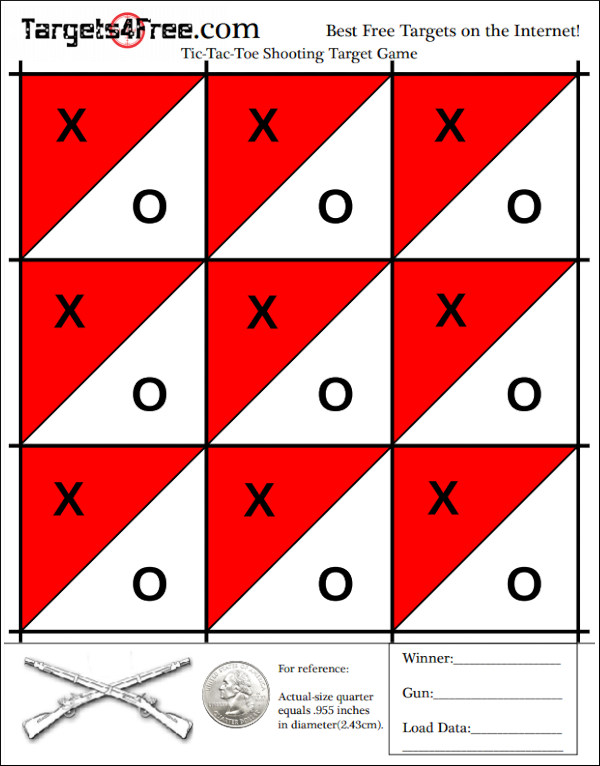
This Tic-Tac-Toe Shooting Game Target lets you challenge your shooting buddies at the range. One player can shoot the red triangles, while the other shoots the white zones, taking turns. You proceed just like a regular Tic-Tac-Toe game, alternating shots, with the goal of getting three of the same color in a row. This is a fun game for a parent and a young family member. You’ll find other fun targets on Targets4free.com.
5. NRA Dartboard Target with Five Bullseyes
There are many dartboard-style targets available, but this one has the extra feature of FIVE notable black bullseye aiming points. That makes this NRA Dartboard Target quite good for handgun shooting. NOTE: You’ll want to set the target PDF file to print in landscape (horizontal) mode to get the best results with 8.5×11″ paper.
The CMP National Matches at Camp Perry, Ohio kick off July 7, 2023 with smallbore events. The Camp Perry matches are historic, having been held since 1907 at this location on the shores of Lake Erie. The 2023 First Shot Ceremony takes place Monday, July 10, at 4:30 p.m. on the grounds of Camp Perry. Multi-time Nat’l High Power Champion SFC Brandon Green will speak and make the traditional First Shot to officially open the National Matches.
For this week’s Saturday at the Movies, we offer six videos from Camp Perry. These cover both rimfire and centerfire shooting, team matches (including the famous “Rattle Battle”), along with pistol shooting. If you’re heading to Camp Perry this summer, today’s video showcase provides an informative preview.
CMP National Matches at Camp Perry — 2023 Preview
This 3-minute video shows the Camp Perry ranges and shooting facilities and explains the programs scheduled for summer 2023, including training courses. The video also covers nearby accommodations and explains how to register for the National Matches on the CMP website.
NTIT Team Match — “Rattle Battle” at Camp Perry
The CMP’s National Trophy Infantry Team Match (NTIT) has been a staple at the National Matches since 1922. Also known as the “Rattle Battle,” the event is one of the most unique in the competitive rifling world — scoring is based on how many hits six-person teams can score on a bank of targets during a series of 50-second firing periods at four yardages.
Watch CMP ‘Rattle Battle’ Video — 50 Seconds of Rapid Fire…
Teams fire upon eight silhouette targets from 600, 500, 300 and 200 yards during successive 50-second periods. After each rapid-fire string, team members move forward (to the next-closest distance) carrying all equipment from firing line to firing line. The video shows the California Grizzlies, one of the top junior squads. The lead photo shows the U.S. Army Reserve (USAR) Team in action during the NTIT match. See more in USAR “Rattle Battle” Video.
Camp Perry M1 Garand Competition — Vintage Military Rifle
The John C. Garand match is a Camp Perry classic. Note the signature Garand clip in the air.
The CMP hosts the popular M1 Garand Match as well as the Springfield M1A Match. This writer’s father carried a Garand in WWII — reason enough for me to want one. But I also loved the look, feel, and heft of this classic American battle rifle. And the unique “Ping” of the ejected en-bloc clip is music to the ears of Garand fans. Some folks own an M1 Garand for the history, while others enjoy competing with this old war-horse. The CMP’s John C. Garand Match is one of the most popular events at Camp Perry every year. There are other vintage military rifle matches.
Rimfire Sporter Event Draws Hundreds of Competitors
If there is a single CMP event at Camp Perry every summer that offers the highest level of shooter satisfaction, the most diverse group of competitors, and the lowest cost of entry, that would have to be the annual Rimfire Sporter Match. This year’s match will be held on Saturday, July 8, 2023, during the first weekend of the National Match Schedule at Camp Perry. One of the most popular annual Camp Perry events, the Rimfire Sporter Rifle match features .22 LR competition in open sights (O-Class), telescopic (T-Class) and tactical/unlimited (TU) classes, fired at 25 and 50 yards. A CMP Rimfire Clinic will be held prior to the match.
Each year, the Rimfire Sporter Match attracts hundreds of shooters to the shore of Lake Erie at Camp Perry. The CMP National Rimfire Sporter Rifle Match offers shooters a recreation-oriented competition where they use affordable, smallbore sporter rifles with either scopes or iron sights. All you need are a .22 LR rifle, sling, and ammo.
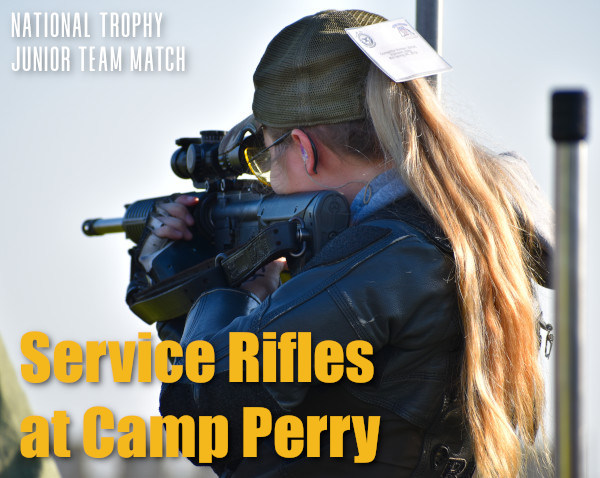
Service Rifle Matches — AR-Platform Rifles, Now with Optics
Service Rifle shooting is fun yet challenging. You need to develop skills with multiple positions and be able to make rapid wind calls. However, the modern AR-based service rifle is affordable and has relatively low recoil. Highly-customizable, modern service rifles can be fitted with adjustable stocks and optional magnified optics. Older military rifles, such as the M1A and M1 Garand, offer different challenges with heavier-recoiling cartridges, greater weights, and classic iron sights. Hi-Lux asked competitors at Camp Perry during CMP’s 2021 summer games what they enjoyed most about competition with service rifles and Military rifles such as the M1 Garand. The shooters’ responses had four key themes: Self-Improvement, Comradery, History (enjoying shooting rifles with heritage), and Challenge.
Camp Perry Bullseye Pistol Competition
Camp Perry hosts the most prestigious annual trophy matches in our nation’s history. And in a venue renowned for service rifle matches, the sport of precision pistol is no less important, no less challenging, and no less respected. The National Trophy Pistol Matches are all about traditional handgunning — the stance, the intense concentration, and of course, the one-handed grip. It’s all unmistakable as the game of Bullseye Pistol. Every year there are 20+ match trophies for the top Bullseye Pistol shooters, both military and civilian. And the very best will claim National Match Trophies and receive the President’s 100 Tab.
CMP Camp Perry National Matches Registration Links
The 2023 CMP National Matches at Camp Perry commence Friday, July 7, 2023 with the Rimfire Sporter Clinic and Smallbore check-in/practice. The summer schedule concludes Saturday, August 5 with the Palma Match and awards. Here is the full CMP schedule (click to zoom):
NOTE: This CMP Calendar is hosted online in spreadsheet format. This allows you to increase display size, and also to search for specific words. CLICK HERE to view full spreadsheet calendar.
History of Camp Perry
“In the year 1907 the machinery of the National Matches, now grown to immense proportions, was moved to the mammoth new range at Camp Perry.”
—James Drain, Arms and the Man, August 1911
Federal legislation originally launched the National Matches. The 1903 legislation also established the National Matches, commissioned the National Trophy and provided funding to support the Matches. The National Matches have been held at Camp Perry since 1907. The range is located along the shores of Lake Erie in northern Ohio near Port Clinton. The site was first acquired in 1906, in response to the need for a larger facility for military training and the NRA’s shooting programs. The original land for Camp Perry was purchased in 1906, and the reservation was named after Commodore Oliver Hazard Perry, the American naval commander who won the Battle of Put-in-Bay during the War of 1812.
On August 19, 1907, Cpl. L. B. Jarrett fired the first shot at the new Camp Perry Training Site. And that year, 1907, Camp Perry held its first National Pistol and Rifle Championship events. This location has hosted the annual National Matches ever since. Typically over 4,000 competitors attend the National Matches each year, making it the most popular shooting competition in the western hemisphere.
For three consecutive years, MidwayUSA Foundation has provided cash Coach Training Grants to support the training and certification of youth shooting sports coaches. This year, 52 cash grants were awarded for a total payout of $250,000. These grants will assist regional and state youth shooting agencies in training about 1,625 youth shooting sports coaches. This can, in turn, benefit 30,000 youth shooting athletes.
Coach Training grants are paid annually through the MidwayUSA Foundation. The grant cycle begins on February 1 and concludes on March 1 each year. CLICK HERE to learn more.
Brian Beard, President of USA Youth Education in Shooting Sports (USA YESS), said: “The Foundation’s Coach Training Grant Program has been instrumental in allowing us to train and certify more coaches for our shooting teams. The more trained coaches we have, the faster youth shooting sports will grow! We … can’t thank the Foundation enough!”
In addition to nearly 2,800 youth shooting team endowments, MidwayUSA Foundation also funds about 80 state and national youth shooting sports organizations through Agency and Donor Designated endowments. These organizations, including SCTP, SASP, ATA, ACUI, NCSSAA, and more, are eligible for the Coach Training Grant Program. Youth shooting teams interested in certifying more coaches should contact their state, regional, or national organization.
The MidwayUSA Foundation is a 501(c)(3) public charity working to sustain and grow the shooting sports industry by providing long-term funding to youth shooting teams. Donations are tax-deductible. The Foundation supports all shooting disciplines. For more information about the MidwayUSA Foundation, visit MidwayUSAFoundation.org or call 1-877-375-4570.
Thinking of getting started in the Practical/Tactical shooting game? Looking for ways to be more stable when shooting from unconventional positions? Then you may want to read Marcus Blanchard’s Practical Shooter’s Guide (A How-To Approach for Unconventional Firing Positions and Training). Unlike almost every “how to shoot” book on the market, Blanchard’s work focuses on the shooting skills and positions you need to succeed in PRS matches and similar tactical competitions.
Blanchard provides clear advice on shooting from barricades, from roof-tops, from steep angles. Blanchard says you need to train for these types of challenges: “I believe the largest factor in the improvement of the average shooter isn’t necessarily the gear; it’s the way the shooter approaches obstacles and how they properly train for them.”
Blanchard also offers good tips on shooting fundamentals. Here’s an example:
Blanchard on Trigger Control
“There will always be some amount of wobble when shooting in positions other than prone, and timing the shot to go off when the reticle is within the target is difficult to accomplish when poor trigger techniques are employed. The most common [mistake] I have seen is ‘slapping’ the trigger. The finger is usually hovering off the trigger, and when the shooter determines that NOW is the time to fire, they quickly pull their finger to the rear and ‘slap’ the trigger. The finger never pulls the trigger in the same place and often provokes a sympathetic contraction of the rest of the muscles in the hand, which results in unwanted movement before the bullet exits the muzzle.”
Author Marcus Blanchard has the credentials. A Marine Corps veteran, Blanchard is a regular Top 10 finisher in Precision Rifle Series events. In 2015 Blanchard was ranked 8th overall (nationwide) in the PRS series at year’s end. In 2016 Blanchard won the New Mexico Precision Rifleman’s Championship.
Check out the Table of Contents to see the Topics Covered:
Click image above to view larger Table of Contents.
6.5 Guys Recommend Practical Shooter’s Guide
The 6.5 Guys have reviewed Blanchard’s book and they recommend it highly: “What’s a good book for the beginning shooter who wants to get into long range precision rifle or the intermediate shooter who wants to improve his scores? [The Practical Shooter’s Guide] is particularly useful because it explores firing from various positions and props that are encountered in long range precision rifle [events]. This knowledge is completely missing from more traditional books where the shooter is usually slung up and shooting at a paper target. Marcus… goes into considerable detail about shooting from rooftops, reverse rooftops, side slopes, tank traps, barricades etc. This is the type of information that is very difficult to find. We consider ourselves reasonably knowledgeable shooters and this book provided us with new and useful information.” CLICK HERE for 6.5 Guys REVIEW.
6.5 Guys Review Marcus Blanchard’s Practical Shooter’s Guide
Former USMC scout-sniper Frank Galli explains that there is no voodoo when it comes to precision rifle marksmanship, but there ARE techniques that, when practiced, make the difference between good marksmanship and great marksmanship. Understanding the reasons that a bullet hits or doesn’t hit its intended target at ultra-long distances is a crucial element to learning.
Galli’s explanations of how to understand and compensate for wind speed and direction are excellent. In this book, Galli offers great wind-reading advice.
Published in 2020, Galli’s treatise is four years newer than Blanchard’s book, so it includes more of the latest gear and equipment. Galli’s book covers the fundamentals of precision marksmanship with easy-to-understand methodology. The book follows the same instruction process Galli uses in his live marksmanship classes (CLASS REPORT HERE).
Published in 2020, this well-illustrated, 272-page book covers the latest equipment (scopes, LRFs, chassis systems, magazines, bags, bipods, tripods) favored by tactical competitors in PRS/NRL type matches.
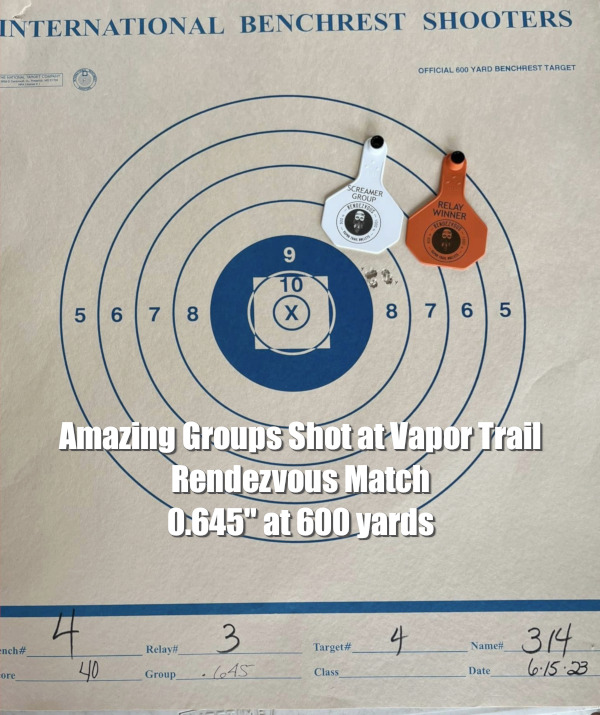
Modern long-range benchrest rifles are capable of remarkable accuracy. At the recent Rendezvous Match at the Vapor Trail Valley shooting club, some exceptional targets were shot. This is a special combined match with relays at both 600 and 1000 yards. Be amazed at the accuracy modern rifles can achieve at these distances. Match director Tom Jacobs reports: “We had two screamer groups under a inch at 600 yards, and six groups under 3″ at 1000 yards. Three of those were under 2.5″ screamers.”
New Range Record at 1000 Yards — 1.338″ 5-Shot Group
Dave Way set a new Vapor Trail 1000-yard Range Record for single 5-shot group. He had a wicked small 1.338″ group (0.128 MOA) with a 49 score.
New Single Target Small Group Record at 600 Yards — 0.645 (0.103 MOA)
At the Rendezvous, Jason Cohen set a new single-target small group range record at 600 yards. This was a 0.645″ group shot with a .284. That works out to 0.103 MOA (1 MOA is 6.282″ at 600 yards).
Multiple Agg and Overall Titles for Al Benarrock — and a $1500.00 Check
Al Benarroch had a phenomenal weekend. He won the 16 target 600yd/1000yd Ultimate Agg (Grand Overall), the 1000-yard 8-target group Agg with 4.953″, and the 1000-yard 8 target Overall. What a weekend for Al!
The match was a big success. Match director Tom Jacobs posted: “We had great weather at a match for once, temps were mild for us this time of the year, the winds were not bad at all but we did have quick switches, that the valley is known for. Mirage was bad at times, but no dam hurricanadors for once! We hung 778 targets down range, not including all the tuning targets throughout the week. We estimate 9336 rounds went down range for the match, not counting a week of guys tuning.”
What’s better than a super-accurate 6BR rifle? Well, two super-accurate 6BRs. This week we feature a pair of tack-drivers owned Forum member Mark Schronce. These “Brothers in Arms” share similar stocks, but otherwise the components are different. Mark’s 17-lb gray laminate Light Gun features a Hall action, HV taper barrel, and muzzle brake. The 21-lb Heavy Gun, in “Desert Camo” laminate, boasts a trick dual-port BAT action, and full-contour 30″ barrel without brake. Both guns shoot tiny groups, track like they’re on rails, and give Mark a serious hardware advantage in club competition.
Mark provides this report: “The Light Gun started as my 22-250 AI varmint gun, with a Hall action and McMillan Hunter Benchrest stock. I wanted to build a proper Egg Shoot gun, so I had Richard Franklin (Richard’s Custom Rifles) chamber a Lilja 12-twist in 6mm BR Norma, with a .262″ neck. Using Fowler 80gr FB bullets, the gun shot great right out of the gate. (See my report, Egg Shoots and 600-yard 6 BR). I was curious about the heavier 6mm bullets, so I had Richard chamber and fit a 1:8″ Krieger in 6BR. But this time we went with a .271″ no-turn neck. The Krieger holds quarter-MOA with the heavy bullets, and, to my surprise, it shot the 80s as well as the 12-twist Lilja did. For the 2005 season, I ordered one of Richard’s latest 008 F-Class stocks. This new design is very comfortable to shoot and it’s much more stable in the bags than my old Hunter stock. That added stability will be a big plus for 600- and 1000-yard benchrest matches.
A Heavy Gun for 1000-yard BR and “Belly Benchrest” (F-Class)
I’ve been active in 1000-yard Benchrest for a few years, shooting my 6mm BS and 6mm BR Light gun in both Light and Heavy classes. I wanted to build a rifle for the Heavy Gun Class yet stay within the 22-lb F-Class limit. And I wanted it to have the best hardware I could buy. On a BAT ‘MB’ action (with Jewell trigger) we fitted a 30″ 8-twist 3-groove Lilja, 1.250″ diameter, no muzzle brake. Richard cut the chamber for 6mm BR Lapua Brass, .271″ no-turn neck, throated for Sierra 107gr MKs, matching my current Light Gun. The stock is a pillar-bedded Richard’s 008 1000-yd/F-Class model, with 10 coats of auto clearcoat, all work by Richard. Burris Zee rings hold a Leupold 8.5-25×50 LRT mounted on a BAT one-piece Weaver base. The Heavy Gun weighs in at 21 lbs, much lighter than most Heavy Guns (50 to 100 lbs). But with the 6BR’s light recoil, it’ll do just fine for long range, yet still make weight for F-Class.
Why a 6mm BR Chambering in a Heavy Gun?
I toyed with the idea of going with a 6BR Improved for Heavy Gun, but I’m not convinced the Improveds are worth the extra hassle of fire-forming, not to mention the added cost of custom dies. By way of background, I used to have a Rem-actioned rifle chambered in 6BR BS (Bill Shehane), which is very similar to the 6BR Dasher. I found the 6BR BS was only about 100 fps faster than a standard 6BR. For the shooting I do, that extra 100 fps is not critical. If, in the future, I feel I need more speed, I will go to a .243 AI or a 6.5-284. To be honest, I love the 6BR cartridge. Barrels last forever, and the accuracy can’t be beat. Yes a 6BR is a little light for everyday 1000-yard shooting, but on good days it can set world records. I may move up to a 6.5-284 some day, but for now I will stay with the standard 6mm BR. If I ever do want to go to a bigger caliber, the 8.5-inch BAT Machine MB action gives me this option.
Hall vs. BAT Light vs. Heavy
Comparing the two actions’ bolt lift, lock-up, fit, and finish, I feel they are equally good. However, the BAT can run stout loads with Federal 205 primers — loads that cratered Fed 205s with the Hall. I don’t know if this is a function of the actions’ engineering, or the barrels. I’ve got a Lilja on the BAT, while the Hall wears a Krieger. I do know the BAT has a tight-fitting firing pin, and that might make a difference.
Both my actions have a built-in recoil lug — a really nice feature when you are changing barrels, and one of the main reasons I favor custom actions over a Remington. I think anyone would be pleased with either the BAT or the Hall.
There is a big difference in shooting a Light Gun vs. a Heavy Gun, as you might expect. The Heavy Gun is more stable and recoils straight back. However, even at 21 pounds, the Heavy Gun actually recoils harder into your shoulder than the muzzle brake-equipped Light Gun. But if you take the Light Gun’s brake off, and put the action back in the old Hunter bench stock, the gun would jump, torque and roll. It’s much better with the 008 stock now, but still not as rock solid as the Heavy Gun. On recoil the 21-pounder just tracks straight back, no jumping, no yaw, no rolling–very impressive.
Load Development and Accuracy Results
Developed last year, my favorite Light Gun load is 30.5 grains Varget, CCI BR4 primers, and 106gr Clinch River VLDs, running 2825 fps. The Light Gun shoots other bullets very well, but the Clinch Rivers performed best, with groups in the 0.1s to the low 0.2s at 100 yds. I use Lapua brass of course.
I began my load development for the Heavy Gun with components I had from last year: Varget, N140, and N540 powders, plus Fed 205, CCI BR4, and CCI 450 primers. I also had a good selection of bullets: 95gr and 105gr Bergers, 105gr Lapua Scenars, 106gr Clinch Rivers, and 107gr Sierra MKs.
The Heavy Gun liked the Bergers right from the start. During break-in and fire-forming (with 95gr Bergers 0.20” into the lands, 30.0gr Varget and CCI 450s), the rifle shot in the low 0.2s at 100 yds, 0.3s at 200 yds, with a 0.182″ small group at 200 yards (see photo). I then moved up to the heavier bullets and again the Bergers stole the show. Best load for the Berger 105s (seated 0.15″ into the lands) was 30.5 grains Varget and Fed 205s at 2850 fps. At 100 yards, this recipe shot in the 0.1s to the low 0.2s with a small group of 0.089″. (By the way, this same load in my Hall Light Gun would crater the Fed 205 primers. I may have to change to CCI BR4 primers for the hot summer days.) After working with the 105s I wanted to see how the Heavy Gun performed with lighter bullets. I tried my favorite Egg Shoot and 600-yard load–80gr Fowlers pushed by 31.5 grains of Vihtavuori N135 with Fed 205 primers. The results were fantastic. The big BAT produced a 100-yard aggregate (five, 5-shot groups) in the 0.2s with an 0.129″ small group. Overall, at 200 yards, both guns could agg five 5-shot groups in the 0.3s and 0.4s. Eggs Beware!
Big, Strong, and Versatile ‘MB’ Action by BAT Machine
I looked at all the custom actions, and decided on a BAT model ‘MB’, configured Right Bolt, Left Port, Right Eject. The ‘MB’ action has some pretty unique features, including an integral recoil lug on the underside, and a recessed tenon (i.e. the threads start 1″ from the front of the receiver). The action is 8.5″ long, but with a 7.5″ bolt. The extra inch is added to the front. That provides extra bedding surface and room for a third pillar. The 8.5″ action length gives me the option to go up to a 6.5-284, while the dual ports should help give me the speed I need for the 10-round strings in Heavy Class. Also I can load from either side for F-Class.
Why did I choose a BAT? First, BAT quality is second to none. Moreover, BAT will custom-configure your port(s) and bolt for the same price, no added fees. Other action-makers charge extra for anything other than your basic Right Bolt, Right Port. This makes the BAT about the same price as a Stolle or Nesika, if you want a set-up like mine. The right-side ejection port is slightly smaller than the left feed port, but I can still feed 6BR cases from either side if I wish. The MB action is so big, the little BR case runs out of ejector as soon as the case leaves the chamber, so I push the case out to the right as I load the next round from the left. The BAT will eject a loaded 6BR round just fine, but a fired case only ejects sometimes. This action would work great with a longer round, such as a .243 AI or 6.5-284. If you want completely reliable 6BR ejection, you’ll need a smaller BAT action. But then, like my Hall standard action, the port would be too small for a 6.5-284.
Richard’s #008 Stock — How it Handles
The 008 stock is the best design I’ve ever shot off the bench. I like to hold my guns, and the 008’s grip profile gives me the control I like. The trigger is close enough for my short fingers. The underside of the buttstock is flat and completely straight (parallel to the barrel), so the gun tracks straight back. During recoil, the scope stays on target, making for quicker recovery time. In the picture at left, you can see that the underside of the fore-arm is relieved in the middle with raised strips on the left and right. These “rails” make for less surface area contacting the bags, less friction, and more consistent recoil. The high comb on the stock allows better prone shooting. For now, the stock is fine for what prone shooting I do. But if I do get seriously into into F-class I may want to add an adjustable comb or cheekpad. We’ll see.
Plans for Competition — The Lure of Hickory Groundhog Shoot Dollars
Some years ago, after building this pair of accurate 6mmBR rifles, Mark Schronce told us: “I can’t wait to see how this pair perform at long range. I will also take the Light Gun to the big Hickory GroundHog match in April, but I may put the barreled action back in the Hunter stock. This year you have to use bipods or sand bags, no front rest. [Editor: that is no longer the rule.] I don’t know if want to drill into my pretty new 008 stock for a bipod mount. I’ll let you know how it goes, and hopefully I’ll come back with some loot from the Shoot.” NOTE — that year Hickory offered about $8000 worth of prizes.






 1. Walk the Base. Do not drive around. Get used to walking. Walk from your hut to everything. Walk to the administration buildings. Walk to the ranges. Walk to commercial row. Walk to the CMP North Store. Walk to the CMP or Army trailer to have the triggers of your rifles(s) weighed. Walk. This is your primary mode of transportation while on base.








 Hall vs. BAT

 Load Development and Accuracy Results
 Big, Strong, and Versatile


