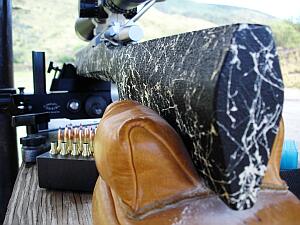
Vudoo V22 Ravage with a fluted 18″ Kukri barrel in an Urban Camo Grayboe Ridgeback stock.
Rimfire precision shooting is hot. NRL22 and PRS Rimfire are some of the fastest-growing shooting disciplines in the USA. The NRL now runs 7-8 times as many rimfire matches as centerfire matches these days. The popularity of rimfire precision shooting is easy to understand — .22 LR ammo is a small fraction of the cost of handloaded centerfire ammunition and you can have a fun competition at any local range that goes out to 200 yards or so.
If you’re looking for a top-tier .22 LR precision bolt-action rifle, here is a very impressive option…
Vudoo Gun Works Ravage Precision .22 LR Rifle
Among the most accurate .22 LR precision rifles you can buy is the mag-fed Vudoo Ravage with Ridgeback stock. Popular YouTube gun tester 22Plinkster declared: “It’s a Tack-Driver … this .22 LR Rifle is the most accurate .22 LR bolt-action rimfire rifle I have ever shot in my life.” And he notes that he has shot Anschutz, Lithgow, and other quality rifles.
Firing from a Lead Sled, 22Plinkster starts out at 50 yards, and produced a 0.335″ group at 50 yards using Lapua Midas+ ammunition (4:00 time-mark). Then this session gets really impressive. Continuing with Lapua Midas+ ammo, this Vudoo Ravage produced a sub-half-inch group at 100 yards*. You can watch that Midas+ group form up from 7:20 to 8:25 in the video. Then, with ELEY Tenex ammo, he produced a 0.707″ group (10:30) and an even smaller group (11:55). This complete rifle is available from Vudoo Gun Works for $2905.00 without optics. That a ton of money, but if you compete in the rimfire ELR game, the investment may be worth it, as the exceptional accuracy really makes a difference past 250 yards.
22Plinkster says Vudoo’s Ravage is a top choice for NRL22/PRS rimfire matches and Rimfire ELR competitions: “This is the cream of the crop. [Many] people who are winning PRS rimfire matches are shooting Vudoos. What sets this rifle apart from a lot of the other Match 22 rifles is what it does past 300 yards. A lot of rifles — Anschutz, Lithgow, CZ — shoot really good out to 300 yards. But after 300 yards, their accuracy diminishes big-time.”
If you are interested in getting a Vudoo rimfire rifle, then definitely watch this 20-minute Guns & Tactics video. It provides extensive accuracy testing for multiple ammo types with verified group sizes. Then the reviewer shows the working details of the rifle, including the bolt, trigger system, and magazine. The video also includes field testing from bipod as well as competition-type practical stages out to nearly 400 yards.
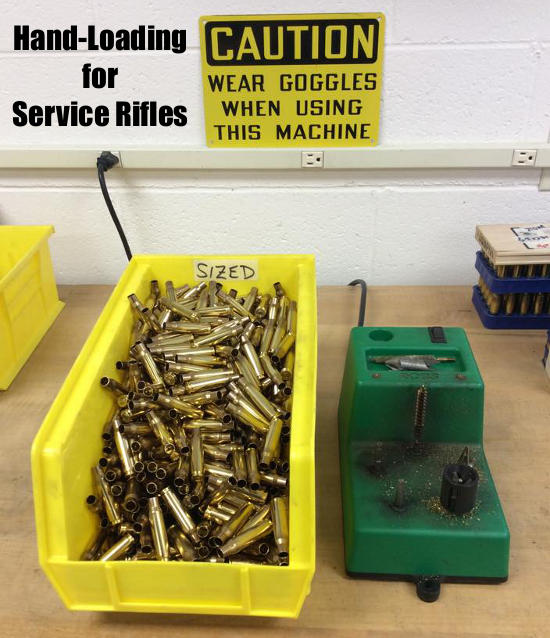
The U.S. Army Marksmanship Unit (USAMU) has published a great series of reloading “how-to” articles on its Facebook Page. This post covers key factors to consider when loading ammunition for Match Rifles and Service Rifles, with a particular focus on self-loading “gas guns”. Visit the USAMU Facebook Page regularly for other, helpful reloading and marksmanship tips.
We offer some “cardinal rules” to help new gas-gun handloaders with safety and efficiency. These address both Match Rifle and Service Rifle versions of the AR15, M1 Garand, M1A, and M110. However, they can also improve safe reloading for many other auto-loaders such as M1 Carbines, FALs, SIGs, etc. The author distilled these principles many years ago to help focus on the essential aspects of these rifles.
RULE ONE: Service Rifles Are Not Benchrest Rifles
Gas-guns require a relatively loose fit between ammunition and chamber (vs. bolt actions) for safe, smooth operation. Many techniques, such as neck sizing and keeping cartridge headspace quite tight, are popular in the extreme bolt gun accuracy realm. However, they are of little value with Service Rifles, and some could even be hazardous. Before adopting a specialized technique, seriously consider whether it is appropriate and beneficial in a gas-gun.
RULE TWO: Never Compromise Safety to Obtain Accuracy
Example: If choosing a brand of great, but ultra-sensitive match primers offers possibly better accuracy at the risk of slam-fires in your design of rifle, don’t do it! You are issued exactly two eyes and ten fingers (best-case scenario). Risking them trying to squeeze 0.25 MOA better accuracy out of an M1A, etc. simply isn’t worth it.
RULE THREE: Tailor the Precision to Your Individual Skill and Your Rifle’s Potential
This has been addressed here before, but bears repeating for newcomers. If you are struggling to break out of the Marksman Class, or using a CMP M1 “As-Issued,” then laboriously turning the necks of your 600-yard brass is a waste of time. Your scores will improve much faster by practicing or dry-firing. On the other hand, if the reigning champions anxiously check your scores each time you fire an event, a little neck-turning might not be so far-fetched.
Verifying Load Improvements — Accuracy hand-loading involves a wide variety of techniques, ranging from basic to rather precise. Carefully select those which offer a good return on investment for your time and labor. In doubt? Do a classic pilot study. Prepare ammo for at least three or four ten-shot groups with your new technique, vs. the same with your standard ammo. Then, pick a calm day and test the ammo as carefully as possible at its full distance (e.g. 200, 300, or 600 yards) to verify a significant improvement. A little testing can save much labor!
This video explains the procedure for ordering an M1 Garand from the CMP.
RULE FOUR: Be Your Own Efficiency Expert
Serious Service Rifle shooters generally think of ammunition in terms of thousands of rounds, not “boxes”, or even “hundreds”. Analyze, and WRITE DOWN each step in your reloading process. Count the number of times each case is handled. Then, see if any operations can be dropped or changed without reducing safety or accuracy. Eliminating just two operations saves 2000 steps per 1000 rounds loaded. Conversely, carefully consider any measurable benefits before adding a step to your routine.
RULE FIVE: In Searching for Greater Accuracy with Efficiency, Look for System Changes
For example, instead of marking your 300-yard rounds individually to differentiate them from your 200-yard ammo, would a simple change in primers work? If accuracy is maintained, using brass-colored primers for 200 and silver for 300 provides an indelible indicator and eliminates a step! Similarly, rather than spending hours selecting GI surplus brass for weight and neck uniformity, consider splurging on some known, high-quality imported match brass for your 600-yard loads. Results should be excellent, time is saved, and given limited shooting at 600 yards, brass life should be long.
RULE SIX: Check All Your Primers Before Packaging Your Loaded Ammo
This seems simple and even intuitive. However, many slam-fires (which were much more common when M1s and M1As were the standard) are due, at least in part, to “high” primers. Primers should be seated below flush with the case head. The USAMU has addressed this at length in a previous column, but each round should be checked for properly-seated primers before they are packaged for use.
After being held at the Kelbly’s Range in Ohio for decades, the Super Shoot, the top-tier short-range benchrest score competition, will be held May 22-25, 2023 at the Bench Rest Rifle Club in Missouri. This is a great location, much favored by elite benchrest shooters. This excellent range was the host of the 2022 NBRSA Nationals (photo above).
This will be Super Shoot 49. Historically, the Super Shoot has been the largest 100/200-yard Benchrest match in the world. This year the Super Shoot will be held at one of the premier benchrest facilities in the USA, the Bench Rest Rifle Club of St. Louis situated in Wright City, just northwest of St. Louis.
To shoot in the big match, it’s best to first register as a member of the SuperShootSports.com website. Membership is free. By becoming a member you will have access to online registration for the 49th Super Shoot and other features as they become available. There is no charge to join as a site member but there ARE fees to compete in the actual 2023 Super Shoot. So no payment is required initially to register on the site, but competition fees will be required at a later date. Match Sponsors include Shilen Rifles and Hottenstein Bullets.
The Bench Rest Rifle Club of St. Louis hosted the 2015 World Benchrest Championships:
The St. Louis shooting range facility is excellent. Forum member Alex M. posted: “The St. Louis Bench Rest Rifle Club is the finest shooting facility I have seen. The various rifle, pistol, shotgun, and archery ranges are great. They have a nice official trap field, together with manually operated traps. I shoot pistol and rifle with my wife at 25 to 600 yards. They have a very nice dedicated rimfire range, and training bays. I shoot their monthly F-Class matches (600 yards) where they award medals (1st, 2nd, 3rd) for F-Open, F-T/R and F-Bench. They also host the very popular Sierra Cup Challenge.”
Map to Bench Rest Rifle Club Range in Wright City, Missouri.
2022 Super Shoot — Last One at the Kelbly’s Range
The last Benchrest Super Shoot at the Kelbly’s Range was held May 24-27, 2022. This was the “final showdown” of the world’s group-shooting benchrest aces at the Kelbly’s range facility in Ohio. The overall 2022 Super Shoot Champion, with best combined 100 and 200-yard group-size Two Gun Aggregates (Aggs), was Jeff Summers. Gun writer James Mock noted: “The master of the Super Shoot, Jeff Summers, did it again. He fought the tough conditions and came out on top of the 200+ shooters at the final Kelbly-held Super Shoot. [That is] four times that Jeff has finished first. This shows that good guys can do well. Second place went to Ohioan Don Powell.” Summers finished with a 0.2513 Agg.
Doug Koenig is one of the best action shooters in history — both with rifle and pistol. In a recent video from SHOT Show Range Day, Doug, a 19-time Bianchi Cup Champion and a PRS Production Division Champion, talks about the disciplines he shoots, both rifle and pistol. He notes he has moved to Florida and he will be starting his own shooting school, which will open at the end of the year.
In this video, Doug is interviewed by Shooting Sports USA Editor John Parker. Koenig talks about his namesake Precision Rifle Series competition held in Colorado, the revitalized U.S. Steel Nationals and more.
You can see more Doug Koenig PRS/NRL videos on the Pursuit Channel, including coverage of precision rifle matches in Pennsylvania, Colorado, and Wyoming. The videos are worth watching for the scenery as well as the rifle action.
Doug Koenig — Action Pistol Master
Doug Koenig has won the Bianchi Cup a remarkable 19 times. No one else, man or woman, is even close to that achievement. After his Bianchi victory in 2021, Doug said: “Winning the Bianchi Cup title for the 19th time in my career is very special on its own. But to do so after the difficult year we’ve all faced, and to do so wearing a Team Ruger jersey, has made this win that much more meaningful for me.”
What skills does it take to win a Bianchi Cup? You need speed, accuracy, control, and discipline. Koenig explains some of these techniques in the video below. You’ll find 30 more Doug Koenig videos on the NSSF YouTube Channel:
The NRA Blog ran an feature on Silhouette shooting by NRA Silhouette Program Coordinator Jonathan Leighton. Here are selections from Leighton’s story:
NRA Silhouette Shooting
The loud crack from the bullet exiting the muzzle followed by an even louder ‘clang’ as you watch your target fly off the railing is really a true addiction for most Silhouette shooters. There is nothing better than shooting a game where you actually get to see your target react to the bullet. In my opinion, this is truly what makes this game so much fun.
Metallic Silhouette — A Mexican Import
Silhouette shooting came to this country from Mexico in the 1960s. It is speculated that sport had its origins in shooting contests between Pancho Villa’s men around 1914. After the Mexican Revolution the sport spread quickly throughout Mexico. ‘Siluetas Metalicas’ uses steel silhouettes shaped like game animals. Chickens up front followed by rows of pigs, turkeys, and furthest away, rams. Being that ‘Siluetas Metalicas’ was originally a Mexican sport, it is common to hear the targets referred to by their Spanish names Gallina (chicken), Javelina (pig), Guajalote (turkey) and Borrego (ram). Depending on the discipline one is shooting, these animals are set at different distances from the firing line, but always in the same order.
Before Steel There Was… Barbeque
In the very beginnings of the sport, live farm animals were used as targets, and afterwards, the shooters would have a barbeque with all the livestock and/or game that was shot during the match. The first Silhouette match that used steel targets instead of livestock was conducted in 1948 in Mexico City, Mexico by Don Gonzalo Aguilar. [Some matches hosted by wealthy Mexicans included high-ranking politicians and military leaders].
As the sport spread and gained popularity during the 1950s, shooters from the Southwestern USA started crossing the Mexican border to compete. Silhouette shooting came into the US in 1968 at the Tucson Rifle Club in Arizona. The rules have stayed pretty much the same since the sport has been shot in the US. NRA officially recognized Silhouette as a shooting discipline in 1972, and conducted its first NRA Silhouette Nationals in November of 1972.
Great Video of Silhouette Shooting in Canada with Drone Footage
Now There Are Multiple Disciplines
The actual sport of Silhouette is broken into several different disciplines. High Power Rifle, Smallbore Rifle, Cowboy Lever Action Rifle, Black Powder Cartridge Rifle, Air Rifle, Air Pistol, and Hunter’s Pistol are the basic disciplines. Cowboy Lever Action is broken into three sub-categories to include Smallbore Cowboy Rifle, Pistol Cartridge Cowboy Lever Action, and regular Cowboy Lever Action. Black Powder Cartridge Rifle also has a ‘Scope’ class, and Hunter’s Pistol is broken into four sub-categories. Some clubs also offer Military Rifle Silhouette comps.
Where to Shoot Silhouette
NRA-Sanctioned matches are found at gun clubs nation-wide. There are also many State, Regional, and National matches across the country as well. You can find match listings on the Shooting Sports USA website or contact the NRA Silhouette Department at (703) 267-1465. For more info, visit SteelChickens.com, the #1 website dedicated to Silhouette shooting sports.
Anschutz .22 LR rifle set up for F-Class competition. Photo courtesy Sportschieben Blog.
Here’s a fun new discipline that will grow in years ahead — Smallbore F-Class with .22 LR rimfire rifles. Rest-supported prone rimfire matches have been held around the world for quite some time, but only a few years ago was the discipline officially codified in the NRA Smallbore Rulebook. And the first-ever Smallbore F-Class National Championship was held in July 2018 in conjunction with the Smallbore Nationals at Camp Wa-Ke’-De in Bristol, Indiana. The Nationals involved multiple days of prone shooting at 50 meters and 100 yards. For more information read Hap Rocketto’s Shooting Sports USA Smallbore F-Class Report.
Smallbore F-Class competitors may shoot F-TR style with a bipod, or use a front rest. In the above photo from the inaugural NRA National Championship you can see a shooter with SEB Coaxial Rest at top, with a competitor using a low-profile bipod at bottom. Note the extended handle used to adjust bipod elevation. This is not a coaxial joystick, but rather a long handle attached to the mariner wheel.
Smallbore F-Class — The Future Looks Bright
With the high cost of centerfire ammunition, and the limited number of 1000-yard (or even 600-yard) ranges, we can envision that Rimfire F-Class will become a popular event at ranges across the country. Clubs don’t even need benches — just a 100-yard target bay and flat ground for the shooters. You can start with an inexpensive rimfire rig and Harris bipod. Then work up from there. Here is a custom rimfire F-TR style rig that belongs to F-Class ace and past centerfire F-TR National Champion James Crofts.
Rimfire F-Class and Fun Prone Matches with Front Rest or Bipods
Rimfire F-Class offers the fun of centerfire shooting at a much lower cost. Shooting is done prone with either a front rest or a bipod. You can shoot a relatively inexpensive rifle such as a CZ 457 MTR, or a custom build that has the same design features, weight, and ergonomics as a full-size F-TR or F-Open rifle. The choice is yours. We like shooting smallbore F-Class, because you can find decent .22 LR ammo for just $0.20 per round. By contrast, you’ll probably spend at least $1.20 per round for F-Class centerfire ammo (counting bullet, powder, primer, and part of the brass cost).
Top-Tier Vudoo V22-S Target Rifle for Rimfire F-Class
Vudoo Gun Works now offers an impressive .22 LR Single Shot Target Rifle that should prove ideal for rimfire F-Class (Open division). It features the new V22-S single-shot action, McMillan stock, and Flavio Fare BR-VS trigger.
Rimfire F-Class in the Canary Islands
This video comes from the Canary Islands, part of Spain. The voice-over is in Spanish but there are English sub-titles. The host explains: “In this video we summarize the main characteristics of this [shooting sport] that is practiced at 50 meters, 100 meters, and 200 meters with your .22 LR. Learn how to prepare your rimfire carbine and learn how to score your own targets by following our simple explanations. In another video we will delve into shooting techniques, shooting accessories and field accessories.”
Here is another rimfire F-Class video from the Canary Islands. This shows how the sport can be done with a variety of rimfire rifle types, even including a .22 LR AR clone. Some shooters are using a wide-base bipod, others are using normal Harris-type bipods, while others are using a large, benchrest-style front rest.
Rimfire F-Class-Style Local Fun Match in Oregon
In this video, F-Class John shoots an F-Class-style local fun match in Oregon. He is using a .22 LR rimfire rifle that has a full-size stock very similar to his custom F-Open centerfire rifles. This allows him to easily switch from centerfire F-Class to rimfire prone shooting with front rest and rear bag. The local fun match rules are a little different than an official F-Class match, but the shooting skills required are the same. Shooting this kind of local rimfire match allows John to keep his F-Class skills at a high level at a fraction of the cost of shooting centerfire F-Open.
Rimfire F-Class in Russia
NOTE: This video was filmed in Russia. The dialog is in Russian (without English subtitles), but it is still interesting to watch. Shooting F-Class with .22 LR ammo has become popular in Russia and other parts of Europe. You can have fun on a relatively short (200m) range with low-cost ammo.
Smallbore F-Class Course of Fire
The Smallbore F-Class Nationals was completed on paper targets at 50 yards and 100 yards. According to Shooting Sports USA: “The tournament ran during the any sight and metric phases of the 2018 NRA National Smallbore Rifle Championships, featuring a daily course of fire which mirrored the sling shooters, 40 shots at 50 meters on the A-50 target, a Metric Dewar, followed by 40 shots at 100 yards on the A-33 target. Although the international targets were shot throughout, the first two days were titled ‘conventional’ and the last two ‘metric’.”
The specifics of the match such as rifle requirements, rests, and sights may be found in the Provisional Smallbore Rifle F-Class Rules (Section 23), found on page 65 of the current NRA Smallbore Rifle rulebook. Any rules not covered in Section 23 will [reference] the normal rules of Sections 1 through 22.
This Sunday we showcase a top choice for PRS/NRL Production Division competition. Savage Arms has adapted its Impulse straight-pull action for the tactical market. Savage’s Impulse Elite Precision combines the award-winning* Savage Impulse straight-pull action with a precision MDT aluminum alloy chassis. The ability to shoot faster, with less rifle movement, is potentially a game-changer for the tactical/precision rifle competitions where stages run “on the clock” and fast follow-up shots are very important. And with a $2499.00 MSRP (for 6mm Creedmoor and .308 Win), and $2719.00 for 6.5 Creedmoor, the Impulse Elite Precision qualifies for the PRS Production Division, which is now capped at $3000 for rifle and $2500 for optic under 2023 PRS Rules (2.3.1). The 2022 PRS Production rifle max price was $2500.00.
The Savage Impulse Elite Precision in the Field
This Savage Arms video shows an Impulse Elite Precision rifle being fired in the field, shooting off a tripod at steel targets. There are good close-ups showing the rifle being shot and cycled rapidly. Starting at 00:19, watch how quickly the operator can cycle the action in just about 1 second. If you are considering purchasing an Impulse Elite Precision, definitely watch this video:
The new Impulse Elite Precision features a straight-pull action fitted in a ACC (adjustable core competition) chassis from Modular Driven Technologies (MDT). With a full-length ARCA rail, the Impulse Elite Precision can be easily customized for individual balance preferences. You can add weight and accessories on the fore-arm easily through the ARCA mounts. And the rear section offers adjustable length of pull and cheekpiece height. The ambidextrous bolt can be fitted on either right or left sides.
This Impulse straight-pull action is bedded in an Adjustable Core Competition chassis from Modular Driven Technologies (MDT). From its full-length ARCA rail to its nitride coatings, the Impulse Elite Precision is optimized for the PRS/NRL game.
Seven Chamberings Offered for Impulse Elite Precision
The Impulse Elite Precision is offered in seven chamberings: 6mm Creedmoor, 6.5 Creedmoor, 6.5 PRC, .308 Win, .300 PRC, .300 Win Mag, and .338 Lapua Magnum. MSRP for the rifle in 6mm Creedmoor and .308 Win (both with 26″ barrels) is $2499.00. In 6.5 Creedmoor and 6.5 PRC, also with 26″ barrels, the rifle retails for $2719.00. For the bigger chamberings, .300 PRC, .300 Win Mag, and .338 LM, which have 30″ barrels, MSRP is $2799.00. Effective January 1, 2023, the max allowed price for PRS Production Class is $3000.00 (Rule 2.3.1 update).
“The Elite Precision has changed the way Savage shooters think about long-range capability,” said Jessica Treglia, Senior Brand Manager for Savage Arms. “The addition of the Impulse straight-pull action is going to add a new element of speed to an already efficient rifle. When split times are an important aspect of the competition, Impulse Elite Precision will be a game-changer.”
Savage Impulse Straight-Pull Action — Overview
Savage’s Impulse series of straight-pull bolt rifles is the first American-designed and crafted straight-pull centerfire rifle. The new Impulse features an innovative Hexlock bolt-locking mechanism with six spherical bearings that move radially outward into a ring in the barrel extension, thereby locking the bolt in place. That barrel extension is held in the receiver assembly by four cross-bolts on the lower front section. Ahead of the barrel extension is a conventional recoil lug and a familiar Savage barrel nut.
Innovative Hexlock Bolt System in New Savage Impulse
When the bolt is closed, the Hexlock system holds it in place instead of conventional lugs. With the Hexlock, six (6) hardened steel bearings lock the bolt in place inside the receiver’s barrel extension. Savage says “As pressure increases, Hexlock’s hold tightens, ensuring that there can be no rearward movement of the bolt. Once the round has left the barrel, the pressure subsides, and the action can safely open again with the straight pull of the bolt handle.”
Savage Impulse — Hexlock System (Bolt Locks in Barrel Extension)
* Hunting Version of Impulse Named 2021 Rifle of the Year — The Savage Impulse straight-pull hunting rifle won the coveted NRA American Hunter 2022 Golden Bullseye Award as Rifle of the Year. Previously, Guns & Ammo magazine editors also named Savage’s Impulse the 2021 Rifle of the Year.
This discussion of rear bag designs and fill levels may offer some new insights for many readers. By “tuning” your rear bag you can reduce hop on shot-firing and help your rifle track better. All that can translate to better scores, particularly with large-caliber rifles.
Tuning Your Rear Sand Bags
Over the years, noted gunsmith and a Benchrest Hall-of-Fame inductee Thomas ‘Speedy’ Gonzalez has learned a few things about “tuning” rear sandbags for best performance. On his Facebook page, Speedy recently discussed how sand bag fill levels (hard vs. soft) can affect accuracy. Speedy says you don’t want to have both your front and rear sandbags filled up ultra-hard. One or the other bag needs to have some “give” to provide a shock-absorbing function (and prevent stock jump). And you want to tune your fill arrangements to match your shooting style. Free recoil shooters may need a different fill levels than bag squeezers (who a softer bag but harder ears).
SAND BAGS & HOW TO FILL THEMby Speedy Gonzalez
I was asked several times by competitors at the S.O.A. Matches and F-Class Nationals as to how I fill my sand bags for benchrest competition. Here is a copy of a reply I gave several years ago:
Back in the old days, Pat McMillan told me: “You can not have two bags filled so hard that you gun bounces on them in the process of firing round at your target, especially if you have a rig with a very flexible stock. The bags must be set up in a manner for them to absorb the initial shock of the firing pin moving forward and igniting the primer.
Then [they must] maintain their shape and absorb the second shock wave as well the rearward thrust and torque of the rifle. What happens to the rifle when this is not done? Well let me tell you. The rifles have a very bad tendency to jump and roll in the bags. This causes many of those wild, lost shots that one can’t explain.”
Here’s some Good General Advice for Bag Set-up:
1. You should not have TWO hard bags [i.e. both front AND rear] in your set-up.
2. Heavy sand magnifies these phenomena.
3. If you are a bag squeezer, pack ears hard and leave bag pliable enough to squeeze for the movement required. You may pack front bag as hard as rules permit.
4. Free recoil shooters pack both bags firm, but not so hard as to allow stock jump. Especially if you have a stock with a very flexible forearm.
5. We use play-ground sand, also know as silica sand. I sift mine to get any large impurities out then mix it with 25% to 50% with Harts parakeet gravel to the desired hardness that I am looking for. The bird gravel keeps the sand from packing itself into that solid as a brick state.
Speaking of bricks — another thing that happens when shooters employ that heavy zircon sand is the ears form a low spot under them from recoil and then tend to rock back and forth with the rifle causing many low shots to crop up. Edgewood makes an Edgewood/Speedy rear bag specially reinforced under the ears to eliminate this scenario.
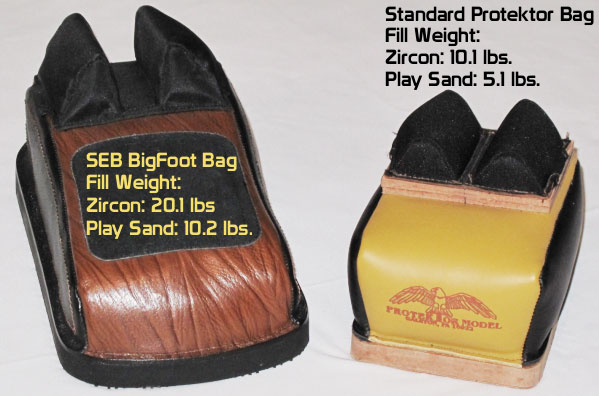
Shown below are the latest SEB Bigfoot Bags. Note that the bags sit perfectly flat — there is no bulge on the bottom even though the bags are “packed to the brim with sand”.
General Thoughts about Bag Construction and Ear Materials
I do not like the solid double-stitched leather bottoms. While this seems like a good idea, I see more shooters have problems because of them. They tend to slide around the bench and or slide with the rifle on recoil. The standard Protektor with Cordura rabbit ears and an Otto ring bag with a Cordura front would be what I would suggest to the new shooter or one of the Edgewood / Speedy rear bags, these mimic the “Donut” and feature a ring of leather around the bottom circumference that keep the bottom from rocking on the bench or ground[.]
One last note –If you use the Cordura bags, keep them sprayed with a good silicon spray or “Rain-Ex”. This keeps them from getting sticky. — Speedy
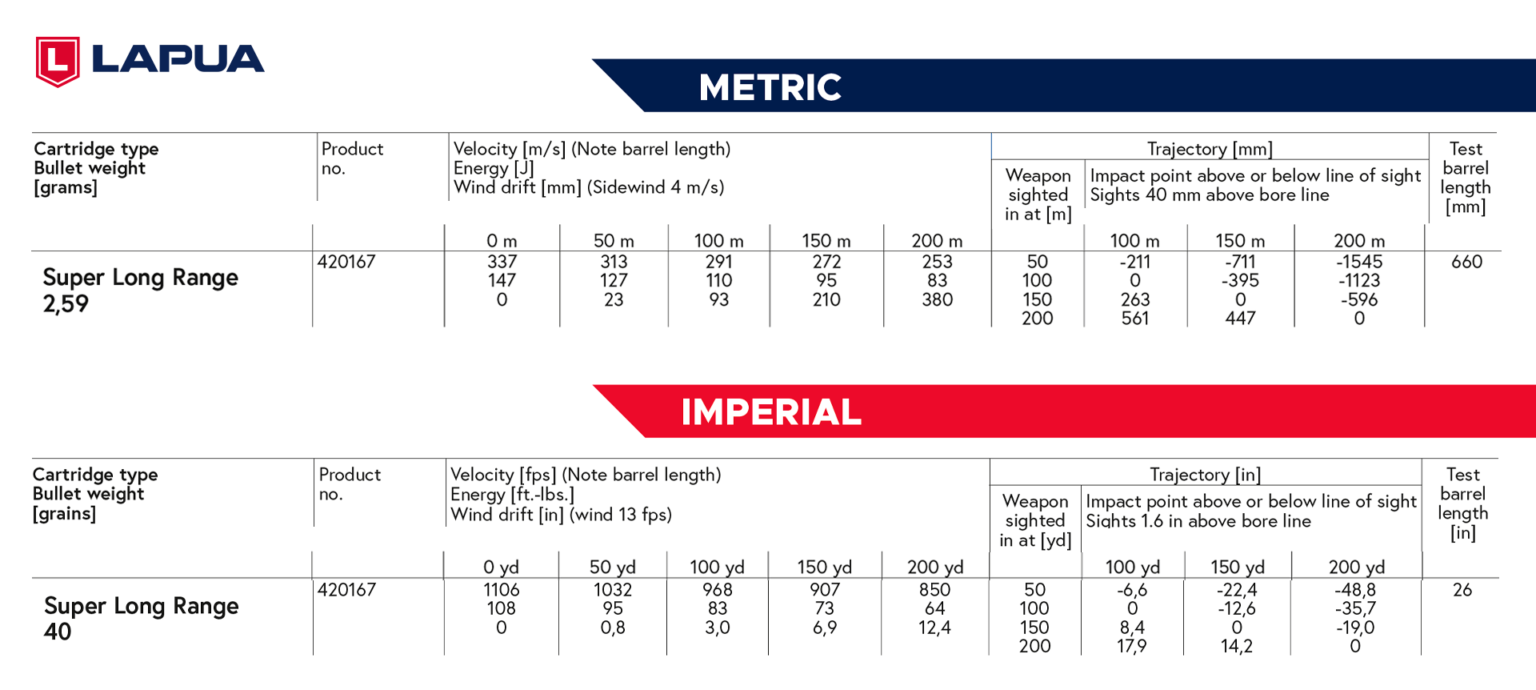
Lapua just introduced two new Long Range Rimfire ammo offerings. New for 2023, Lapua’s Super Long Range and Long Range rimfire ammunition are optimized for long range accuracy and consistency. The goal was to have extremely low extreme spread (ES) and standard deviation (SD), to yield the highest precision down range. Shooters competing in disciplines such as NRL22X and Rimfire ELR where targets are routinely placed beyond 250 yards, will benefit from Lapua’s new ultra-consistent Long Range rimfire ammo. Both the new Long Range and the Super Long Range have a 1106 FPS muzzle velocity (from 26″ barrel) and a 0.172 G1 Ballistic Coefficient.*
Introducing Lapua Super Long Range and Long Range .22 LR Ammo
Lapua’s two new .22 LR cartridges are designed for use at distances of 100 yards and beyond. The result of extensive product development and extremely advanced production processes, Lapua Super Long Range and Long Range rimfire ammunition offer ultra-consistent velocities and BC values for every shot. These new ammo types are designed for those competing in .22 LR rimfire disciplines at longer ranges. Those disciplines include: NRL22X, PRS 22, Rimfire Long Range, rimfire benchrest, and Field Target shooting. These new ammo types provide excellent performance on targets at 100 yards and beyond. With a 1106 FPS muzzle velocity, Lapua Long Range and Super Long Range provide a flat trajectory and improved wind performance. Both rimfire ammo types bring a competitive advantage with the Super Long Range offering the very best group accuracy.
Lapua states: “With a flat trajectory and improved wind performance, Lapua Super Long Range provides the very best accuracy for any top .22 LR shooter looking to beat the competition at longer distances.” The new Lapua Long Range ammo offers similar performance with the same 1106 FPS MV.
“Lapua’s new Long Range offerings are a game-changer for shooters seeking a competitive advantage in today’s most popular rimfire disciplines”, stated Jeff Knowles, Lapua U.S. Sales Director. “Lapua’s product innovation and manufacturing capabilities are unprecedented”.
Ammo Availability: Lapua’s new Long Range rimfire offerings will soon be available at authorized Lapua retailers for delivery by the end of the first quarter of 2023. Learn more about new Lapua Long Range rimfire ammunition at Lapua.com.
About Lapua: For 100 years, Lapua has been producing the highest-quality small caliber cartridges and components for civilian and professional use. Lapua is a part of the Capstone Precision Group, exclusive U.S. distributor for Berger, Lapua, Vihtavuori and SK-Rimfire products.
*Ballistic coefficients are calculated by Quick Target Unlimited Lapua Edition from V0 to V75 BC. G1 BC for all rimfire .22 LR bullets = 0.172.
Today is Friday the 13th. For those of you who are superstitious — maybe you should avoid climbing ladders, playing the stock market, or using power tools today.
When it comes to shooting, there are many things that shooters chalk up to “bad luck”. In fact, most of these instances of “bad fortune” just come from a failure to anticipate problems. When you have a major, critical problem at a shooting match, i.e. a “train wreck”, this can be the end of your weekend. In this article, Ballistics Guru Bryan Litz talks about “train wrecks” and how to avoid them, even if you are shooting on Friday the 13th. As Bryan told us: “I don’t believe in superstition — we make our own luck!”
How to Avoid “Train Wrecks” In Competition
In any shooting competition, you must try to avoid major screw-ups that can ruin your day (or your match). In this article, past F-TR National Mid-Range and Long Range Champion Bryan Litz talks about “Train Wrecks”, i.e. those big disasters (such as equipment failures) that can ruin a whole match. Bryan illustrates the types of “train wrecks” that commonly befall competitors, and he explains how to avoid these “unmitigated disasters”.
Urban Dictionary “Train Wreck” Definition: “A total @#$&! disaster … the kind that makes you want to shake your head.”
Success in long range competition depends on many things. Those who aspire to be competitive are usually detail-oriented, and focused on all the small things that might give them an edge. Unfortunately it’s common for shooters lose sight of the big picture — missing the forest for the trees, so to speak.
Consistency is one of the universal principles of successful shooting. The tournament champion is the shooter with the highest average performance over several days, often times not winning a single match. While you can win tournaments without an isolated stellar performance, you cannot win tournaments if you have a single train wreck performance. And this is why it’s important for the detail-oriented shooter to keep an eye out for potential “big picture” problems that can derail the train of success!
Train wrecks can be defined differently by shooters of various skill levels and categories. Anything from problems causing a miss, to problems causing a 3/4-MOA shift in wind zero can manifest as a train wreck, depending on the kind of shooting you’re doing.
Below is a list of common Shooting Match Train Wrecks, and suggestions for avoiding them.
1. Cross-Firing. The fastest and most common way to destroy your score (and any hopes of winning a tournament) is to cross-fire. The cure is obviously basic awareness of your target number on each shot, but you can stack the odds in your favor if you’re smart. For sling shooters, establish your Natural Point of Aim (NPA) and monitor that it doesn’t shift during your course of fire. If you’re doing this right, you’ll always come back on your target naturally, without deliberately checking each time. You should be doing this anyway, but avoiding cross-fires is another incentive for monitoring this important fundamental. In F-Class shooting, pay attention to how the rifle recoils, and where the crosshairs settle. If the crosshairs always settle to the right, either make an adjustment to your bipod, hold, or simply make sure to move back each shot. Also consider your scope. Running super high magnification can leave the number board out of the scope’s field view. That can really increase the risk of cross-firing.
2. Equipment Failure. There are a wide variety of equipment failures you may encounter at a match, from loose sight fasteners, to broken bipods, to high-round-count barrels that that suddenly “go south” (just to mention a few possibilities). Mechanical components can and do fail. The best policy is to put some thought into what the critical failure points are, monitor wear of these parts, and have spares ready. This is where an ounce of prevention can prevent a ton of train wreck. On this note, if you like running hot loads, consider whether that extra 20 fps is worth blowing up a bullet (10 points), sticking a bolt (DNF), or worse yet, causing injury to yourself or someone nearby.
[Editor’s Note: The 2016 F-Class Nationals will employ electronic targets so conventional pit duties won’t be required. However, the following advice does apply for matches with conventional targets.]
3. Scoring/Pit Malfunction. Although not related to your shooting technique, doing things to insure you get at least fair treatment from your scorer and pit puller is a good idea. Try to meet the others on your target so they can associate a face with the shooter for whom they’re pulling. If you learn your scorer is a Democrat, it’s probably best not to tell Obama jokes before you go for record. If your pit puller is elderly, it may be unwise to shoot very rapidly and risk a shot being missed (by the pit worker), or having to call for a mark. Slowing down a second or two between shots might prevent a 5-minute delay and possibly an undeserved miss.
4. Wind Issues. Tricky winds derail many trains. A lot can be written about wind strategies, but here’s a simple tip about how to take the edge off a worse case scenario. You don’t have to start blazing away on the command of “Commence fire”. If the wind is blowing like a bastard when your time starts, just wait! You’re allotted 30 minutes to fire your string in long range slow fire. With average pit service, it might take you 10 minutes if you hustle, less in F-Class. Point being, you have about three times longer than you need. So let everyone else shoot through the storm and look for a window (or windows) of time which are not so adverse. Of course this is a risk, conditions might get worse if you wait. This is where judgment comes in. Just know you have options for managing time and keep an eye on the clock. Saving rounds in a slow fire match is a costly and embarrassing train wreck.
5. Mind Your Physical Health. While traveling for shooting matches, most shooters break their normal patterns of diet, sleep, alcohol consumption, etc. These disruptions to the norm can have detrimental effects on your body and your ability to shoot and even think clearly. If you’re used to an indoor job and eating salads in air-conditioned break rooms and you travel to a week-long rifle match which keeps you on your feet all day in 90-degree heat and high humidity, while eating greasy restaurant food, drinking beer and getting little sleep, then you might as well plan on daily train wrecks. If the match is four hours away, rather than leaving at 3:00 am and drinking five cups of coffee on the morning drive, arrive the night before and get a good night’s sleep.”
Keep focused on the important stuff. You never want to lose sight of the big picture. Keep the important, common sense things in mind as well as the minutia of meplat trimming, weighing powder to the kernel, and cleaning your barrel ’til it’s squeaky clean. Remember, all the little enhancements can’t make up for one big train wreck!




 The
The 
 Metallic Silhouette — A Mexican Import
 Before Steel There Was… Barbeque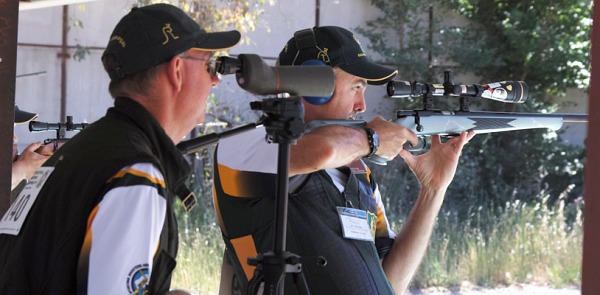


 Back in the old days, Pat McMillan told me: “You can not have two bags filled so hard that you gun bounces on them in the process of firing round at your target, especially if you have a rig with a very flexible stock. The bags must be set up in a manner for them to absorb the initial shock of the firing pin moving forward and igniting the primer.

 Lapua just introduced two new


 Train Wrecks (and How to Avoid Them)
 4. Wind Issues. Tricky winds derail many trains. A lot can be written about wind strategies, but here’s a simple tip about how to take the edge off a worse case scenario. You don’t have to start blazing away on the command of “Commence fire”. If the wind is blowing like a bastard when your time starts, just wait! You’re allotted 30 minutes to fire your string in long range slow fire. With average pit service, it might take you 10 minutes if you hustle, less in F-Class. Point being, you have about three times longer than you need. So let everyone else shoot through the storm and look for a window (or windows) of time which are not so adverse. Of course this is a risk, conditions might get worse if you wait. This is where judgment comes in. Just know you have options for managing time and keep an eye on the clock. Saving rounds in a slow fire match is a costly and embarrassing train wreck.


