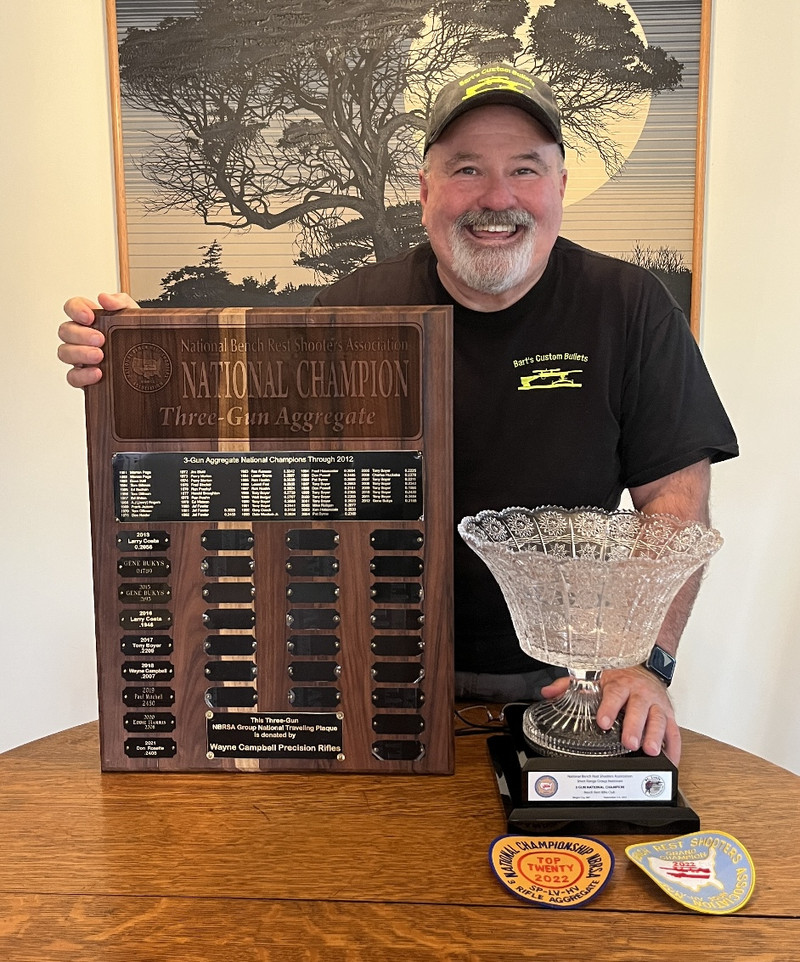
Interview with NBRSA 3-Gun and Tackdriver Champ Bart Sauter
Bullet-maker Bart Sauter is one of the world’s best benchrest shooters. He won the 2022 NBRSA 3-Gun National Championship this year, and he also has won the multi-class Tack Driver event two years in a row. Plus he has set small-group world record at 600 yards. In this very informative interview, Bart talks about bullets, equipment selection, match preparation, and shooting techniques. We think every benchrest shooter should watch this video.
Master at Work — Sauter in Action
If you want to see how a world-class bench shooter runs his rifle, check out this short video showing Bart Sauter in action. He runs five shots in about 9 seconds.
Interview with 6-Time Nat’l Long Range Champion John Whidden
CLICK HERE for full 81-minute interview with John Whidden.
John Whidden of Whidden Gunworks is one of the greatest American marksman in history. Shooting sling rifles, John has won the U.S. Long Range National Championship a remarkable six times. He has also won a Palma World Championship, and this summer John won the 2022 Smallbore Prone U.S. National Championship. While a humble individual, John has superb shooting skills and unrivaled mental toughness. In this interview, John talks about the challenges of competition and what motivates him to excel. John also talks about the products he has developed for Whidden Gunworks.
Interview with Tod Hendricks, 2021 F-Open National Champion
A member of Team Lapua/Brux/Borden, Tod Hendricks has been one of the most talented and consistent F-Open competitors for many years. He used his mental toughness and wind-reading skills to capture a National Championship in 2021. In this wide-ranging interview with his team-mate Erik Cortina, Tod reveals what it takes to win in F-Open these days, covering equipment, ammo quality, and match preparation.
Brux Barrels is a machine tool company located in Lodi, Wisconsin, specializing in premium, custom, cut-rifled barrels. Brux barrels have set some impressive benchrest records, and have won championships in multiple disciplines. In this video Erik Cortina interviews Ken Clemens of Brux. They discuss the production process at Brux, from the selection of top-quality steel blanks to the final hand-lapping procedures.
Interview with Lanny Bassham, Olympic Gold Medalist and Author
Erik Cortina recently interviewed noted author and Olympic Gold Medal-winning shooter Lanny Bassham. Erik asked Lanny about his book With Winning in Mind. Lanny discussed the “mental game” in the shooting sports and Lanny’s program for visualization of a winning performance. Lanny explains that after you have mastered your rifle skills, and learned to read the wind, it is important to adopt a winning mentality and to visualize success. Lanny should know. He won a shooting Gold Medal in the Olympics along with 22 world individual and team titles.
Interview with Lindsey Paul, Queen of 2 Miles
Lindsey Paul is the only women to win the King of Two Miles ELR competition, becoming the first-ever QUEEN of Two Miles, shooting a .375 CheyTac. In 2021, the talented lady Texan beat a field of top competitors, including past KO2M Champions, all guys. Lindsey had a truly outstanding performance, including 3 hits in 5 shots at the max distance, 2.0 miles (3520 yards). In this interview, Lindsey, who works in the law enforcement field, talks about the Extreme Long Range (ELR) game, and she also explains what it’s like to shoot the heavy-recoiling .375 CheyTac.
Interview with Frank Galli — Founder of Sniper’s Hide
The founder of the popular Sniper’s Hide Forum, Frank Galli is an online pioneer and living legend in the tactical shooting sports world. A former U.S. Marine Scout-Sniper, Frank (aka “Lowlight”) runs a very active Forum with over 180,000 members. Along with moderating his Forum, Frank runs training clinics and hosts regular podcasts. Frank is also the author of the book Precision Rifle Marksmanship: The Fundamentals, an excellent resource for PRS/NRL competitors as well as tactical marksmen.
BONUS Videos — Two Great Tech and Reloading Videos
How to Find Jam Point on your Barrel
Loading for F-Class
Erik Cortina produces his own line of EC Barrel Tuners and Tuner Brakes. These have been used successfully by many top shooters. View the full line of Cortina Precision products at: ShootSmallGroups.com.
Story by Paula Crenshaw
Congratulations to Team Lapua’s Allison Zane for winning overall Top Lady for the 2022 Precision Rifle Series (PRS). Zane, who scored a 169 at the PRS Pro Series Finale, clinched the Top Lady title for the third consecutive year. That’s an impressive “Three-Peat” for the Ladies’ title.
The 2022 PRS Pro Series Finale was held November 5-6 at the K&M Precision Rifle Training Complex in Finger, TN. The Finale brings together the best of the best within the PRS Pro Series to crown the annual champion. Competitors must qualify to attend the Finale. Out of 260 competitors, Zane finished Top Lady and placed 27th overall.
At the PRS Finale, Zane competed in the Open Division and used Lapua 6mm Creedmoor cartridge cases loaded with Berger 109gr Long Range Hybrid Target (LRHT) bullets. This combination was a favorite among the attendees competing in this year’ Finale. Zane’s next big match is the AG Cup in Finger, Tennessee.
Zane Competed with Team USA This Summer in France
This past summer Zane competed with the U.S.A. precision rifle team in France at the Precision Rifle World Championships. That event, held at the at France’s Bitche Military Camp in August, saw competitors from 26 countries including: Australia, Austria, Canada, Chile, Czech Republic, France, Georgia, Germany, Great Britain, Greece, Hungary, Indonesia, Ireland, Italy, Lithuania, Namibia, Norway, Poland, Slovakia, Slovenia, South Africa, Spain, and Sweden.
About representing the USA at the Precision Worlds, Allison said: “I am beyond excited and humbled to have been selected by the U.S. Precision Rifle Association as a member of the first U.S. Precision Rifle Team competing in the inaugural World Championship. I can’t think of a greater honor in this sport I love, than the opportunity to represent the United States of America on an international level.”
Zane competed at the worlds with a 6mm Creedmoor rifle shooting Lapua brass and Berger 109gr LRHT bullets. Her precision rifle was built by Short Action Customs using a Defiance Machine Ruckus Tactical action, Modular Driven Technologies (MDT) ACC chassis system, Vortex Razor HD Gen III 6-36×56 scope, Hawk Hill Custom Marksman Contour barrel with MDT brake, and Huber two-stage trigger.
Shooting Sports USA (SSUSA) offers a wide selection of informative articles on marksmanship techniques. If you shoot prone, “hard-holding”, you know how important proper positioning and technique can be. There is a SSUSA article that every prone shooter should read — whether you shoot air rifle, smallbore, or High Power. Compiled wtih the help of some of the country’s best prone marksmen, this article, How to Master Prone Shooting, provides a step-by-step guide to perfecting your prone position technique.
How to Master Prone Shooting — SSUSA by NRA Staff
The prone position is the most precise of the rifle shooting positions. It is used in many different shooting events at distances as close as 5 meters and as far away as 1,000 yards, and beyond that in long-range disciplines such as PRS and NRL. Prone shooting is very popular among shooters whose training time is limited, because it does not require as much practice. Age has little effect on a shooter’s ability to do well in prone; many older shooters are able to continue competing successfully in prone matches.
Here is a sample, listing STEP ONE, the basics of the prone position:
Step One: Study the Position
The prone position is steady because it is low, which gives a wide base of support to help keep the rifle still. Below are the key features of the prone position.
1. Straight line form left hand through left arm, side and leg.
2. Head tipped down comfortably.
3. Right hand grips rifle lightly.
4. Body lies behind rifle. Angle to rifle is 10 to 20 degrees.
5. Right knee bent slightly, toe pointing out.
6. Rifle lies on heel of left hand, fingers relaxed.
7. Left elbow rests to left of rifle.
8. Sling (if present) supports weight of rifle. Left arm relaxed.
9. Body rests slightly more on left side.
10. Left leg straight, toe pointing inward or straight back.
There are FIVE MORE STEPS described in detail with specific actions to perform, in the FULL Article. For example, in STEP FOUR (Sling Adjustment), the article explains: “Put the sling high on the arm and tighten the sling keeper. Wrap the arm around the sling so that the sling comes across the left hand and forearm.”
This week, Shooting USA TV spotlights the 2022 GAP Grind, the largest PRS Pro-Am Tactical match with nearly 400 competitors. The 10th Annual GA Precision/Elite Tactical GAP Grind PRO-AM was held September 30 through October 2, 2022 at the K&M Shooting Complex in Tennessee. The GAP Grind, the largest, most popular PRS match in the world, drew nearly 400 amateur and pro shooters from across the USA and from many other nations. Recognized as the premier PRO-AM precision rifle match with both individual and team competition, the GAP Grind has introduced thousands of new shooters to the sport since its inception. It was great to see the GAP Grind successfully mark its 10th Anniversary.
SHOW TIMES: This Shooting USA Episode airs Wednesday, November 16, 2022 at 9:00 PM Eastern and Pacific; 8:00 PM Central. If you miss the regular broadcast, you can stream the show at any time on Vimeo for $0.99 per episode.
In this video Eagle Eye Shooting Shares Highlights from the 2022 GAP Grind
Excellent Attendance at 10th Annual GAP Grind Event
The year’s largest PRS match drew hundreds of attendees, and more than 80,000 rounds were fired throughout the three-day event. In addition to competition stages, the GAP Grind featured a vendor area, live music and entertainment. Bushnell gave out $5,000 to the top place finishers and added over $5,000 worth of product to the prize table. Trophies were awarded to the top 5 teams, top 5 professionals, and to the top 5 amateurs.
Lots of Action, with 20+ Stages
The GAP Grind is a challenging, “high tempo” match with minimal down-time between stages. Over the course of 20+ stages, competitors will fire 200+ shots at a variety of steel, paper, moving, and reactive targets out to 1,200 yards. Targets vary in size/difficulty based on the shooter’s position, distance, and time allotted. Most stages include “stressors” — i.e. time limits or required movement(s).
This extensive, 45-minute video shows many of the 2022 GAP Grind Stages
GAP Grind Pro-Am Format — Seasoned Shooters Help Newcomers
The GAP Grind typically attracts nearly 400 competitors — half experienced shooters and the other half newcomers to the sport. The key to growing the shooting sports is attracting new shooters. The best way to bring in “new blood” seems to be the Pro-Am type format. At the GAP Grind, experienced shooters share their knowledge and guide the new shooters through the competition.
GAP Grind Hardware
You’ll find the latest and greatest PRS hardware at the GAP Grind. Over the past few seasons, most top competitors have “stepped down” from the 6.5/6mm Creedmoor to the smaller, more efficient 6mm Dasher, 6BRA, 6 GT and other 6mm cartridges. The Dasher offers excellent accuracy with less recoil than the 6.5 Creedmoor. Also, many competitors will be switching to the impressive new Zeiss FFP LRP S3 and S5 scopes in the months ahead.
Readers often ask us: “Is there an inexpensive way I can get started in position shooting?” The answer is “yes” — across the country CMP-affiliated clubs host Rimfire Sporter matches. You can use a wide variety of .22 LR rimfire rifles — manual actions (such as a Winchester model 52) or semi-automatics (such as a Ruger 10/22). There are prone, sitting/kneeling, and standing stages. CMP rules provide separate classifications for scoped rifles, open-sighted rifles, and aperture-sighted rifles. The matches are fun, the ammo is inexpensive, and everyone has a good time while improving their marksmanship.
Rimfire Sporter Match Basics
The CMP Rimfire Sporter Rifle Match is an inexpensive, fun-oriented competition using .22 caliber sporter rifles (plinking and small game rifles) commonly owned by most gun enthusiasts. To compete, all you need is a basic rifle, safety gear, and ammunition. No fancy, high-dollar rifles are required.
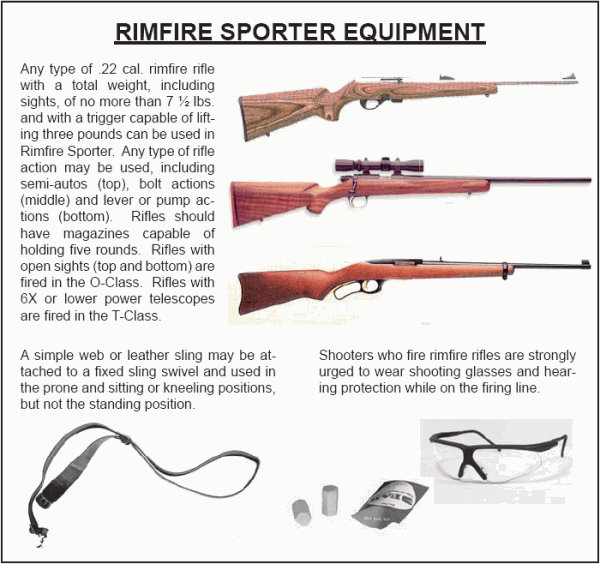
The event is shot with standard sporter-type, rimfire rifles weighing no more than 7.5 pounds, with sights and sling. Rifles may be manually-operated or semi-automatic. Rifles may be manually operated or semi-automatic, with three classes.
The three classes of competition are: 1) standard “O Class” for open-sighted rifles; 2) “T-Class” for telescope-sighted and rear aperture-sighted rifles; and 3) “Tactical Rimfire” class, which is a .22 caliber A4 or AR15 style rifle.
Firing for all classes is done at 25 and 50 yards on a target with a 1.78″ ten-ring and an 18″ outer one-ring. Even new shooters can get hits on this target, but it’s still challenging.
Rimfire Sporter Excellence
Above, young Samuel Payne won the inaugural Talladega 600 Rimfire Sporter event. In 2015, Payne became the first-ever Rimfire Sporter competitor to fire a perfect 600 x 600 score (600-50X) in a CMP-sponsored competition. Payne shot the perfect score at the CMP Eastern Games at Camp Butner, NC.
Rimfire Sporter Competition is fun for all ages — including senior shooters.
Rimfire Sporter Course of Fire
In a CMP Rimfire Sporter match, competitors will complete slow fire prone, rapid fire prone, slow fire sitting or kneeling, rapid fire sitting or kneeling, slow fire standing, and rapid fire standing shot sequences.
The CMP has adaptive Rimfire Sporter programs for shooters with physical impairments.
Rimfire Sporter Local Matches with Modified Rules
One great thing about the rimfire shooting discipline is that you can start with a very inexpensive rifle and still be competitive and have fun. The matches involve multiple stages including standing, kneeling/sitting, and prone. There are classes for both scoped rifles and iron-sights rifles.
Our friend Dennis Santiago helps run CMP Rimfire Sporter Matches in Southern California. Dennis observes: “You want something challenging? Well that X-Ring 50 yards away is the diameter of a 50 cent piece, and there are people out there that can womp that thing with iron sights.”
Dennis notes: “There are six (6) stages of fire on a tough little target. Notice the rifles that can be used run the gamut from pump and bolt actions to variations on the semi-auto theme. All still require a good eye and a steady hold to earn one’s bragging rights for the day. A match takes about an hour and a half per relay. The slowest part of the match is initial sighting in. It’ll take longer than the allocated 5 minutes for the typical first timer coming to a club match.”
At Dennis’s Burbank Rifle & Revolver Club (BRRC), procedures are modified a little bit: “What we typically do at BRRC is run two relays. Experienced competitors shoot per the full rulebook. New shooters are afforded a bit more relaxed environment to make the experience more fun and inviting. We do the same thing in our M-1 Garand Clinic/Match series.”
Official CMP Guide to Rimfire Sporter Competition
The Civilian Marksmanship Program (CMP) has a CMP Guide to Rimfire Sporter Shooting. This FREE, 50-page digital publication covers equipment, positions, course of fire, rules, scoring and much more. You’ll find helpful “how-to” sections on aiming, sight picture, hold control, and trigger control. Reading these instructional sections can benefit any prone or three-position competitive shooter.
Rimfire Sporter competitors should read Gary Anderson’s Rimfire Sporter Guide Part II. This well-illustrated, 8-page, 2014 publication covers shooting positions, sling use, sight picture, trigger technique and more.
Highlights from the 2016 National Rimfire Sporter Match at Camp Perry:
* Shooting Sports USA notes: “Samuel Payne had an unforgettable 2015. At just 16, he dominated the Rimfire Sporter events at the Civilian Marksmanship Program’s (CMP) Eastern Games, National Matches, Western Games and the Talladega 600, while also setting two new National Records during the year. Sam’s photo also graced the cover of the 10th Edition of the CMP Guide to Rimfire Sporter Shooting — and rightfully so. He proved his undeniable talent at every event he entered, not only winning the matches, but also setting the bar high for competitors in the future.”
Here is an interesting project by one of our Forum members. Martin C. (aka “Killick”) modified an Anschutz 1411 Match 54 rimfire prone stock to become a comfortable, great-tracking F-Class Open Division Stock. No Killick didn’t sacrifice a perfectly good rimfire rifle for this project — he bought the Anschutz stock by itself on eBay, then transformed it…
Killick explains: “This project started about seven years ago. I bought the Anschutz prone stock on eBay and whittled it a bit into a Palma rifle with a Barnard action and block and a Doan Trevor cheek piece and scope rail. Then about two years ago I decided to re-task the stock/action assembly into an F-Open rig. With more whittling, gluing, sanding, body fillering, sanding, filling, sanding, more sanding…and sanding, forming, priming, sanding, painting, waiting, painting, painting…painting and before you know it, Bob’s your uncle.”
Here is the eBay-sourced Anschutz 1411 stock, with new high-gloss blue finish, as initially modified for use in Killick’s centerfire Palma rifle. Looks nice!
Next step was the addition of a 3″-wide wood fore-end for F-Open duties with front rest:
Almost done here… just needs priming and final painting:
Here is Killick’s completed F-Open rifle with its much-modified Anschutz stock now finished in fire-engine red lacquer. This image shows the detail of the grip and customized cheekpiece.
Forest of Windflags at World Benchrest Championships in France in 2011
There’s a simple, inexpensive “miracle device” that can cut your groups in half. If you’re not using this device, you’re giving away accuracy. The “miracle device” to which we refer is a simple wind indicator aka “windflag”. Using windflags may actually improve your accuracy on target much more than weighing charges to the kernel, or spending your life savings on the “latest and greatest” hardware.
Remarkably, many shooters who spend $3000.00 or more on a precision rifle never bother to set up windflags, or even simple wood stakes with some ribbon to show the wind. Whether you’re a competitive shooter, a varminter, or someone who just likes to punch small groups, you should always take a set of windflags (or some kind of wind indicators) when you head to the range or the prairie dog fields. And yes, if you pay attention to your windflags, you can easily cut your group sizes in half. Here’s proof…
Miss a 5 mph Shift and You Could DOUBLE Your Group Size
The table below records the effect of a 5 mph crosswind at 100, 200, and 300 yards. You may be thinking, “well, I’d never miss a 5 mph let-off.” Consider this — if a gentle 2.5 mph breeze switches from 3 o’clock (R to L) to 9 o’clock (L to R), you’ve just missed a 5 mph net change. What will that do to your group? Look at the table to find out.
Values from Point Blank Ballistics software for 500′ elevation and 70° temperature.
Imagine you have a 6mm rifle that shoots half-MOA consistently in no-wind conditions. What happens if you miss a 5 mph shift (the equivalent of a full reversal of a 2.5 mph crosswind)? Well, if you’re shooting a 68gr flatbase bullet, your shot is going to move about 0.49″ at 100 yards, nearly doubling your group size. With a 105gr VLD, the bullet moves 0.28″ … not as much to be sure, but still enough to ruin a nice small group. What about an AR15, shooting 55-grainers at 3300 fps? Well, if you miss that same 5 mph shift, your low-BC bullet moves 0.68″. That pushes a half-inch group well past an inch. If you had a half-MOA capable AR, now it’s shooting worse than 1 MOA. And, as you might expect, the wind effects at 200 and 300 yards are even more dramatic. If you miss a 5 mph, full-value wind change, your 300-yard group could easily expand by 2.5″ or more.
If you’ve already invested in an accurate rifle with a good barrel, you are “throwing away” accuracy if you shoot without wind flags. You can spend a ton of money on fancy shooting accessories (such as expensive front rests and spotting scopes) but, dollar for dollar, nothing will potentially improve your shooting as much as a good set of windflags, used religiously.
Windflags Sources and Options
Which Windflag to buy? There are many vendors selling windflags of various types, some with daisy wheels others without. You may want to go to a match and see what types works best for you. CLICK HERE for the Benchrest Central Classifieds with multiple windflag types and accessories for sale. Here is a sample:
Bullet-maker Bart Sauter is the king of 300 meters, winning his second straight Tack Driver III multi-discipline match in South Carolina. For the second year in a row, Bart won the Tack Driver Grand Agg, after finishing sixth in Group shooting and first in Score shooting. Finishing second overall was short-range Benchrest ace Wayne Campbell. Wayne finished first in the Group-shooting phase and took eighth place in score shooting. Third overall was Jeff Peinhardt who, interestingly, was fifth in Group AND fifth in Score — that’s consistency. According to reports, 6mm PPCs dominated this year’s Tack Driver III match held November 5-6, 2022. We believe 6 or 7 out of the top 10 finishers shot a 6PPC. For decades the 6PPC has been the leading chambering for 100/200-yard benchrest-for-group competition.
The Tack Driver Showdown is a one-of-a-kind “all comers” rifle match. This unique multi-discipline match, with both SCORE and GROUP targets, reveals what rifle types are truly the MOST accurate, at least out to 300 meters. The Tack Driver Showdown III match took place last weekend, November 5-6, 2022 at the Mid-Carolina Gun Club in Orangeburg, South Carolina. The organizers invited virtually any type of rifle (except railguns) to compete at 300 meters for group and score honors. No organization membership is required. There were 89 competitors this year.
Unlike any other rifle match in the world, on the Tack Driver firing line you might see 6 PPC LV/HV rifles, 30 BR score rigs, and 17-lb 600-yard and 1000-yard benchrest guns together all lined up together. There may also be a few F-Class rifles, a PRS rifles, and maybe even an AR15 or two. But in 2022, nearly all the competitors had benchrest-style rifles, the majority designed for the 100/200 yard score and group games. That’s not surprising, as low-profile, smooth-recoiling BR rifles rule the roost at 100, 200, and 600 yards. Here are the list of rifles that competed this year according to cartridge type:
Tack Driver III targets were placed at 300 meters (328 yards). That’s not even “mid-range” by benchrest standards, but it is far enough that higher-BC bullets should have an advantage in windy or rapidly changing conditions. This year, however, the 6PPCs shooting lighter-weight 6mm bullets dominated.
Commentary by Tack Driver III Winner Bart Sauter
Winning Equipment — I shot a 6PPC with a .273 no-turn neck, Bartlein 1:13.5″-twist barrel, BAT DS action, Jewell trigger, Harris tuner, and Scarborough stock. On top was a great big ole 10-60X Valdada “Precision” scope with 40mm tube. I also used Vihtavuori N133 powder and my 68gr boat-tail bullets.
Shooter vs. the Gun — The long and the short of it is… you’re only as good as your equipment and the equipment can only perform up to the ability of the shooter. It’s a system. I’ve won it last year with a 6BRA and now with a 6PPC. I’m telling you, caliber-wise, there are a lot of different cartridges and combinations that can win. Jeff Godfrey (of the Piedmont Mafia) brought his 6BRX (I believe), and it shot like a laser. Jeff was in second place at the end of Day 1. If not for a couple of “Orangeburg Gotchas” Jeff would have been right there for the win.
Rifle and Cartridge Choice — Why did I shoot the 6PPC? It’s simple — the goal for this year was to try to make the benchrest World Team. So my resources were directed towards barrels for the 6PPC. I didn’t buy a single long range barrel this year. I used the last of my competitive long range gear for the 600- and 1000-yard Nationals. If I had both the 6BRA and 6PPC working, for this match I’d pick the 6BRA EVERY TIME and TWICE ON SUNDAY.”
Video of Bart Explaining Rest/Bag Set-Up and Showing Shooting Technique
Editor’s Note: 2022 has been a good year for Bart Sauter. He also won the 2022 NBRSA 3-Gun Short Range National Championship shooting his no-turn-neck 6PPC.
Comments by Forum Members:
“Congratulations Bart for your second Tack Driver win! Bart is no doubt a great shooter. He has [the ability] to prepare for a match to the Nth degree, then adapt and overcome changes that arise during a match. Not many have his skill, knowledge, and dedication! Congratulations to all that were there. You are all winners… I hear it was a great time had by all competitors!” — Samuel Hall (Past IBS Champion)
“While the Tack Driver concept is designed to attract shooters from Short Range Group, Short Range Score, F Class, PRS, and all of the other disciplines that require the ultimate in rifle accuracy, it is still a Benchrest match, run under Benchrest rules. Downrange ballistics such as a bullet’s ability to buck conditions take a back seat to a combination’s overall Agging capability. That includes the bullets, the barrel, the tune, the bench equipment[.]” — Jackie Schmidt
“What [the Tack Driver match] shows is the domination of the 6mm bore and small cases. It is a great event to showcase precision bench shooting [with] different disciplines coming together. Good job to Mr. Cline and all those involved including the shooters.” — Jeff PPC
Basic Information on the Tack Driver Shoot:
There are two divisions — bolt-action rifles and semi-auto gas guns. There are no specific design limits other than a 22-lb maximum weight, and a .338 maximum caliber. Past IBS President Jeff Stover tells us: “We envision the full array of the world’s most accurate rifles on the line: short and long range benchrest rifles, F-Class, AR, other tactical, egg-shoot rifles, whatever…[.]” Semi-autos required chamber flags, otherwise bolts must be out at all times.
Shooting USA TV has a very good show released today. Shooting USA’s Wednesday Night episode features an interesting tactical-style airgun competition, and then there’s a sequence from Julie Golob on how to use video recordings to improve your pistol handling and marksmanship. For fans of military firearms, this week’s episode also features a notable WWII German rifle — the Gewehr 43.
Shooting USA SHOW TIMES: This Shooting USA Episode airs Wednesday, November 9, 2022 at 9:00 PM Eastern and Pacific; 8:00 PM Central. If you miss the regular broadcast, you can stream the show online at any time on Vimeo for $0.99 per episode.
The Rocky Mountain Airgun Challenge
The 2022 Rocky Mountain Airgun Challenge in Provo, Utah attracted top shooters with over $100,000 worth of prizes. The stages look like what you’d see at PRS/NRL events, but the targets are smaller, the range is shorter, and the power behind each shot is air. Practical Air-Gun competition has a well-established community that spans the globe, and recently competitors from other shooting disciplines, the powder burners, beginning to take notice. Air-Gun practical competition is fun and inexpensive — you are paying pennies a round vs. a $1.25 or more for premium centerfire ammo. The Rocky Mountain Airgun Challenge is leading the way in this interesting air-powered shooting discipline. This multi-day event featured a variety of events on multiple stages.
Germany’s Answer to the M1 Garand — the Gewehr 43
The Gewehr is now one of History’s Guns on Shooting USA. When the legendary M1 Garand served as the US standard issue rifle in WWII the impact on the battlefield was undeniable. And the effectiveness of the Garand was not lost on the German military, armed with bolt-action Mausers that dated back to the first world war. For Nazi Germany the pressure was on to develop a semi-automatic battle rifle that could match the repeating firepower of the M1. The result was the Gewehr 43 was created to serve the German armed forces.
Using Video to Improve Your Shooting — S&W Pro Tip
The talented Julie Golob has another Smith & Wesson Pro Tip on using video to improve your shooting. Julie states: “Did you know that one of the best tools for self-diagnosing technique is your smart phone? You can set up your smartphone to record your shooting and coach yourself through valuable skills. In this Pro Tip I am going to walk you through three different ways to use your [smartphone’s video camera] to become a better shot. READ FULL STORY with More TIPs and 14 Photos.
When setting up the shot for the draw you can use either landscape or portrait, that doesn’t matter. A small tripod is useful, or you can use a larger one.
One last tip when we’re using video is to use the pause function and drag the frames along so that you can stop frame-for-frame so you can see exactly your positioning when you draw, reload, or shoot positions and your footwork. Until the next one be safe and have fun.
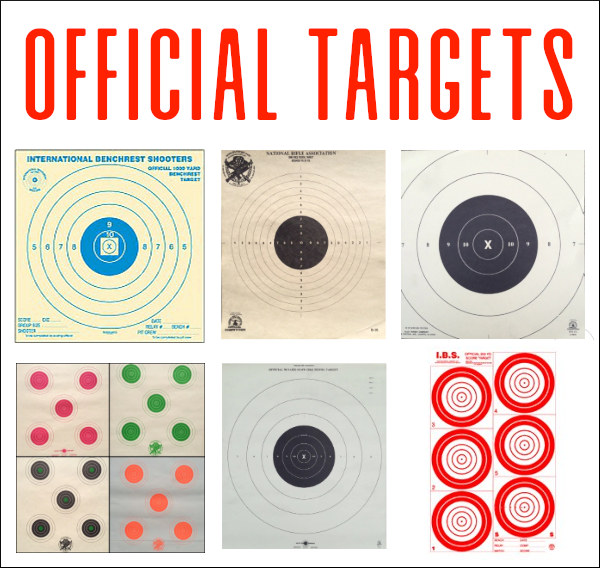
Do you need targets — not just any old targets, but the correctly-sized targets for specific shooting disciplines (such as NRA Smallbore, F-Class, and 1K Benchrest)? Well you won’t find them at your neighborhood gun store. Precise, dimensionally-correct competition targets are produced by a half-dozen specialty printers. In this article we provide links to the leading target sellers, with a chart showing “who’s got what”. Look for your particular discipline and the vendors will be specified.
Sources for Official Shooting Competition Targets:
AccurateShooter.com offers dozens of FREE, printable targets for target practice, load development, and fun shooting. We also offer a few of the most popular NRA Bullseye targets. One or more of these printable targets should work for most training purposes. However, some readers have asked: “Where can we get the real targets… exactly like the ones used in NRA, IBS, and NBRSA shooting matches?”
All these vendors carry nearly all the NRA High Power and Smallbore targets, including the smaller F-Class targets. National Target has the F-Class and High Power targets, including 100-yard reductions of the 200, 300, and 600-yard military targets.
Orrville Printing currently sells IBS targets for rimfire (50 yard) benchrest, short-range centerfire Benchrest (100, 200, 300 yards), Hunter BR Rifle (100, 200, 300 yards), plus the official 600-yard and 1000-yard IBS targets. National Target Company also has most of the IBS targets. NBRSA short-range, 600-yard, and 1000-yard benchrest targets are available directly from the NBRSA Business Office. Send an email to nbrsa@icloud.com or call (434) 993-9201.
Need Steel, Cardboard Silhouettes or specialty targets? ALCO Target Company in Duarte, California is the USA’s leading producer of the full spectrum of shooting targets including paper targets, cardboard targets, steel targets, and target stands.




 There’s a simple, inexpensive “miracle device” that can cut your groups in half. If you’re not using this device, you’re giving away accuracy. The “miracle device” to which we refer is a simple wind indicator aka “windflag”. Using windflags may actually improve your accuracy on target much more than weighing charges to the kernel, or spending your life savings on the “latest and greatest” hardware.