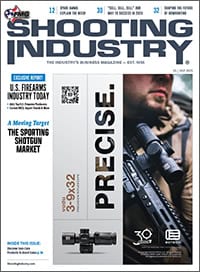
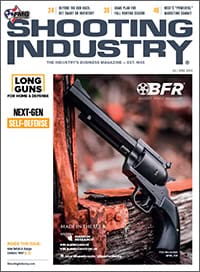
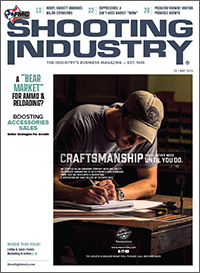
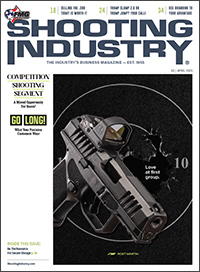
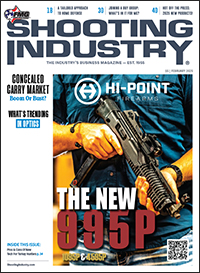
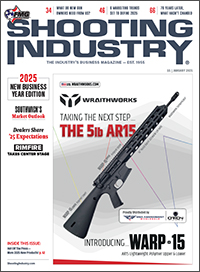
If you want to learn about trends in the firearms industry, and read about new products, you should check out Shooting Industry magazine. While tailored for firearms/outdoor gear retailers and industry professionals, this business publication also provides valuable information for all gun owners. We read Shooting Industry to learn about sales trends, new products, and gun legislation and regulatory issues.
READ for FREE — Shooting Industry is available in a digital PDF format for FREE. There are free archives for 2025 (10 months), 2024, 2023, and 2022.
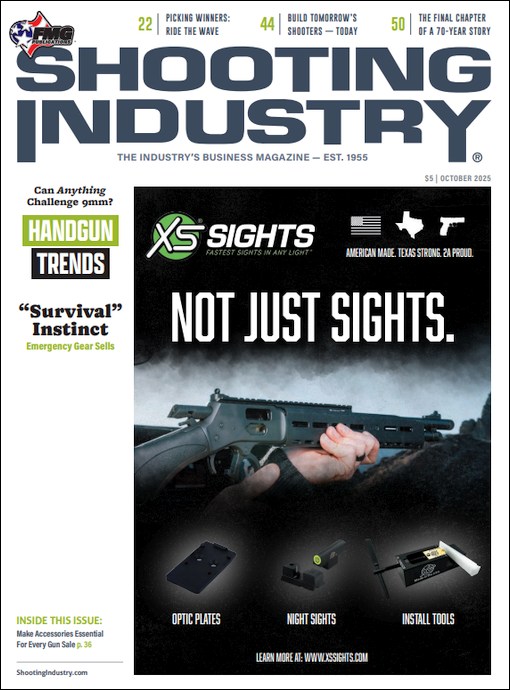
Here are direct links for all ten 2025 issues, from the January 2025 issue through October 2025 (the last issue available in PDF format). You can also CLICK HERE to bring up a page with live links to all 2025 (10), 2024, 2023, and 2022 Shooting Industry magazine issues. From that landing page, for all 2022-2025 issues, simply click the link labeled “Click Here to VIEW”, found below the cover shot for each issue.
Shooting Industry — October 2025 Issue
September 2025
Top Stories:
“Silence” Is Golden
Navigating Used Gun Market
August 2025
Top Stories:
Profits At The Range
Muzzleloading Market
July 2025
Top Stories:
Long-Range Precision Market
Target Cameras
June 2025
Top Stories:
Long Guns For Home Defense
Eye/Ear Protection
May 2025
Top Stories:
The Ammunition Squeeze
Hunting The Hunters
April 2025
Top Stories:
On the Firing Line
Secure Storage
March 2025
Top Stories:
SHOT Show 2025
“Grandpa’s Gun” No More
February 2025
Top Stories:
2025 New Product Showcase: 3
Concealed Carry Market
January 2025
Top Stories:
2025 New Product Showcase: 2
Rimfire Takes Center Stage
BONUS! FREE Content from GUNS Magazine and American Handgunner
FMG Publications, the publisher of Shooting Industry magazine, also produces the popular GUNS Magazine and American Handgunner periodicals. If you visit the respective websites for these two magazines, you will find dozen of photo-illustrated articles available for FREE online. To access, just visit the Guns Magazine home page and scroll down, or likewise visit the American Handgunner home page and scroll down the page to find many interesting articles.
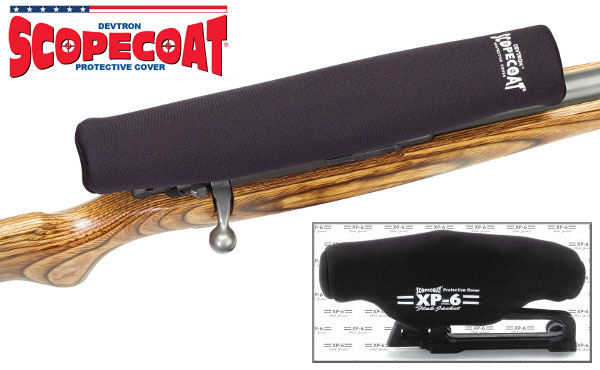
With the price of premium scopes approaching $3400.00 (and beyond), it’s more important than ever to provide extra protection for your expensive optics. ScopeCoat produces covers that shield scopes with a layer of neoprene rubber (wetsuit material) sandwiched between nylon. In addition to its basic covers, sold in a variety of sizes and colors, ScopeCoat has a line of heavy-duty 6mm-thick XP-6 covers that provide added security. CLICK HERE to review the full line of ScopeCoats on Amazon.
Triple-Thickness XP-6 Model for Added Protection
The XP-6 Flak Jacket™ is specifically designed for extra protection and durability. The 6mm-thick layer of neoprene is three times thicker than the standard ScopeCoat. XP-6 Flak Jackets are designed for tall turrets, with sizes that accommodate either two or three adjustment knobs (for both side-focus and front-focus parallax models). To shield an expensive NightForce, March, or Schmidt & Bender scope, this a good choice. XP-6 covers come in black color only, and are available for both rifle-scopes and spotting scopes.
The heavily padded XP-6 Flak Jacket is also offered in a Zippered version, shown at right. This is designed for removable optics that need protection when in storage. The full-length, zippered closure goes on quick-and-easy and provides more complete protection against dust, shock, and moisture. The line of XP-6 Scope Covers run $30 – $40 on Amazon.
Special Covers for Binoculars and Red-Dots
ScopeCoat offers many specialized products, including oversize covers for spotting scopes, protective “Bino-Bibs” for binoculars, rangefinder covers, even sleeves for small pistol scopes and red-dot optics. There are also custom-designed covers for the popular Eotech and Trijicon tactical optics.
At the request of our readers, we provide select “Deals of the Week”. Every Sunday afternoon or Monday morning we offer our Best Bargain selections. Here are some of the best deals on firearms, hardware, reloading components, optics, and shooting accessories. Be aware that sale prices are subject to change, and once clearance inventory is sold, it’s gone for good. You snooze you lose.
NOTE: All listed products are for sale to persons 18 years of age or older. No products are intended for use by minors.
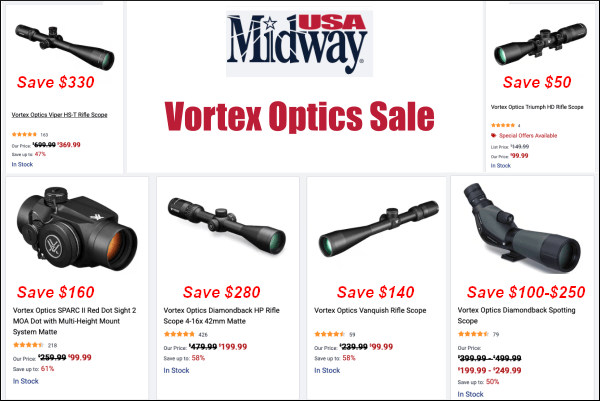
Midway USA — Vortex Optics Sale
⏺️ » Major savings on Vortex scopes, spotters, rangefinders
If you need to upgrade your pistol or rifle with new optics check out the Vortex Optics Sale over at Midway. From red-dots to rifle scopes to spotting scopes there’s something for all your needs at some of the lowest prices we’ve seen this year.
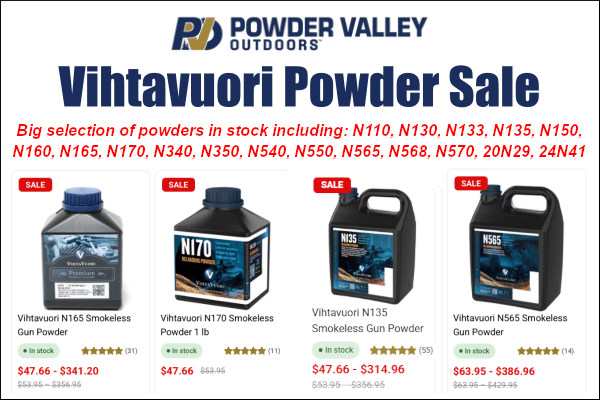
Powder Valley — Vihtavuori Powder Sale
⏺️ » Significant discounts on popular Vihtavuori powders
If you’re looking for powder, check out the Powder Valley Vihtavuori Powder Sale. Right now you’ll find everything from fast pistol powders to slow ELR powders at major savings. The choice of champions in many shooting disciplines, Vihtavuori (VV) powders are also reasonably priced. They are now some of the most cost effective, high-quality, ultra-consistent powders.
As an Amazon affiliate, this site can earn revenues through sales commissions.
For affordable, low-recoil shooting fun it’s hard to beat a semi-auto .22 LR. While Ruger’s 10/22 is the most popular semi-auto .22 LR rifle, many manufacturers are now offering AR-style self-loading rimfire rifles. We like AR-style .22 LR rigs for Rimfire Tactical Matches and 3-Gun cross-training. With an AR-style rimfire rifle you can train with low-cost ammunition while enjoying the same ergonomics, controls, and sighting systems found on your centerfire ARs.
If you shoot service rifle, and want to train at a fraction of the cost of shooting centerfire, a rimfire AR clone makes sense. This allows you to practice with a rifle with the same feel, balance, and ergonomics of your .223 Rem/5.56×45 service rifle.
These rimfire versions of the AR-15 are excellent training tools for 3-Gun and tactical match shooters. You can practice with less expensive rimfire ammo, and save wear and tear on your centerfire ARs. Rimfire AR clones also work great for Rimfire Tactical Matches.
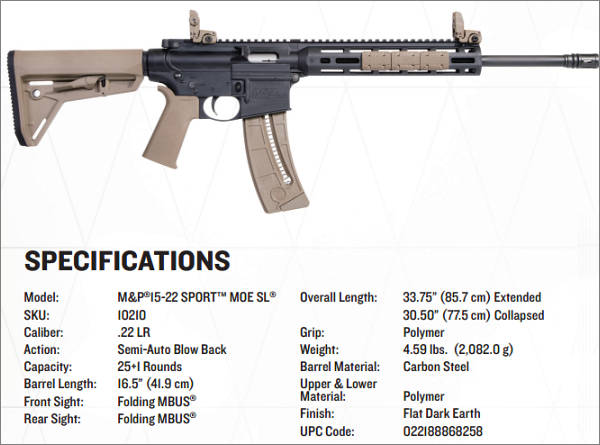
Below we feature a variety of popular .22 LR rimfire AR-style rifles, including the Smith & Wesson M&P 15-22, the Tippman Arms series of rimfire ARs, and the HK 416 marketed by Walther.
Smith & Wesson M&P 15-22
Smith & Wesson has upgraded its M&P 15-22, a fun rifle that we’ve praised in the past. The latest M&P 15-22 Sport MOE SL model (Magpul Original Equipment Slim Line) features a more comfortable handguard, an improved grip, and an adjustable Magpul buttstock. The dedicated .22 LR M&P rifle retains the look and features of the company’s popular M&P rifle line, with the enhanced ergonomics of Magpul furniture. It’s offered with Flat Dark Earth (tan) furniture or dressed in matte black.
Field Testing the Smith & Wesson M&P 15-22
Smith & Wesson’s 15-22 is a nice little rifle. The M&P 15-22 is designed and built as a true .22 LR semi-auto from the ground up, with ergonomics (and most controls) identical to a centerfire M&P 15 rifle. NRA reviewer Colon Noir tested the M&P 15-22 and was impressed: “This gun is unbelievably fun to shoot. There is virtually no recoil. The non-existent recoil makes shooting fast a breeze. Yeah, the magazine is a little quirky… but in the grand scheme of things, this gun feels like a full-out AR-15. The M&P 15-22 makes for a great training companion. I would place this gun in the ‘Fun Box’ — it’s reliable enough that you can have a fun time shooting. I’m picking one up, because it’s guns like these that make you truly realize how fun shooting is.”
Here’s a Video Review of the M&P 15-22 by the NRA’s Colin Noir
Tippmann Arms .22 LR AR-Type Rifles
Tippmann Arms makes a large variety of AR-15 style rimfire rifles. Tippmann also offers “house-brand” .22 LR magazines that work great with virtually all .22 LR ammunition — even the low-cost bulk ammo. To learn more, watch the videos below, which demonstrate the excellent functionality and reliability of the Tippmann AR clones. We also recommend the Shooting Sports USA Review of the Tippman Arms M4.
Owners have been very impressed with these Tippmann .22 LR semi-auto rifles. They are very reliable and have ergonomics/layout identical to a centerfire AR15. That makes them ideal for cross-training. Here are comments from some Tippman .22 LR rifle owners:
“Wanted a dedicated .22 LR to shoot with my 22 suppressor. I have a CMMG .22 LR conversion for use in my ARs. I just didn’t like ‘dirtying’ up my regular ARs shooting rimfire. So I bought the Tippmann. Very impressed with the gun. Runs well, and great quality. And I hear they have great customer service. And unlike some other “22LR” ARs, the Tippman is identical to a regular AR as far as controls, feel, and operation. Great for training, or plinking!”
“The wife and I have been running a Tippmann Redline in matches for a year now. Great rifle and company. Picked-up one of the speedloaders last fall and it makes a huge difference in both speed and comfort. No more sore thumb syndrome from loading those 25-round mags.”
Walther HK 416 D145RS .22 LR Rifle
Walther Arms offered an excellent, high-quality .22 LR AR-15 clone sold with the Heckler Koch (HK) label. The HK 416 D is a good cross trainer with high-quality construction and good reliability. The HK 416 D145RS Semi-Automatic Rifle in .22 L.R. is manufactured exclusively by Walther under license from HK. It is the only genuine HK tactical rimfire replica available.
Keith Glasscock is one of America’s greatest F-Class shooters and one of highly respected wind coach. A High Master, Keith finished second overall at the 2021 NRA F-Class Long Range Championship in F-Open division. He also finished second at the 2020 F-Open Nationals, and second at the 2019 F-Open Nationals. His consistency is unrivaled, which means he definitely knows the secrets of competition shooting and loading ultra-accurate ammo. In recent seasons, Keith has started PRS/NRL competition, bringing his impressive shooting skills to those popular tactical disciplines.
Keith has a great YouTube Channel with multiple new video releases every month. On Keith’s Winning in the Wind channel, Keith offers 265+ informative videos on a wide range of topics including wind reading, reloading, component selection, load development, and training.
For today’s Saturday Video Showcase, we offer nine of our favorite Keith Glasscock videos. These cover many key topics — ballistics, barrel care, gunsmithing, bullet sorting, reloading, maintenance and more. Each video has important points that can benefit any competitive rifle shooter, whether you shoot in local 100-yard fun matches or compete at the National Level in F-Class, LR Benchrest, Palma, High Power, or PRS/NRL.
Top 10 Methods to Improve Your Shooting Accuracy
To shoot top scores, you need great skills and great hardware. This video covers 10 things that can improve accuracy, starting with the most important. The #1 item, notes Keith, is rifle shooting skill — you need to be able to hold on target properly and run the rifle consistently shot after shot. The second most important thing is an accurate rifle — you need a rifle with an excellent barrel, quality components, and top-tier inherent accuracy. Third, you need very accurate ammo, and this means you need to perfect your reloading skills. You need precise powder measurement and good, consistent bullet seating. Fourth in the list is related to ammo — you need the ability to do effective load development to pick the best load for your particular barrel. Number 5 is the “right bullet”. You need a high-quality, ultra-consistent bullet that is a good match for your particular barrel and discipline. Watch the video for the other five items.
Wind Direction vs. Wind Speed — Which is More Important
Most shooters find wind reading somewhat intimidating. That is understandable. The wind can change constantly during a match, with variations in both wind velocity and angles. Sometimes you think you have a cycle figured out, but then there can be an unexpected lull. Or you may start a string in what you think is a stable condition, but then a surprise shift changes everything. In addition, wind flows can be influenced by terrain features, such as berms, which have varying effects depending on wind angle (e.g. a tailwind hitting a berm will act differently than a 90-deg crosswind). That is why a good wind reader needs to identify both the wind speed AND the wind angle. In this video, Keith explains when to focus primarily on direction and when to pay most attention to velocity. With headwinds and tailwinds, Keith notes, you should monitor angle changes carefully. With crosswinds, speed is the key variable to watch.
KEY Points to Remember
— Small changes in wind direction changes alter POI drastically at long range
— During head or tailwinds, focus on wind direction
— During crosswinds, focus more on wind speed
— The wind is cyclic — always be aware of the pattern
Reloading for PRS/NRL vs. F-Class
Keith Glasscock is one of the very few PRS/NRL competitors who has shot F-Class at the very highest level, finishing second three times in F-Class National Championships. PRS/NRL and F-Class are very different disciplines with different challenges. F-Class is shot prone with time between shots and target distances from 600 to 1000 yards. In PRS/NRL competition, you are shooting from multiple positions, at many distances from 100 yards on out, with fast follow-up shoots. For F-Open, you want an extremely accurate load that can deliver sub-quarter MOA groups at 200 yards. For PRS/NRL you don’t necessarily need that level of accuracy (though it helps). But you also need a load that is very consistent, has relatively low recoil, but can also provide sufficient impact energy to clearly show a hit on distant steel. In this video, Keith Glasscock explains his reloading objectives for the two disciplines.
How to Find (and Fine-Tune) Seating Depth
This is Keith’s most popular video, with 295,000 views on YouTube. Keith definitely knows how to maximize accuracy by finding the optimal seating depth for each particular barrel. He is achieving groups in the high Ones for three shots. That would be good for a short-range benchrest cartridge, but Keith is achieving that with a .284 Winchester which has much more recoil. If you shoot F-TR or F-Open or even PRS, you should watch this video.
How to Remove Carbon Build-Up in Barrels
Hard carbon is the bane of rifle shooters. Hard carbon build-up in the barrel can adversely affect accuracy, and in extreme cases, can lead to increased pressure. If possible, you should clean your barrel(s) soon after a match (or shooting session) before the carbon fully hardens. We’ve used Wipe-Out Foam right after a match (with an hour soak time) and that dramatically reduced the amount of brushing required. In this video Keith Glasscock explains the negatives of hard carbon in your barrel, and he discusses how to diagnose the problem and how to remove the carbon build-up efficiently.
Key Methods for Precision Load Development
Keith starts this video with this adage: “The best do the basics better.” He then explains how that applies to load development and achieving great accuracy. Your need to start with high-quality components then do every step of the reloading process — case prep, powder mesauring, bullet seating with precision. Keith then goes through his recommended process for developing an accurate load that will sustain accuracy throughout a match.
Recommended Barrel Break-In Methods
Barrel break-in is a controversial subject. With premium finish-lapped barrels from top manufacturers, some ace F-Class shooters get away with hardly no break-in — just shoot for score right from the get-go. On high-quality custom barrels, we’ve had success with minimalistic break-in with a few wet patches ever 3 rounds for the first 20 rounds. However, with relatively rough factory barrels, you may get better long-term results with a systematic break-in process, even using specialized products on your patches. In this video Keith Glasscock explains break-in procedures he’s found to work for various barrel types and applications.
What Counts More — ES or SD?
In general, we have gotten the best match results with loads showing an Extreme Spread (ES) under 13 FPS and an extremely low Standard Deviation (SD). We know that F-Class and ELR shooters competing at 1000 yards and beyond definitely want an extremely low ES to minimize vertical dispersion at long range. That said, some short-range Benchrest competitors look at group size more than ES/SD. In this video, Keith Glasscock talks about the reloading process and methods for lowering ES and SD. Proper brass prep is important, as is precise powder measuring. And long range shooters may want to test 3 or 4 different powder types to find the one that offers the best combination of accuracy and low ES/SD.
Sorting Bullets — Various Methods Compared
Should you sort your bullets? If so, should you sort by weight, OAL, base-to-ogive, or max diameter? Which factor? Well the answer is “it depends”. You need to carefully examine a couple dozen bullets from each batch to see how consistent they are. We had some Lapua bullets that were ultra-consistent with 97 out of 100 within .0015″ base to ogive length. We used those bullets unsorted to set a local range record at 600 yards. On the other hand if you find significant differences in weights, diameters, or bearing surface lengths, you probably should sort. One tip — many shooters do not consider the width difference in bullets. We have seen 6mm bullet diameters vary from 0.2428″ to 0.2436″. We have one 3-groove 6BR barrel that likes the skinny bullets and another 6-groove barrel that definitely prefers the fatter bullets.
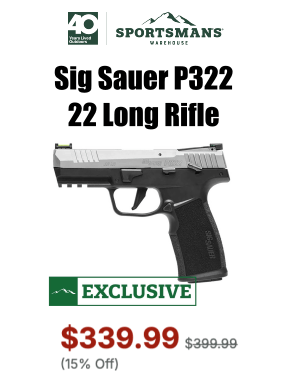
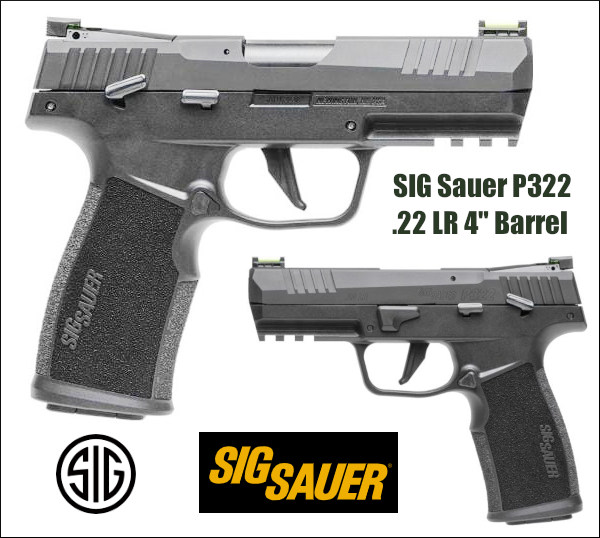
If you are looking for a versatile, well-crafted semi-auto .22 LR pistol, here’s an option you should definitely consider — the SIG Sauer P322. Introduced in 2022, this .22 LR rimfire pistol that should be popular with SIG’s centerfire handgun owners and anyone who wants a quality polymer-framed .22 LR pistol. The optics-ready P322 offers excellent ergonomics and 20+1 capacity, making it good for cross-training and fun rimfire shooting.
The P322 is built by SIG Sauer in the USA. It has many premium features, including an optics-ready removable rear sight plate allowing installation of a red dot optic without adapter plates. The P322 offers ambidextrous controls, interchangeable flat and curved triggers, and fiber optic front and rear sights. The P322 even comes with a threaded barrel adapter making it suppressor-ready right out of the box. And with a 20-rd magazine for 20+1 total capacity, the new P322 is the highest-capacity .22 LR pistol in its class. (Plus a 25-rd mag extension is offered).
The P322 is offered in both all-black and stainless-slide versions at affordable prices. Right now the handsome stainless version is just $339.99 at Sportsman’s Warehouse, a $60 savings.
The SIG P322 is a hammer-fired, single-action-only design (the hammer is enclosed by the rear of the slide). The P322 is blow-back operated with a fixed (non-tilting) 4″ barrel. This helps contribute to excellent accuracy and reliability.
Hands-On P322 Testing by 22Plinkster
SIG Sauer P322 Pistol Features:
Ambidextrous Controls With Reversible Magazine Catch
Optics-Ready Removable Rear Sight Plate
Fiber Optic Front and Rear Sights
Hammer-fired, Single-Action-Only, Fixed 4″ Barrel
Suppressor-Ready With Included Threaded Barrel Adapter
Interchangeable Trigger Shoes (flat and curved included)
20 Round Magazine Capacity (with +5 optional mag extension) SEE PRODUCT PAGE
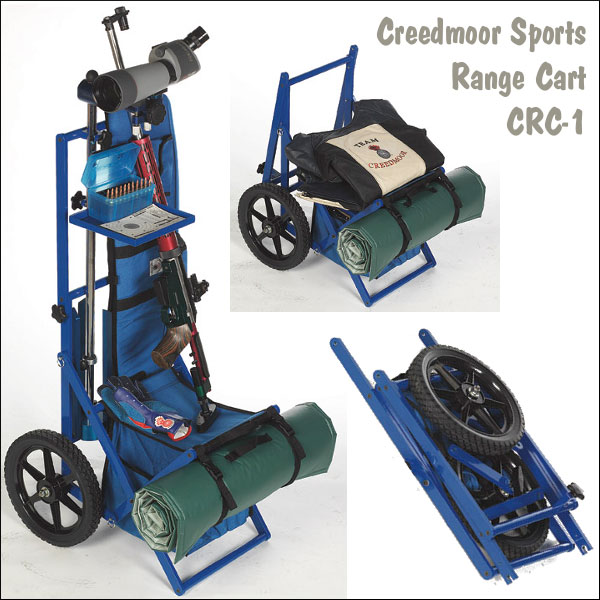
High Power and F-Class shooters have a ton of gear they need to carry out to the firing lines. To do the hauling, you can certainly purchase a factory-made, purpose-built cart that folds up and has all the bells and whistles. The Creedmoor Sports CRC-1 (photo right) is a proven, quality product that works great. You’ll find these used by top shooters at Camp Perry. But the Creedmoor CRC-1 cart costs $499.95.
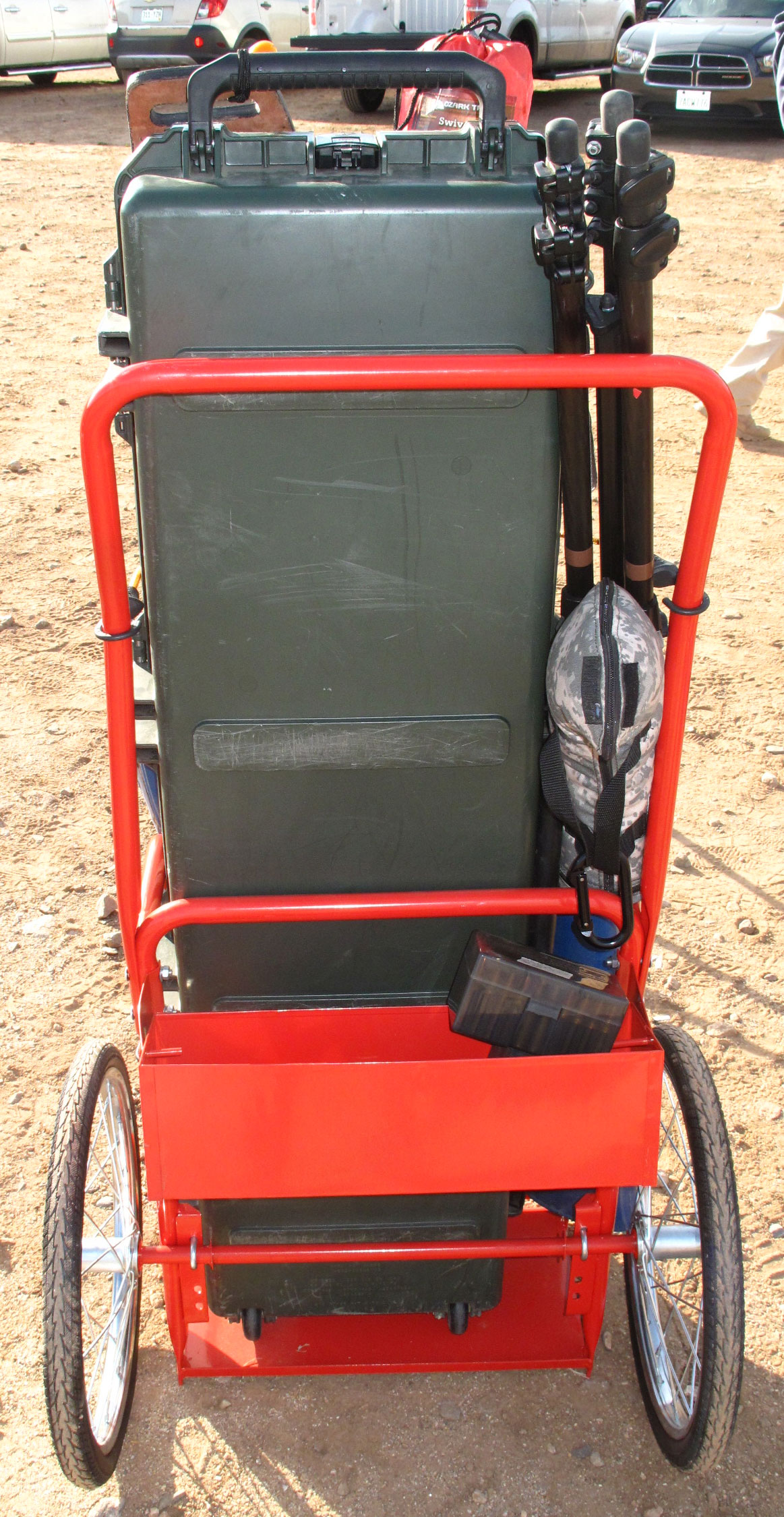
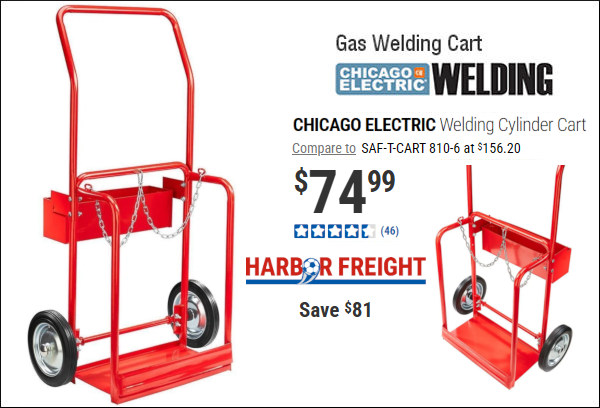
For a fraction of that price ($74.99), plus a few dollars more for do-it-yourself enhancements, you can have a heavy-duty cart that will haul all your gear just fine, though it doesn’t fold up. In the top photo is a Harbor Freight Welding Cart we saw at the Berger Southwest Nationals. This rig is carrying a rifle in hard gun case, bipod, folding chair, shooting mat, tripod, spotting scope, rear sand-bag, and ammo box — that’s a lot of gear!
Check out the Harbor Freight Welding Cart, item #70869. This cart is ON SALE now for just $74.99. The Chicago Electric Welding Cylinder Cart (SKU 70869) has an overall height of 49 inches, a length of 28 inches, and a width of 17-3/4 inches. NOTE the wheels for the current version are smaller diameter than shown in the photos above. The current cart has metal wheels with solid rubber (non-inflated) tires.
As sold, the Harbor Freight Welding Cart can benefit from upgrades for range use. But with a few bungee cords (and some creativity), the cart can be adapted pretty easily to hauling your gun gear. If you want to enhance the basic cart, it’s easy to add plastic side-panels on the bottom unit, and fit a barrel-holding system on the cross-tube. This ensures rifles and gear won’t flop forward. (A small piece of wood under the bottom panel provides a bit of extra lift that will keep the bottom plate out of the dirt and gravel.)
Jonathan Ocab, a High Power shooter from California, had gunsmith Doan Trevor install a Sako-style extractor in the Rem 700 bolt in Ocab’s 6mmBR Eliseo R5 tubegun. Jonathan produced an excellent video showing how the Sako extractor improves the ejection of the short, fat 6mmBR cartridges in his rifle. Jonathan’s video demonstrates 6mmBR case ejection with an unmodified Rem 700 factory bolt versus a factory bolt fitted with a Sako-style extractor.
Johnathan explains: “Note how even when slowly operating the bolt, the bolt with the Sako extractor easily ‘kicks’ out the brass on ejection with minimal chance of operator error resulting in a failure to extract. While the unmodified bolt has issues ejecting brass on slow operation, it will eject if the operator pulls the bolt back quickly (fast and with some force).
While a Sako-style extractor isn’t an absolute necessity, this video shows the definite improvement this modification provides. For short cartridges like the 6mmBR, this is very useful. This modification is highly recommended for competition shooters, especially High Power competitors who seek improved function in rapid-fire stages. This modification is fairly inexpensive and any competent gunsmith should be able to perform the work (usually under $100 with parts and labor).”
EDITOR’s NOTE: In his video, Jonathan deliberately worked the unmodified Remington bolt slowly to show how the standard Rem extractor can struggle with short fat cases like the 6mmBR. In fact, when you work a standard, unmodified bolt more quickly, the extraction can be much more positive. Cycling the bolt with more “snap” provides more energy to eject the cases. We have run an R5 Tubegun chambered in 6mmBR with an unmodified Rem 700 bolt (no SAKO extractor), and the extraction was reliable, provided the bolt was worked quickly.
He who dies with the most toys wins — right? Well Sinclair has another interesting gadget you can add to your reloading bench. The Sinclair Case Neck Sorting Tool lets you quickly sort brass by neck-wall thickness. For those who shoot “no-turn” brass, this can improve neck-tension consistency. Large variances in neck-wall thickness can cause inconsistent neck “grip” on the bullet. Generally, we’ve found that more consistent neck tension will lower ES and (usually) improve accuracy. We know some guys who shoot no-turn 6mmBR brass in competition with considerable success — but their secret is pre-sorting their brass by neck-wall thickness. Cases that are out-of-spec are set aside for sighters (or are later skim-turned).
Watch Case Neck Sorting Tool Operation in Video
How the Case Neck Sorting Tool Works
Here’s how the Sinclair tool works. Cases are rotated under an indicator tip while they are supported on a case-neck pilot and a support pin through the flash hole. The unit has a nice, wide base and low profile so it is stable in use. The tool works for .22 through .45 caliber cases and can be used on .17- and .20-caliber cases with the optional carbide alignment rod. The MIC-4 pin fits both .060 (PPC size) and .080 (standard size) flash holes. Sinclair’s Case Neck Sorting Tool can be ordered with or without a dial indicator. The basic unit without dial indicator (item item 749006612) is priced at $59.99. With this standard tool you can use your own dial indicator with standard specifications. You can also buy the tool complete with dial indicator (item 749007129) for $89.99. IMPORTANT: This sorting tool requires caliber-specific Case Neck Pilots which must be ordered separately.
Editor’s Comment: The purpose of this Sinclair tool is rapid, high-quantity sorting of cartridge brass to ascertain significant case-neck-wall thickness variations. Consider this a rapid culling/sorting tool. If you are turning your necks, you will still need a quality ball micrometer tool to measure neck-wall thickness (to .0005) before and after neck-turning operations.
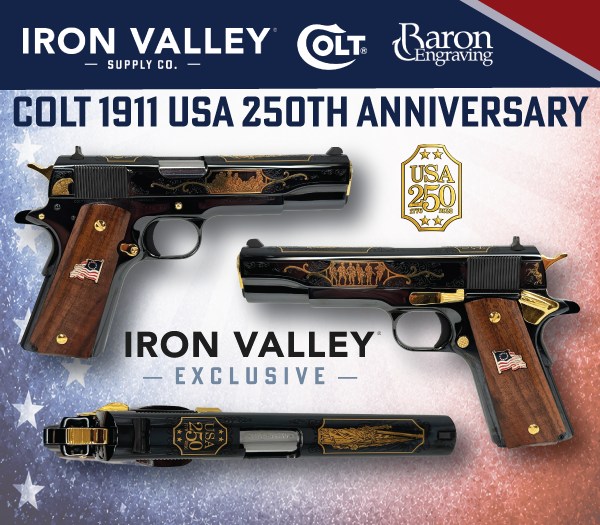
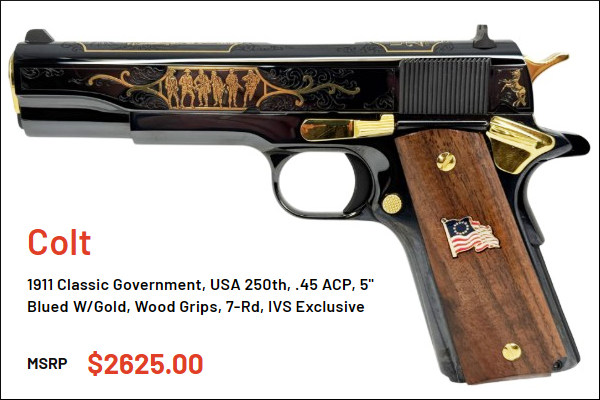
The 250th Anniversary of the founding of the United States of America is coming up on July 4, 2026 — just 24 days from now. To help celebrate this event, Colt has created a Colt 1911 USA 250th Anniversary Special Edition pistol. This impressive, engraved 1911 Colt pistol will be sold exclusively through Iron Valley Supply, based in Birmingham, Alabama.
This handsome Colt 1911 Classic Government Special Edition pistol is adorned with gold embellishments that exhibit the signing of the Declaration of Independence while honoring those who have fought to defend America’s freedoms.
Colt 1911 Classic Government — USA 250th Special Edition
About Iron Valley Supply: For decades, Iron Valley as been a leading supplier of shooting sports and outdoor products. Based in Birmingham, Alabama with offices across the country, Iron Valley distributes more than 150 of the nation’s leading brands of shooting and outdoor products.




 With the price of premium scopes approaching $3400.00 (and beyond), it’s more important than ever to provide extra protection for your expensive optics.
  The heavily padded XP-6 Flak Jacket is also offered in a Zippered version, shown at right. This is designed for removable optics that need protection when in storage. The full-length, zippered closure goes on quick-and-easy and provides more complete protection against dust, shock, and moisture. The line of XP-6 Scope Covers run





 Keith has a great


 High Power and F-Class shooters have a ton of gear they need to carry out to the firing lines. To do the hauling, you can certainly purchase a factory-made, purpose-built cart that folds up and has all the bells and whistles. The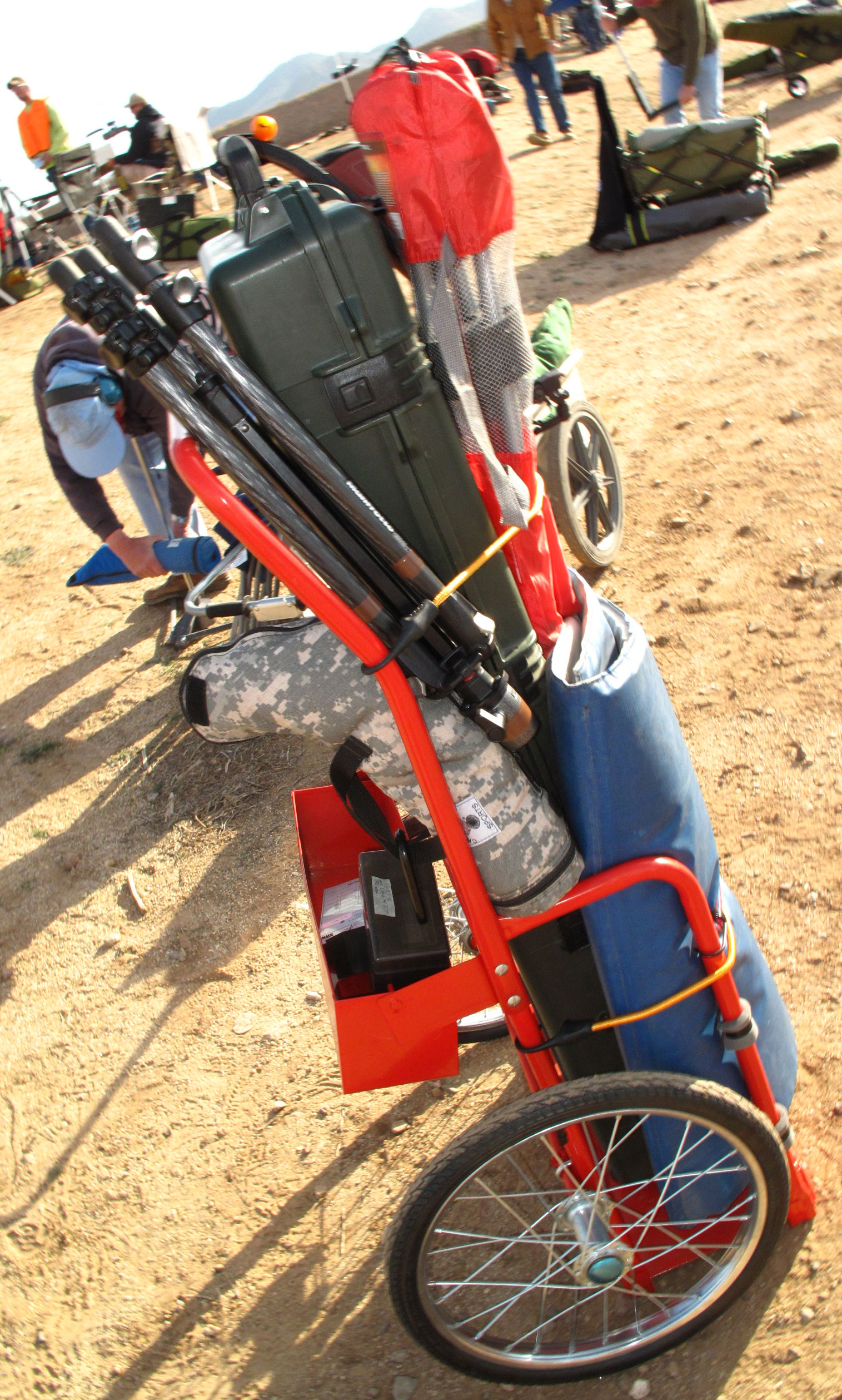


 He who dies with the most toys wins — right? Well Sinclair has another interesting gadget you can add to your reloading bench. The Sinclair