|
|
February 19th, 2008
German optics-maker Schmidt & Bender has recently released comprehensive information on the new 12.5-60×56 PMII scope. The spec sheets are found on S&B’s German-language website. (The USA website has not been updated yet.) We’ve handled this new scope at SHOT Show and it is very impressive to say the least. While our auto-translation from the German isn’t perfect, (and some of the published info appears to be incorrect), here are key specs we’ve discerned:

Weight: 21.52 ounces (610 grams) HOWEVER 1100 grams may be more accurate*
Overall Length: 16.38″ (416.5 mm)
Main Tube: 34mm
Click Value: 1 cm per click OR 1/4 MOA (two versions)
Reticle: P3 (Others may be available later)
CLICK HERE for Schmidt & Bender 12.5-50 Scope INFO
Note: S&B also lists an exit pupil size range of 13.3 to 3.3 mm. The smaller number doesn’t seem right, unless S&B has achieved a major breakthrough in optics design. At max 50X power, with a 56mm front objective, we calculate the minimum exit pupil as 1.12 mm.
*We also question the stated weight of 610 grams. The 12.5-50X56 S&B Field Target Scope, which is similar in size and features, is listed at 1150 grams or 40.56 ounces.
The scope description states: “The sight is alternatively available with foreseeing in the 1st plane or 2nd plane.” By this we think it means BOTH first-focal-plane reticle and second-focal-plane reticle versions will be offered. On a variable power scope, a first-focal-plane reticle increases or decreases with the power setting, so the reticle always appears the same size relative to the target. When the reticle is in the second focal plane, the reticle stays a constant size as the image increases or decreases in size with the power setting.


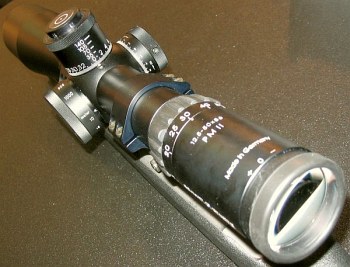
We still have no concrete information on scope price or availability in the USA. We’ve heard the figures $2700-2900 tossed around, but S&B representatives won’t give out hard numbers. Keep in mind that the 12.5-50 is NOT illuminated so it could actually be a little cheaper than the 5-25×56 PMII with illuminated reticle.
February 19th, 2008
 The National Shooting Sports Federation reports that Grits Gresham, one of America’s best-known outdoorsmen and a longtime friend to NSSF, died yesterday (2/18/2008) in his hometown of Natchitoches, La., at age 85. Gresham enjoyed an extraordinary career that included serving as field host and producer for the “The American Sportsman” TV series on ABC and as a magazine writer and editor, book author, conservationist and television personality. At one time, Gresham was the outdoor industry’s most visible champion thanks to his role in a series of commercials for Miller Lite beer. Back in the early 1980s, when cable television and outdoor programming were gaining a national audience, NSSF began to explore how to best use this new outreach for its hunting and shooting sports promotional messages. “What we really needed,” said NSSF President Doug Painter, “was a great spokesman, and who better than the former co-host of ‘The American Sportsman’ series, Grits Gresham. We began in 1984 with a series of ‘Where to Hunt’ and ‘Where to Shoot’ specials on ESPN hosted by Grits. These specials were followed by broadcasts of the first ‘made-for-TV’ shooting event, the ‘Sportsman’s Team Challenge,’ and continued with our ‘Shooting Sports America’ series on prime-time ESPN through the mid-1990s. Grits was a terrific host and a wonderful ambassador for our sports.”
Text COPYRIGHT © 2008 by National Shooting Sports Foundation, Inc.
February 18th, 2008
Long-time friend of the site David Apple let us know that he has decided to part with his “masterpiece” Terry Leonard-stocked 30BR. This gun represents the ultimate in the art of benchrest gunsmithing and it shoots as good as it looks.
2/21 UPDATE — The Rifle is sold to a well-known shooter with a prominent small-caliber website.
The rifle features a Leonard redwood and carbon fiber stock with fancy wood top-layer shell. The action is a Farley Right Bolt, Left Port, Right Eject with 30mm Farley rings. Sid Goodling smithed the rifle, chambering the Rock Creek 17-twist barrel in 30BR. David tells us the barrel only has 110 rounds through it, and “it’s a shooter”. Asking price for the rifle by itself is $3,225.00. A new NightForce scope is also available at extra cost.

Here’s your chance to start the shooting season with a spectacular new Benchrest for Score Rifle. (Scope and arbor press are not included in price.) If you’re interested, email Mailbox@6mmBR.com. We’ll forward your message to David.
February 18th, 2008
As we noted recently, the case of District of Columbia vs. Heller, is slated to be heard by the U.S. Supreme Court on March 18, 2008. This landmark case squarely presents the High Court with the question whether the Second Amendment of the U.S. Constitution affords an individual right to own firearms.
Along with many other interested organizations, the National Shooting Sports Foundation (NSSF) has filed a “friend of the court” Amicus Brief in the D.C. v. Heller case. The NSSF’s well-researched brief provides a fascinating history of the Second Amendment, explaining the factors which gave rise to its adoption. We recommend you read the brief and save it for future reference.
CLICK HERE to READ NSSF AMICUS BRIEF (.pdf format)

February 17th, 2008
If you shoot a 22-250, or are just interested in the history of the cartridge, Peterson’s RifleShooter Magazine offers a fascinating article by Terry Wieland. The author explains how the 22-250 was developed in the late 1930’s and was initially known as the 22-250 Varminter. In 1963 the round gained popularity when Browning chambered it in a production rifle — even before factory-loaded ammo was available. Then, in 1965, the round became “official” when Remington standardized the 22-250 with “Remington” added to the name. Remington produced 22-250 Rem ammo and sold Rem 700s chambered in the “new” cartridge.
Once Remington got involved, the round became hugely popular. According to Wieland: “Overnight, it seemed, the .22-250 established itself as the dominant high-velocity .22. Winchester had just discontinued the .220 Swift and replaced it with the oddball .225 Winchester, a rimmed cartridge that was gone in less than a decade. Everyone ignored the .225 while falling over themselves to chamber the .22-250.”

February 16th, 2008
The March 40X target scope has already made a big splash in benchrest competition. Many of the top shooters have replaced their Leupold Competition scopes with the March. This editor has shot with a March 40X and I can affirm it is brighter than the Leupold Comp 40X, and the March is sharp and bright all the way out to the edges. There are none of the side-focus parallax lash problems sometimes encountered with the Leupold. In competition so far, the March scopes have shown superior tracking and repeatability.
Based on the successful 40X format, March has introduced two new fixed-power target scopes, a 50X and a 60X. (In addition, there is a new 10-60X zoom–but that will be the subject of a later report.) Lou Murdica has been using the 50X in recent matches and he reports “it is outstanding. Even at 50X it is plenty bright. Visually you won’t notice the difference between the 40 and the 50 except you get more power, of course.”
The new 50X and 60X are the same size and weight as the March 40X. All three versions are 14.29 inches long, and weigh 599 grams (21.04 ounces). That’s about 12 ounces lighter than a Nightforce 12×42 BR. Front objectives are 52mm and the main tube is 30mm. All three fixed-power March scopes feature 72 MOA of total elevation and 50mm of windage. Clicks are 1/8th-MOA for 40X, 50X, and 60X.
The primary optical difference (other than magnification), is the size of the exit pupil. (A scope’s exit pupil is the actual diameter of the tiny cone of light that your eye perceives. A large exit pupil is more “user friendly”. With a very small exit pupil, it becomes more difficult to pick up the white circle of light–the position of your head becomes ultra-critical.) In optics there is no “free lunch”. Holding the front objective diameter constant, if you increase magnification, the exit size will get smaller. The March 40X has a 1.3mm exit pupil, the 50x measures 1.04mm, and the 60X has a 0.87mm exit pupil. We think the very small exit pupil on the 60X may undercut the practical utility of the higher magnification.

In the USA, March Scopes are sold exclusively by Kelbly’s. Call Hobie Bond at Kelby’s for current pricing and availability. We expect the 50X and 60X to run about $2200.00.
CLICK HERE for MARCH 50X and 60X SPEC SHEET
February 16th, 2008
Benchmark Barrels of Arlington, Washington has earned a stellar reputation for its rimfire barrels. Many of the most accurate rimfire BR rigs in the country sport Benchmark barrels. Benchmark pioneered the 2-groove barrel, and its reverse-taper blanks, in 2-groove, 3-groove, and 6-groove, are in high demand. Benchmark is known for the quality of its lapping work and its ability to craft a precise progressive taper (or “choke”) along the full length of the barrel. Typically, Benchmark’s rimfire barrels are hand-lapped with .0006-.0007″ of internal bore taper. This is an even, slight reduction of bore diameter–not just a choke at the end.

Centerfire Barrel Production
Benchmark offers a full range of centerfire calibers now, from .22 all the way up to .50 caliber. The three-groove, standard land, 8-twist 6mm barrel has been shooting exceptionally well, and Benchmark recently acquired new buttons so it can deliver 1:7″ and 1:9″ twists too. The 6.5mm barrels and 30 caliber barrels have been shooting very well also according to match reports. Benchmark can deliver both canted-land and conventional land versions of its centerfire barrels. Which shoots best? According to barrel-maker Ron Sinnema, “the 6mm 3-grooves with standard lands are working great. Bruce Baer tried one recently and said is was exceptionally accurate.” And for customers who prefer cut-rifled barrels, Benchmark now offers cut rifling in most bore sizes, from .22LR all the way up to rifled shotgun bores.

Great Value: $250.00 for a Premium Centerfire Barrel
Benchmark barrels are attractively priced. A centerfire blank with 27.5″ finished length costs just $250.00. Sinnema noted: “That’s our highest quality — we only sell one grade”. A variety of contours are available and (at added cost) Benchmark can provide fluting or an octagon barrel profile.
Rimfire barrels cost $325.00. They are more expensive because of the extra hand labor required. Ron explains: “The taper lapping is very time-consuming on the rimfire — but that’s one secret to their accuracy.”
Benchmark has a website “under construction”. For more info, contact Benchmark by phone, fax, or email:
Benchmark Barrels
Ron Sinnema, Barry Graber
1105 Pioneer Hwy East
Arlington, WA 98223
phone: (360) 652-2594
email: benchmarkbarrels [at] yahoo.com
February 15th, 2008
As you probably know by now, an important gun rights case, District of Columbia vs. Heller (docket 07-290), is now before the U.S. Supreme Court. As it directly involves the issue of individual rights under the Second Amendment of the U.S. Constitution, this case may impact ALL firearms owners. Legal experts note that this is the first time in 70 years that the High Court has been asked to interpret the basic meaning of the Second Amendment. The Supreme Court will hear the case on March 18. (Oral Arguments are scheduled for 10 am). Amicus briefs have been submitted by notable parties, including many U.S. States, and Vice President Dick Cheney recently lent his signature (in his role as President of the U.S. Senate) to a brief filed by a Congressional Caucus.
If you want to learn more, American Rifleman Magazine has an excellent article that covers the “Top 10 Facts” about D.C. vs. Heller. Authored by NRA-ILA Executive Director Chris Cox, this is a “must-read” summary of the landmark case.
CLICK HERE to READ ARTICLE on SUPREME COURT CASE

February 14th, 2008
A new, two-stage CG Universal Match Trigger is in production. It will be available from Jackson Rifles in Europe and Tom Myers in the USA. The trigger’s final stage pull-weight adjusts from 10 ounces to over 63 ounces, and both a curved or straight trigger finger is offered. Notably, this new design works with a very wide range of actions, both custom and factory. In addition to a Remington 700 version, for example, there are versions for Barnard, Mauser, RPA, SAKO, Tikka, and Winchester Model 70 actions. That makes this CG Trigger one of the most versatile match triggers ever offered.
German Salazar of ShootersJournal.com has one of the new CG Triggers, and he plans to field test and review the product for us very soon.

The CG Universal Trigger uses a variety of upper frames to fit each specific rifle action. The upper frame contains the final lever(s) of the trigger. A universal main housing is attached to this upper frame. This ensures similar function, settings and “feel”, whatever action the trigger is fitted to. The CG Universal is a true two-stage trigger, so that (unlike modified direct-pull triggers fitted to some “tactical” rifles), the sear engagement reduces and fully recovers with the first-pull movement of the trigger finger. The CG Universal trigger system was designed by Robert Chombart, who also designed the CG MILLENNIUM, CG INCH and other target rifle actions.
The CG Universal Trigger System works with numerous rifle actions including:
ANSCHUTZ
BARNARD
CG INCH
CG MILLENNIUM
MAUSER 98
MUSGRAVE
PARAMOUNT
PARKER-HALE M85, L81A2
REMINGTON 700
RPA 2000
RPA QUADLITE
RPA QUADLOCK |
SAKO 75
SAKO FINNFIRE
SAKO TRG
SPRINGFIELD
SWING
TIKKA 5xx/6xx
TIKKA T3*
US 1917 – P14
WEATHERBY MK V
WINCHESTER M70 |

February 14th, 2008
AccurateShooter.com’s Editor attended the recent SHOT Show. CLICK HERE to read our Show Highlights Report, complete with interviews, late-breaking product news, and Video interviews.
For more info on SHOT Show, you can still access the four (4) official Daily Reports created in .pdf format during SHOT Show. We noticed the official ShotShow.com web links for these reports were pretty hard to find last week, so you may have missed them. Below you’ll find handy links for each daily report. Note: There is some duplication of content from day to day, but each “issue” does contain new content. In particular, the “New Product” sections were updated daily.

SHOT Daily 1 (Feb. 2)
Features: New Rifles for 2008, New Shotguns 2008, New Handguns 2008, Hunting Boots/Clothing, NSSF Industry Research, New Products (Part 1)
SHOT Daily 2 (Feb. 3)
Features: Air Rifles, Custom Knives, Scholastic Clay Program, Field & Stream “Best” Awards, New Products (Part 2)
SHOT Daily 3 (Feb. 4)
Features: Air Rifles, Custom Knives, NSSF Outdoor Challenge, New Products (Part 3)
SHOT Daily 4 (Feb. 5)
Features: NSSF Shooting Sports Summit Report, Legislator of Year, Writer of Year, Small Item Product Reviews, Custom Products, New Products (Part 4)

|


