A hot new 6mm match bullet has arrived — the impressive Berger 109-grain Hybrid. This new 109-grainer, officially called the Long Range Hybrid Target (LRHT), features a formed meplat (bullet tip) for more consistent Ballistic Coefficient (BC). Berger tells us that the new 109gr LRHT boasts a high-BC, “jump-tolerant” hybrid ogive profile along with an extremely consistent BC. In fact, Doppler Radar testing confirms less than 1% BC variation from bullet to bullet. While a high BC is of course desirable for competitive shooting, shot-to-shot BC consistency is most critical when engaging targets to 600 yards and beyond. The 109’s BC numbers are very impressive for a 6mm bullet: 0.568 G1 and 0.292 G7.
AccurateShooter.com plans to test these new 109s very soon — we’re getting them into the hands of some championship-level shooters. The new 109s should prove very popular. These bullets are optimized for leading accuracy cartridges such as 6mm Creedmoor, 6mmBR, 6BRA, 6mm Dasher, 6BRX, 6GT, 6XC, and 6×47 Lapua among others. NOTE: Berger states that the new 109gr LRHT offers the same stability factor as Berger’s outstanding 105gr Hybrid Target. Accordingly, the new 109 can be considered a “direct replacement” for the 105s. And YES, the 109gr LRHT will work in 1:8″-twist barrels.
“The 6mm 109 offers several advantages,” said Bryan Litz, Berger’s Chief Ballistician. “Its ultra-sleek profile provides a higher Ballistic Coefficient (BC) resulting in less wind drift at all ranges. Using the proprietary MRT technology also results in a higher and more consistent BC, which is important for reducing dispersion at long range.”
Meplat Reduction Technology for More Consistent BCs
Berger’s new 6mm 109-grain Long Range Hybrid Target™ Bullets is designed to provide Benchrest, F-Class, and PRS enthusiasts a class-leading level of precision and consistency. Utilizing advanced/proprietary manufacturing processes, Berger’s Meplat Reduction Technology™ (MRT™) System applies controlled pressure along the projectile nose, producing a homogeneous and repeatable bullet profile. This yields what Berger claims are “the industry’s most consistent Ballistic Coefficients (BC)”.
The Berger 6mm 109 Grain Long Range Hybrid Target™ Bullets will be available very soon at authorized Berger Retailers. Use the Berger Dealer Locator to find a store near you.
Are you looking for a muzzle brake for your rifle? Then you MUST check out the epic Muzzle Brake Test performed a few seasons back by PrecisionRifleBlog.com. This massive, data-driven field test was organized by PRB head honcho Cal Zant. Over a period of months, Cal and his team tested 20+ muzzle brakes designed for 6mm, 6.5mm, and .30-caliber precision rifles. Hundreds of hours went into this research, which provided vital new insight and empirical data for several aspects of muzzle devices. Cal put a huge amount of labor/engineering into these tests and his findings deserve to be widely read.
The Muzzle Brake Overview Article covers designs, specs, and prices of 20+ brakes. Then separate, detailed PRB articles cover sound levels, recoil reduction results, ability to stay on target, muzzle blast/ground effects and more. SEE PRB Muzzle Brake Test Results SUMMARY.
Recoil Reduction
Cal created a system to directly measure the entire recoil force signature of each muzzle brake using high-speed sensors. Although the recoil cycle happens very quickly (around 1/100th of a second), his test equipment could record up to 1,000 force data points during a single recoil cycle! He fired over 1,000 rounds of match-grade ammo through four different rifles: 6XC, 6.5 Creedmoor, .308 Win, and the monster .300 Norma Magnum. He literally spent thousands of dollars on this part of the test, to ensure he got it right.
Cartridge Types Tested: 6XC, 6.5 Creedmoor, .308 Win, and .300 Norma Magnum
Ability To Stay On Target
David Tubb helped Cal develop this part of the test, because David believes this is the most important aspect of a muzzle brake. Using a laser and high-speed camera, Cal was able to objectively quantify how well each design helped you stay on target.
Noise Level
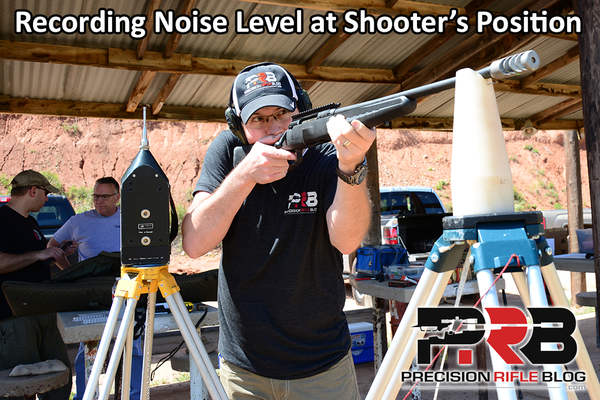
Muzzle brakes are loud, but some are louder than others … three to four times as loud. Cal enlisted the help of an expert from the suppressor industry to precisely measure how much louder each muzzle brake made a rifle. Each brake was tested in accordance with MIL-STD-1474D using calibrated military-approved equipment, and the noise level was also tested at the shooter’s position.
Recoil Reduction Summaries by Caliber
In the detailed summaries of recoil reduction test results, PRB provides hard data that might surprise a few people and even dispel a few myths. Particularly interesting is Zant’s comparison of recoil reduction with a suppressor compared to muzzle brakes. How do you think the suppressor performed compared to the brakes? You may be surprised.
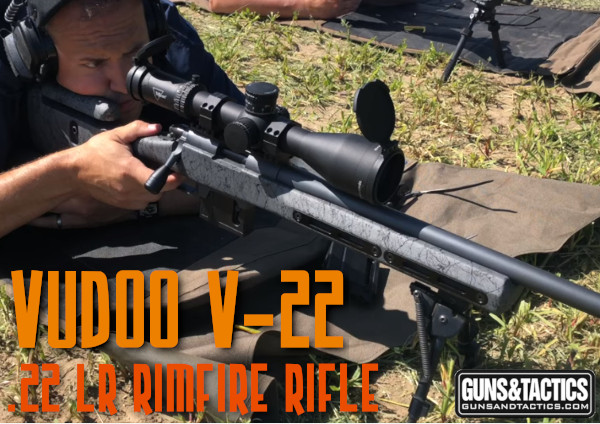
This Sunday GunDay story features a .22 LR rifle built around a Vudoo Gun Works V-22 rimfire repeater action. The V-22 action, arguably one of the best tactical rimfire actions available, owes its lineage to the respected Remington 40X action. Many rimfire matches have been won with 40X actions, so we understand why Vudoo chose that design for a starting point. Vudoo then added some important enhancements, including a controlled-feed design. This makes the Vudoo a great choice for rimfire cross-training, rimfire tactical matches, and NRL22 competition. In the video below you can see the Vudoo Gun Works rifle used an a PRS-style, long-range precision rimfire match in Minnesota.
As it has the same footprint as a Remington 700, the Vudoo Gun Works V-22 action is 100% compatible with a wide variety of Rem 700 chassis, triggers, and rifle accessories. This allows you to have a rimfire trainer with near-identical ergonomics as a centerfire match rifle. Rimfire training provides valuable trigger time with dramatically lower ammo costs. Along with actions, Vudoo sells barreled actions, and complete rifles through its website: VudooGunworks.com.
In this video, Dave Timm of GunsandTactics.com employs a Vudoo V-22 in the Minnesota .22 LR Long Range Precision Rimfire Match at the Rush Lake Range. This PRS-style match had targets out to 300 yards during the main match, followed by a long range challenge out to 465 yards. Dave’s Vudoo Gunworks V-22 rifle features a Grayboe Ridgeback stock, Harris bipod, and Trijicon Accupower 4.5-30x56mm FFP scope. Dave was shooting Lapua Center-X .22 LR ammunition.
This course of fire was challenging. Dave explains: “Stages included barricades and barrels and props to shoot out to targets at 100, 169, and 214 yards. So we’re shooting a 6″ piece of steel at 214 yards with an awkward position and a .22! It’s a good challenge and it really forced you to get all your fundamentals together. You’d be surprised at how much movement [there is]. You feel that you’re steady but all of a sudden that reticle just doesn’t want to stop moving.”
This Minnesota Match is similar to a PRS-style competition, but for rimfire rigs. Dave said “This match was an absolute blast and pushed out the .22 LR round out to some distance.”
About the V-22 Action — Controlled-Feed Design
Vudoo Gun Works states: “Our V-22 runs a full-size short action bottom metal (DBM) and our V-2210 magazine has a [full-size] AICS form factor. The V-22 is the only controlled-round-feed .22 LR receiver out there. The bolt has full capture control of the cartridge from the time it leaves the magazine until it ejects the spent round out the ejection port. That means the round never touches anything during feed travel so the bullets won’t be nicked/dented during rapid cycling.”
V-22 Product Description from Vudoo Gun Works:
The V-22 has been designed from the ground up as a true-to-scale Rimfire receiver that fits the Rem 700 footprint [for] stocks and chassis[.]. It also runs a full size short action bottom metal (DBM) and our V-2210 magazine has an AICS form factor[.]
The V-22 has a very unique control-round-feed protocol. The bolt has full-capture control of the cartridge from the time it leaves the magazine until it ejects the spent round out the ejection port. The significance of that is two-fold. Great feed and extraction reliability and…equally as important, the cartridge is controlled in a way that it never touches anything on its entrance into the bore. There is no feed ramp, nor does the projectile go in at an angle that would damage it in any way. We all know how susceptible the soft lead of the .22 LR is to accuracy-degrading damage and minor nicks during the chambering process. [That kind of bullet damage] is eliminated in the V-22 geometry.
About Dave Timm — Dave is a police officer serving his community on night patrol. Dave serves as his agency’s lead firearms and use of force instructor. He also owns and operates the Learning Firearms training operation in Baxter, Minnesota. Dave’s company offers realistic practical training solutions.
Brownells has partnered with Special Operations Wounded Warriors (SOWW), a 501(c)(3) charitable organization, to provide service dogs for Purple Heart recipients of the U.S. Special Operations community during the Cash for K9s event.
Cash for K9s started on Veterans Day (November 11th) and runs through November 17. Brownells shoppers may make donations to support Cash for K9s, with Brownells matching the total of all donations up to $50,000. Brownells will donate a minimum of $25,000 to SOWW and will match up to $50,000.
Customers can donate on the Brownells SOWW page by clicking on the brown buttons below the Cash for K9s image. there are seven (7) buttons, for $1 up to $100 donations. All donations are sent directly to SOWW to help cover all costs associated with training the dogs and pairing them with their new, deserving best friends.
CLICK buttons to go to DONATION Page. Matching Program ends 11/17/2019.
“We are forever thankful for the great support offered to America’s Veterans and members of the Special Operations communities by our partners in charity at Brownells,” said SOWW Board Vice President Joel Pellicci. “Their efforts today to raise funds for our K9 program will help provide these incredible service animals to Warriors in need[.] Brownells’ continued and consistent ability to serve those that serve us is truly helping save lives.”
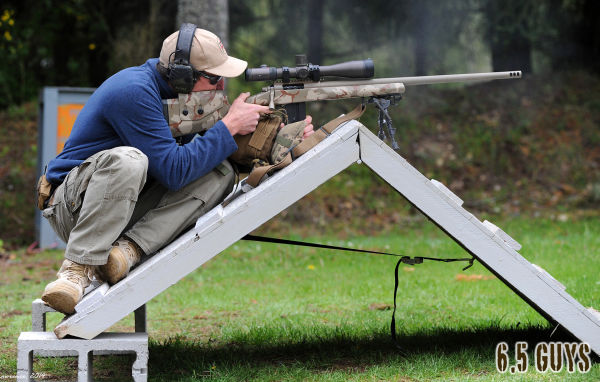
Our friends, Ed Mobley and Steve Lawrence, aka the “6.5 Guys”, have written an excellent article on getting started in practical/tactical competition. If you are new to the game, these tips can help you save money, progress faster, and have more fun. Here are article highlights, but we recommend you read the full story,5 Tips for Attending Your First Precision Rifle Match, onwww.65guys.com.
We often meet people who are new to long range precision shooting, and want to improve their knowledge and skill level. However, they aren’t sure if they are ready to sign up to compete in a match. They often ask, “What knowledge or skills are necessary to compete in a match?” Others may state, “I need to purchase this gear or that gear before I can attend a match”. For those guys who have a strong interest in precision rifle shooting, and who wish to chec out a precision rifle match, below are Five Tips to make it a positive experience.
TIP ONE: Make Plans and Commit to Go
First you need to start by finding a match to attend. This may entail a little bit of research and investigative work on your part to find what matches are scheduled in the next few months. We recommend starting with any match that may be within a reasonable driving distance. This may likely be a local “club” match, many of which are held on a regular basis. These make great venues because it will provide an opportunity to meet some of the regular attendees as well as shooters that are from your geographic area. Additionally, most of the smaller matches are a little more relaxed in terms of level of competitiveness.
Once you decide on the match you want to attend, do your homework. This means finding out if you need to pre-register or pre-pay the match fee. Commit to going by registering for the match and putting it on your schedule. Be sure to find other useful information for questions such as:
— What time should I arrive?
— Is there a mandatory safety briefing for new shooters at that venue?
— What is the travel time required to get to the match site?
— How many stages will there be?
— Is there a description of the stages available before the match?
— How many rounds should you bring?
— Are there special equipment requirements? (E.g. do you need chamber flags, is there a pistol stage?)
TIP TWO: Bring What You Have
(Don’t Spend a Fortune at the Start)
Some new shooters often assume they need a custom match rifle or all of the miscellaneous shooting gear associated with long range precision shooting to compete in match. While having a Kestrel weather meter and a high quality laser range finder and other shooting accoutrements are invaluable kit, you will find other shooters at your first match that will provide you with the information and coaching you need to get on target.
In fact, the only gear you really need to bring is a scoped rifle with a bipod and ammo capable of consistently shooting within one MOA. Also, be sure to know the ballistic drops or have a ballistic drop table prepared for your rifle/ammo to dial the correct DOPE on your scope for different target ranges. Many of the other participants at the match will be willing to let you borrow a support bag, bipod, tripod or other gear if you need one — just ask. Don’t use the excuse of not having the right gear to delay getting out to a match!
One reason not to make a big initial investment in a new rifle and assorted gear before competing, is we’ve seen a number of people come into the sport and try it for a year and then make the decision to move on to something else.
TIP THREE: Be Prepared to Learn
As a new shooter at a match, there is no better opportunity to learn. We often look to our local club matches as a group ‘training’ session to prepare for the bigger matches. You will find competitors at all levels of skill and many of your fellow shooters will enthusiastically provide helpful advice once they learn you are new to the sport. Take advantage of the opportunity to ask questions if you would like ideas for how to engage a stage, but also be sure to do more listening than talking as you receive guidance and tips from more experienced competitors.
Watch and observe other shooters and how they approach and ‘game’ a specific stage or course of fire. You’ll begin to recognize which shooting positions work best for different scenarios, and maybe even come up with some new ones that no one has thought of before.
Seeing what the better shooters do is an invaluable instructional tool. You can use your smart phone’s video camera to record other shooters (with their permission). When you’re ready to shoot, ask another shooter to record your performance. Watching yourself will point out needed areas of improvement.
After each match conduct an informal after action review and summarize for yourself the things that went well and what you should continue to do. You should also identify the specific shooting skills you should develop and make a plan to integrate the appropriate practice drills into your practice sessions. Finally, if you maintain a shooter’s data book or journal you’ll want to note things such as:
After Action Review – How you did, what went well, things you need to work on in practice. Stage Observations – Successful methods used for specific courses of fire. Note barricades, positions used, specific gear used for stages. Gear Observations – How your rifle/gear performed, what new items you should add to your “buy list”.
TIP FOUR: Be Safe and Have Fun
You’ve all heard a parent or teacher say, “It’s all fun and games until someone loses an eye.” The same can be said of the shooting sports. Safe handling of firearms is the number one rule at any match, and comes before the FUN part in terms of importance.
Before all matches start there will always be some form of a mandatory safety briefing. Make sure you know, understand, and follow any unique safety protocols for the match you attend. Some matches require all rifles have chamber flags inserted and are stowed in bags/cases while not on the firing line — other matches may not. If you run afoul of any safety rules, you risk the chance of being disqualified from a stage or worse, the entire match.
The second rule is simply have fun. This starts with having a good attitude throughout the day. Keep in mind that as a new competitor you should think of a match as a solid day of practice and training. If you blow a stage, use it as an opportunity to diagnose what you could have done differently or what you need to improve on — then smile and drive on.
Any day at the range or shooting is a good day. A match is an opportunity to hang out with like-minded people who are passionate about shooting and impacting targets far-far away. Life is great when you are doing what you enjoy!
TIP FIVE: Make Friends
There is no better way to meet lots of precision rifle shooters and make friends than at a match. The people that attend the tactical precision matches on a regular basis are those that have ‘fallen into the deep end of the pool’ and are really into the sport. As a result, they have become part of the local precision shooting community. As you strike up conversations at the match, find out if your new-found friends visit specific forum boards or social media outlets, or if there are other matches they attend.
Precision shooters tend to congregate and share information in different corners of the Internet. It will serve you well to meet some of the guys in person at matches and be able to connect a face to a screen name. As you develop your friendships and develop a level of trust, you will find opportunities become available to shoot with others in your local area, or get ‘read-in’ on a secret honey-hole of a spot to shoot long distance. Additionally, the local shooting community will often find it more convenient to sell or trade gear and equipment locally than deal with buyers/sellers that are out of state.
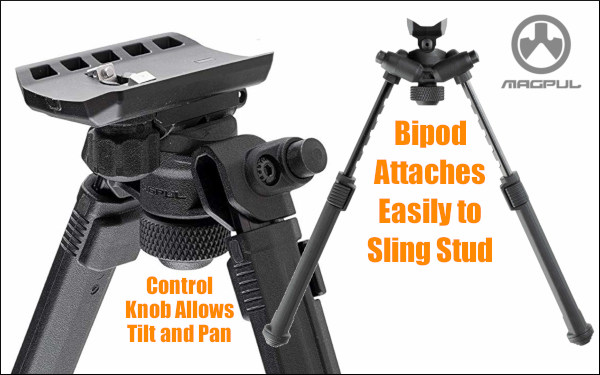
Are you looking for a stable bipod that attaches quickly and easily to the sling stud on your hunting or varmint rifle? Magpul has a new bipod that fits standard hunting-style, radiused fore-ends well. This new Magpul Sling Stud QD Bipod clamps to a sling stud in seconds. Watch the video to see how it works.
Priced around $110.00 on Amazon, this new Magpul is more expensive than a Harris-type bipod, but it has some advantages. There are no exposed springs to grab your hand. The vertical leg adjustment is quick and easy. There is a large knob in the center that allows you to traverse (pan) left to right, while keeping the feet in position. In addition, by loosening the knob you can tilt the rifle up to 25° from vertical either side (i.e. rotate the rifle around the bore axis). For this kind of rotational adjustment, a Harris swivel with a Pod-Loc is faster and easier, but the Magpul isn’t bad.
The legs consist of anodized 6061 T-6 aluminum shafts inside injection-molded, reinforced polymer columns. The legs stow neatly forward and lock into place with one hand. You can adjust leg height from 6.6″ to 10.0″ using push-button locking detents. Should users choose to change feet, the Magpul bipod’s legs accept most Atlas-pattern bipod replaceable feet.
Magpul Sling Stud QD Bipod Features:
• Rapid, self-locating mounting system attaches to Sling Studs on narrow or wide fore-ends.
• Up to 25 degrees of tilt either way around the bore axis of weapon (50 degrees total).
• Uncle Mike’s-style sling stud on rear of mounting body.
• Efficient individual leg height adjustability in 0.5″ increments for a total of seven positions.
• Adjustable friction knob for setting tilt and ease of movement.
• Removable rubberized feet compatible with Atlas pattern replaceable feet.
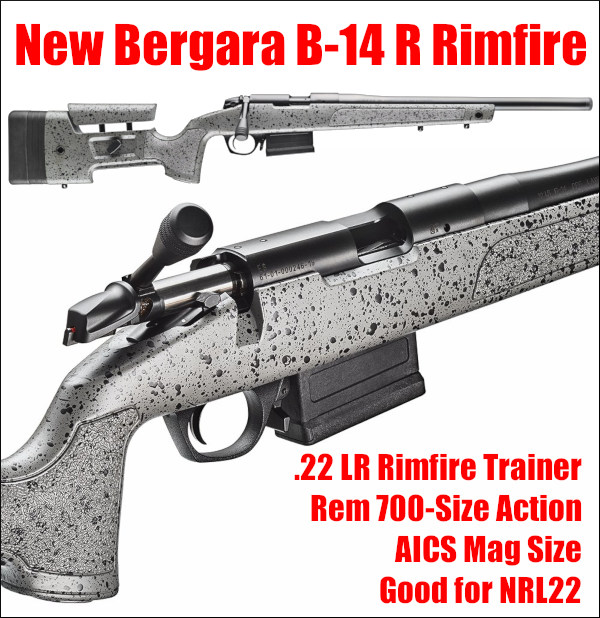
Looking for a nice .22 LR rimfire training rifle that works well with rear bags and bipods? Then check out the new B-14 R from Bergara. It is set up for rimfire training and tactical-style competitions. The action and magazine are full centerfire dimensions, so that you can train with a rimfire rifle offering centerfire-style “feel” and ergonomics. MSRP is $1150.00 so expect street price to be around $1000.00.
We think this would be a good choice for the NRL22 tactical competition for shooters preferring a conventional-style stock. It has an adjustable cheekpiece and LOP adjusts with spacers. The toe of the buttstock is straight so this will work well with bags. And if you want to later swap to a metal or composite chassis, the B-14 R barreled action will fit stocks and chassis systems designed for Rem 700s. In fact you can even use aftermarket Rem 700-compatible triggers.
B-14R Bolt Action .22 LR
The Bergara B-14 R Bolt Action Rifle in .22 LR is the latest offering in Bergara’s popular B-14 series of rifles. The company states: “The Bergara B-14 R has been a product that our customers and enthusiast have been requesting for quite some time, and with the growing NRL22 and PRS .22 competition matches, we believed that the time was right to introduce a rifle of this nature.”
This rifle is designed as a true rimfire trainer with the feel of a Rem 700 centerfire rig. The action shares dimensions of a Rem 700 receiver so you can upgrade to Rem 700-compatible stocks, and triggers. The single-stack .22 LR magazine has the same external dimensions as the commonly-used short action AICS mag for centerfires. So even your mag swaps will duplicate the “feel” of your centerfire rifle.
Bergara B-14 R Specifications
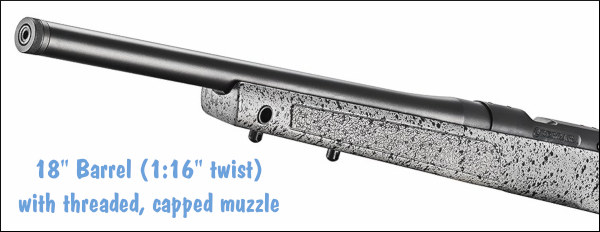
Barrel: 1:16″-twist 4140 Bergara, 18″ free-floated
Muzzle Thread: 1/2-28
Rifle Weight: 9.25 lbs. (without optics)
Rifle Length: 38″ with all spacers
Magazine Capacity: 10 rounds
Scope Mounts: 6-48 screws, Rem 700 compatible
Stock: Bergara HMR stock molded with full-length integrated mini-chassisinternal mini-chassis, integrated OD flush cup sling mounts and swivel mounts, adjustable cheek piece and length-of-pull.
Today is October 31st, Halloween (originally “All Hallows Eve”). That means it’s pumpkin time. Just how much fun can you have with pumpkins? Watch these two videos and find out. In the first video, the RatedRR team sends a few orange gourds to pumpkin heaven using Det Cord, C4, and binary explosives. The sequence starting at the 2:00 minute mark in the first video is truly amazing. WARNING: DO NOT TRY THIS AT HOME!
Watch Pumpkin Blasting with Explosives
In the next video, a pumpkin carved as a Death Star serves as the target for a .50 caliber rifle (looks like a Barrett M82 .50 BMG). As you may guess, the pumpkin Death Star suffers the same fate as the Hollywood version in Star Wars. NOTE: At the 0:42 mark in the video, a graphic displays “30,000 FPS”. That’s the high-speed camera’s frame-per-second rate, NOT the projectile velocity in feet-per-second.
Watch .50 BMG Rifle vs. Death Star Pumpkin
Warning: These demonstrations were carried out on closed ranges by experienced professionals certified to use explosives. Possession of C4 and Det Cord may be a violation of various Federal, State, and local laws. Detonating cord and C4 are classified as high explosives and are regulated by the BATFE. Don’t even think about trying to repeat these stunts on your own.
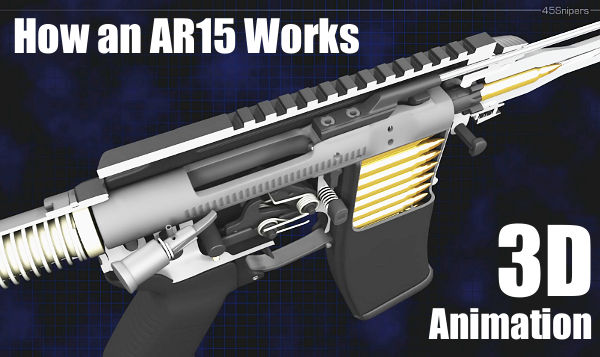
Ever wondered how the parts inside an AR15 work together? Just exactly how does the reciprocating bolt carrier feed rounds from the magazine? How do the elements in the trigger group work and reset after each shot? How does the gas system bleed gas from the barrel and operate the bolt carrier? These and other questions are answered in this eye-opening video from 45Snipers. Using “cutaway” 3D computer animation, this 5-minute video shows all features of an AR15 inside and out. This fascinating firearms animation allows the viewer to look inside the upper and lower receivers, into the bolt carrier, chamber, barrel, and magazine.
This video starts off slow and has annoying background music, but it is well worth watching if you own or shoot any AR-platform rifle. It illustrates all the key operations during the charging, loading, firing, and ejection processes. The cutaway animation shows how rounds are stripped from the magazine and then chambered. It then shows how every part of the trigger group works, and how the firing pin strikes the primer. You can even watch the bullet move down the barrel before the empty shell casing is removed from the chamber and tossed out the ejection port. Here are sample frames from the video:
Video find by Grant Ubl. We welcome reader submissions.
We love the NRL22 rimfire tactical series. When you consider the amount of fun you experience per dollar expended, NRL22 .22LR rimfire competition is hard to beat. You enjoy the challenge of PRS-type shooting at reduced distances, and much reduced cost. In the NRL22 series you can be completely competitive with .22 LR ammo costing 15 cents a round. That’s a fraction of what you’d spend making your own centerfire handloads, or buying match-grade, factory-loaded centerfire ammo.
There’s a new option for NRL22 competitors competing in the Open Class. Modular Driven Technologies (MDT) now offers its ACC Chassis for the popular CZ 457 series of rimfire rifles. There are nine different CZ 457 variants currently offered. You can get the CZ 457 Training Rifle for around $400 (MSRP is $449.00). Simply install your CZ 457 barreled action in the MDT ACC chassis and you’re got a high-quality rimfire system with ergonomics that duplicate a full-size centerfire ring. NOTE: MDT also offers an ACC chassis that fits the CZ 455 series, predecessor to the CZ 457. The ACC CZ 457/455 chassis systems cost $999.00 — too expensive we think, but then quality ain’t cheap. Purchase from MDTTAC.com.
MDT ACC Chassis System (Shown with Centerfire Actions)
The MDT ACC (Adjustable Core Competition) Chassis was designed around an integrated, modular weight system that allows shooters to fine tune chassis weight and balance point. A series of weights (up to 9 lbs. of steel) can be added to either the buttstock, interior fore-end or exterior fore-end. With action, barrel, scope and accessories, shooters can configure their rifles upwards of 25-30 lbs. in the ACC. Other features include: full 17” ARCA/RRS fore-end, flared mag well, extended barricade stop, widened thumb shelf, and adjustable cheek riser/length of pull.