Our friend Bill Marr of Rifleshooter.com has done it again — conducted a fascinating 6mm Creedmoor barrel cut-down test that reveals how velocity changes with barrel length. This time Bill started with a 24″ Proof Research stainless steel barrel on a Howa action. Bill says this was a well-used barrel, with over 1800 rounds through it. So, the velocities might be a bit different than a new barrel of similar length. Bill cut the barrel down in one-inch increments. Here are some results from the test:
For this latest test, Rifleshooter cut the barrel in one-inch increments from 24″ to 16.1″ (just over legal minimum). Velocities were measured with a MagnetoSpeed V3 chronograph mounted on arm attached to the stock. This allowed the chrono to be adjusted inwards as the barrel was cut shorter, inch by inch.
For the 6mm Creedmoor cartridge, Bill loaded Hornady 108gr ELD Match bullets over 41.5 grains of Hodgdon H4350 with CCI 200 primers in new Starline brass.
The results were interesting to say the least. Bill reports: “Muzzle velocities ranged from 2,893 ft/sec at 24″ to 2,598 ft/sec at 16″ for a decrease in muzzle velocity of 295 ft/sec. Muzzle velocity changes per inch of barrel length ranged from 6 ft/sec per inch between 20 and 19 inches to 63 ft/sec per inch between 19 and 18 inches. Average velocity change per inch of barrel length was 37.9 ft/sec.”
Bill concludes: “An average drop of 37.9 ft/sec/inch of barrel is fairly significant and is what would be expected with a fast moving 6mm cartridge like the 6mm Creedmoor. While I’m used to seeing 6mm Creedmoors with slightly longer barrel lengths than 24″, when coupled with a sound suppressor the additional length can make moving the rifle quickly more difficult.
I’d suggest staying with longer barrel lengths wherever possible with this cartridge. At shorter lengths, it does give up more performance than its big brother the 6.5 Creedmoor.”
More 6mm Creedmoor Velocity Data from 2017 Cut-Down Test
If you’re curious about 6mm Creedmoor velocities at longer barrel lengths, back in 2017 Rifleshooter completed a 6mm Creedmoor barrel cut-down test from 31 inches all the way down to 17 inches. The test included four bullet types from 95 grains to 110 grains. With the 110gr Sierra MK, velocity at 31″ was an impressive 3110 fps. Surprisingly the velocity didn’t decrease that much for the first few inches. Even at 26″ (a five-inch reduction), measured velocity with the 110s was 3073 fps, a loss of 7.4 fps per inch on average. With a barrel shortened all the way to 20″ however, velocity had dropped down to 2949 fps, a significant (161 fps) loss. CLICK HERE for complete results from that 31″-17″ Barrel Cut-Down Test.
The 6.5 Creedmoor cartridge is now one of the most popular cartridges for new factory rifles. Ruger, Savage, Howa and other gun-makers all offer 6.5 Creeemoor rifles. The 6.5 CM has been a leading cartridge for tactical/practical gun games (although many shooters have moved to a 6mm Creedmoor or even a 6mm Dasher). It offers excellent ballistics, moderate recoil, and good accuracy with a variety of powder and bullet combos. Along with the 6.5×47 Lapua, the 6.5 Creedmoor has demonstrated that a .264-Caliber mid-sized caliber is truly a jack of all trades — it can be accurate on paper, win PRS matches, and also harvest game during hunting season. If you own a 6.5 Creedmoor (or plan to get one) and hand-load your ammo, this post should provide a good start. Sierra Bullets now offers 6.5 Creedmoor Load Data for bullets from 120 to 142 grains — the most popular weight range for this chambering.
Sierra Bullets has released very complete load data for the popular 6.5 Creedmoor cartridge. This medium-sized cartridge has become one of the most popular chamberings for tactical and PRS shooters. The 6.5 Creedmoor combines excellent accuracy, good mag-feeding, good barrel life, moderate recoil, and reasonable component cost. That’s why this cartridge has caught on quickly.
The Springfield M1A is now available in 6.5 Creedmoor. For Gas Guns like this, be sure to full-length-size your brass after every firing, with adequate shoulder bump.
Developed in 2007 by Dennis DeMille and Dave Emary, the 6.5 Creedmoor is a shortened and improved 30 TC cartridge case that was inspired by the .308 Winchester design. This short action design was created to maximize case capacity and a wide range of loading lengths, while still fitting in standard short action magazines. With the correct twist barrel, the versatile 6.5 Creedmoor can take advantage of the wide range of bullet weights available in 6.5 mm (i.e. .264 caliber).
Reloaders should keep in mind that the 6.5 Creedmoor works best with medium to medium-slow powders such as H4350, Reloder 16, Varget, and IMR 4451. The light recoil and adaptability of the efficient 6.5 Creedmoor cartridge has already proven itself in high power and PRS matches, and in the hunting fields. Couple that with respectable barrel life and its intrinsic accuracy potential and you have a recipe for success.
Here are three tables from the Sierra Bullets Reloading Manual (5th Edition). IMPORTANT — This is just a sample!! Sierra has load data for many other 6.5mm bullet types, including FB, Spitzer, SBT, HPBT, and Tipped MK from 85 grains to 142 grains. To view ALL 6.5 Creedmoor DATA, CLICK HERE.
INDICATES MAXIMUM LOAD – USE CAUTION
LOADS LESS THAN MINIMUM CHARGES SHOWN ARE NOT RECOMMENDED.
INDICATES MAXIMUM LOAD – USE CAUTION
LOADS LESS THAN MINIMUM CHARGES SHOWN ARE NOT RECOMMENDED.
INDICATES MAXIMUM LOAD – USE CAUTION
LOADS LESS THAN MINIMUM CHARGES SHOWN ARE NOT RECOMMENDED.
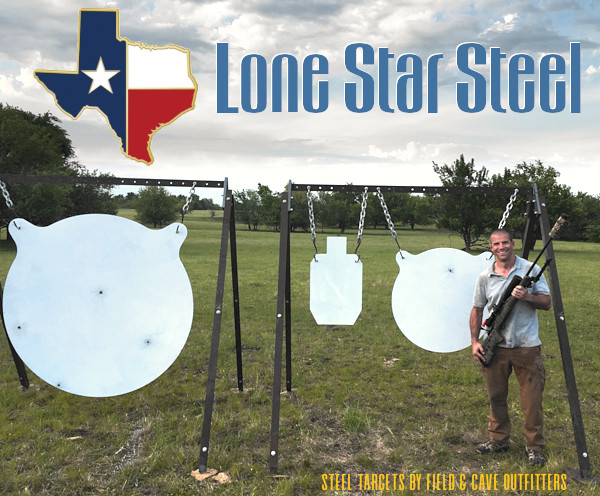
These targets were set at one mile (1760 yards). Travis Frazer (with rifle) and friend Curtis went a combined 5 for 5 at this distance.
They say that “Everything is Bigger in Texas”. Well that’s apparently true, at least when it comes to steel targets — really BIG steel targets. Our friends at Field & Cave Outfitters (FCO), based in Mesquite, Texas, recently delivered a trailer-load of super-sized steel targets to a large ranch. The Field & Cave team placed a total of 117 steel targets on 34 frames at distances from 25 yards to 1760 yards (one statute mile).
It took Field & Cave Outfitters a big trailer to haul 117 steel targets.
Naturally, after setting the targets up (on 34 frames), Travis Frazer and buddy Curtis Attaway tested the steel — with considerable success. In fact, Travis and Curtis managed to go five-for-five with the One Mile targets. That’s mighty impressive when you consider neither man had ever shot past 1200 yards before. Travis provides a yardage-by-yardage account of his Steel Shooting Adventure below. Enjoy!
Along with the jumbo-sized targets for Extreme Long Range (ELR), Field & Cave Outfitters supplied numerous smaller gongs and plates for shorter distances, starting at 25 yards.
Building a Rifle Shooter’s Paradise and Ringing Steel at One Mile
Friend and gunsmith Johnathon Stigall of Crimson Accuracy introduced me to a customer looking to build a private range on his very expansive ranch. Curtis Attaway, a fellow shooting nut, served as facilitator for the ranch owners who ordered a vast array — 117 steel targets and 34 frames to be set up from 25 yards to a full mile. The largest was a 63″-diameter round gong cut from 3/8″ A46100 armor to serve as a One Milliradian-sized target at one mile. (Meaning the diameter of the target equals 1 Mil at 1 Mile.)
“What do you get the guy that has everything — several sections of land, a range out to one mile? Lots of steel, naturally. We delivered 117 steel targets and 34 frames!” — Travis Frazer
After about eight weeks of production time, we delivered and set up the targets in late April 2019. Upon arrival at the property, Curtis and I met the ranch manager and two hands. Luckily we had a tractor, truck, trailer, and mobile power — all the tools necessary to get things done. We worked from 10:00 am to 6:30 pm and only managed to get the long-range rifle targets set. We put steel at 200, 300, 400, 500, 600, 750, 1000, 1100, 1320 (3/4 mile), 1450, 1600, and 1760 yards (1 mile). All the targets were accessible from the same elevated shooting position on the side of a hill.
Shooting Steel from 200 Yards to One Mile
Luckily, after the work was done there was still some daylight left. Optical conditions were near perfect and the wind, while still pretty stiff, had come around to straight out of 6 O’Clock. Curtis brought his 6.5×55 Swede and 28 Nosler. I brought my 6.5×47 Lapua hunting rifle. We took turns shooting — Curtis was prone on his UTV trailer, I was lying in the bed of my truck. We started at 200 yards, each shooting a single round at a steel torso silhouette. We continued taking one shot per distance, making adjustments to what our ballistic APPs suggested, based on the observed impacts on the targets. We continued scoring first-round hits until we reached one thousand yards. After a few shots, getting centered at 1K, we continued on, hitting more than we missed.
I ran out of elevation trying to engage the 1450-yard target. I needed 67 MOA of “up” and only had 60. After three shots and zero hits with varying amounts of hold-over on a Full Scale IPSC torso, I called it quits with the little 47.
Meanwhile, Curtis put a 195gr Berger out of his 28 Nosler on a half-inch-thick AR550 torso at 200 yards to confirm his zero and stress-test the steel. Both passed with flying colors. After that, it was straight to 1100 yards where he scored a first-shot hit, then followed it up with a second shot about two inches to the right. He continued to walk it out, scoring a first round hit at 1320 then 1600. We couldn’t see the hit at 1600 because a tree line obscured the lower third of the 58″ diameter gong. We only knew he hit it because of the glorious ring!
Knowing that he hit it low, Curtis dialed up to one mile, but ran out of travel three minutes short. He backed the power down to 24X so his reticle would subtend properly, held the three minutes and let one fly. He was rewarded with a first-, second-, and third-round hits — the third being almost perfectly centered on the 63-incher. He let me get behind the trigger and told me where to hold. I hit the 63″ gong on the first try, so I decided to give the smaller, half-Mil 37″ target a shot.
That two and a half-second flight time seemed like an eternity. I had resigned to the fact that I missed… but then I saw the 37″ plate swing with the impact. Incredible! The impact was centered horizontally, about 10″ below the top edge (see top photo). That Crimson Accuracy-smithed 28 Nosler made two newbies look like old pros at ELR. The ranch manager watching through the spotting scope couldn’t believe what he was seeing. What he didn’t know is that neither could we!
Do you shoot a Springfield M1A rifle chambered for the .308 Win/7.62×51? Or maybe you have a rugged, semi-auto FN-FAL in 7.62×51 NATO? Are you looking for very strong, durable brass you can shoot in these semi-auto battle rifles, without breaking the bank?
Photo of 2009 M1A Match at Camp Perry. Shooter is Nick Till, 2007 Service Rifle Champion.
Semi-autos such as the M1A are tough on brass. You want brass that isn’t too costly, but at the same time is very strong and durable. For decades, USA-made Lake City brass have been a solid choice for 7.62×51 semis, and now you can get quality, unfired 7.62×51 Lake City brass for just $49.99 for 250 cases at Midsouth. That’s just $0.20 (twenty cents) per case! That’s a fourth what you’ll pay for premium, virgin .308 Winchester brass. These cases are never-fired brass, with CCI #34 primers seated in crimped, military-style primer pockets.
This 7.62×51 Lake City brass comes from disassembled “pull-down” ammunition. It has NOT been fired, but it has been previously assembled. So, there may be some cosmetic issues with the brass. Note that these are primed cases. If you choose to neck-size or FL-size the brass before loading for the first time, REMOVE the decapping rod in your sizing die. This brass has LIVE PRIMERS!! Do NOT use a die with a decapping rod for the first loading of this brass. Got that guys? This is important!!
We have shot FN-FAL-type rifles built on DS Arms semi-auto lowers with European uppers. Those beasts were tough on brass, so we relied on Lake City brass when available. If you have a FN-FAL or STG-58, you should give this Lake City primed, pull-down brass a try. (Federal Gold Medal Match ammo shot great in our DSA/STG-58 but the brass was toast after a few firings).
Today, May 1st, 2019, Shooting USA TV features The Brawl at Rifles Only, a tactical competition that draws top long-range shooters from military, law enforcement and civilian shooting communities. The match is held at the famed Rifles Only range in Kingsville, Texas. The Brawl is a one-of-a-kind physical and mental challenge that tests shooters’ abilities to read wind, figure ballistics, and adapt to difficult shooting scenarios. There is even a helicopter stage. This Shooting USA episode airs on the Outdoor Channel at 9:00 pm Eastern and Pacific, 8:00 pm Central.
Helicopter Stage at 2014 Brawl in Texas:
Shooting from a helicopter, shooting off of a wire, and shooting from the physically demanding maze called the Mouse Trap. These are just a few of the unique courses of fire at the Bushnell Brawl, part of the PRS series. Over the course of two days, competitors tackle more than a dozen stages. In addition, Bushnell hosted a special one-day event for the new PRS Production Class. This new division should attract new shooters by limiting the cost of equipment — making PRS competition more affordable.
PRS Production Division — Lowering the Cost of Entry
The Production Division is a new PRS classification. Under Production Division rules, the rifle must not exceed $2000.00, and rifle + scope combined must not exceed $4000.00. All other accessories, such as bipod, support bag, and the sling, can be added at the shooter’s own discretion. Even with these cost limits, you can put together a great rig: “There’s a lot of gear out there that’s not that expensive,” says Production Division Match Director Jacob Bynum. For example, you can get the new Howa KRG Bravo in 6.5 Creedmoor for $1034.99. Then use Brownells CODE V2F to save 10% for a net price of $941.50 with Free Shipping. NOTE this is a 1-DAY Special 10% OFF Code (check for other discount codes in the future). With an $800 Nikon FX1000 FFP MRAD optic, and $109 Game Changer Bag, you’re good to go for well under $2000.00 complete. Here’s the Howa KRG Bravo:
Are you shopping for a long range optic? Unfortunately, it is pretty much impossible to “test drive” a half-dozen or more optics. Thankfully, there are some video reviews on the internet that are, for the most part, helpful. Pew Pew Tactical (PPT) recently did a lengthy comparison of nine long range scopes. For each model PPT examined clarity, eye relief, reticle design, parallax, and windage/elevation travel. For each optic PPT also provides short videos showing the operation of the controls. FULL PPT REVIEW HERE.
NINE Long Range Scopes Compared
1. Vortex Strike Eagle 4-24×50mm
2. Vortex Viper PST II 5-25×50mm
3. Leupold VX3i LRP 8.5-25×50mm
4. Leupold Mark 5HD 5-25×56mm
5. Burris XTR II 5-25×50mm
This is actually a pretty good video. The host, Joel, tests and compares the Leupold Mark 5 vs. the Athlon Argos. Joel considers a variety of performance categories including clarity, tracking, elevation travel, ergonomics, and reticle options. This video asked the question “Can a $400 scope hang with a much higher priced optic?” You might be surprised how well the Athlon actually did.
Kalibre 22 — High-End Tactical Optics Comparison
In this video, Todd Hodnett explains the pros and cons of different brands and types of scopes. Scopes tested include Horus, Leupold, Nightforce, Schmidt & Bender, and Vortex. He uses the scopes in the field, and actually does a pretty good job describing the pros and cons of each model.
Top 10 Reviews — Manufacturer Marketing Videos Compilation
This video covers ten different scope models, from budget to high-end. For the most part the scopes appear in cost order, with the more affordable optics first. This YouTube video is mostly pieced together from manufacturer marketing footage, but it does cover a wide variety of scope options.
Please note, the above video does has some actual review segments, but nearly all the content is provided by the scope makers. So the Top 10 rankings are somewhat arbitrary. Nonetheless it is handy to have ten scopes covered in a single video. In order of appearance, here are the ten scopes featured, with video time marks if you want to “fast forward” to particular models.
TEN Scopes In Order of Display
10. Burris Veracity Riflescope: 00:23
9. Vortex Viper PST Gen II Riflescope: 01:24
8. Nikon BLACK FX1000 Riflescope: 03:18
7. ATN X-Sight 4K PRO Riflescope: 04:29
6. Bushnell Engage™ Riflescope 06:00
5. Leica Magnus i Riflescope: 07:50
4. Nightforce ATACR 5-25x56mm F1 Riflescope: 08:29
3. Vanguard Endeavor RS IV Riflescope: 10:31
2. Leupold Mark 8 Riflescope: 12:33
1. Swarovski Z8i Riflescope: 14:21
Great Deals on Vortex Now
Looking for a great deal on a new scope? Leading vendor EuroOptic has a wide variety of Vortex Scopes at deeply discounted close-out prices now:
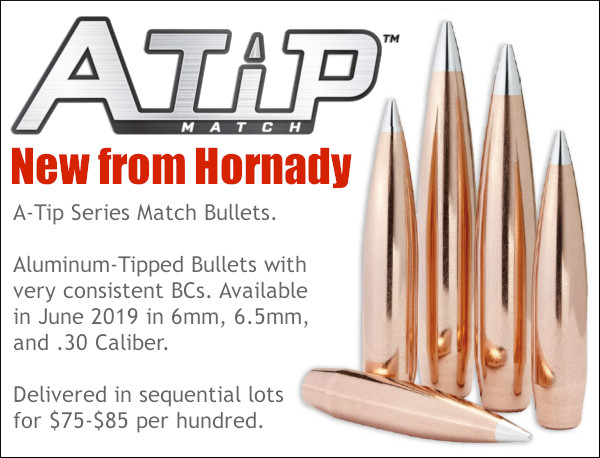
Hornady has a new line of A-Tip bullets, fitted with precision aluminum tips. These machined, aluminum tips resemble the plastic tips used in many other bullets, but Hornady says its aluminum tips are longer and more uniform than typical plastic tips. Also aluminum tips will not deform during flight:
“We wanted to incorporate aluminum tips in a full line of match bullets for years because we can make longer tips than we can with polymer materials,” said Joe Thielen, Assistant Director of Engineering. “This longer tip is a key component that helps move the center of gravity of the bullet rearward, thus enhancing in-flight stability and reducing dispersion.”
Hornady claims the new A-Tip bullets have more consistent bullet-to-bullet Ballistic Coefficients (BCs) than conventional fully-jacketed bullets or plastic-tipped bullets. Hornady’s new A-Tip bullets are pricey. Expect to pay from $75 to $85 per 100-ct box of 6mm, 6.5mm, and .30-Cal A-Tips. These bullets should be available by late June 2019 from Graf & Sons, Midsouth Shooters Supply, and other vendors.
There are currently five A-Tip bullet types in three calibers: 6mm (.243), 6.5mm (.264), and .308 (7.62mm). These have impressive claimed G1/G7 BCs for their respective sizes and weights. Here are the A-Tip Bullets that can be pre-ordered now for expected delivery in late June:
A special A-Tip bullet seating stem (shown above) is required for optimal bullet seating. A-Tip bullet BC values have been measured at Mach 2.25 and corrected back to ICAO Standard Atmosphere (sea level, 59° F, 29.92 inHg, 0% humidity). For Mach 2.0 and Mach 1.75 BCs, go to hornady.com/BC.
A Different Kind of Packaging
Hornady delivers A-Tip bullets in lot-specific 100-count sequences. Unlike most bullets, these new A-Tips are NOT bulk-washed (presumably so as not to dent/chip the tips. Hornady provides a polishing bag.
Here’s what Hornady explains:
“Right off the press, the projectiles are sequentially packed, for ultimate lot consistent performance, ensuring your projectiles are truly YOURS every step of the way. Think of it like shooting with clones of your load every time (100 in each box)! Minimal handling throughout the process means there’s less of a chance of YOUR bullet being marred, scuffed, or altered, which is why each box is packaged with a Polishing Bag for you to give the final buff to your beautiful new projectiles!”
The 2019 Eastern CMP Games & CMP Cup Matches are scheduled for April 26 through May 5, 2019. This is one of the biggest shooting matches on the East Coast, held at the Camp Butner Range in North Carolina. The CMP Games include Small Arms Firing School (SAFS), Garand/Springfield/Vintage/Modern Military Matches, Carbine Match, Rimfire Sporter match, and Vintage Sniper Team Match. There are also several pistol matches.
Following the CMP Games Matches will be the CMP Cup Matches: 4-Man Team Match, CMP 800 Aggregate Matches, and EIC Service Rifle Match. There will also be a GSM New Shooter Clinic, M1 Maintenance Clinic, and Team CMP High Power Clinic. The CMP will also sell rifles and ammunition at the event.
CMP Electronic Targets for Games and Cup Matches
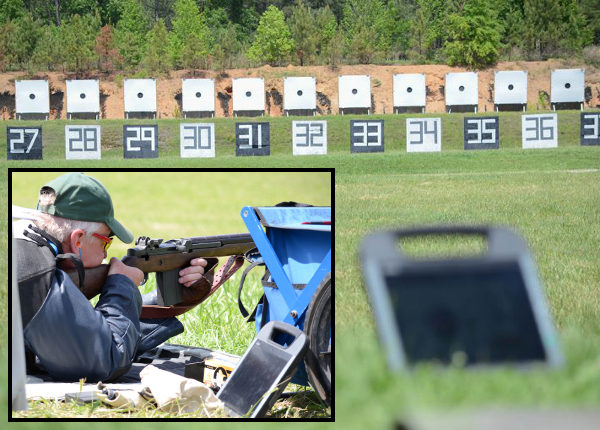
All matches on the High Power rifle range will be conducted using Kongsberg Electronic Targets (KTS). The KTS system registers each shot and relays the location and score value to a monitor beside each shooter on the firing line.
The CMP Eastern Games have been very popular, thanks in no small part to the mobile electronic target system. Recent Eastern Games have drawn over 350 competitors. The Kongsberg electronic targets allowed the CMP to run relays more efficiently, and the targets eliminate the need for competitors to do pit duty. GSM Matches, which typically run four relays each day, saw days with a total of nine and 10 relays during its scheduled times, while the Vintage Sniper and other matches finished in record time.
“The electronic targets are phenomenal,” said brothers Richard and Jonathan Mast, who attended the Eastern Games along with other family members. Jonathan added, “It was the best shooting experience I’ve ever seen as far as immediately finding out where you’re shooting — best I’ve ever had.”
Throughout the CMP Games, competitors will use the CMP’s mobile electronic high power target system. The Kongsberg targets contain internal microphones that locate shot position. The scores are instantly calculated by computer and then wirelessly transmitted to portable, tablet monitors on each firing point.
The electronic targets provide immediate feedback. Importantly, the e-Targets eliminate pit duties and permit relays to fun faster and more efficiently. Shooter Caleb Mast noted: “This makes it easier for people who don’t have [a spotting scope]. All you pay is the registration fee, and I just brought what I’m wearing and was still able to score well enough to get my feedback on the monitor.”
Berger Match Solids are now government-endorsed. The U.S. military has selected Berger’s .375 caliber ELR Match Solid Bullet for the Extreme Sniper Strike Operations (ESSO) program (Phase 2). The ESSO program is a U.S. government project to develop a high performance, extreme long-range sniper weapon system built on a bolt-action, magazine-fed platform.
For ESSO, .375-cal Berger solids are loaded into the .375 EnABELR (Engineered by Applied Ballistics for Extreme Long Range) cartridge. This was designed to offer .375 CheyTac performance in a slightly shorter package that mag-feeds well.
Bryan Litz, Berger’s Chief Ballistician said: “The .375 caliber Berger ELR Match Solid Bullets were optimized for use in the ESSO project, which requires high performance and reliability over many rounds in adverse conditions. In addition to meeting the needs of our US military, the Berger Match Solids provide proven, match winning performance for the ELR competition shooter as well.”
ELR Match Solid Bullets drive state-of-the-art ESSO weapon systems. The EnABELR is designed to reliably engage targets at distances out to 2500 meters.
Table 1 below presents basic load data for the .375 EnABELR. Considering the Berger .375 Cal 379gr and 407gr solid bullets were developed in conjunction with the EnABELR case, load data is provided to achieve certain landmark velocities with these bullets, for a range of suitable powders. According to Applied Ballistics, with a 30″ barrel, “the .375 EnABELR can safely push the Berger 379gr Solid to 2900 fps, and the Berger 407gr Solid to 2800 fps.”
Table 1 — .375 EnABLER Load Data
Table 2 — .375 EnABELR Comparative Velocities
Applied Ballistics notes that: “These are conservative, baseline velocities. Higher velocities are possible but the above performance is safely achievable well within pressure limits of the cartridge. Note the performance of the .375 EnABELR is driven by the high BC Berger Solid bullets. If the .375 CheyTac were loaded with the same bullets, the performance would be about the same. ”
About Berger Bullets
Berger manufactures precision projectiles and match-grade ammunition for Target, Hunting and Tactical applications in Mesa, AZ. Berger is part of the Capstone Precision Group, the exclusive U.S. distributor for Berger, Lapua, Vihtavuori and SK-Rimfire products. For more information, visit Bergerbullets.com.
.338 EnABLER (left) with Berger 300 gr Hybrid, and .375 EnABELR (right) with Berger 407 gr Solid.
Applied Ballistics .338 EnABELR and .375 EnABELR Cartridges Applied Ballistics Weapons Division (ABWD) has announced the release of the new EnABELR cartridge. The EnABELR is a medium-capacity, magazine-feedable cartridge available in both .338 and .375 calibers. As you can see from this chart, when using the new Berger solid .375-cal bullets, the .375 EnABELR shows less drop at 2500 meters than the .338 Lapua Magnum and .375 CheyTac (with 400gr CE bullets).
EnABLER Brass, Dies, Reamers, and Complete Rifles Available Applied Ballistics will be offering all components required to shoot (and reload) the EnABELR cartridges including: chamber reamers, Peterson brass, ABWD-made reloading die sets, and complete tactical and competition rifle systems chambered in both .338 and .375 versions of the EnABELR cartridge.
The .375-caliber version of the EnABELR has been selected for Phase 2 of the Extreme Sniper Strike Operations (ESSO) program, a government-funded project to develop a high-performance, Extreme Long Range sniper weapon system.
Bryan Litz, Chief Ballistician for Applied Ballistics and Berger Bullets states that: “The EnABELR Cartridge and the new Berger .375 caliber Solids were optimized for use in the ESSO application which requires high performance, as well as reliability over many rounds in adverse conditions. In addition to meeting the needs of the military, these are also favorable properties for the serious competition shooter as well.”


 For this latest test, Rifleshooter cut the barrel in one-inch increments from 24″ to 16.1″ (just over legal minimum). Velocities were measured with a MagnetoSpeed V3 chronograph mounted on arm attached to the stock. This allowed the chrono to be adjusted inwards as the barrel was cut shorter, inch by inch.


 Developed in 2007 by Dennis DeMille and Dave Emary, the 6.5 Creedmoor is a shortened and improved 30 TC cartridge case that was inspired by the .308 Winchester design. This short action design was created to maximize case capacity and a wide range of loading lengths, while still fitting in standard short action magazines. With the correct twist barrel, the versatile 6.5 Creedmoor can take advantage of the wide range of bullet weights available in 6.5 mm (i.e. .264 caliber).






 The 2019