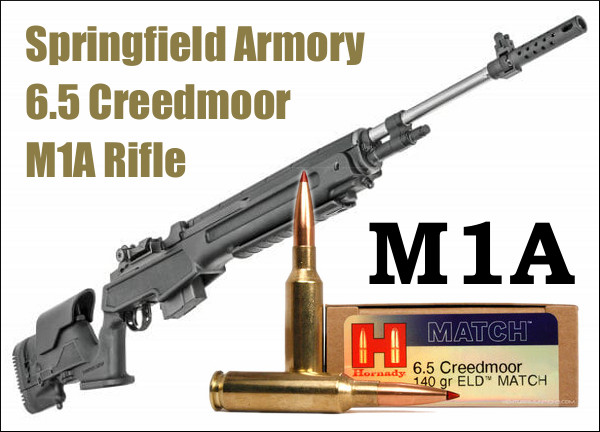
The 6.5 Creedmoor craze goes one step further. Soon you can buy a Springfield M1A chambered for this mid-sized cartridge popularized by PRS shooters. Both bolt-action and AR-platform rifles chambered for the 6.5 Creedmoor have been available for quite some time, but this is a new direction for the M1A, which has traditionally been chambered for the 7.62×51 NATO/.308 Winchester round. As chambered for the 6.5 Creedmoor, Springfield’s M1A should be easier on shooters’ shoulders. The 6.5 Creedmoor M1A has 28% less recoil than the .308 Winchester version.*
The new 6.5 Creedmoor M1A features a 22″ medium-contour, 1:8″-twist stainless barrel with factory muzzle brake. The rifle comes with iron sights: .062 post front sight and .0520 aperture rear sight adjustable for ½ MOA windage and 1 MOA elevation. Springfield ships the rifle with a 2-stage trigger tuned to 4.5 – 5 pounds. A Springfield Armory Optics mount is available to fit a magnified optic, but, to be honest, we haven’t been very impressed with that mount.
Two stock options are offered: a basic black polymer stock (not recommended — it’s weak and flexy) or a deluxe “precision” stock with adjustable cheekpiece and adjustable LOP. The deluxe precision stock, shown above, is much more rigid, and can be configured with front underside Picatinny rail (see video). Rifle Specs HERE.
With the basic polymer stock, the 6.5 Creedmoor weighs 11.4 pounds (unloaded) and has a $1985.00 MSRP. With the adjustable precision stock, the gun is a bit heavier and retails for $2045.00 in either matte black or Flat Dark Earth (FDE).
“Having a 6.5 Creedmoor caliber in the M1A lineup gives long-range shooters more choices with the precision and accuracy they require,” says Springfield Armory CEO Dennis Reese. “They can choose the round they prefer…”, i.e. .308 Win or the 6.5 Creedmoor. Excellent factory ammo is available for both chamberings.
Photo of 2009 M1A Match at Camp Perry. Shooter is Nick Till, 2007 Service Rifle Champion.
If you are looking for a robust semi-auto rifle that has an interesting legacy (the M1A was derived from the U.S. Military’s M14), this new M1A may suit your tastes. Every year at Camp Perry, Springfield Armory sponsors a very popular M1A match which attracts marksmen from around the country. We can’t say for sure that the 6.5 Creedmoor M1As will be allowed in M1A matches, but we would expect they will, though perhaps competing in a separate division.
Ask most gun guys about the Precision Rifle Series (PRS), and they’ll tell you it’s a discipline for bolt-action “tactical” rifles. Yes that’s true, but PRS now has a “Gas Gun” series as well, and many local PRS-style matches also allow gas guns to compete in their own division.
Capitalizing on the success of the bolt-gun competitions, this year the PRS approved a new Gas Gun series for semi-auto rifles such as AR15s and AR10s. The inaugural 2017 PRS Gas Gun Series competition took place February 17-19, 2017 at the CORE Shooting Solutions range in Baker, Florida. This article explains the basics of the Gas Gun Series and offers some factory hardware options.
PRS Director Shawn Wiseman Explains New Gas Gun Series in this Video:
Gas Gun Series Basics — Interview with PRS President Shooting Sports USA interviewed PRS President Shawn Wiseman.
SSUSA: What will be the format of the 2017 PRS Gas Gun Series matches?
Wiseman: The matches will be a two day format with 8 to 10 stages per day. There are three Divisions; Tactical Light for 5.56x45mm NATO/.223 Rem. rifles, Tactical Heavy for 7.62x51mm NATO/.308 Win., and Open for everything else up to .30 cal. The maximum distance will be 800 yards.
SSUSA: What guns do you expect to be popular?
Wiseman: In the Open Division, I expect to see a lot of 6.5 Creedmoors for two main reasons; it’s an inherently accurate cartridge and Hornady makes great ammo for the folks that aren’t into reloading. I think the Tactical Light Division will probably be the most popular. It is hard to say specifically what rifles will be the most popular but there are a few AR companies that are known for the accuracy. Armalite, GA Precision, LaRue and Seekins will all be very popular rifles in this Series. I think we will continue to see high-end optics with 5X to 6X zoom range on the rifles. Bushnell, Kahles, Leupold, Nightforce and Vortex will continue to be the most popular.
PRS Gas Gun Series Factory Firearm Options
While you can compete in the Gas Gun Series with an AR15, many Open Division competitors are favoring the larger AR10-platform rifles that can shoot the 6.5 Creedmoor and 6mm Creedmoor cartridges. Both Savage and Smith & Wesson offer AR10-type rifles optimized for this competition.
Smith and Wesson M&P 10, 6.5 Creedmoor
S&W’s AR10-platform rifle is a leading choice for the PRS Gas Gun Division. The M&P 10 in 6.5 Creedmoor shows good build quality and good accuracy with factory 6.5 Creedmoor ammo. If you’re a fan of the 6.5 Creedmoor cartridge, the M&P 10 is a smart gas gun option. S&W offers good customer service and a rock-solid warranty. This rifle features a 2-Stage Match Trigger, Magpul MOE Stock, 15″ M-LOK handguard, and a 20″ barrel with 1:8″-twist 5R Rifling. MSRP is $2035.00.
Savage MSR-10 Long Range, 6.5 Creedmoor and .308 Win
The updated Savage MSR-10 Long Range is available now in .308 Win and 6.5 Creedmoor. Next month (January 2018), Savage will also release a 6mm Creedmoor version. This rifle features a Magpul PRS Gen3 Stock, Blackhawk 2-stage trigger, non-reciprocating side charging handle, and QPQ-treated heavy barrel (1:8″ twist for 6.5 Creedmoor; 1:10″ for .308 Win). MSRP for all chamberings is $2284.00.
New .224 Valkyrie for AR15 Platform
Another option would be the smaller AR15 chambered for the new .224 Valkyrie cartridge. This brand new offering from Federal is basically a 6.8 SPC necked down to .224 caliber. With the 90gr Sierra MatchKing, it offers ballistics comparable to a 6.5 Creedmoor, with less recoil.
PRS Gas Gun Series Rules
For the new PRS Gas Gun Series, a committee of top PRS shooters, Multi-Gun shooters, and Match Directors developed the PRS Gas Gun Series Rule Book. Highlights of the Rules are listed below.
For the new PRS “Gasser” Competition, the PRS developed rules on gun types, scoring, match timing, penalties, safety and other key topics. CLICK HERE for Full PRS Gas Gun Series Rules.
Open Division: The Open Division rifles will not exceed a caliber of .30 or a velocity of 3,200 fps. A match DQ will result any rounds over the speed limit of 3,200 fps (+/- 32 fps for environmental factors and equipment discrepancies). Match Officials may request at any point during a match that a competitor fire their rifle through chronograph. If the bullet exceeds the 3,200 fps speed limit, the shooter will receive an automatic match DQ.
Tactical Light Division: Intended to allow competitors the opportunity to compete using traditional military and law enforcement caliber (.223/5.56). This promotes Active Duty military and law enforcement competitors use of their Service and Department-issued rifles. Tactical Light Division rifles are restricted to 5.56 NATO/.223 Remington chamberings only. Bullet weight cannot exceed 77 grains and muzzle velocity cannot exceed 3,000 fps.
Tactical Heavy Division: Intended to allow competitors the opportunity to compete using traditional military and law enforcement caliber. This promotes Active Duty military and law enforcement competitors’ use of their Service and Department issued rifles. Tactical Heavy Division rifles are restricted to 7.62 NATO/.308 Winchester calibers only. Bullet weight cannot exceed 178 grains and muzzle velocity cannot exceed 2,800 fps. No modified wildcat rounds permitted to shoot in the Tactical Divisions Anyone discovered violating this rule will receive an automatic Match DQ. Tactical Division shooters will shoot the exact same COF as Open Division shooters.
Many of our readers are thinking of trying out PRS-type competition. Tactical matches are becoming more popular every season. Along with F-Class, tactical/practical disciplines are the fastest-growing forms of competitive rifle shooting. Rich Emmons, one of the founders of the Precision Rifle Series (PRS), has written an insightful article about getting started in the tactical game. This will help PRS novices pick the right equipment and understand the game. Here are highlights from Emmon’s “PRS — Intro to Competition” article, originally published on the PRS website. You may also want to read the current PRS FAQ Page.
Precision Rifle Series — Intro to Competition
by Rich Emmons, PRS President
Tactical Shooting with a precision rifle is not like other disciplines, there is no set course of fire or format. That is what makes it so fun!
First, you have to ask yourself what do you want to accomplish. When I was introduced to long range shooting, immediately a light turned on for me, once I saw how easy it was to hit 300–600 yard targets. What I quickly learned from my first competition and the many that followed was there is so much to learn and shooting in competition put everything you thought you knew to the test. So back to the question: “What do YOU want to accomplish?”. The reality is you may not know yet, you just think it is cool to have a bad ass rifle and scope that can make almost any shot. Now if you’ve got that rifle and scope, it’s time to take it to the next level.
Watch PRS 2016 Championship
Getting Started — What to Expect
If you’re reading this, you have probably already have been bitten by the long range shooting bug. It can seem quite intimidating to just jump in with a new bunch of shooters you don’t know and shooting lingo you don’t quite understand yet. But here is the key — show up and shoot! I guarantee you if you show up to a match as a new shooter, other experienced shooters will guide you along and give you help on anything you need.
AUDIO: Click Button to hear Rich Emmons Talk about the Precision Rifle Series.
Now, a couple things you should just expect. You’re not as good as you think you are. Don’t expect to come into your first match and beat all the veterans. That just doesn’t happen unless you have had some really good coaching or other shooting competition experience to get you ready for this type of competition. If possible, find a local rifle club that has monthly long range matches, or any type of match will help prepare you for a larger PRS event. Getting involved with a rifle club and starting out shooting monthly matches is definitely the way to jump into competition shooting.
The Gear You Need
The first question that many ask is: “What kind of rifle/caliber/scope do I need?” The easiest answer to this is, the best you can afford. It’s no secret the gear is expensive. It took me several years of buying sub-par gear and eventually trading up to figure this out. Now, a guy can get a real sense of pride of doing it on the cheap, or with a factory rifle. I’ve seen many old Savage 10FPs take down custom rigs that cost 10 times as much. And if that’s all you can afford, then eventually you will learn the limitations of yourself or your gear. As for choice of cartridge/caliber, the respected Precision Rifle Blog has analyzed three years worth of match results (2014, 2015, 2016) from the best tactical shooters in the nation. CLICK HERE to read an article that reveals what the “top guns” use. (CLICK HERE for PRB cartridge survey covering 2012-2014.)
Making Good Ammo
Producing quality reloads is something you have to master. It’s not hard at all, you just have to pay attention to detail, and eventually you are going to do something stupid like mis-priming your brass, or skip a row of brass when dumping your powder. Everybody has their own horror story of some reloading failure that cost them a stage or even a match. So load to perfection, work with your rifle to find what load it likes the best, then start your practice.
Practice Makes Perfect
You want to become ONE with your rifle, learning everything you can about its functionality. Getting comfortable with the operation of your rifle is key. Learn the feel of your trigger, dry-firing until you wear the paint off your bolt handle. Learn how the rifle works best — pay attention to little things like the sound and feel of the bolt feeding a round from the mag (or when it doesn’t). Learn how to remove a jammed round quickly, learn how to reload a magazine quickly. Learn to scan across a field and find targets in a quick manner, seeing the targets with your eye and coming into the scope on target. These are some of the basic practices that separate the new shooters from the seasoned ones.
Own a Ruger Precision Rifle (RPR)? Looking for the single best hardware upgrade that will improve inherent accuracy and shot-to-shot consistency? Here’s your answer. Krieger Barrels is now producing Pre-Fit barrels for the RPR in two popular chamberings: 6.5 Creedmoor and .308 Winchester. These “Drop-In Ready” barrels come finish-chambered and threaded to fit the Ruger action. The Ruger barrel attachment system allows correct headspace with a pre-chambered barrel. Krieger explains: “Thanks to Ruger’s proprietary barrel nut design, a competent gunsmith will be able to swap out your barrel using an AR15 barrel wrench and proper headspace gauges.”
Kreiger’s 6.5 Creedmoor RPR barrel is an 1:8″-twist with 26″ finished length, 0.750″ at muzzle. The .308 Win RPR barrel is a 1:10″-twist with 24″ finished length, also 0.750″ at muzzle. Both these Krieger RPR Pre-Fits feature muzzles with factory-spec thread so you can re-install the factory muzzle brake.
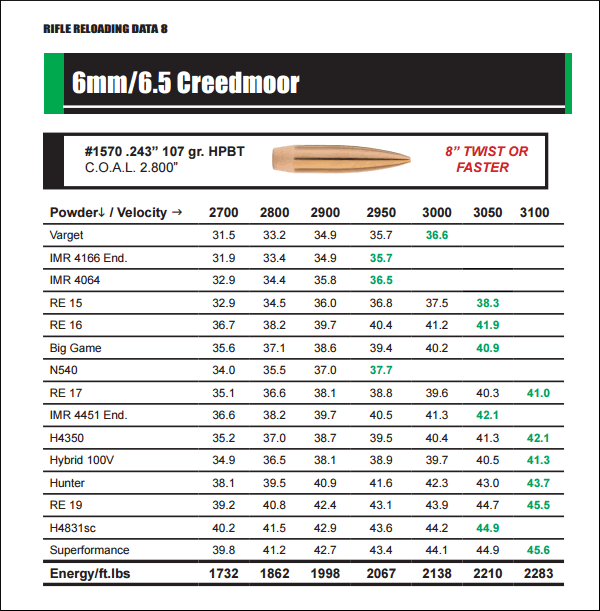
Sierra Bullets has recently released load data for the 6mm Creedmoor cartridge, a necked-down version of the 6.5 Creedmoor, a popular PRS, tactical, and hunting cartridge. Sierra has released very comprehensive 6mm Creedmoor load data, covering fifteen (15) different bullets from 55 to 110 grains. NOTE: Hornady-brand brass was used for Sierra’s 6mm Creedmoor load tests, not the newer, stronger Lapua 6.5 CM brass with small primer pockets. Hand-loaders using Lapua 6.5 Creedmoor brass necked to 6mm may have to adjust their loads.
Sierra writes: “As soon as the 6.5 Creedmoor was released in 2007, a 6mm version was being envisioned. After the 6mm Creedmoor demonstrated its worth at 1000 yards it began to catch the attention of Precision Rifle Series (PRS) competitors. The 6mm/6.5 Creedmoor is a great fit for those looking for an AR platform-friendly cartridge. It delivers velocities very similar to the .243 Win and yet fits the AR10 magazine length[.] The 30-degree shoulder makes this a very efficient case and helps prolong case life as well. The 6mm/6.5 Creedmoor works well with powders such as H4350, RE-17, and Ramshot Hunter for heavier long-range bullet weights. Slightly faster powders such as RE-15, Win 760, and Vihtavuori N540 work well with lighter weight bullets.”
Sierra Bullets Tested for 6mm Creedmoor Load Data
55gr BlitzKing (#1502)
60gr HP (#1500)
70gr HPBT (#1505)
70gr BlitzKing (#1507)
75gr HP (#1510)
In developing its 6mm Creedmoor load data, Sierra tested a very wide selection of propellants, two dozen overall. For the smaller bullets, fast-burning powders such as Benchmark, H4895, and CFE223 were tested. For the heavier 100+ grain bullets, Sierra tested a selection of medium-burn-rate powders including H4350, Reloder 16, Reloder 17, Varget, and Superformance. Sierra did a very thorough job. We know this information will be welcomed by 6mm Creedmoor shooters.
Don’t know what powder to try first? For the 107-110 grain bullets, if you want best accuracy and low ES/SD, our Forum members recommend Alliant Reloder 16 and Hodgdon H4350. If you are seeking max velocity with the 110-grainer, look at Hodgdon Superformance and Reloder 19.
Here are Sierra’s 6mm Creedmoor Load Data Charts for the 107gr MK and 110gr MK. There are a half-dozen other tables for lighter-weight bullets.
Dave Emary is concluding his 24-year career at Hornady. Although retiring from full-time duties, Emary will continue with Hornady as a consultant. AccurateShooter.com wants to acknowledge Dave’s decades of important work in the gun industry. Brilliant, dedicated, and forward-thinking, Dave has been one of the top minds in our industry for many years. He will be missed. He can claim credit for many of the most important innovations in cartridge and bullet design in recent decades.
Ask Dave Emary what he liked best about his job as senior ballistics scientist at Hornady, and he’d tell you that it was finding better ways to do things. “At the heart of me, I’m a tinkerer,” Emary said.
To borrow an expression from aeronautics, this Air Force veteran is inclined to “push the envelope,” to think outside the box. “I’m not one willing to just go with the status quo,” Emary said.
Over his 24-year tenure with the company, Emary helped accomplish some of the biggest breakthroughs at Hornady. Although Emary said he was merely in the right place at the right time, the list of projects he influenced in one way or another is a long one.
Dave Emary the Innovator
Fans of Hornady products will quickly recognize the names of ammunition lines such as Critical Defense®, Precision Hunter™ and LEVERevolution®, or cartridges like the 6.5 Creedmoor and 17 HMR, but those are just a few of the dozens Emary worked on after being hired as bullet/ammo lab manager in 1994. For his groundbreaking work, Emary was honored as one of Outdoor Life’s Top 25 for Innovation in 2007.
Emary came by his interest in ballistics naturally, growing up on a farm near Wakeman, Ohio, where he began shooting when he was 10 years old. His dad had a .22, and he shot a lot of small game, rocks and other targets of opportunity.
In this 2008 video, Dave Emary talks about the “new” 6.5 Creedmoor cartridge.
Father And Son at the Vintage Sniper Match
Dave Emary was a key figure in starting the CMP’s Vintage Sniper Rifle Match. Dave was instrumental in bringing the new match to fruition and he says his father was his inspiration. Below, Dave Emary and his father Robert reflect on the success of the first Vintage Sniper Rifle Team Match held at Camp Perry.
Robert Emary (above right) was a decorated World War II scout sniper who parachuted into Holland after the Normandy Invasion and fought all the way to the Eagle’s Nest. (Photo: CMP The First Shot)
Dave Emary was a competitive shooter. This photo shows Dave (left) and “Gunny” R. Lee Ermey (right) shooting the Vintage Sniper Team Match at Camp Perry. (Photo: NRA Blog)
Q and A with Dave Emary
There is an interesting interview with Dave Emary on the Hornady Blog. Dave shares some insider knowledge on how new cartridge types are developed and SAAMI/CIP standardized. And Dave also comments on his favorite new and old cartridges:
Q: Which Hornady rounds have you helped design?
A: This list gets pretty long, Light and Heavy Magnum, A-MAX Match bullets, V-MAX bullets and the Varmint Express line, 450 Marlin, 17 HMR, 204 Ruger, 17 M2, LEVERevolution bullets and ammunition, 308 and 338 Marlin Express, Ruger Compact Magnums, Critical Defense bullets and ammunition line, 6.5 Creedmoor, Critical DUTY bullets and ammunition, Superformance propellants and ammunition. There’s probably some I’ve forgotten.
Q: What is your personal favorite caliber and why?
A: I love the 6.5 Creedmoor. It provides exceptional accuracy along with being very easy and comfortable to shoot. The external and terminal performance offered by 6.5 mm bullets for the ease of shooting is unmatched. At this point in time it is the only bolt action hunting rifle I own. I occasionally pick it up rather than my lever guns to go hunting. It almost seems unfair hunting with it because of how accurate and flat it shoots and how effective it is.
Q: Which historic calibers do you admire and which is the greatest in your view?
A: It’s hard to look past the .303 British and 8×57 because of their tremendous historic significance. I would also rate the .30–06 in with the previous two. The other cartridge I think really started the present day commercial sporting ammunition designs is the 30–30 Winchester. It was one of the first high velocity, smokeless, commercial offerings and lead the way for cartridge development that eventually far eclipsed it.
Dave Emary’s Background — Physics, Astronomy, Air Force Service, and Ballistics
After earning his Bachelor of Science in physics from Bowling Green State University, Dave worked for a year at the National Radio Astronomy Observatory’s Karl G. Jansky Very Large Array in New Mexico before joining the U.S. Air Force. In the Air Force, he earned a second bachelor’s degree, in aeronautical/astronomical engineering. He served for six years, rising to the rank of captain.
After the Air Force, Emary worked at the New Mexico Institute of Mining and Technology’s Energetic Materials Research and Testing Center (EMRTC), the largest ordnance-testing facility in the U.S. outside the government. “That’s where I really got into the ballistics side of things,” Emary said. Among other things, research by Emary and his colleagues led to the development of the electromagnetic railguns now being used by the U.S. Navy that launch projectiles at 4,500 mph.
From there, he went to work for St. Marks Powder in Florida, the nation’s largest gun propellant producer. There, his work caught the attention of Steve Hornady, who offered Emary a job. “Dave had built a reputation as an innovative thinker and problem solver, and I wanted those qualities for our team,” Hornady said.
Dave Emary Returns to EMRTC as Engineering Director
Although he has retired from Hornady, Dave Emary will still use his skill set and vast ballistics knowledge in a new job at a familiar place — as Director of Engineering at the Energetic Materials Research and Testing Center. EMRTC is internationally recognized in explosives research and testing. For Emary, it’s just his way of easing into retirement.
“I feel incredibly blessed to have been able to be a member of this industry, Hornady Manufacturing and to have been afforded the opportunities I have been given,” Emary said. “I thank the Lord every day for the success I have had, which has been enormously aided by many other people.” — Dave Emary
There are some interesting firearms featured this week on Guns & Gear, a syndicated TV show by the creators of Gun Talk Radio. This week, the Guns & Gear team tests a Smith and Wesson M&P 10 chambered in 6.5 Creedmoor. This 6.5 CM version of S&W’s AR10-platform rifle is a leading choice for the PRS Gas Gun Division. The rifle shows good build quality and good accuracy with factory 6.5 Creedmoor ammo. If you’re a fan of the 6.5 Creedmoor cartridge and want to see how it works in a gas gun, the M&P 10 is a smart option. S&W offers good customer service and a rock-solid warranty.
Along with Smith & Wesson’s 6.5 Creedmoor semi-auto rifle, Guns & Gear’s crew tests the new Ruger 8-Shot Redhawk revolver in .357 Magnum. That short-nosed wheelgun is one ugly beast, but greater ammo capacity is probably a good thing. Then the crew samples Springfield Armory’s XD handguns. There is also a fun feature on Crimson Trace Master Series Lasergrips. It’s cool to watch the laser beams track from gun to target (see below).
Here is a sneak preview of this week’s Guns & Gear Episode:
Why We Love Wheelguns
We were intrigued by the 8-shot Ruger Redhawk, being avid revolver fans. When we go out plinking with handguns, a classic revolver is often our first choice. This Editor’s S&W model 617 ten-shot .22 LR revolver probably has more rounds through it than all my other handguns. And I have a S&W Performance Center .44 Magnum that has shot 1″ groups at 50 yards (off a rest). I like full-sized revolvers for long sight radius and inherent accuracy of the fixed barrel, combined with the superb trigger break in single-action mode.
Guns & Gear Showtimes
Guns & Gear airs year-round on the Sportsman Channel on Wednesdays at 2:00 PM Eastern, Thursdays at 8:30 PM and 11:30 PM EST, Fridays at 2:30 PM EST, and Sundays at 4:00 AM EST. Find the Sportsman Channel at DirectTV Ch. 605, DISH Network Ch. 395, AT&T U-Verse Ch. 642, Spectrum Ch. 315, and your local cable provider. Watch past Guns & Gear episodes on Gun Talk Media’s YouTube Channel, or visit www.GunTalk.com.
Christensen Arms just unveiled a new rifle for PRS competitions and tactical applications. Christensen’s innovative Modern Precision Rifle features an all-new, proprietary chassis system and weighs less than seven pounds (for the 16″-bbl .308 Win version). The Modern Precision Rifle sports high-tech features, such as carbon fiber handguards/fore-end and cheek-piece, and black nitride-coated bolt, receiver, and muzzle brake. The rifle comes complete with a +20 MOA scope rail and a true folding stock with magnetic closure. The Christensen MPR carries a $2295.00 MSRP. That’s a grand more than a Ruger Precision Rifle, but the Christensen MPR’s action runs smoother and the gun is much, much lighter. The fore-end also feel better in the hand and the Christensen Arms rifle balances better than the Ruger.
The Christensen MPR is made from top-quality materials throughout. The chassis is machined from 7075 billet aluminum and features V-block bedding to promote superior accuracy. Other features include an adjustable folding stock with a locking hinge mechanism, and oversized, fluted bolt knob. The Modern Precision Rifle is built with a carbon fiber-wrapped barrel, free-floating handguard, and adjustable comb. The rifle is guaranteed to shoot sub-MOA.
Initial chamberings include 6.5 Creedmoor and .308 Winchester in a variety of barrel lengths. Additional calibers, including long-action offerings, are expected in 2018. The Modern Precision Rifle will hit dealers’ shelves within the next 6-8 weeks with an MSRP of $2295.00.
Carbon Components Keep Weight Down
Visit the Christensen Arms website for full specifications, technical drawings, and more photos.
Up until now, 147 grains was the high end of 6.5 mm (.264 diameter) match bullets offered by major bullet-makers. Now Sierra has “raised the bar” — releasing a 150-grainer with a killer 0.713 G1 Ballistic Coefficent (BC). You read that right — 0.713! Compare that to the 0.626 G1 BC for Sierra’s well-known 142gr MatchKing, 0.697 for the Hornady 147gr ELD Match, and 0.607 for the Berger 140gr Hybrid Target. To increase (and uniform) the BC, Sierra’s new 150-grainer is pointed at the factory. Recommended barrel twist rate is 1:7.5″.
Sierras’ product announcement states: “Shooters … will appreciate the accuracy and extreme long range performance of our new 6.5 mm 150 grain HPBT (#1755). A sleek 27-caliber elongated ogive and a final meplat reducing operation (pointing) provide an increased ballistic coefficient for [reduced wind drift] and velocity retention. To ensure precise bullet-to-bore alignment, a unique bearing surface-to-ogive junction uses the same 1.5-degree angle commonly found in many match rifle chamber throats. This bullet requires a twist rate of 1:7.5″ or faster to stabilize.”
Sierra’s new 6.5 mm 150 grain HPBT MatchKing bullet is available in 100-count boxes (#1755) for $50.98 MSRP, and 500-count boxes (#1755C) for $226.45 MSRP.
Savage Introduces 10/110 Stealth Evolution in Six Popular Chamberings
Savage has just introduced the new 10/110 Stealth Evolution Chassis Rifle in six chamberings, including the PRS-pleasing 6mm Creedmoor and 6.5 Creedmoor. This rifle will be offered in right-hand and left-hand models. Big Boomer fans can order a .300 Winchester Magnum or the .338 Lapua Magnum.
The 10/110 Stealth Evolution pairs a heavy fluted 5R barrel with a monolithic aluminum chassis finished in bronze Cerakote. The hard polymer-ceramic coating resists abrasion, corrosion, and impact damage. The rifle features a factory-blueprinted 10/110 action, matched with user-adjustable AccuTrigger. The Stealth Evolution comes standard with an extra-long top rail and factory muzzle brake. MSRP for standard calibers is $1799.00 (.300 Win Mag $1999.00 MSRP; .338 Lapua Magnum $2149.00 MSRP).
AccurateShooter Comment: We like the availability of the 6mm Creedmoor chambering, which is finding favor among many PRS shooters. The 6mm CM has less recoil and a flatter trajectory — plus 6mm bullets are cheaper. Savage did the 6mm version right. At 26″, the barrel is long enough, and the 1:7.5″ twist can stabilize the new 110gr SMKs. That Magpul PRS GEN3 stock looks good — controls are tucked away and the toe can be used with a sand-bag. Some other tactical stocks have rails and/or other “pointy bits” that snag on a rear bag. In .223 Rem or 6mm Creedmoor, this rifle would be a good choice for Prairie Dog safaris. We do wish Savage offered a front sled for bag use though.






 Along with Smith & Wesson’s 6.5 Creedmoor semi-auto rifle, Guns & Gear’s crew tests the new Ruger 8-Shot Redhawk revolver in .357 Magnum. That short-nosed wheelgun is one ugly beast, but greater ammo capacity is probably a good thing. Then the crew samples Springfield Armory’s XD handguns. There is also a fun feature on Crimson Trace Master Series Lasergrips. It’s cool to watch the laser beams track from gun to target (see below).


