|
|
July 21st, 2009
Grant, one of our Forum members from New Zealand, asked if there was a universal shell-holder that could hold cartridges securely for neck-turning, trimming, and case prep. He complained that the screwdriver-type case holder he was using didn’t center easily, was hard to tighten, and the case sometimes came loose during rotation. Another forum member agreed that he has experienced the same problems using a screwdriver-type case-holder.
This editor has found that a K&M screwdriver-type case holder CAN work securely if you tighten the locking mechanism tightly with the supplied wrench. But then you need the wrench again to get the case OUT. We were interested to see if there was a better solution that held the case securely, yet was easy to lock and unlock without tools.
Forum member Gunamonth provided a solution: “I use a Lee Zip Trim three-jaw case holder. With a little practice it centers the case quite nicely and holds just about anything. Chuck it in a cordless drill and have at it. It is much better than either the K&M or Sinclair [case-holder] in my opinion and the Zip Trim jaw is a lot cheaper (about $12.00). To use with power, you also need the Zip Trim three-jaw spindle, which is another $2.00.”

July 20th, 2009
We generally don’t put too much stock in awards handed out by print magazines, nor the NRA’s Golden Bullseye awards (which often seem to be the “Golden Ad Revenue Payback Awards”), but we were pleased to see the Sako 85 rifle receive some recognition. The Sako 85 Finnlight stainless model received an “Excellent” rating from Outdoor Life magazine in its annual review of hunting rifles. The Finnlight ST was the only rifle tested to receive an overall rating of 4 Stars, or the classification of “Excellent”. READ Sako 85 Finnlight REVIEW.

Each year Outdoor Life performs tests and offers awards in various product categories. This year 13 new rifle models were tested and more than 3,500 rounds of ammunition were fired. “Our rigorous … testing protocol offers the toughest, most honest comparison of new hunting rifles on the market,” according to John B. Snow, Executive Editor. The Finnlight ST received “A” grades in both Workmanship and Performance. Outdoor Life’s tester wrote: “The proven Sako 85 action is as slick and reliable as they come, and the accuracy of our test sample (in .308 Win.) was impressive, especially in light of the rifle’s unscoped weight of 5 pounds 6 ounces. One of my 5-shot groups using Hornady 168gr A-Max ammo measured a scant .581″. The Finnlight is a rifle you can trust your hunt to, which is about the highest praise of all.”

The complete 2009 Hunting Rifle Test can be read online on the Outdoor Life Website. Guns tested are listed alphabetically below, and you can click the links to read individual reviews:
CLICK HERE to Read 2009 Outdoor Life Hunting Rifle Reviews.
July 20th, 2009
 Army Sgt. 1st Class James Henderson won the 2009 NRA National Pistol Championship with a 2646-141X score, followed by Philip Hemphill (2642-131X), and Brian Zins (2637-131X). SFC Henderson, who shoots for the USAMU, also won the Regular Service Champion Title. For his victories, Henderson received the Harrison Trophy, a new firearm, and $550 in Visa gift cards. Below are other winners by category: Army Sgt. 1st Class James Henderson won the 2009 NRA National Pistol Championship with a 2646-141X score, followed by Philip Hemphill (2642-131X), and Brian Zins (2637-131X). SFC Henderson, who shoots for the USAMU, also won the Regular Service Champion Title. For his victories, Henderson received the Harrison Trophy, a new firearm, and $550 in Visa gift cards. Below are other winners by category:
Civilian Champion: Brian Zins, 2637-131x
Woman Champion: Judy Tant, 2566-72x
Grand Senior Champion: John Farley, 2538-77x
Senior Champion: Ron Steinbrecher, 2607-99x
Junior Champion: Bryan Layfield, 2545-81x
Collegiate Champion: John Gunn, 2442-45x
Police Champion: Philip Hemphill, 2642-129x
Army Reserve Champion: SFC Keith Sanderson, 2623-109x
National Guard Champion: SFC Ralph Young, 2565-65x
CLICK HERE to download NRA Pistol Championship Results.
SFC Henderson put in a truly dominant performance. Henderson swept every major individual award, breaking national records along the way and establishing himself as the standard bearer in service pistol. He is the first active-duty Soldier to win the national championship in 24 years. Henderson won every event he was entered in and also led his team to a championship. The Soldier’s dominance commenced at the NRA’s Pistol Championship when he won the Harrison Trophy as the top individual with a score of 2646. He also finished in first-place in the individual .22-caliber and center-fire events.
Next up was the National Trophy Individual Pistol Match, where Henderson won the General Cluster Trophy for the third time. In the process, Henderson set a new national record with a score of 297 out of 300, breaking a record that had stood since 1978.
“What Sgt. 1st Class Henderson accomplished this season is best left undescribed, as there are no words that can put it in a context that does the feat justice,” said Sgt. 1st Class Jason St. John, service pistol team noncommissioned officer-in-charge. “Imagine that never in the history of marksmanship competition that dates over 100 years has anyone done this. No one ever has or probably ever will.”
Congratulations to all of the Champions from the 2009 NRA National Pistol Championships! Complete match standings (with scores) are available in .pdf format from the NRA Championship Results webpage.
This report courtesy the NRA BLOG.
July 19th, 2009
 Ernie Paull from California was an active competition shooter for many years. However, his eyesight has declined so he has turned his attention to providing components for shooters and gunsmiths. Through his Ernie the Gunsmith website, Paull sells a variety of useful products including gun trigger springs, pillar-bedding kits, Accu-Risers, and pillar installation tools. This Bulletin post focuses on Ernie’s trigger springs. Ernie offers springs for a wide variety of rifles: Browning (A-Bolt, A-Bolt 22, X-Bolt), CZ (m452), Kimber, Remington (XR100, XCR, 7, 700, 722, 788, 7600 and more), Ruger (77, 77-22, LC6), Tikka (T-3), Weatherby (MK-V), and Winchester (M-70). Ernie Paull from California was an active competition shooter for many years. However, his eyesight has declined so he has turned his attention to providing components for shooters and gunsmiths. Through his Ernie the Gunsmith website, Paull sells a variety of useful products including gun trigger springs, pillar-bedding kits, Accu-Risers, and pillar installation tools. This Bulletin post focuses on Ernie’s trigger springs. Ernie offers springs for a wide variety of rifles: Browning (A-Bolt, A-Bolt 22, X-Bolt), CZ (m452), Kimber, Remington (XR100, XCR, 7, 700, 722, 788, 7600 and more), Ruger (77, 77-22, LC6), Tikka (T-3), Weatherby (MK-V), and Winchester (M-70).
Springs start at just $6.95. Ernie also sells springs for the Rem-compatible Shilen Benchrest trigger, as well as Rem 700 ejector springs and trigger alignment springs. For Rem 700 rifles, Paull makes a spring that fits all Remington M-7 and M-700 triggers including the 2007-vintage X Mark-PRO trigger (but not the new X Mark-PRO trigger introduced in 2009). Ernie says: “on average, installation of his Model-700 spring will reduce factory triggers’ weight of pull by 1½ to 2½ lbs with no other changes. The exact amount of creep, overtravel, and weight of pull are dependant upon the type and amount of tuning accomplished by your gunsmith.”
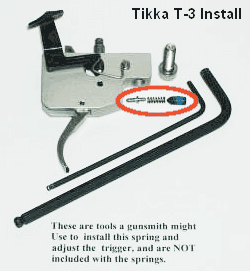 We often hear requests from Tikka T-3 owners asking how they can reduce their trigger pull weight. Paull offers a Tikka T-3 varmint trigger spring which can reduce the pull weight significantly. The photo at left shows the Tikka T-3 trigger assembly. We often hear requests from Tikka T-3 owners asking how they can reduce their trigger pull weight. Paull offers a Tikka T-3 varmint trigger spring which can reduce the pull weight significantly. The photo at left shows the Tikka T-3 trigger assembly.
While there is more to a good trigger job (in most cases) than just a spring swap, you need to have the proper rate spring when adjusting trigger pull weight downwards. NOTE: For safety reasons, we recommend you consult a competent gunsmith before modifying factory triggers. We stress the word competent…
Ernie has observed that some gunsmiths try to lighten trigger pulls by modifying factory springs in questionable ways: “I have worked with gunsmiths in the past who, when the subject turned to trigger springs, preferred to clip them, grind them, heat them, bend them, smash them, or simply back out the weight of pull screw until there was no or almost no pressure on the spring. With any of these methods, you get a spring whose rate is rapidly rising as the trigger is pulled. As the trigger is released, the spring rate rapidly decreases as it approaches full or near-full extension. A more uniform weight of pull will be achieved when the trigger spring is compressed within its normal working range throughout the entire movement of the trigger. In the long run, the benefits of saved time, plus more uniform and reliable results, will more than offset the cost of these [replacement] springs. If you want a lighter trigger pull, you need a lighter trigger spring.”
July 19th, 2009
 A handgun is useless for home defense unless it is readily accessible in an emergency. At that same time, you must keep handguns safely secured from children and curious house guests. The “loaded .45 under the pillow” is a bad idea. There are many small handgun safes on the market, but most are still too large to be placed at arm’s reach, but out of sight, inside a dresser drawer or bedside table drawer. A handgun is useless for home defense unless it is readily accessible in an emergency. At that same time, you must keep handguns safely secured from children and curious house guests. The “loaded .45 under the pillow” is a bad idea. There are many small handgun safes on the market, but most are still too large to be placed at arm’s reach, but out of sight, inside a dresser drawer or bedside table drawer.
Gunvault’s new MicroVault, measuring 11″ x 8 1/2″ x 2 1/4″, is ideal for bedside table installations. It can be secured via four bolt holes in the bottom. Using the No-Eyes® Keypad, a special set of finger-activated push-pads, the MicroVault can be unlocked in under three seconds — we’ve tested this ourselves. It is a reliable set-up that is much faster than using a key or spinning a combo lock. The finger-slot system also works in the dark, unlike most electronic numeric keypads.

MicroVault for Vehicle Applications
There are also situations where you want to transport a handgun in a locked case, but still want to be able to access the weapon in seconds. The new MicroVault serves that purpose well. In many states, it is illegal to carry a handgun in your vehicle unless it is in a locked container. (This assumes you do NOT have a separate concealed carry license.) But if that lockbox has a conventional hasp lock or combination lock with small tumblers, you’re not going to be able to access the weapon in a hurry. With the Microvault, your gun can be secured in the glove box or center console, yet still be accessed in seconds by pressing the right combination of fingers. LEGAL NOTE: In some jurisdictions handguns must be in a locked container in a remote part of the vehicle (e.g. backseat or the trunk), not immediately accessible by the driver. CHECK YOUR LOCAL LAWS.
If you need to transport a handgun, the MicroVault also serves as a secure, locked container that will fit inside a backpack or attache case. The standard MicroVault (model MV500) is available from vendors such as SportCo Warehouse for about $90.00. There is also a “biometric” version that works by reading your fingerprint. Potentially, the biometric MicroVault (model MVB500) offers the fastest access of all. It retails for about $175.00.
July 18th, 2009
Our “master fabricator” and silhouette guru Mark LaFevers recently attended the SoCal Precision Rifle Competition, Mark’s first-ever tactical match. Competition was fierce at this year’s SCPRC. The match winner, and “top gun” among the 50+ competitors was Sgt. Dan Gilland, (USMC), a scout-sniper from a nearby Marine base. This was only Dan’s second civilian match and yes, the young Marine was shooting a .308 Win (7.62×51 to be precise). Jason Boak took second place while Gordon Campfield finished third. Jason was the top shooter among the NorCal guys, who did well, capturing 6 of the top 10 places, earning California intra-club bragging rights.
 |
 |
Mark told us that the match was a humbling yet very fun experience. In these kind of matches very few, if any, sighters are allowed, and you’re often shooting at unknown distances. Accordingly, it is imperative that you have rock-solid come-ups at all distances, before you arrive at the match. In addition, the SCPRC offered the challenges of angled shooting (requiring ballistic compensation), and lowlight shooting. Log on to the CalGuns.net Forum for a complete match report by NorCal shooter Vu Pham, with lots of photos, plus stage descriptions (match directors take note).

A wide variety of calibers were shot at the match, and Mark observed that no one chambering seemed to have the edge (though a .308 finished on top). However, most of the top shooters were running detachable magazines, and had barrels fitted with muzzle brakes. You can see the dust kicked up from the muzzle brakes in the video below. The first part of the video shows a stage where competitors had to start with standing (off-hand) shots, then transition to a stepped barricade, moving lower and lower as the timer ticked off the seconds. For the standing stages, Mark noted, you wanted a rifle that balanced well and was not too heavy. Some of these beefy tactical rifles, optimized for prone work, are tough to hold offhand.
Please enable Javascript and Flash to view this VideoPress video.

July 16th, 2009
 Bryan Litz, chief Ballistician for Berger Bullets, has just released an impressive new, hard-cover treatise on external ballistics. While Bryan’s 536-page Applied Ballistics for Long-Range Shooting will surely take its place among the “classic” reference books on precision shooting, it does much more than explain theories of bullet flight. Using advanced equipment, Litz measured the actual drag of over 175 popular bullet types in the field. Armed with this new experimentally-derived data, shooters can now calculate their loads’ true trajectories with greater precision than ever before. Bryan Litz, chief Ballistician for Berger Bullets, has just released an impressive new, hard-cover treatise on external ballistics. While Bryan’s 536-page Applied Ballistics for Long-Range Shooting will surely take its place among the “classic” reference books on precision shooting, it does much more than explain theories of bullet flight. Using advanced equipment, Litz measured the actual drag of over 175 popular bullet types in the field. Armed with this new experimentally-derived data, shooters can now calculate their loads’ true trajectories with greater precision than ever before.
If you’re serious about long-range shooting, or just have an interest in bullet design and performance, you should buy this book. It is offered for $39.95 directly from Bryan’s website, AppliedBallisticsLLC.com.

In the video above, Litz explains some of the key features of his new book. (Watch the video — Bryan explains what you’ll get for your $39.95!) Don’t be fooled by Bryan’s youthful appearance. This guy is the Einstein of external ballistics. He holds a degree in Aerospace Engineering, and he was an honest-to-goodness rocket scientist who worked with the U.S. Air Force on air-to-air missile design for six years before joning Berger Bullets. What’s more, Bryan is an extremely talented long-range shooter. Bryan was the 2008 National Palma Champion, and he holds the all-time NRA mid-range iron-sight record (450-39X).

Even if you rely on a software program to calculate your come-ups, it is important to know how bullets are affected by wind and gravity, and how bullet ballistic coefficients are determined. If you’re looking to expand your knowledge of ballistics and the nuances of bullet design, you should find Bryan’s book informative and readable.
You don’t need an MIT degree to understand this book. It was Bryan’s goal to explain the important elements of exterior ballistics in a practical way that can be understood and applied by shooters. What you learn from Applied Ballistics for Long-Range Shooting can help you make better decisions about the bullet(s) and the caliber(s) you choose to shoot, and give you more confidence when taking those long shots in the field.
July 16th, 2009
Reactive targets — whether balloons, steel gongs, or clay birds — always add fun to a range session. But precision shooters may want something more challenging (i.e. smaller) than a clay bird when shooting inside 300 yards. For a change of pace, try shooting at small reactive targets attached to your target board.
 Necco Wafers and Paint Balls Necco Wafers and Paint Balls
We’ve seen folks shoot at candy NECCO® Wafers at 100 yards. When hit, these disintegrate nicely but don’t offer much of a visual display. For serious “splat factor”, some shooters use paint balls as targets. Glued to a cardboard backer, the paintballs explode dramatically when hit. Unfortunately paintballs make a really big mess, and your rangemaster might not be happy with the residue. Accordingly, we suggest you leave the paintballs to the “gravel pit”-type plinking ranges.
Pool Cue Chalks — Cheap, Fun, Dramatic
If you’re looking for a nice small target that makes a nice big cloud of color when hit, try pool cue chalks. You know, those little blue cubes you use to dust the end of billiard cues. Measuring about 7/8″ per side, billiard chalks make very challenging targets at 100 and 200 yards. When you hit them, if you nail the circular “dimple” in the middle, they disintegrate impressively, tossing blue “smoke” in all directions.

To see actual hits on chalk at 100 and 200 yards, watch the video below. The movie-maker, Phil of the Random Nuclear Strikes Blog, cautions that: “You’ll notice (in the video) that some of the hits are ‘wiffs’ instead of ‘poofs’. If you look at the picture above, you’ll see the 1/2 inch dimple in the cube face. If you don’t put the bullet in that dimple, it’ll ‘wiff’ on you.”
Pool cue chalks are inexpensive. You can buy a dozen chalks online for about $3.00 — just 25 cents each. And the prices drop with more quantity. One gross of chalks (that’s 144 pieces) costs just $23.00 at ozonebilliards.com.
July 15th, 2009
 On Monday, we reported that Powder Valley, Inc. would be receiving a very large shipment of Wolf Primers today, July 15th. In addition, Wideners.com has already received a big shipment of Wolf Primers on 7/14. You can now place orders online with Wideners, but they caution that there will be shipping delays of up to one week. Wideners has Small Rifle Magnum primers in stock for $29.00/1000 and the Large Rifle (Regular) and Large Rifle Magnum in stock for $29.50/1000. NOTE: for the BR and PPC cases we recommend the Small Rifle Magnum primers. Regular Wolf Small Rifle primers have soft cups. On Monday, we reported that Powder Valley, Inc. would be receiving a very large shipment of Wolf Primers today, July 15th. In addition, Wideners.com has already received a big shipment of Wolf Primers on 7/14. You can now place orders online with Wideners, but they caution that there will be shipping delays of up to one week. Wideners has Small Rifle Magnum primers in stock for $29.00/1000 and the Large Rifle (Regular) and Large Rifle Magnum in stock for $29.50/1000. NOTE: for the BR and PPC cases we recommend the Small Rifle Magnum primers. Regular Wolf Small Rifle primers have soft cups.
CLICK HERE to order Wolf Primers from Wideners.com.
July 15th, 2009
 With the current high demand for AR15-style rifles, the sales of both bare (stripped) and semi-assembled lower AR receivers has increased dramatically. This has led to questions, from both buyers and Federal Firearms License holders, as to how these lower receivers should be handled during sales. The ATF has issued a letter which deals with these issues. Important points to note are: With the current high demand for AR15-style rifles, the sales of both bare (stripped) and semi-assembled lower AR receivers has increased dramatically. This has led to questions, from both buyers and Federal Firearms License holders, as to how these lower receivers should be handled during sales. The ATF has issued a letter which deals with these issues. Important points to note are:
1) An FFL may not sell a frame or receiver to anyone under 21 years of age [Title 18, U.S.C., section 922 (b)(1)]. Comment: This is because the receiver could, potentially, be made into a pistol.
2) An FFL may not transfer a frame or receiver to an unlicensed person from another State. [Title 18, U.S.C. section 922(b)(3)]. Comment: Again, this tracks the rules regarding transfers of pistols, because some frames/receivers can be built into pistols.
3) Multiple handgun sales forms (ATF forms 3320.4) are NOT required for sales of multiple frames or receivers of any firearm, as they are not pistols or revolvers. Comment: This may seem inconsistent with points 1 and 2 above, but this follows from the provisions of CFT 478.11 which states that bare frames or receivers are not handguns until so assembled.
Further information on these points is contained in the July 7, 2009 letter from the ATF, which is linked below. All FFLs are encouraged to download this letter and read it carefully.
CLICK HERE for 7/9/2009 Letter from ATF Re Firearm Frames and Receivers

|


