|
|
November 15th, 2009
 Since 2001, November 19th has been decreed National Ammo Day. The backers of this event want each and every gun owner to purchase 100 rounds of ammunition this Thursday the 19th. The purpose of Ammo Day is to support the Second Amendment and to send a message to politicians. Since 2001, November 19th has been decreed National Ammo Day. The backers of this event want each and every gun owner to purchase 100 rounds of ammunition this Thursday the 19th. The purpose of Ammo Day is to support the Second Amendment and to send a message to politicians.
There are an estimated 75 MILLION gun owners in the United States. If even 10% of them purchase ammo on Nov. 19th, this will demonstrate the size, and economic importance, of the gun-owning citizenry. If there’s one thing politicians cannot ignore, it’s tax revenues. The sales and excise taxes on guns and ammo help support many important public programs.
To learn more about National Ammo Day, visit www.Ammoday.com. Unfortunately, certain types of ammunition remain in short supply. Because of the surge in gun and ammo sales following last year’s Presidential election, most ammunition is quite a bit more costly than it was 12 months ago… if you can find it at all. One person, commenting on the Ammoday.com website, expressed his frustration with price hikes: “How about we don’t purchase any ammo on the 19th to send a message to the manufacturers that the price gouging better stop, or we’ll simply reload everything we shoot.” He has a point. However, in a market economy, supply and demand will always influence price levels.
November 14th, 2009
 Sinclair International has a new tool assembly that lets you sort bullets by base to ogive length. The $79.95 Sinclair Bullet Sorting Stand with Dial Comparator (item 59-2000) comes with a heavy black granite base that stays put on your loading bench. The included dial indicator has a quick-release lever allowing easy placement and removal of bullets into the comparator. This lever allow the spring-loaded indicator shaft to pop up out of the way. Sinclair International has a new tool assembly that lets you sort bullets by base to ogive length. The $79.95 Sinclair Bullet Sorting Stand with Dial Comparator (item 59-2000) comes with a heavy black granite base that stays put on your loading bench. The included dial indicator has a quick-release lever allowing easy placement and removal of bullets into the comparator. This lever allow the spring-loaded indicator shaft to pop up out of the way.
The special base comparators used with this tool (see photo), are sold separately for $10.99, and are offered in 22 caliber, 6mm, 6.5mm, 7mm, 30 caliber, and 338 caliber. The sorting stand can also be used with Sinclair multi-caliber hex comparators (item 09-700, $18.25).
Measuring Bullet Bearing Surface with Calipers and Comparators
While we like this Sinclair tool, the same function can be performed with a regular set of calipers, using two comparators with caliber inserts. If you use the Hornady (formerly Stoney Point) OAL system you probably already have a #B2000 comparator body and a caliber-specific insert ($3.99 at Grafs.com).
Buy a second body ($14.39 at Grafs.com) and second insert (of the same caliber) and mount one on each caliper jaw, opposite each other. Tuck the bullet’s boat-tail in one insert and the “pointy end” in the other, and you can quickly measure the bearing surface. It takes a few tries to get the right “feel” of how hard to close the caliper jaws. But if the comparator bodies are set up right, the process should be quite repeatable, and you can probably measure just as fast with calipers as with the Sinclair measuring stand. However, the Sinclair unit should be a bit more precise, if you’re trying to resolve bullet lengths to less than one-thousandth. If you want to measure base to ogive (rather than bearing surface length), just remove one comparator and measure with the heel of the bullet (end of boat-tail) touching one jaw, and the bullet’s “pointy end” in the remaining comparator.

November 13th, 2009
A full-time lawyer, Robert Whitley is also an avid prone, Highpower, and cross-course shooter. Over the past two years, Robert has pioneered a cartridge for these disciplines (as well as long-range varminting) based on the 6.5mm Grendel necked down to 6mm. Robert calls the cartridge the “6mmAR”.

The 6mmAR cartridge has performed very well in AR-based comp guns, both with shorter bullets loaded to mag length, and 105-107gr bullets single-loaded. Robert has complete info about the 6mmAR on his website, 6mmAR.com, including recommended loads and field test results. Robert has also developed a higher capacity version, with the shoulder blown forward and a shorter neck. He calls this the 6mmAR Turbo. This round can drive 105-108gr bullets in the 2850-2900 range, and it has proven very accurate. It is one of the best options for AR-platform space-gun shooters.
Though making 6mmAR brass from 6.5 Grendel brass is quite straight-forward and simple, Robert receives many questions about forming the brass, so he recently prepared a video. The two-minute video shows how quick and easy the brass-forming process can be:
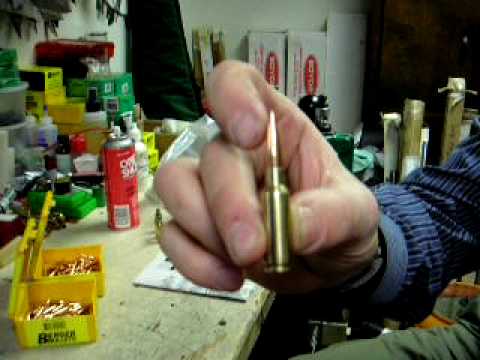
Robert also builds and sells products for across-the-course shooters, including complete AR uppers, chambered in a variety of calibers, including 6mmAR. Jerry Tierney, 2005 NBRSA 1000-yard champion, has a 6mmAR upper built by Robert and Jerry says the upper “Absolutely shoots great. I love it.” In the past few months, Jerry has broken many NRA senior records with his new 6mmAR-chambered rifle.
CLICK HERE for Feature Article on 6mmAR and Robert Whitley (many photos)
CLICK HERE for 6mmAR LOAD DATA
November 13th, 2009
Avid Design has released a new multi-tool designed expressly for rifles and shotguns. The $24.99 Gun Tool combines 18 of the most commonly used long gun tools in a compact package. The Gun Tool boasts three Torx wrenches (T20; T15; T10), two Allen hex drives (3/32″; 5/32″), and four screwdriver blades (1/8″ flat; 3/16″ flat; Phillips 1 & 2). In addition, there is a magnetic 3/16″ driver, a pin punch, and a stainless claw blade useful for opening shipping boxes or trimming target backers.
The most unique feature of the Gun Tool is a stepped, multi-size choke-tube wrench that fits six shotgun bores from .410 all the way up to 10 gauge. For active shotgunners, that provides great versatility in a small package.

Respected gun writer Jim Shepard has reviewed the Gun Tool: “I can honestly say that I’ve been playing with ‘The Gun Tool’ for a couple of days, and I’ve found it to be a pretty promising device that really should find a place in lots of range bags. If you’re a long gun shooter, it has something you’ll eventually need in the way of a tightening/loosening/adjusting tool.” Jim cautions, however, that the claw blade does not lock into place.
Currently, the Gun Tool can be purchased online for $24.99. NOTE: With each Gun Tool you get a FREE set of polycarbonate shooting glasses, complete with handy, lanyard-attached 26 NRR ear plugs. We figure the shooting glasses and plugs are worth at least $6.00, making the Gun Tool a pretty good deal at $24.99. And if you purchase two Gun Tools you get free shipping.
November 12th, 2009
We saw an interesting gizmo on Peter White’s front rest at the recent California Long-Range Championship. Peter, who won the F-Class division, has fitted a remote drive system that allows him to adjust his Sinclair windage top without moving from his shooting position.

The windage control cable (actually a McMaster-Carr flexible drive shaft) attaches to the right side of the windage top in place of the regular adjustment knob. It then circles back to the shooter, and is clamped at the end of the pedestal leg (near the vertical adjustment speed screw). A large, knurled knob is attached to the end of the flexible drive.

 With this set-up, Peter can adjust windage easily with his left hand, while keeping his right (trigger) hand in place on the rifle. In addition, he can fine-tune his vertical using the rotary knob (speed screw) on the threaded shaft for the rear-most rest “foot”. The flex-drive adjustment system places his windage control right next to his elevation fine-tune control, so both windage and elevation controls can be manipulated with the “free hand” from the shooting position. With this set-up, Peter can adjust windage easily with his left hand, while keeping his right (trigger) hand in place on the rifle. In addition, he can fine-tune his vertical using the rotary knob (speed screw) on the threaded shaft for the rear-most rest “foot”. The flex-drive adjustment system places his windage control right next to his elevation fine-tune control, so both windage and elevation controls can be manipulated with the “free hand” from the shooting position.
Peter fabricated this system himself from less than $60 worth of parts. All you need is a McMaster Carr flexible drive shaft ($50-$60), an adjustment knob at the shooter’s end, and a small bracket to hold the adjustment knob securely.
Many F-Class shooters have fabricated a similar remote windage control system. If you have basic mechanical skills, you can build your own system in a couple hours (with the correct parts). Or, Leroy Johnson of Johnson’s Precision Gunsmithing, jpgrifles [at] yahoo.com, can build you a working system, if you send in your windage top. Leroy explains that “the various windage tops all have slightly different configurations, so the price depends on how much special work is required.”
Peter’s Parts List and Tips
Peter White offers some advice on building a remote windage control: “The parts were obtained from McMaster-Carr, www.mcmaster.com. The flexible drive shafts come in various lengths and diameters. When using the smallest diameters in this application the bend radius is critical as the cable wants to kink in one direction of operation. The tape you see on my rig covers a couple of stiffener rods. I have seen others using a longer cable with a larger bend radius with no need of a stiffener. Others have employed jacketed cables that have a much higher torque rating (but also much higher cost).”
Products Needed (Total = $49.31)
| Part Number |
Description |
Price |
| 3127K22 |
Panel-Mount Flexible Drive Shaft, 18″ Overall Length, 0.130″ Shaft OD |
$42.31 |
| 2577K18 |
Stainless Steel Knurled-Rim Knob W/Set Screw, 1/4″ Unthreaded Through Hole, 1″ Diameter |
$7.00 |
November 12th, 2009
Here’s a great deal if you’re shooping for hunting gear, shooting supplies, or holiday gifts (yep, the Christmas shopping season has already started). Cabelas.com is now offering $30.00 off a puchase of $150.00 or more. This is a bonafied offer, not a sales gimmick. This Editor just purchased a pair of Cabela’s boots listed at $153.99, and I got $30.00 off the purchase price, for a net cost (before shipping) of $123.99.

How does it work? Click the promo link above. That takes you to a page where you type in your email address. Then you’ll receive an email with a Rebate Number and a “Cabela’s Bucks Code”. Fill in the rebate number and the Bucks Code during “check-out” of the online ordering process. You can also use these discount codes when ordering by phone or at a Cabela’s store.
Offer Expires November 17, 2009
NOTE: The $30.00 off promo expires at 11:59 pm on 11/17/2009. Also the offer may only be used once, and it is valid ONLY on merchandise — it can NOT be used for Gift Certificates.
November 12th, 2009
 A successful air rifle clinic for disabled shooters was held recently in Statesville, North Carolina. Coordinated by NRA Disabled Shooting Services Manager Vanessa Warner, the event was co-sponsored by Bridge II Sports and Turning Point Nation and was hosted at the VFW Post 2031. A successful air rifle clinic for disabled shooters was held recently in Statesville, North Carolina. Coordinated by NRA Disabled Shooting Services Manager Vanessa Warner, the event was co-sponsored by Bridge II Sports and Turning Point Nation and was hosted at the VFW Post 2031.
Warner explained the clinic’s purpose: “One facet of my job involves introducing competitive air rifle shooting to people with disabilities through shooting clinics. Shooting clinics include an overview of air rifles, equipment, shooting positions, sight alignment and trigger control. At the conclusion of each clinic, a participant has a good understanding of competitive shooting and may even be able to compete in an air rifle match.”
Clinic Trains Many New Shooters
Warner brought 10 air rifles and 10 Creedmoor Sports Range Systems, a portable backstop that allows indoor shooting with pellet guns. The clinic began at 10:00 am and Warner reviewed equipment, types of shooting, the components of an air rifle and positions. By the end of the day, Warner and her assistants had introduced competitive air rifle shooting to more than 35 individuals whose ages ranged from 10 to 60, plus four reporters and many volunteers.

Warner reports that “This was one of the best organized and well-run of all of the clinics I’ve attended. There were almost as many volunteers as there were participants and I even got one of the reporters to try one of the guns. Bridge II Sports and Turning Point Nation deserve a huge pat on the back for a job well done.” Warner offered special thanks to VFW Post 2031, and post Commander Gerry Bancroft, for providing a venue on short notice.
November 11th, 2009
On the 11th hour, of the 11th day, of the 11th month of 1918, bugle calls signaled the ‘cease fire’ ending the First World War. (The official Armistice was signed earlier that morning.) To those who endured it, WWI was the “Great War”, “the War to End All Wars.” Tragically, an even greater conflict consumed the world just two decades later.
Today, 91 years after the end of WWI, Americans mark the anniversary of the WWI Armistice as “Veterans Day”. In Canada it is known as Remembrance Day. On this solemn occasion we honor all those who have served in the military in times of war and peace. While more WWII veterans pass away each year, there are still over 23 million veterans in the United States. Take time today to honor those soldiers, sailors, and airmen who have served their nation with pride. Today we remember that… “All gave some, and some gave all.”
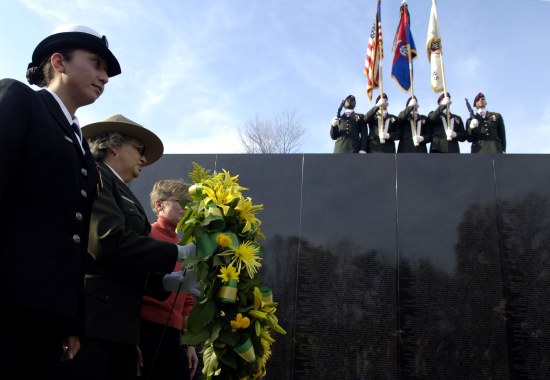
Former Secretary of Veterans Affairs Dr. James Peake asked Americans to recognize the nation’s 23.4 million living veterans and the generations before them who fought to protect freedom and democracy: “While our foremost thoughts are with those in distant war zones today, Veterans Day is an opportunity for Americans to pay their respects to all who answered the nation’s call to military service.” Major Veterans Day observances are scheduled at 33 sites in 20 states.
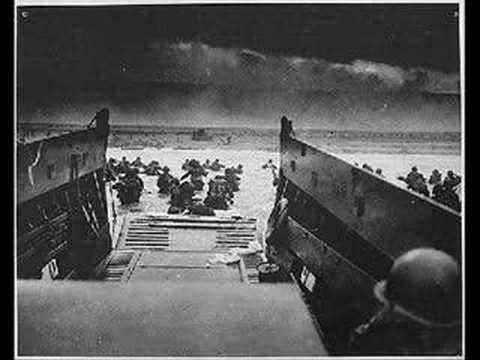
On Veterans Day we especially need to remember the seriously wounded combat veterans. These men and women summon great courage every day to overcome the lasting injuries they suffered in battle. CLICK HERE for inspirational profiles of wounded vets who, through courage and determination, have learned to adapt to their disabilities. Some of these soldiers have lost limbs, yet volunteered to return to combat duty. That is dedication beyond measure.
November 11th, 2009
4,734,991 Americans served in uniform during World War I. They fought on land and sea, in the first true global conflict. By the end of WWI over 15,000,000 soldiers and civilians worldwide had died in that conflict, including 120,000 Americans (as many from disease as from wounds). A thousand U.S. Soldiers died every DAY in the 3-week Meuse-Argonne offensive.
Frank Buckles — The Last Doughboy
This past July, Britain’s Harry Patch died at age 111. Patch had been the oldest soldier-survivor of the “War to End All Wars.” Now American Frank Woodruff Buckles, 108, Britisher Claude Choules, 108, and Canadian John Babcock, 107, stand as the last known veterans of World War I. Buckles lives quietly on a farm in West Virginia. He still remembers his service in the Great War, explaining why he joined the Army at age 16: “When your nation calls,” Buckles said, “you have to go”. (Read recent interview.)
Now, 91 years since the end of WWI, 108-year-old Army veteran Frank Buckles is our last living link with the American “Doughboys” who fought in Europe. His story is a profile in patriotism (and youthful exuberance). When only 16 years old, he tried to enlist in the U.S. Marines. They turned him down, so he joined the Army, lying about his age. He served in Britain and France as an ambulance driver, then helped escort German prisoners home to Germany after the surrender.
 
Following WWI, Buckles wanted to see the world, so he took work with a steamship company. That job placed him in the Philippines when the Japanese invaded. He was captured and interred in a prison camp for three years before being liberated. Below is a CNN feature on Frank Buckles. As all other American WWI vets have passed away, Buckles was honored as the last U.S. Soldier to fight in the “Great War”. To learn more about Frank Buckles and his experiences in WWI, CLICK HERE for a USAToday Feature Story. (Highly recommended–worth reading.)

November 10th, 2009
 It was “Ladies First” at the California State Long-Range Championship held this weekend at the Coalinga Range in central California. Palma ace Noma Mayo topped a field of 26 shooters (24 men and 2 women) to take the CA title with an impressive 787-34X score. It was “Ladies First” at the California State Long-Range Championship held this weekend at the Coalinga Range in central California. Palma ace Noma Mayo topped a field of 26 shooters (24 men and 2 women) to take the CA title with an impressive 787-34X score.
The diminutive senior lady shooter had the men saying “Noma, ‘No Mas'” by the end of the 3-day event. Using the latest (#2156) Sierra 155gr Palma bullets, Noma steered her .308 Win, iron-sighted Palma rifle to victory, displaying great consistency and superior wind-reading skills. Finishing second overall was Michael Dunio (782-29X), while Noma’s husband Marty Mayo took third with a 779-16X score. Marty teamed with Noma to win the two-person Team match on Saturday, with a combined 385-7X.
Shooting his trusty 6BRX, Peter White took the F-Class title with a strong 785-36X score. Taking second was our friend and Forum member Gary Wood, who shot a 778-28X with the 6.5-284 featured recently in the Daily Bulletin. Gary Childs placed third in F-Class (769-25X), shooting a straight .284 Win with a handsome stock he crafted himself. When comparing these scores to the iron sight shooters, keep in mind the F-Classers shot a target with much smaller ‘X’ and scoring rings. We want to give special thanks to Gary Wood, whose generous donation to AccurateShooter.com made it possible for this Editor and assistant Mark LaFevers to cover the event.

There were some beautiful long-range rigs at the match, including many Gary Eliseo tubeguns. (Gary competed at the event, and shot well on Friday and Saturday, but fell victim to shifty winds on the final day.) In addition to the high-tech tubeguns, many handsome wood-stocked Palma rifles were used, including a Bastogne-walnut-stocked beauty built and shot by gunsmith Tom Luhmann of TLC Gunworks in Clovis, CA.

An interesting “California-legal” AR Platform rifle caught Mark’s eye. It sported a handsome matte camo finish, but the chambering was the most noteworthy feature. This rifle was chambered as a 6mm Dasher, an improved 6mmBR with a shorter neck and 40° shoulder. Most of the AR match rifles we’ve seen have gone to a Grendel-based case, if they step up past the .223 Remington. The 6BR parent case uses a .308-sized bolt-face, whereas the Grendel case rim is smaller. Also, with its steep shoulder angle, the Dasher can prove challenging to feed. However, the gun’s builder Marcus Naslund said they had achieved good feeding and function by opening up the gas port and adapting a custom single-stack magazine, made from aluminum billet. Despite California’s Draconian gun laws, this rifle is legal for sale in the Golden state because a “tool” (which can be a bullet tip) is required to remove the otherwise “non-detachable” magazine.

|


