|
|
February 11th, 2012
 Imagine if your shooting club organized a public range day and 1500 people attended (including hundreds of first-time shooters). Now imagine that taking place in “gun-phobic” California. Well, believe it or not, this really happened when the San Luis Obispo Sportsmen’s Association (SLOSA) hosted its first annual SLOSA Expo. The January event drew more than 1,500 attendees who shot nearly 40,000 rounds while trying out a variety of shooting disciplines under the guidance of 150 volunteers. As a model event, the SLOSA Expo demonstrates how successful a well-organized Range Day Promotion can be. Imagine if your shooting club organized a public range day and 1500 people attended (including hundreds of first-time shooters). Now imagine that taking place in “gun-phobic” California. Well, believe it or not, this really happened when the San Luis Obispo Sportsmen’s Association (SLOSA) hosted its first annual SLOSA Expo. The January event drew more than 1,500 attendees who shot nearly 40,000 rounds while trying out a variety of shooting disciplines under the guidance of 150 volunteers. As a model event, the SLOSA Expo demonstrates how successful a well-organized Range Day Promotion can be.
Expo Introduces Hundreds of New Shooters to the Sport
The purpose of the Expo is to raise gun-safety awareness and expose non-shooting members of the public to what the shooting sports have to offer. The Expo fulfilled its charter by drawing in 63% new shooters to the SLOSA range. In fact, one-quarter of Expo participants fired their first shots ever.
 At the SLOSA Expo, personal instruction, ammunition and loaner guns were provided at no cost to attendees — thanks to a grant from the National Shooting Sports Foundation (NSSF). Men, women and children of all ages came from as far as 100 miles away to participate in the free fun event. Visitors could try a variety of disciplines including: archery, sporting clays, action pistol, black powder, cowboy action, and much more. At the SLOSA Expo, personal instruction, ammunition and loaner guns were provided at no cost to attendees — thanks to a grant from the National Shooting Sports Foundation (NSSF). Men, women and children of all ages came from as far as 100 miles away to participate in the free fun event. Visitors could try a variety of disciplines including: archery, sporting clays, action pistol, black powder, cowboy action, and much more.
“This one-day event did more to promote the 2nd Amendment and the range itself than 20 years of the range simply being open.” Said Kevin Wooley of Calguns.org. “Kudos to the volunteers.”
“We were elated at the interest and response from the community.” said Art Leach, President of SLOSA. “We expected no more than 500 people to come out for the Expo and were overjoyed to reach over 1,500 guests before 2 o’clock”. One reason for the event’s high attendance is the SLOSA Range’s unique location, just a few hundred yards from scenic California Highway 1.

“This is the first event of this magnitude I’ve heard of ever happening” said Maddy Cooley, Resources Director at SLOSA and author of the Expo grant. “The Expo will forever change the way firearms are viewed by [California] Central Coast residents.”
Story tip from EdLongrange. We welcome reader submissions.
February 11th, 2012
 Valentine’s Day is just three days away, so you better start planning how you’ll show some appreciation for the lady in your life. Of course there are the old reliables: flowers, chocolates, and dinner at a fancy restaurant. But if you want to do something really different this year, how about giving your special lady some “pretty in pink” shooting gear. (Don’t forget the flowers though… if you value your life.) Valentine’s Day is just three days away, so you better start planning how you’ll show some appreciation for the lady in your life. Of course there are the old reliables: flowers, chocolates, and dinner at a fancy restaurant. But if you want to do something really different this year, how about giving your special lady some “pretty in pink” shooting gear. (Don’t forget the flowers though… if you value your life.)
Natchez Shooters Supplies offers a variety of pink products for ladies. How about a set of pink electronic ear muffs from Champion Shooters? A portion of the proceeds from sales of these muffs goes to fighting breast cancer. These muffs only have a 21 NRR (not so great), but they do collapse for easy storage. The Champion Ladies Target Muffs, item CM40975, sell for just $34.95.

Natchez also offers pink cases for both pistols and rifles. The Bulldog-brand 52″ Pink Rifle/Shotgun Case will hold most rifles or shotguns without optics. This would be a great gift for a young girl who shoots trap or who uses an iron-sighted rimfire rifle (such as a CMP H&R M12). The case features a water-resistant outer shell with a soft, scratch-resistant, tricot inner lining. The pink long-gun case costs just $14.75 at Natchez, item JZBD254.

For the Pistol-Packin’ Mama in the family, the Outdoor Connection makes a hot pink, range case. This tough, leather-bottomed bag features padded central compartments for pistols, with accessory pockets on all four exterior sides. There is plenty of room to stow ammo boxes, muffs, trigger locks, and other shooting gear. The great thing about this bag is that it can do double-duty as a general travel case when it’s not being used to haul pistols to the range. Made from heavy 600-denier nylon, the pink Range Bag is On Sale for $21.95 at Natchez.

Last but not least, MizMac.com offers a Pink, Limited Edition 4-Gun Range Cart, that’s perfect for a gal who shots service rifle, High Power, or multi-gun matches. The cart features a steel frame, run-flat tires on chrome spoke rims, and it even has dual rear parking brakes. The Cart can hold four, full-size long guns in a vertical position. It’s also a great cart for shotgunners, as it has a lower storage compartment that will hold 18 boxes of 12ga shells. Just as important as its ammo carrying capacity, the Rugged Gear Cart has a built-in Six-pack Cooler, for those vital liquid refreshments. As sold by MizMac.com, the Rugged Gear Pink Range Cart retails for $389.99.

February 10th, 2012
Forum member Darrel Evans from the UK pulled off a remarkable feat recently. He set multiple 600-yard UK benchrest records shooting a true, military-type tactical rifle, an Accuracy International AW chambered in 6.5×47 Lapua. The gun had a custom 24″ fluted Border barrel, and bag-riding accessories, but other than that, Darrel’s gun was very much “as-issued” by the factory. Darrel pulled off this fine display of precision shooting at the December 27th 600-yard benchrest comp at England’s Diggle Ranges. (The Diggle, as you may know, is notorious for difficult conditions.)

Report by Darrel Evans
Just thought that you all might like to know how I have been getting on with my Accuracy International AW chambered in 6.5×47 Lapua. To make a long story short, I broke three UK records: smallest group of the day — 1.8″ at 600; smallest Agg for the day — 2.8″; and smallest Agg for the Light Gun class — 2.8″. All these records can be viewed on the UKBRA and TargetShooter websites.

To say that I was ‘over the moon’ would be an understatement. I was happy that all of my hard work had paid off. I was delighted to set records on the rifle’s first outing since [adding bag riders]. The 600-yard benchrest comps over here are run as a winter competition and the winds at the Diggle are not very forgiving. I knew that the group was small as the markers were over lapping each other when the target board came back up. But when they told me that it was 1.823″ I knew that I had got a record, as the last record of 2.225″ was set by myself in 2009 on the first Comp with the 6.5×47 barrel on, this was then broken with a 2.18″ on a calm day later that year. Later I received an email from Vince Bottomley telling me that I also had the best factory Agg record and the Agg record for Light Gun class.
About Darrel’s 6.5×47 Accuracy International
My Accuracy International AW (AI-AW), a military rifle system, started life as a .308 Winchester when I first bought it. But after a lot of reading I decided to buy a 6.5×47 Lapua barrel for it. As you know the AI-AW rifle system is a very good switch-barrel design, so after a phone call to Graeham Clark at Sporting Services I bought a Border Barrels 24″ fluted barrel in 6.5×47 Lapua. My .308 barrel is now in my gun safe. After seeing how the 6.5×47 barrel shoots, I doubt the .308 tube will ever go on again.
The rifle falls in the Factory Class for our 600-yard BR comps. This also qualifies in the Light Gun class. Most folks say that a factory rifle will never beat the custom lads in the Light Gun class…. Well, sometimes it’s nice to see this happen. To help the rifle’s bench manners, I made a plate for the front so that it would sit on my compact front rest with a Farley joystick top. I also made a bar to fit on the bottom of the buttstock for the rear sandbag.

Load Development and Accuracy Testing
 After a lot of testing with different powder and bullet combos, I settled on 38.2 grains of Hodgdon Varget, with 130gr JLK bullets and CCI 450m primers. Velocity is 2914 fps. Seems that this is where it likes to be. In the photo below, you can see the results of a few different powders, but all with the fantastic JLK 130gr bullets. The 38.3 Varget load had all four rounds in nearly one hole and I pulled the fifth, so this was pretty much the load that I went with for my 600-yard Comp. The JLKs are really good, consistent bullets, and I think that the next barrel that I buy will be set up for these bullets and no other — they are that good. I seat the bullets at 2.157″ OAL, just kissing the lands. I could not go any further out as the bearing surface is short. After a lot of testing with different powder and bullet combos, I settled on 38.2 grains of Hodgdon Varget, with 130gr JLK bullets and CCI 450m primers. Velocity is 2914 fps. Seems that this is where it likes to be. In the photo below, you can see the results of a few different powders, but all with the fantastic JLK 130gr bullets. The 38.3 Varget load had all four rounds in nearly one hole and I pulled the fifth, so this was pretty much the load that I went with for my 600-yard Comp. The JLKs are really good, consistent bullets, and I think that the next barrel that I buy will be set up for these bullets and no other — they are that good. I seat the bullets at 2.157″ OAL, just kissing the lands. I could not go any further out as the bearing surface is short.

Wrapping up his success story, Darrel added: “I hope that this is of some help to people who have a 6.5×47 or are thinking of building one. All the best for 2012.”

February 10th, 2012
Creedmoor Sports is currently running an auction of the very first CSR-1 rifle, the personal rifle of Creedmoor’s Gen’l Manager (and former National Champion) Dennis DeMille. NOTE: 50% of the total selling price will be donated to the M1 for Vets program. This CSR-1 rifle (serial number CS-0001) features a Pierce Engineering custom action in a Gary Eliseo Tube-gun chassis. The rifle will be up for auction through February 14, 2012. Current high bid is $3,600.00, as of 2/10/2012, 0900 Pacific Time.
This rifle currently belongs to Dennis DeMille. Dennis’s log book indicates the rifle only has 571 total rounds through it. Dennis reports: “With those few rounds I’ve posted some very good scores: 790-?, 498-23x, 497-?. I used this rifle to test various 6.5 Creedmoor loads from Hornady prior to the initial release of the round.” The rifle is still chambered in 6.5 Creedmoor and comes with four (4) mags, single round follower, handstop, and gun log-book.

This is your opportunity to own the very first CSR-1, and at the same time help support the M1 for Vetsprogram. Bids will be accepted either via email or phone. Log on to CreedmoorSports.com for more info. The highest current bid will be posted periodically during business hours.
February 10th, 2012
Effective hearing protection is a must whenever you are shooting firearms or when you are in the vicinity of gun-shots. For ultimate protection, we recommend a good set of tapered foam earplugs, topped by ear-muffs. However, there are situations when you may prefer lighter-weight hearing protection that can be quickly removed. For example, if you are standing well behind the firing line as an observer, or if you are working as a rangemaster or waddie some distance away from the shooters.
In addition to traditional ear plugs and ear-muffs, new band-style protectors provide a third sound-blocking option. Howard Leight, a top name in the sound-protection business, now offers the “Quiet Band”, a device with soft foam plugs attached to a plastic band worn around the neck. This “Quiet Band” product is comfortable, easy to deploy, and surprisingly effective.

 Three Quiet Band Models Three Quiet Band Models
There are three (3) types of Leight Quiet Band® sound protectors. We prefer the QB2 Supra-aural model (item QB2HYG, NRR 25). As shown in the photos, the NRR 25-rated QB2 positions cone-shaped foam pads next to the ear openings and holds them there with light pressure from the orange-colored band. There is also an Inner-aural version (item QB1HYG, yellow band, NRR 27), and a Semi-aural model (item QB3HYG, red band, NRR 21). Our preferred QB2 Supra-aural (orange band) model is just as comfortable as the QB3 (red band) version, and offers much better protection. The QB1 Inner-aural (yellow band) model requires that you place the ear buds in the ear canal, so it’s not really any easier to use than conventional earplugs. That’s why we like the QB2 Supra-aural model best of all. Other users agree. Here’s what two QB2 owners had to say:
 “I first saw these used by Hickok45 on Youtube and he talked positively about them. I got two and gave them a try. At first, I didn’t think they were going to work very well. After some fiddling, I found they work pretty darn good. With my ears, they fit the best if the band starts on top of my head, I insert the plugs then rotate the band behind my head. PRESTO, perfect fit. Shooting the 9mm and 12 gauge out back was comfortable with no ringing afterward. [They are] small and easy to transport — just throw in the range bag. Yet, they are big enough to keep around your neck out of the way[.] I can sit these Howard Leights down on the shooting bench without worrying about them getting dirty since the band is curved, placing the plugs in the air. I highly recommend them to anybody needing banded hearing protection.” — Tom W. “I first saw these used by Hickok45 on Youtube and he talked positively about them. I got two and gave them a try. At first, I didn’t think they were going to work very well. After some fiddling, I found they work pretty darn good. With my ears, they fit the best if the band starts on top of my head, I insert the plugs then rotate the band behind my head. PRESTO, perfect fit. Shooting the 9mm and 12 gauge out back was comfortable with no ringing afterward. [They are] small and easy to transport — just throw in the range bag. Yet, they are big enough to keep around your neck out of the way[.] I can sit these Howard Leights down on the shooting bench without worrying about them getting dirty since the band is curved, placing the plugs in the air. I highly recommend them to anybody needing banded hearing protection.” — Tom W.
“Great for woodworkers — These are lightweight AND very effective at reducing noise. When not in use the band hangs loosely around your neck, out of your way completely. Very cost effective for a great product!” — Sheri D.
Quiet Band® sound protectors can be purchased from many online vendors for under $5.00 per set, which includes a spare pair of ear buds. Amazon.com has the Leight QB2 (by Sperian) for just $2.50 per set, while Enviro Safety Products currently sells the QB2 for $3.87 per set. Replacement ear buds are available and sold by the pair. Ten-unit Bulk packs are also available for $35.00 with free shipping.
February 9th, 2012
 The American Gunsmithing Institute (AGI) has released a new Precision Long Range Shooting DVD. For what it’s worth, AGI guarantees this DVD can increase the hunter or tactical shooter’s accuracy by 37%. We’re skeptical of course, but that’s AGI’s claim. The DVD features gunsmith and long-range shooting expert Darrell Holland who narrates a multi-step course of instruction. The American Gunsmithing Institute (AGI) has released a new Precision Long Range Shooting DVD. For what it’s worth, AGI guarantees this DVD can increase the hunter or tactical shooter’s accuracy by 37%. We’re skeptical of course, but that’s AGI’s claim. The DVD features gunsmith and long-range shooting expert Darrell Holland who narrates a multi-step course of instruction.
The DVD starts off with hardware — rifle, cartridges, and bullets. Next, ranging and equipment calibration are covered, followed by a discussion of optics and range finders. Shooting techniques are covered from the point of view of both the hunter and tactical shooter. Holland gives tips for bench and field shooting positions. Darrell also demonstrates field-expedient shooting techniques and accessories for optimum accuracy.
The DVD includes filmed demonstrations of precision shooting out to 600 yards. Developed exclusively for AGI customers, this DVD includes a set of tables for calculating aiming points for long-range shots. The AGI Secrets of Precision Long Range Shooting DVD is available at www.americangunsmith.com for $39.95 (Product ID# 322DVD).
Editor: This video is brand new, so we haven’t had a chance to preview it yet. Honestly, we don’t know whether it is worth the money. You probably can learn more in our own Shooters’ Forum for FREE. But there are few video/DVD resources for precision long-range shooting, so we thought this release was worth mentioning. Darrell Holland, the DVD’s featured expert, is a talented gunsmith, who runs highly regarded shooting clinics for long-range hunters. Darrell’s advice is probably going to be sensible and useful. Whether his coaching can actually increase a shooter’s accuracy 37% is for viewers to decide for themselves.

February 9th, 2012
Forum member Skeeter has a 6mm Dasher falling block varmint rifle. The Dasher case is based on the 6mm BR Norma cartridge with the shoulder blown forward about 0.100″ and out to 40°. This gives the Dasher roughly 3.5 grains added capacity compared to the standard 6BR.
Last year, Skeeter needed to form 300 cases for varmint holiday. Skeeter decided to fire-form his brass without bullets. This method avoids barrel wear* and saves on components. There are various ways to do this, but Skeeter chose a method using pistol/shotgun powder, some tissue to hold the powder in place, Cream of Wheat filled to within an 1/8″ of top of the neck, and a “plug” of tissue paper to hold it all in place. Shown below are cases filled with a pistol/shotgun powder charge topped with Cream of Wheat and then a tissue paper plug.


To ensure the case headspaced firmly in his Dasher chamber, Skeeter created a “false shoulder” where the new neck-shoulder junction would be after fire-forming. After chamfering his case mouths, Skeeter necked up all his cases with a 0.257″ mandrel (one caliber oversized). Then he used a bushing neck-sizing die to bring the top half of the neck back down to 0.267″ to fit his 0.269″ chamber. The photo below shows how the false shoulder is created.

After creating the false shoulder, Skeeter chambered the cases in his rifle to ensure he could close the bolt and that he had a good “crush fit” on the false shoulder, ensuring proper headspace. All went well.

The next step was determining the optimal load of pistol powder. Among a variety of powders available, Skeeter chose Hodgdon Titewad as it is relatively inexpensive and burns clean. The goal was to find just the right amount of Titewad that would blow the shoulder forward sufficiently. Skeeter wanted to minimize the amount of powder used and work at a pressure that was safe for his falling block action.
Working incrementally, Skeeter started at 5.0 grains of Titewad, working up in 0.5 grain increments. As you can see, the 5.0 grain charge blew the shoulder forward, but left it a hemispherical shape. At about 7.0 grains of Titewad, the edge of the shoulder and case body was shaping up. Skeeter decided that 8.5 grains of Titewad was the “sweet spot”. He tried higher charges, but the shoulder didn’t really form up any better. It will take another firing or two, with a normal match load of rifle powder and a bullet seated, to really sharpen up the shoulders. Be sure to click on the “View Larger Image” link to get a good view of the cases.


The process proved to be a success. Skeeter now has hundreds of fire-formed Dasher cases and he hasn’t had to put one bullet through his nice, new match-grade barrel. The “bulletless” Cream of Wheat method allowed him to fire-form in a tight-necked barrel without neck-turning the brass first. The only step now remaining is to turn the newly Dasher-length necks down about .0025″ to fit his 0.269″ chamber. (To have no-turn necks he would need an 0.271″ or 0.272″ chamber).
Skeeter didn’t lose a single case: “As for the fire-forming loads, I had zero split cases and no signs of pressure in 325 cases fire-formed. Nor did I have any misfires or any that disbursed COW into the action of the firearm. So the COW method really worked out great for me and saved me a lot of money in powder and bullets.” To learn more about Skeeter’s fire-forming process, read this Dasher Fire-Forming Forum Thread.
*Skeeter did have a fire-forming barrel, but it was reamed with a .269 chamber like his 10-twist Krieger “good” barrel. If he fire-formed with bullets, he would have to turn all 300 necks to .267″ BEFORE fire-forming so that loaded rounds would fit in the chamber. Judging just how far to turn is problematic. There’s no need to turn the lower part of the neck that will eventually become shoulder–but how far down the neck to turn is the issue. By fire-forming without bullets now he only has to turn about half the original neck length, and he knows exactly how far to go.
February 8th, 2012
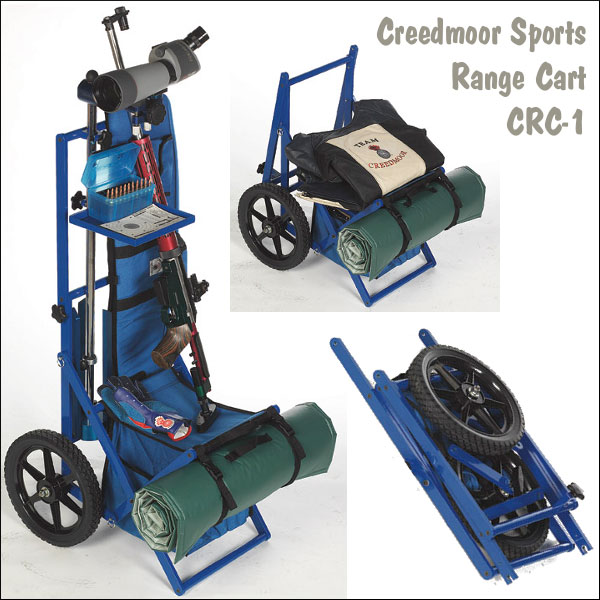 Some High Power shooters on the Forum asked about carts for carrying their gear to the range. You can certainly purchase a factory-made, purpose-built cart that folds up and has all the bells and whistles. The Creedmoor Sports CRC-1 (photo right) is a proven, quality product that works great. You’ll find these used by top shooters at Camp Perry. But the Creedmoor CRC-1 cart costs $499.95. Some High Power shooters on the Forum asked about carts for carrying their gear to the range. You can certainly purchase a factory-made, purpose-built cart that folds up and has all the bells and whistles. The Creedmoor Sports CRC-1 (photo right) is a proven, quality product that works great. You’ll find these used by top shooters at Camp Perry. But the Creedmoor CRC-1 cart costs $499.95.
For a tenth that price ($49.99), plus a few dollars more for do-it-yourself enhancements, you can have a heavy-duty cart that will haul all your gear just fine, though it doesn’t fold up.
 Check out the Harbor Freight Welding Cart, item #65939. This cart is ON SALE right now for just $49.99. Overall size is 29-1/2″ L x 20″ W x 49″ H, and width between side rails is 18″. The wheels (with tires) are 20 3/4″ in diameter for smooth rolling. Consider that, if you made your own cart from scratch you could easily pay $30.00 or more just for the large-diameter wheels and axle. Do note — this cart has air-filled tires. Be sure to inflate before you go to the Range! Check out the Harbor Freight Welding Cart, item #65939. This cart is ON SALE right now for just $49.99. Overall size is 29-1/2″ L x 20″ W x 49″ H, and width between side rails is 18″. The wheels (with tires) are 20 3/4″ in diameter for smooth rolling. Consider that, if you made your own cart from scratch you could easily pay $30.00 or more just for the large-diameter wheels and axle. Do note — this cart has air-filled tires. Be sure to inflate before you go to the Range!
As sold, the Harbor Freight Welding Cart isn’t quite ready for range use. But it’s easy to add plastic side-panels on the bottom unit, and fit a barrel-holding system on the cross-tube. I also suggest bolting/welding on extra spacers on the most forward underside edge of the bottom so that, at rest, the cart tilts slightly back. This ensures rifles and gear won’t flop forward. (A bit of extra lift also keeps the bottom plate out of the dirt and gravel.)
How to Upgrade Welding Cart for Range Use
Get a block of hard foam rubber. Cut keyhole slots in the rubber to grip the barrel and umbrella/scope stands. Mount the rubber block to the cross piece with self-tapping screws, or drill a horizontal channel in the rubber so the whole block fits over the cross-tube. On the lowest leading edge of the welding cart box (at ground level, front), fit a block of wood 2″ high (you can also fabricate metal extensions). This will make the cart lean back a little more, which helps stabilize the contents on sloping terrain.
 You’ll want to enclose the sides of the bottom box area so small items don’t fall out. You can tack-weld aluminum side-plates if you want a fancy appearance. I prefer to just cut sheet plastic from a home improvement store. These plastic panels can be attached with screws or even zip-ties around tubing. You’ll want to enclose the sides of the bottom box area so small items don’t fall out. You can tack-weld aluminum side-plates if you want a fancy appearance. I prefer to just cut sheet plastic from a home improvement store. These plastic panels can be attached with screws or even zip-ties around tubing.
Run the plastic side panels up high enough that stuff like hats and muffs don’t fall out. After transport you can transfer ammo boxes and small items to the upper box (attached to the back side of the cross-tube).
The hardest component to find may be the hard rubber blocks for the barrel keeper, but you can also make a barrel-holding block out of wood, with some carpet to protect the barrels. The nice thing about the rubber is that it can be cut to snap over the barrels so you don’t need straps. Likewise, you can drill a hole transversely through the rubber, then slot it from the bottom and it will slide over the horizontal tubing with no fasteners needed.
Comment: This cart is heavy and it takes up a lot of space. You’ll need a station wagon, SUV or pickup truck to haul it around. But it’s cheap. The money you save on a range cart could pay for a new Krieger or Bartlein barrel, AND some new brass. Those things (new barrel and brass) will likely improve your scores more than having a fancy $500.00 range cart.
February 8th, 2012
Robert Whitley of AR-X Enterprises, LLC builds match-grade uppers for AR-platform rifles. Many of Robert’s favorite chamberings are based on the 6.5 Grendel case necked-down to 6mm. Until 2011, Lapua was the only source for 6.5 Grendel brass. As you’d expect, Lapua’s Grendel brass is truly excellent, but it is also pricey, and sometimes hard to find. Now Hornady is producing USA-made 6.5 Grendel brass. Robert Whitley has worked with the Hornady 6.5 Grendel brass for over a year now and he is able to assess its performance compared to the original Lapua version. Writing in our Shooters’ Forum, Robert reveals: “It’s decent brass but hot loads will loosen the primer pockets fast. With moderate loads you will get good case life and service from the brass and it can deliver excellent accuracy as well. Not Lapua but not bad either.”
Robert reports: “I was able to get my hands on some of Hornady’s 6.5 Grendel brass. My big question was how it would measure up, particularly the loaded necks, and whether it would be compatible with our existing 6mmAR and Turbo 40 die sets. As it turns out, this brass looks like a perfect fit for our existing die sets (and obviously 6.5 Grendel die sets too). Accordingly, folks with existing die sets will be able to use the Hornady brass without any issues.” However, as the loaded neck on the Hornady brass is .001″ (one-thousandth) slimmer than Lapua brass, you may want to try a smaller bushing when sizing Hornady Grendel brass.

The Hornady 6.5 Grendel brass has a LARGE Flash Hole, about .078″ versus .0591″ for Lapua brass. Dimensionally, the biggest difference is the shoulder diameter, with the Hornady brass measuring 0.428″ vs. 0.424″ for the Lapua brass. The Hornady is actually a better fit for 6mmAR chambers which are about 0.432″ at the shoulder. Interestingly, case H20 capacity is virtually identical. Water capacity of new, unfired Hornady 6.5 Grendel brass is 35.1 grains, while new, unfired Lapua Grendel brass holds 35.0 grains of H20. Both brands of Grendel brass increase to about 36.0 grains H20 capacity after firing and full-length sizing.
Here are some of the particulars of the Hornady cases:
| Hornady 6.5 Grendel Brass |
Lapua 6.5 Grendel Brass |
Flash hole diameter: ~ .078″
OAL of brass: Average 1.515″
Weight of cases: 111.7 to 113.0 grains
Web diameter, unfired: 0.4375″
Shoulder diameter, unfired: 0.428″
Loaded neck diameter: 0.2895″
6mmAR loaded neck: 0.270″ |
Flash hole diameter: 1.5mm (0.0591″)
OAL of brass: Average 1.515″
Weight of cases: 111.0 to 112.5 grains
Web diameter, unfired: 0.4385″
Shoulder diameter, unfired: 0.424″
Loaded neck diameter: 0.290″
6mmAR loaded neck: 0.271″ |
February 7th, 2012
 Past F-Open Class National Champion (and Forum Member) Larry Bartholome, has authored an authoritative article on the 2011 F-Class National Championship held last fall in Lodi, Wisconsin. Larry writes: “With a wind tunnel for a range, and rain that canceled the final team match, only the strongest stood on the winners’ podium when the Championships ended”. Larry provides a day-by-day guide to the match, with complete results for both F-Open and F-TR classes. You’ll find Larry’s article in the February 2012 edition of Shooting Sports USA. Past F-Open Class National Champion (and Forum Member) Larry Bartholome, has authored an authoritative article on the 2011 F-Class National Championship held last fall in Lodi, Wisconsin. Larry writes: “With a wind tunnel for a range, and rain that canceled the final team match, only the strongest stood on the winners’ podium when the Championships ended”. Larry provides a day-by-day guide to the match, with complete results for both F-Open and F-TR classes. You’ll find Larry’s article in the February 2012 edition of Shooting Sports USA.
You can read, for FREE, the digital version of Shooting Sports USA. CLICK HERE to read Larry’s article (pp. 20-22). Along with the report on the F-Class Nationals, there are many other items of interest in the February edition of Shooting Sports USA. You’ll find a 14-page 2012 Event Calendar that covers NRA competitions all across the country.

 In addition, this month’s edition features a well-written, 4-page Guide to Field Target Competition by Jock Elliot. Field Target is a form of outdoor silhouette shooting using high-tech PCP Air Rifles with high-magnification scope. Check out the special Marauder Hybrid bullpup used by Team Crosman member Ray Apelles in the photo below. These high-end rigs are not cheap. A “full-race” Open Class Field Target rifle can cost up to $3000.00 with another $1000.00-$3000.00 for optics. In addition, this month’s edition features a well-written, 4-page Guide to Field Target Competition by Jock Elliot. Field Target is a form of outdoor silhouette shooting using high-tech PCP Air Rifles with high-magnification scope. Check out the special Marauder Hybrid bullpup used by Team Crosman member Ray Apelles in the photo below. These high-end rigs are not cheap. A “full-race” Open Class Field Target rifle can cost up to $3000.00 with another $1000.00-$3000.00 for optics.

|


