At the 2013 Western CMP Games, SGT Robert Evans attained what many shooters seek their entire shooting careers — a Distinguished Rifleman Badge. Evans earned his DR badge with just one hand, after losing his right hand while serving in Iraq with the U.S. Army.
SGT Robert Evans: Defying the Odds, Single-Handedly
AFter joining the Army in 2003, SGT Robert Evans served two tours in Iraq, suffering a spinal injury on the first tour. On his second tour, his life changed forever. On May 31, 2007, Evans was commanding a Bradley Fighting Vehicle in Iraq. As the Bradley drove under an old Fedayeen guard shack, an IED on top of the guard shack detonated while Evans was reaching out of the turret. The blast amputated Robert’s right hand at the wrist.
Even as a young boy, Evans had always enjoyed shooting. He vowed to stay involved with the sport despite his injury: “I couldn’t give up shooting after I lost my hand. It’s always been too important to me,” he said. “No matter what is going on in my life, when the sights are aligned and the hammer is about to fall, nothing in the world matters at that second. It’s my nirvana.”
Evans worked his way back into the sport by starting in F-Class. The position allowed him to hold hard and pull the trigger, while also being able to use his optics. Then he got involved with J.J. O’Shea’s M1 for VETS Project. The project helps transition wounded combat veterans back into the world of shooting, with equipment arrangements, position training and mental preparations.
Working with the M1 for Vets group, Evans started shooting again. But there were challenges: “The first time I shot after my amputation, it was very frustrating,” he said. “I couldn’t hold still, and shooting left-handed was so foreign.” Being extremely right-eye dominant his entire life, the loss of his right hand caused him to relearn many things, including how to shoot. Learning how to reload and adjust for wind while slung up became a pain for Evans….
In 2008, after several months and rigorous hours of dry firing, Evans found himself crossing the threshold of Camp Perry — a dream he had waited to fulfill his entire life. He scored around 50 points standing, out of 100, on his first trip. Though not bad for someone with an amputation, that wasn’t enough for Evans. He wanted to become a Distinguished Rifleman.
SGT Evans during Team Match at 2013 CMP Western Games.
He began to realize his dream as he earned his first 10 points (towards Distinguished) at Camp Perry in 2012. It took him 15 months to LEG out. His next 6 points came at the 2013 Eastern Games in Camp Butner, NC, followed by 10 more points at the 2013 National Matches. There, hoping to “bronze out,” he managed to one-up himself to actually earn a silver medal.
Then came the 2013 Western Games at the Ben Avery Shooting Facility in Phoenix, AZ. Never giving up hope and remembering his long journey from the hospital bed to the firing line, he received his final 8 points. SGT Robert Evans had become a Distinguished Rifleman.
“There was a lot of pressure, speculation and competition as to who would be the first Combat Wounded Veteran to ‘go Distinguished’ within M1 for VETS,” he said. “I’m very proud to have earned my badge, but more importantly, I hope that more wounded veterans will realize that it is within their grasp. It’s not an impossibility anymore. I hope it motivates everybody to train a little harder and hold a bit tighter – not just wounded veterans. If I can do it, anybody can.”
Commentary by GS Arizona
Robert Evans’ inspirational effort is a fresh reminder of the value of marksmanship in creating a focused challenge and reward that can help our wounded warriors regain the confidence and motivation to succeed in all aspects of life.
Robert’s effort is very reminiscent of that of Karoly Takacs, a Hungarian pistol competitor who lost his right hand in a grenade accident in World War II. Determined to overcome the injury, Takacs taught himself to shoot left-handed after the war and earned gold medals in the 1948 and 1952 Olympic Games. Robert brings that Old World grit and determination into the modern day and into the context of our nation’s most historic and cherished award for marksmanship. Robert’s Distinguished badge will shine brightly as a beacon to those who face challenges in their lives and can find a path to renewal in the brotherhood of marksmen. We salute him for his efforts and for the inspiration he brings to us all.
Editor’s Note: GS Arizona is a Distinguished Rifleman, Distinguished Pistol Shot, Distinguished Smallbore Rifleman (NRA) and a dedicated student of shooting history.
A Special Message from SGT Evans
SGT Evans wanted to thank all those who were instrumental in helping him achieve his goal of “going distinguished”. has a long list of individuals to whom he owes his successes.
“I think it’s necessary to let our fellow competitors and enthusiasts know how important they’ve been to me and the rest of the M1 for VETS shooters. They are the ones who keep us going and make our world go round,” he said. “Without all of the support from the shooting community, organizations and businesses that have donated to M1 for VETS, it never would have happened. Thank you all so very much!”
“I’d really like to thank the CMP and everyone who has helped me. That’s the real reason I went Distinguished,” he said. “M1 for VETS is a fantastic organization, and I really can’t thank them enough for what they do. No matter where my shooting career takes me, I’ll always be thankful to them for teaching, mentoring and accepting me. They are a fantastic group of guys and the reason I had the opportunity to even try. I’d also like to thank John and May Marx … and Dick Whiting.”
SGT Evans and his wife Karen after a Washington meeting with Senators Harry Reid and John Ensign.
“My mother, father and grandparents have always been there for me and are a constant source of encouragement,” he said. “And last, but certainly not least, my loving wife, Karen. She supports me no matter what I do and backs me up entirely. She’s my world and I can’t thank her enough for her support and loyalty. I love you, Karen.”
Our friends, Ed Mobley and Steve Lawrence, aka the “6.5 Guys”, have written an excellent article on getting started in practical/tactical competition. If you are new to the game, these tips can help you save money, progress faster, and have more fun. Here are article highlights, but we recommend you read the full story,5 Tips for Attending Your First Precision Rifle Match, onwww.65guys.com.
We often meet people who are new to long range precision shooting, and want to improve their knowledge and skill level. However, they aren’t sure if they are ready to sign up to compete in a match. They often ask, “What knowledge or skills are necessary to compete in a match?” Others may state, “I need to purchase this gear or that gear before I can attend a match”. For those guys who have a strong interest in precision rifle shooting, and who wish to chec out a precision rifle match, below are Five Tips to make it a positive experience.
TIP ONE: Make Plans and Commit to Go
First you need to start by finding a match to attend. This may entail a little bit of research and investigative work on your part to find what matches are scheduled in the next few months. We recommend starting with any match that may be within a reasonable driving distance. This may likely be a local “club” match, many of which are held on a regular basis. These make great venues because it will provide an opportunity to meet some of the regular attendees as well as shooters that are from your geographic area. Additionally, most of the smaller matches are a little more relaxed in terms of level of competitiveness.
Once you decide on the match you want to attend, do your homework. This means finding out if you need to pre-register or pre-pay the match fee. Commit to going by registering for the match and putting it on your schedule. Be sure to find other useful information for questions such as:
— What time should I arrive?
— Is there a mandatory safety briefing for new shooters at that venue?
— What is the travel time required to get to the match site?
— How many stages will there be?
— Is there a description of the stages available before the match?
— How many rounds should you bring?
— Are there special equipment requirements? (E.g. do you need chamber flags, is there a pistol stage?)
TIP TWO: Bring What You Have
(Don’t Spend a Fortune at the Start)
Some new shooters often assume they need a custom match rifle or all of the miscellaneous shooting gear associated with long range precision shooting to compete in match. While having a Kestrel weather meter and a high quality laser range finder and other shooting accoutrements are invaluable kit, you will find other shooters at your first match that will provide you with the information and coaching you need to get on target.
In fact, the only gear you really need to bring is a scoped rifle with a bipod and ammo capable of consistently shooting within one MOA. Also, be sure to know the ballistic drops or have a ballistic drop table prepared for your rifle/ammo to dial the correct DOPE on your scope for different target ranges. Many of the other participants at the match will be willing to let you borrow a support bag, bipod, tripod or other gear if you need one — just ask. Don’t use the excuse of not having the right gear to delay getting out to a match!
One reason not to make a big initial investment in a new rifle and assorted gear before competing, is we’ve seen a number of people come into the sport and try it for a year and then make the decision to move on to something else.
TIP THREE: Be Prepared to Learn
As a new shooter at a match, there is no better opportunity to learn. We often look to our local club matches as a group ‘training’ session to prepare for the bigger matches. You will find competitors at all levels of skill and many of your fellow shooters will enthusiastically provide helpful advice once they learn you are new to the sport. Take advantage of the opportunity to ask questions if you would like ideas for how to engage a stage, but also be sure to do more listening than talking as you receive guidance and tips from more experienced competitors.
Watch and observe other shooters and how they approach and ‘game’ a specific stage or course of fire. You’ll begin to recognize which shooting positions work best for different scenarios, and maybe even come up with some new ones that no one has thought of before.
Seeing what the better shooters do is an invaluable instructional tool. You can use your smart phone’s video camera to record other shooters (with their permission). When you’re ready to shoot, ask another shooter to record your performance. Watching yourself will point out needed areas of improvement.
After each match conduct an informal after action review and summarize for yourself the things that went well and what you should continue to do. You should also identify the specific shooting skills you should develop and make a plan to integrate the appropriate practice drills into your practice sessions. Finally, if you maintain a shooter’s data book or journal you’ll want to note things such as:
After Action Review – How you did, what went well, things you need to work on in practice. Stage Observations – Successful methods used for specific courses of fire. Note barricades, positions used, specific gear used for stages. Gear Observations – How your rifle/gear performed, what new items you should add to your “buy list”.
TIP FOUR: Be Safe and Have Fun
You’ve all heard a parent or teacher say, “It’s all fun and games until someone loses an eye.” The same can be said of the shooting sports. Safe handling of firearms is the number one rule at any match, and comes before the FUN part in terms of importance.
Before all matches start there will always be some form of a mandatory safety briefing. Make sure you know, understand, and follow any unique safety protocols for the match you attend. Some matches require all rifles have chamber flags inserted and are stowed in bags/cases while not on the firing line — other matches may not. If you run afoul of any safety rules, you risk the chance of being disqualified from a stage or worse, the entire match.
The second rule is simply have fun. This starts with having a good attitude throughout the day. Keep in mind that as a new competitor you should think of a match as a solid day of practice and training. If you blow a stage, use it as an opportunity to diagnose what you could have done differently or what you need to improve on — then smile and drive on.
Any day at the range or shooting is a good day. A match is an opportunity to hang out with like-minded people who are passionate about shooting and impacting targets far-far away. Life is great when you are doing what you enjoy!
TIP FIVE: Make Friends
There is no better way to meet lots of precision rifle shooters and make friends than at a match. The people that attend the tactical precision matches on a regular basis are those that have ‘fallen into the deep end of the pool’ and are really into the sport. As a result, they have become part of the local precision shooting community. As you strike up conversations at the match, find out if your new-found friends visit specific forum boards or social media outlets, or if there are other matches they attend.
Precision shooters tend to congregate and share information in different corners of the Internet. It will serve you well to meet some of the guys in person at matches and be able to connect a face to a screen name. As you develop your friendships and develop a level of trust, you will find opportunities become available to shoot with others in your local area, or get ‘read-in’ on a secret honey-hole of a spot to shoot long distance. Additionally, the local shooting community will often find it more convenient to sell or trade gear and equipment locally than deal with buyers/sellers that are out of state.
The NRA National Matches at Camp Atterbury Indiana are just a month away. The first event, the National High Power Rifle Matches, begins with Competitor Orientation on July 10, 2022. Then, after the Opening ceremony, the fun begins with Team Matches on July 11th. There is still time to register for one or more of the events. CLICK HERE to register.
National High Power Matches
July 10-29, 2022
Camp Atterbury, Indiana
PROGRAM
July 10 Packet Pick Up/Orientation
July 11 Team Matches
July 12-15 Across the Course (XTC)
July 16 Mid-Range Packet Pick Up & Squadded Practice
July 19 Mid-Range Team July 17-18 / 20-21 MR Course
July 24 Long Range Packet Pick Up
July 25-27 Long Range
July 26-27 Team Matches
July 28 Palma Individual Match
July 29 Palma Team
National Pistol Championships
July 17-23, 2022
Camp Atterbury, Indiana
PROGRAM
July 17 Registration
July 18 Un-squadded Practice
July 19 Revolver / .22 EIC
July 20 Prelim
July 21 .22
July 22 Center Fire
July 23 .45
National Smallbore Championships
July 25 – August 7, 2022
Camp Atterbury, Indiana
PROGRAM
July 25 3P Registration
July 26-27 3P Metric
July 28-29 3P Conventional
July 30 Prone Registration / Practice
July 31 – August 1 Conventional Prone Iron
August 2 Team/Spc Team
August 3 Pershing/Goodwill
August 4-5 Conventional Prone Any
August 6-7 Metric Prone
NRA Extreme
Long Range Championship
August 5-7, 2022
Camp Atterbury, Indiana
PROGRAM
August 5 Registration
August 6-7 Extreme Long Range
The new covered range at Camp Atterbury was a big hit in 2021 during the Precision Pistol and Smallbore Rifle Championships. This was built with the help of the State of Indiana, Indiana National Guard, the NRA, and the Indiana State Rifle and Pistol Association.
The CMP National Matches will run from July 11 to August 13, 2022 at Camp Perry, Ohio. This major event attracts thousands of shooters over the course of the summer. The 2022 National Matches start with pistol competition and conclude with Long Range Rifle. The Full 2022 Nat’l Matches Calendar is available online. There is still time to register for pistol and rifle matches. We provide registration links below.
Held annually at Camp Perry, the CMP National Matches include the CMP National Trophy Pistol and Rifle Matches, the Pistol and Rifle Small Arms Firing Schools, the National Games Rifle Matches, the National Smallbore Matches, and the National Long Range Matches. These matches are conducted by a partnership of the CMP and Ohio National Guard.
Registration for the 2022 CMP National Matches is still available, but don’t delay much longer. Click the links below to register for particular disciplines.
Looking to improve your competition skills? The Shooting Sports USA website has scores of informative articles that can help your score higher at your next shooting tournament. You’ll find articles on wind reading, position shooting, match strategies, and much more.
One great Shooting Sports USA article, Shooting is 90% Mental, was penned by Chip Lohman (SSUSA’s former Editor). With the help of two very smart Ph.D types, Judy Tant and Mike Keyes, Lohman examines the mental processes involved in the shooting sports. Chip’s co-authors have impressive credentials. Dr. Judy Tant is a Clinical Psychologist and National Bullseye Pistol Champion. Dr. Michael J. Keyes, is a licensed Psychiatrist and former physician for the U.S. Shooting Team.
If you shoot competitively, this is definitely a “must-read” article. The authors examine how the brain functions under stress, how “visualization” can be used to improved performance, how “brain speed” can be enhanced through proper training, and how the brain stores learned routines into “muscle memory.” And that’s just for starters — the article gives many concrete examples of techniques top shooters have employed to improve their “mental game” and shoot higher scores.
Brain Speed and Trigger Control: Research: Scientists believe that the newer frontal lobe may not be able to keep up with “deep” brain signals that transmit at nearly 300 mph. This is explained when athletes talk about “letting go”, rather than over-thinking the shot.
This conscious signal can take up to 0.3 seconds from recognizing the desired sight picture to moving the trigger finger — too long to capture the opportunity for a perfect shot. However, if the signal is initiated spontaneously in the cerebellum where such procedures are thought to be stored through repetition, the reaction speed is much quicker. Signals are processed by the “deep brain” almost twice as fast as the problem-solving frontal lobes.
Mental Preparation for Shooting Matches
Below are tips from Emil Praslick III, former USAMU coach. Considered one of the best wind readers on the planet, Praslick also was known for his ability to help his shooters master the “mental game”.
Thinking Your Way to Success by Emil Praslick III
Why does it seem that the same small group of shooters wins the majority of the matches? What is the difference among shooters who are technically equal? Confidence. A confident shooter is free to execute his shots without the fear of failure, i.e. shooting a poor shot.
Negative thoughts (can’t, won’t be able to, etc.) will destroy a skilled performance. The mind’s focus will not be on executing the task, but on projecting fear and self-doubt. Fear is the enemy, confidence is the cure. How does a shooter on the eve of an important match … attain the confidence needed to perform up to his potential? A pre-competition mental plan can assist in acquiring that positive mental state. The plan can be broken down into a few phases.
Build a feeling of preparedness. Developing and executing a plan to organize your equipment and pre-match routine will aid you in feeling prepared on match day.
Avoid negative and stressful thoughts. Focusing on “winning” the match or shooting for a specific score (like making the “cut” or making the President’s 100) can cause undue stress. Good shooters focus on aspects that are within their control: their sight picture, their sight alignment, their position. Each shot should be treated as an individual event.
Train stage-specific tasks during your practice sessions. Instead of shooting matches or practice matches only, include some drills that focus on your problem areas. Training in this manner will assist your level of confidence.
As part of your pre-match routine, imagine yourself shooting perfect shots. Visualize getting into the perfect position, acquiring a perfect sight picture, and perfect trigger control.
Keith Glasscock is one of America’s greatest F-Class shooters, as well as a highly respected wind coach. A High Master, Keith finished second overall at the 2021 NRA F-Class Long Range Championship in F-Open division. He also finished second at the 2020 Nationals, tied with F-Open winner Pat Scully on points, but with fewer Xs. And he took second also at the 2019 Nationals. His consistency is unrivaled, which means he definitely knows the secrets of long range wind calling and loading ultra-accurate ammo.
Keith has a popular YouTube Channel with new content every week. On Keith’s Winning in the Wind channel, Keith offers 60+ informative videos on a wide range of topics including wind reading, reloading, component selection, load development, and training. For today’s Video Showcase, we offer four of our favorite Keith Glasscock videos. Each video has important points that can benefit any competitive rifle shooter, whether you shoot in local 100-yard fun matches or compete at the National Level in F-Class, LR Benchrest, Palma, or High Power.
How to Prepare for a Match
In this informative video, Keith explains how to prepare for a major medium- or long-range rifle competition, with a particular focus on F-Class. Keith explains how to prepare for weather conditions and “get the lay of the land” before the match. Even the day of the match, your can look and learn. As one viewer noted: “I’ve noticed some guys playing on their phones during matches. This is an important time to get in sync with wind patterns and fine tune your wind strategy.”
How to Find (and Fine-Tune) Seating Depth
This is Keith’s most popular video. Keith definitely knows how to maximize accuracy by finding the optimal seating depth for each particular barrel. He is achieving groups in the high Ones for three shots. That would be good for a short-range benchrest cartridge, but Keith is achieving that with a .284 Winchester which has much more recoil. If you shoot F-TR or F-Open or even PRS, you should watch this video.
How to Lower your ES/SD and Reduce Vertical at Long Range
This is Keith’s first video in a series on how to improve long range groups, precision, and accuracy by reducing velocity Extreme Spread (ES) and Standard Deviation (SD). To achieve the lowest ES you need to look at multiple processes, including precision powder weighing, careful seating, brass annealing, and primer selection. Another factor is bullet selection. Not all bullets of the same nominal caliber and weight class have exactly the same bullet diameter or shape. Sometimes you can get better accuracy AND lower ES by trying a different brand of bullet. We have found bullet diameters, of the same stated caliber, can vary by up to .0008″ (eight ten-thousandths). Some barrels like the fatter bullets, while other barrels may favor the skinny bullets.
How to Find Bullet-to-Rifling Touch Point
Before you even start to load for a new rifle you need to know the point at which the bullet in a loaded round will first touch the rifling. (This will be a base to ogive measurement on your round). Beyond that point you are “in the lands”. If you load shorter than that base-to-ogive length you are “jumping” your bullets. Some cartridge/bullet combos typically shoot best in the lands, while with other bullets and cartridges, jumping is the way to go. Additionally, with some disciplines it is wise to jump your bullets since you may have to unload a chambered round while on the firing line. In this video Keith shows a number of methods to determine “length to lands” with repeatable precision.
Field Test and Review of SEB Mini-X Coaxial Front Rest
While gear reviews are not the primary focus of Keith’s YouTube Channel, Keith does talk about products he likes and uses. In this video. Keith reviews the SEB Mini-X, the newest coaxial tripod rest from SEB Rests. The Mini-X offers fast, precise windage and elevation adjustment with the joystick control. The unit is much easier to pack and transport than a large, heavy front rest such as a SEB NEO or Farley. The latest Mini-X also has upgraded foot controls that make it easier to level the rest on uneven ground. For more info, see our SEB Mini-X Report.
Shooting steel targets is fun — both at close-range with pistols and rimfire, and at long range with centerfire rifles. If you’ve been thinking of getting some steel targets, here’s a great SAVINGS opportunity. Right now, as a June 2022 Pre-Father’s Day Deal, Action Target is offering a full 20% off ALL Steel Targets. That’s a great promo from one of the most respected metal target-makers on the planet.
IMPORTANT — Though this is listed as a Father’s Day SALE, the discount is only valid for TWO DAYS — June 1st and 2nd, 2022. So don’t hesitate. Use discount code FATHERS2022 during checkout on the ActionTarget.com website.
Action Target posted: “Father’s Day is just around the corner, and we know Dads want steel shooting targets. So from June 1st-2nd, use coupon code FATHERS2022 and save 20% on all steel targets.”
If you shoot pistols, or rimfire rifle, this Dueling tree is a ton of fun. Shoot solo or two shooters can enjoy challenge matches on this PT Dueling Tree. With the 20% Off code you can save $93.20 off the regular $466.00 price. There are many other great steel targets, such as the rimfire plate rack or the full Steel Challenge Kit.
An notable era in modern benchrest history is ending. The last Benchrest Super Shoot at the Kelbly’s Range has concluded. Held May 24-27, 2022, this was the “final showdown” of the world’s group-shooting benchrest aces at the Kelbly’s range facility in Ohio. The overall 2022 Super Shoot Champion, with best combined 100 and 200-yard group-size Two Gun Aggregates (Aggs), was Jeff Summers. Gun writer James Mock noted: “The master of the Super Shoot, Jeff Summers, did it again. He fought the tough conditions and came out on top of the 200+ shooters at the final Kelbly-held Super Shoot. [That is] four times that Jeff has finished first. This shows that good guys can do well. Second place went to Ohioan Don Powell.” Summers finished with a 0.2513 Agg. Shown below are the combined 100/200 Two Gun Aggs for the top 21 finishers. SEE Forum Thread.
Over 200 competitors shot at the XLVIII Super Shoot event, considered the “Superbowl of Short-Range Benchrest”. The vast majority of competitors were shooting the 6 PPC cartridge with 6mm bullets under 70 grains. Another Super Shoot-type event may be held in the future in Texas, but this was the last event to be held at the impressive Kelbly’s Range in North Lawrence, Ohio.
This major event, held annually for many years, attracted hundreds of the world’s top short-range benchrest-for-group shooters. Over the years, at the Super Shoot, you would find the world’s best benchrest shooters on the long firing line, including Hall of Fame legends like Tony Boyer, Wayne Campbell, Lester Bruno, Alan Euber and other talented PPC pilots.
Conditions this year were sometimes tough, with brisk winds and rain. Here is a video from Forum member Jay Wallace, captured on Thursday May 26th. You can see the raindrops falling:
Rain Falls at 2022 Super Shoot at Kelbly’s Range in Ohio:
This year’s Super Shoot winner, Jeff Summers, was featured in the Daily Bulletin in 2012, when Jeff won the 40th Annual Super Shoot a decade ago. That article mentioned that Summers used a bag squeezing technique at that time. This shows that while many competitors use expensive joystick rests, bag squeezing (to aim the rifle) can still achieve great results. This shows that one can still be very competitive without having the most sophisticated rest or expensive new toys.
Super Shoot — What It’s All About
The excitement and anticipation leading up to a Super Shoot can be hard to explain to those who haven’t been to one. Every year, some shooters arrive at the Super Shoot a week early to dial in their rifles, learn wind conditions for the range, and enjoy the camaraderie of their fellow shooters. As the match draws closer, campers and RVs fill the area behind the range, and shooters stake out turf all over the property with their reloading and cleaning equipment setups.
Many shooters choose to load cartridges in the main barn directly behind the 60-bench firing line, while others decide to work in pop-ups, campers and other outbuildings around the facility. Benchrest shooters tend to load in small batches, and some most load cartridges between each match. Many shooters clean their rifles after each match, while others sometimes go two or three matches between cleanings, depending on the number of rounds they fire.
Another part of high-level benchrest competition that will amaze first-time attendees is the quality and amount of equipment benchrest shooters use. Just in front of the shooting benches and the targets, range flags of all kinds sprout up, from the typical “daisy wheel” flags to very sophisticated velocity indicators that show varying wind intensity. Shooters adjust their flags to align with the particular target in front of a specific bench, just slightly below the path of the bullet but still partially visible in the high-powered scopes.
The rifles represent a variety of actions, usually custom, with heavy benchrest barrels by various barrel makers. The most popular cartridge used is the 6mm PPC, but occasionally you will run into someone using a Grendel necked to 6mm or 6mmBR-based case. Rifle rests used are typically heavy tripods or plate rests. You see a lot of Sinclair rests, Farley rests, SEB Rests, and a variety of others, including a few homemade rests. Bags are typically Edgewood, Protektor, and now some Lenzis.
Super Shoot — Runners, Pickers and the Pursuit of Perfection
The techniques vary between shooters, and they are interesting to observe. Some shooters “run” their targets and will shoot a quick sighter and then run all 5 shots as fast as they can before conditions change. Others are “pickers” and shoot each shot carefully, going back and forth between the record target and the sighter target to verify wind conditions and bullet drift. These guys will sometimes shoot up to 10 sighters and use the full seven minutes. Both styles of shooting work and many shooters use both techniques depending on the match conditions[.]
Coalinga Range in California. At dawn we could clearly see 7mm and .30 Cal bullet holes at 1000 yards.
While attending the CA Long Range Championship a few seasons back, we had the opportunity to test the performance of a high-magnification (63X) spotting scope in near-ideal conditions (maybe the best I’ve ever witnessed). On the event’s last day we arrived at 5:45 am, literally as the sun was cresting the horizon. I quickly deployed our Pentax PF-100ED spotting scope, fitted with a Pentax SMC-XW 10mm fixed-power eyepiece. When used with the 100mm Pentax scope, this 10mm eyepiece yields 63X magnification. Befitting its $299.00 price, this eyepiece is extremely clear and sharp.
At the crack of dawn, viewing conditions were ideal. No mist, no mirage, no wind. The first thing this Editor noticed was that I could see metal nail heads on the target boards. That was astonishing. As soon as the first practice targets went up, to my surprise, I could see 6.5mm, 7mm, and 30-caliber bullet holes in the white at 1000 yards. No lie…
That’s right, I could see bullet holes at 1000. I know many of you folks may not believe that, but there was no mistaking when I saw a 7mm bullet cut the white line separating the Nine Ring and Eight Ring on the target in view. (I was watching that target as the shot was fired and saw the shot-hole form). And when I looked at the 30-cal targets, the bullet holes in the white were quite visible. In these perfect conditions I could also make out 3/8″ bolt heads on the target frames.
The Human Factor — Good Vision Required
When viewing the bullet holes, I was using my left naked eye (no safety glasses or magnification). I also had a contact lens in my right eye (needed for distance vision). To my surprise, while I could see the bullet holes without much difficulty with my left eye, things were fuzzier and slightly more blurry with the right eye, even when I re-focused the scope. That contact lens was degrading the fine resolution.
Then I invited 3 or 4 shooters to look through the scope. One younger guy, with good eyes, said immediately: “Yeah, I can see the holes — right there at 4 o’clock and seven o’clock. Wow.” Some older guys, who were wearing glasses, could not see the holes at all, no matter what we did to the scope’s main focus and diopter adjustment.
The lesson here — if you have to wear glasses or corrective contact lenses, just that extra bit of optical interference may make a difference in what you can see through the scope. Basically anything that goes between the scope eyepiece and your eyeball can degrade the image somewhat. So… you may be better off removing your glasses if you can still obtain good focus sharpness using the diopter adjustment and focus ring. I did the left vs. right eye test a half dozen times, and I could definitely see small features at 1000 yards with my naked eye that I could not see with my right eye fitted with a contact lens. (I did have to re-focus the scope for each eye, since one had a corrective lens while the other did not.)
Mirage Degrades Image Sharpness and Resolution
The “magic light” prevailed for only an hour or so, and then we started to get some mirage. As soon as the mirage appeared I was no longer able to see raw bullet holes, though I could still easily see black pasters on the black bulls. When the mirage started, the sharpness of the visible image degraded a huge amount. Where I could see bullet holes at dawn, by mid-morning I could barely read the numbers on the scoring rings. Lesson: If you want to test the ultimate resolution of your optics, you need perfect conditions.
Chromatic Aberration Revealed
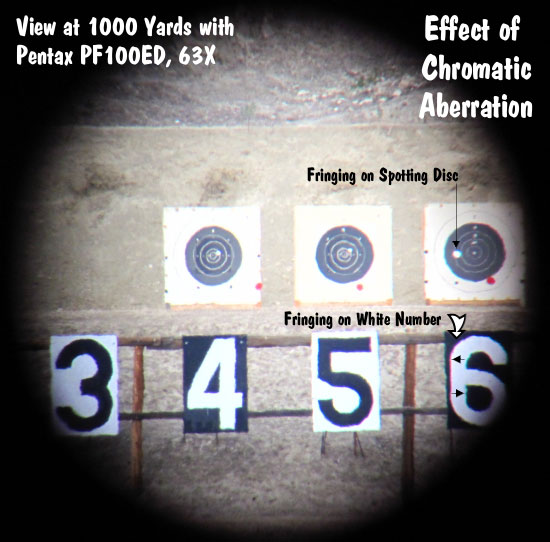
As the light got brighter and the mirage increased I started to see blue and red fringing at the edges of the spotting disk and the large numerals. This was quite noticeable. On one side of the bright, white spotting disc you could see a dark red edge, while on the other side there was a blue edge (harder to see but still present).
The photo below was taken through the Pentax spotter lens using a point and shoot camera held up to the eyepiece. The sharpness of the Pentax was actually much better than this photo shows, but the through-the-lens image does clearly reveal the red and blue fringing. This fringing is caused by chromatic aberration — the failure of a lens to focus all colors to the same point. Chromatic aberration, most visible at high magnification, causes different wavelengths of light to have differing focal lengths (see diagram). Chromatic aberration manifests itself as “fringes” of color along boundaries that separate dark and bright parts of the image, because each color in the optical spectrum cannot be focused at a single common point on the optical axis. Keep in mind that the Pentax does have “ED” or low-dispersion glass, so the effect would be even more dramatic with a cheaper spotting scope.
If you wonder why top-of-the-line spotting scopes (such as the $2980 Swarovski ATS-80 ) cost so much, the answer is that they will deliver even LESS chromatic aberration at long range and high magnification. With their exotic apochromatic (APO), ultra-low-dispersion glass, a few ultra-high-end spotting scopes can deliver an image without the color edging you see in the photo above.
The Pentax PF-100ED is a heck of a spotting scope. Any scope that can resolve bullet holes at 1000 yards is impressive. But if you want the ultimate in optical performance, with minimal chromatic aberration, you may need to step up to something like the 88mm Kowa Prominar TSN-884 with Flourite Crystal lenses ($2450.00 body only), or the 82mm Leica APO ($3899.00 with 25-50X eyepiece).
EDITOR’s NOTE: The purpose of this report is to show what is possible… in IDEAL conditions. With this Pentax 100mm, as well as a Swarovski 80mm, we can often resolve 6mm bullet holes at 600 yards. But again, that performance requires really good viewing conditions. By 10:00 am at my range, even with the 100mm Pentax at 75 power, seeing 6mm bullet holes is “iffy” at best. So don’t go out and mortgage the house to buy a $4000 optic with the hope that you’ll be able to spot your shots at 1000 yards. If conditions are anything less than perfect, you’ll be lucky to see bullet holes at 500 yards. The real solution for very long-range spotting is to set up a remote target cam that broadcasts a video picture to a screen at your shooting station. Among the target cams on the market, we recommend the LongShot LR-3. It boasts excellent resolution and incredible range. The LongShot LR-3 target cam is used in major ELR competitions.
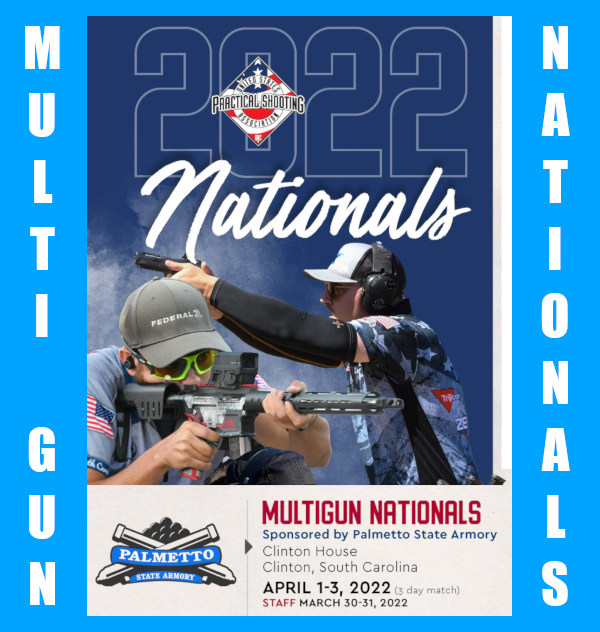
After a one-year hiatus, the United States Practical Shooting Association’s Multi-Gun Nationals event is back at new South Carolina venue — the Clinton House Plantation, which features shooting bays and an impressive 2000-acre hunting preserve. The USPSA Multi-Gun Nationals ran April 1-3, 2022.
Multi-gun competition is tough. Competitors must master pistol, rifle, and shotgun –three platforms, three calibers. Along with having great marksmanship skills, competitors must be very fit — the matches involve a significant amount of running. It’s all part of the challenge at the USPSA’s Multi-Gun Nationals.
If you are a fan of 3-Gun competition, tune in to Shooting USA this week. The latest episode, which airs Wednesday May 25 at 9:00 pm Eastern, 8:00 PM Central, features the 2022 USPSA Multi-Gun Nationals in South Carolina. You can see many of the nation’s top 3-Gun shooters attacking challenging stages with pistols, rifles, and shotguns. CLICK HERE for TV Schedule.
Multi-gun competition has evolved considerably since it started 30+ years ago. The firearms are more sophisticated, the optics are better, and the stage times are much faster. Still, the challenge remains the same: How fast can you shoot multiple targets, with the score determined by speed and accuracy? For the best in the sport, the answer is very fast indeed.
Joe Farwell hosts highlights from 2022 USPSA Multi-Gun Nationals.
Most people compete in the Tactical Division. Competitors in that division are not allowed a bipod, so many competitors utilize structures on the stage to stabilize their long gun. Regardless of division, the USPSA Multi-Gun Nationals is a true test of manipulating three different weapons, under pressure, on run-and-gun courses of fire. And the pressure is definitely on when a National Championship is on the line.
SHOOTING USA TV Air Times
View Shooting USA on the Outdoor Channel Wednesdays 9:00 PM (Eastern and Pacific) + 8:00 PM Central.
NOTE: If you miss today’s 5/25/22 broadcast, you can still view the show on Vimeo for a small 99-cent fee, or just $1.99 per month unlimited. LINK HERE: Shooting USA on Vimeo.
Shooting USA is available On Demand via Vimeo.com. Watch a single episode for $0.99, or get a full-month subscription for $1.99 and watch as many shows as you like with limited commercial interruptions.


 SGT Robert Evans: Defying the Odds, Single-Handedly





 Research: Scientists believe that the newer frontal lobe may not be able to keep up with “deep” brain signals that transmit at nearly 300 mph. This is explained when athletes talk about “letting go”, rather than over-thinking the shot.


 Action Target posted: “Father’s Day is just around the corner, and we know Dads want steel shooting targets. So from June 1st-2nd, use coupon code FATHERS2022 and save 20% on all steel targets.”


 While attending the CA Long Range Championship a few seasons back, we had the opportunity to test the performance of a high-magnification (63X) spotting scope in near-ideal conditions (maybe the best I’ve ever witnessed). On the event’s last day we arrived at 5:45 am, literally as the sun was cresting the horizon. I quickly deployed our
  Then I invited 3 or 4 shooters to look through the scope. One younger guy, with good eyes, said immediately: “Yeah, I can see the holes — right there at 4 o’clock and seven o’clock. Wow.” Some older guys, who were wearing glasses, could not see the holes at all, no matter what we did to the scope’s main focus and diopter adjustment.
 Chromatic Aberration Revealed