Shooting can be a frustrating sport at times, prompting shooters to say some funny things in the heat of the moment. Here’s a collection of humorous range ripostes, supplied by Shooters’ Forum members (who are listed after each quote). Enjoy. (CLICK HERE for full Forum Funny Saying Thread).
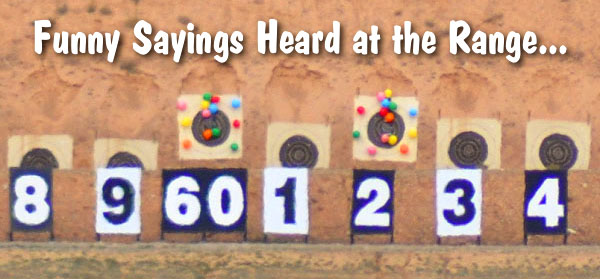
“I paid to use all of the target and I’m getting value for money on all of the real estate!” (Macropod)
“At 65 years of age, 1000-yard benchrest is better than sex, because a relay lasts 10 minutes!” (The Viper)
“How did I do?” “Well the gun went off and nobody got hurt, we can build on that….” (Mr. Majestic)
“Treat that trigger likes it’s your first date, not like you’ve been married to it for 20 years.” (Jet)
“It’s a good thing broad sides of barns aren’t at many shooting ranges.” (Rocky F.)
Target photo by Forum member RyanJay11.
“It was an 0.2″ group! Well, err, except for that flyer….” (Dsandfort)
“It’s not the arrow, it’s the Indian.” (Rocky F.)
“I can’t understand it. That load worked good in my other barrel”. (Hogpatrol)
“You bakin a biscuit?” Said to me as I was sitting at the bench ready to shoot with a cartridge in the chamber of a hot gun, taking longer than necessary. (Ebb)
“Shooting groups is easy. Just put the last three between the first two.” (Uthink)
“There is no Alibi for Stupid” (Seen at Berger SWN — Erik Cortina)
Shooter 1: “Hey you cross-fired on my target!”
Shooter 2: “Well you cross-fired on mine first!”
Shooter 1: “Yeah but you could have at least shot an X like I did on yours.” (At Raton — Rocky F.)
“I had a bughole going and my second shot dropped straight down!” (JDMock)
“The nut came loose on the end of my stock.” (TXDan)
“That’s a pretty eight.” (REastman quoting James Crofts)
In January 2022, the CMP noted that the ISSF was changing its 3×40 three-position event to a 3×20 course of fire and that three-position and air gun finals were also being changed. There has been uncertainty as to what the final version of these rules will be. Since CMP competitors need to know what the CMP rules are going to be this year, the CMP has decided to finalize its 2022 CMP Smallbore Rifle Competition Rules based on what is now known, namely that the 60-shot 3×20 course of fire is likely to stay, while ISSF rules for finals have just seen yet another change.
The updated CMP Smallbore Rifle Rules adopt the 60-shot 3×20 course of fire as the standard three-position event but leave previous finals rules in place until there is more clarity regarding whether the new 2024 Olympic finals rules can or should be adopted for CMP smallbore competitions.
The major change in this Smallbore Rules update is the recognition of the 3×20 course of fire as the standard 3-position event. All smallbore position EIC matches where competitors can earn credit points for the new Distinguished Smallbore Position Badge must be 3×20, not 3×40, events.
Smallbore position tie-breaking has also changed. Three-position ties will be broken according to the highest standing score, then the highest kneeling score. Inner tens will not be used unless two competitors are tied in all three positions. Smallbore prone competitors are NOTE affected by these latest rule changes except that new rules for conducting 40-shot prone events on electronic targets have been added.
Given the uncertainty regarding ISSF finals rules, this edition of the CMP Smallbore Rifle Rules will still include the 45-shot progressive elimination final that the ISSF previously used (Rule SB10.4) and a 24-shot prone final that was previously used by the ISSF.
Airgun Depot has a new skill contest for airgun shooters. Airgun Depot’s 10X10 Challenge encourages customers to head out to the range, test their marksmanship skills, and earn a chance at over $4000 worth of prizes.
No purchase is necessary to enter. You can download FREE 10X10 Challenge targets or order a free set of pre-printed, 10×10 Challenge targets at AirgunDepot.com. CLICK HERE for target page then use Promo Code 10X10 to get the target set for free (shipping is extra).
How the 10×10 Challenge Works
Participants take 10 shots at the 10-inch target from a set distance. Try multiple distances for more challenge. The farther the distance, the bigger the prize level. To enter the contest, you must upload a photo of your completed 10X10 Challenge target. Upload the target using the online instructions at airgundepot.com/challenge.html.
10 yards: 10 winners of a Smith & Wesson M29 BB Revolver
30 yards: 3 winners of a Springfield Armory M1A Pellet Rifle
50 yards: 2 winners of a Air Venturi Avenger Bullpup
100 yards: 1 grand prize winner of a AirForce Texan LSS
The 10X10 Challenge will run from April 15th through May 20th. Winners will be selected randomly at the end of the campaign. NOTE: To enter the contest, you must upload a photo of the target(s) you shot. UPLOAD PHOTOS HERE.
With a wide selection of air rifles, air pistols, ammo, and accessories, Airgun Depot is the one-stop shop for all the airgun enthusiasts on your shopping list. To learn more and browse the full Airgun Depot inventory, visit AirgunDepot.com.
Think you can shoot fast with a bolt gun? Bet you can’t beat these Norwegian speed-demons. In 2019, Inge Hvitås set a Mad Minute World Record, putting 39 rounds inside a 16″ circle at 200 meters, all in a single minute. At the same match, another Norwegian ace fired 48 rounds in a minute, with 38 in the bullseye. Now that’s spectacular speed and accuracy. We first ran this story in 2019 when the record was set. Wikipedia reports this is still the current record. So we believe no one has ever put more rounds on a 16″ target at 200m (with a bolt-action rifle) than Inge Hvitås. We include videos showing Inge’s amazing sequence.
Watch Inge Hvitås Set New Mad Minute World Record:
NOTE: This video, hosted by Facebook, may be slow to load. But be patient — it’s amazing to watch! CLICK HERE to run this story all by itself, speeding up the video load.
Mad Minute World Record — 39 Hits in One Minute (60 seconds)
At the Haga shooting range in Norway, spectators witnessed spectacular speed shooting in 2019. Norwegian shooter Inge Hvitås set a Mad Minute Challenge World Record with 39 hits in ONE MINUTE at 200m. The target was a 40cm (15.75″) bullseye placed at 200m (218 yards). Fellow Norwegian Jesper Nilsstua also shot brilliantly, sending 48 rounds down-range in one minute. Jesper had 38 hits, missing the record by just one. Both shooters were using iron-sighted Sauer 200 STR target rifles, which are normally chambered for the 6.5×55 cartridge. For this event, magazines are limited to 5 rounds and shooters may use slings but no bipods or other support.
Amazing Bolt-Gun Cycling Speed — 48 Rounds in One Minute
Another Norwegian ace, Jesper Nilsstua, missed the Mad Minute Challenge record (by one hit), but boy was he fast. Dennis Santiago (who has done his own Mad Minute drill), was dazzled: “This dude didn’t get the new world’s record of 39 hits in 60 seconds. He ‘only’ got 38 hits after getting off an amazing 48 shots in 60 seconds. Watch the smoothness of his shooting. It’s amazing.”
NOTE to Readers: This video is hosted by Facebook. It may be slow to load. But it is worth watching.
For the Mad Minute Challenge in Norway, a standard 200m DFS target was used, with 1 point per hit within the black area which is 40cm (15.75″, or 6.9 MOA) in diameter.
Norwegian Mad Minute Challenge — Event Rules
The organizers of the event posted: “The Mad Minute Challenge [is] a modern edition of a old military drill. This is a place for sport shooters to … share experiences on the subject of speed shooting with bolt-action rifles. The Mad Minute Challenge is all about the sport! To make a attempt for the record everyone must follow these five simple rules:”
Rapid-Fire Shooting Comparison Video
To illustrate the remarkable speed of Norwegian champion Inge Hvitås, this video shows Inge (top of frame) compared with other skilled competitors shooting the same 1-minute course of fire in Lesja, Norway.
About the Original MAD MINUTE
“Mad Minute” was a pre-World War I term used by British Army riflemen during training at the Hythe School of Musketry to describe scoring a minimum of 15 hits on a target at 300 yards within one minute using a bolt-action rifle (usually a Lee-Enfield or Lee-Metford rifle). It was not uncommon during the First World War for riflemen to greatly exceed this score. The record, set in 1914 by Sergeant Instructor Alfred Snoxall, was 38 hits.
Listed as “Practice number 22, Rapid Fire” of The Musketry Regulations, Part I, 1909, this drill required at least 15 shots on the Second Class target at 300 yards. The exercise was just one of several annual tests to classify a soldier as a sharpshooter, first or second class shooter depending on the points achieved.
Research indicates the Second Class target was a 48″ x 48″ square with 24″ inner circle and 36″ outer circle. The sight mark was a central 12″ x 12″ shape representing a soldier. ALL hits scored points (3 for center circle, 2 for outer circle, 1 for outer square). NOTE: Though some sources say the Mad Minute drill used a 12″-diameter round target, this appears to be a mistake from Ian Hogg’s book “The Encyclopedia of Weaponry”. No other source mentions a 12″ circle, which would be a mere 3.82 MOA. In reality the true drill target was a 48″ x 48″ square, roughly 15 times larger. (From No.WikiPedia.)
NRA Media offers a series of informative videos about the Science of Shooting, covering a wide range of topics, from eye dominance to long-range ballistics. These videos feature high production values, with super-slow motion segments, as well as helpful computer graphics to illustrate the principles covered.
The videos are narrated by Jessie Harrison, a top action pistol shooter (and the first women ever to achieve USPSA Grand Master status). Jessie is assisted by talented shooters such as Top Shot Season 4 Champion Chris Cheng. There are 40 videos in the Firearm Science Video Series. Here are seven good NRA science videos, with links to others below.
BULLET TRAJECTORY — Factors at Play and Zeroing Strategies
Host Jessie Harrison (formerly Jessie Duff) and Veteran Air Force Sniper and Long Range Expert George Reinas help us understand the factors behind bullet trajectory. NOTE: There are some exaggerations in the graphics in the videos, and inconsistent terminology use, but it’s still a helpful basic primer on the subject of trajectories. This popular video has over 1 million YouTube views.
Olympic Gold Medalist Jamie Gray demonstrates the four positions used by competition shooters: Prone, Standing, Sitting, and Kneeling. Helpful overlay graphics show how the human skeleton aligns in each of these positions. This video should help hunters as well as competitive position shooters. If you shoot silhouette, definitely watch this video!
INTERNAL Ballistics — Cartridge Ignition and Bullet in Barrel
What happens inside the barrel of your gun when you pull the trigger? In this edition of Firearm Science, Jessie Harrison goes over internal ballistics, which studies the combustion of propellant, the pressure developed, and the motion of the bullet along the bore of the barrel. There are some good 3D animations showing how the powder charge ignites and the bullet moves through the barrel.
CHOKE TUBES and Shot Patterns — Shotgun Science
With over 2 million YouTube views, this shotgun-centric video is the most popular of all the NRA Firearms Science series videos. Here Olympic trap shooter Corey Cogdell explains how choke tubes affect a shotgun’s shot pattern in this edition of Firearm Science. We recommend that all Shotgun hunters watch this video — it explains the effect of choke tubes very well.
ZEROING RIFLES for Long Range — Tech Tips
The process of zeroing rifles for long range is covered in this Firearm Science video featuring George Reinas, a veteran Air Force sniper. George demonstrates how to adjust his scope to compensate for bullet drop at long range. Our friend Dennis Santiago was involved in the making of this video, which was filmed at the Burbank Rifle & Revolver Club in Southern California.
CHRONOGRAPHS — Calculating the Speed of a Bullet
This video shows a conventional chronograph with front and rear light sensors. The bullet first trips the front sensor and then the rear sensor as it flies over the unit. The difference in sensor time is used to calculate bullet speed. This is not the only kind of chrono in common use today. The popular MagnetoSpeed chrono works by tracking the bullet as it passes over two magnetic sensors mounted on a bayonet-style fixture on the barrel.
The high-tech LabRadar chronograph employs Doppler Radar to measure the speed of a bullet without the need to send the round directly over sensors. No need to set up tripods down-range. Just set the unit near your rifle’s muzzle, on the side. There is also an inertial trigger accessory for LabRadars. Interestingly, this video also explains how, in the days before electric lamps, digital processors, and radar, scientists used a mechanical “Ballistic Pendulum” to calculate bullet velocity using Newtonian physics. The Ballistic Pendulum (shown at right) was first used in the mid 1700s.
EYE DOMINANCE — How to Determine Which Eye is Dominant
Host Jessie Duff and longtime shooter Krystie Messenger demonstrate how eye dominance affects aim and teach you how to determine your dominant eye in this edition of Firearm Science. There are very simple tests you can do to determine your eye dominance. This Editor is right-handed but left-eye dominant. All competitive shooters should check for eye dominance. If you are cross-dominant, you can alter your head position or put a paper patch on one frame of your shooting glasses.
Online registration for the 2022 NRA National Matches at Camp Atterbury is open now at the NRA Competitive Shooting Web Portal. Consisting of the NRA National Championships for Precision Pistol, Smallbore Rifle and High Power Rifle, the NRA National Matches will kick off its second year in the Hoosier State on July 10 and conclude August 7. Also coming back after a hiatus is the NRA Extreme Long-Range (ELR) Championship, which has shooters engaging targets at one mile and beyond.
2022 NRA National Matches Schedule at Camp Atterbury:
High Power OTC (Across the Course): July 10–15, 2022
High Power Mid-Range: July 16–21, 2022
Precision Pistol: July 17–23, 2022
High Power Long-Range: July 24–29, 2022
Smallbore 3-Position: July 25–29, 2022
Smallbore Prone: July 30 – August 7, 2022
Extreme Long-Range (ELR): August 5–7, 2022
Electronic High Power Targets for 2022 — So No High Power Pit Duty
This year, for the first time, electronic targets will be used at Camp Atterbury during the NRA High Power National Championships. NRA Competitive Shooting Deputy Director Aaron Farmer posted: “We will have up to 40 targets using Silver Mountain electronic target systems. Competitors will be squadded on a target and then continue to shoot on the same target all week. The only thing that will change is the starting relay for the day. We will be running three relays. No pit duty!”
Pershing International Match Returns for Smallbore Rifle Championship
Another highlight this year will be during the Smallbore Rifle National Championships. The historic Pershing Match, which was scrubbed in 2021 due to pandemic-related international travel restrictions, is back on for 2022. British competitors are planning to travel to the USA this summer for this historic match, which occurs every eight years.
At the NRA National Championships, shooters from across the country can compete shoulder-to-shoulder, continuing traditions going back to the 19th century. To showcase the National Championships, NRA Publications has created a great 36-page 2021 NRA National Matches commemorative magazine. This provides complete coverage of the inaugural year at Camp Atterbury, Indiana. There are plenty of photos along with interviews with top shooters. CLICK HERE for related story.
Are you looking to get started in PRS and NRL practical precision rifle competition? Or perhaps you’d like to advance your skill set so you can place higher in big matches (and get your hands on those prize table items)? Of course there is no substitute for trigger time in the field, but there ARE some great print resources. These four books can help you select the right equipment, improve your shooting skills, make better wind calls, increase your fitness, and develop a more efficient between-match training program.
1. Precision Rifle Marksmanship: The Fundamentals
Frank Galli, $23.71 Paperback, $15.99 Kindle
Frank Galli (aka “LowLight”) is the founder/head honcho of SnipersHide.com, the most active tactical community on the internet. Galli is also a retired USMC scout-sniper. Practical Precision Rifle shooting is one of the hottest trends in competitive shooting today. PRS and NRL matches draw big turn-outs and boast impressive prize tables. Galli’s Precision Rifle Marksmanship book covers the fundamentals of precision marksmanship with easy-to-understand methodology. The book uses the same instruction process that Galli uses in his live marksmanship classes.
As Sniper’s Hide guru Frank Galli explains, there is no voodoo when it comes to precision rifle marksmanship, but there are techniques that, when practiced, make the difference between good marksmanship and great marksmanship. Understanding the reasons that a bullet hits or doesn’t hit its intended target at ultra-long distances is a crucial element to learning. Galli’s explanations of how to understand and compensate for wind speed and direction are excellent — Galli offers great wind-reading advice.
Published in 2020, this 272-page well-illustrated book covers the latest equipment (scopes, LRFs, chassis systems, mags, bags, bipods, tripods) favored by tactical competitors in PRS/NRL type matches.
2. Long Range Shooting Handbook
Ryan Cleckner, $24.82 Paperback, $9.99 Kindle
Ryan Cleckner’s Long Range Shooting Handbook is the best-selling modern book on practical rifle skills. A former U.S. Army sniper instructor, Cleckner is knowledgeable, and his text is well-organized and chock full of good information. You can view Sample Chapters on Amazon.com.
Ryan Cleckner’s highly-regarded Long Range Shooting Handbook is designed as an intro to important fundamental concepts such as MOA vs. Mils, External Ballistics, and Environmental Effects. Included are personal tips and advice based on Cleckner’s years of experience as a sniper instructor and special operations sniper.
The Long Range Shooting Handbook is divided into three main categories: What It Is/How It Works, Fundamentals, and How to Use It. “What It Is/How It Works” covers equipment, terminology, and basic principles. “Fundamentals” covers the theory of long range shooting. “How to Use It” gives practical advice on implementing what you’ve learned, so you can progress as a skilled, long range shooter. This book will benefit any long-range shooter, not just PRS/NRL competitors.
3. IMPACT! — Training and Preparing for Precision Rifle Matches
Rodney Maze, $14.99 Paperback, $4.99 Kindle
Impact!, by PRS competitor Rodney Maze, is an entry/intermediate level guide to preparing yourself and your equipment to compete in precision rifle type matches. It will also benefit anyone looking to learn about practical-style long range and precision shooting. We recommend you check it out for yourself — there are 20 Pages of free sample content on Amazon. Topics covered include:
— Rifle, optic, and equipment selection
— Setting up your rifle, bags, tripods for PRS/NRL matches
— Understanding ballistics and how to record and use ballistic data
— Techniques for using holdovers for multi-target stages
— Gun skills, rapid fire techniques, clearing malfunctions
— Shooting off of barricades, and specialty stages
— Effects of wind and how to improve your wind calls
— Tips for live fire and dry fire practice
— Preparing yourself and your equipment for a match
— Mental strategies and techniques
Impact! is illustrated with plenty of photographs. Topics are divided logically, and concepts are explained in clear language. Also included is an extensive glossary of terms used in precision shooting and a list of additional resources you can use to further pursue your precision shooting knowledge. This book also includes a handy Appendix with formatted pages for recording data about your rifle, scope, and ammunition. There is also a Wind table for recording your rifle “dope” and wind hold-offs. Lastly, Impact! has a useful table of unit conversions.
4. Practical Shooter’s Guide
Marcus Blanchard, $19.99 Paperback, $9.99 Kindle
Thinking of getting started in the Practical/Tactical shooting game? Looking for ways to be more stable when shooting from unconventional positions? Then you may want to read Marcus Blanchard’s Practical Shooter’s Guide (A How-To Approach for Unconventional Firing Positions and Training). Unlike almost every “how to shoot” book on the market, Blanchard’s work focuses on the shooting skills and positions you need to succeed in PRS matches and similar tactical competitions. Blanchard provides clear advice on shooting from barricades, from roof-tops, from steep angles. Blanchard says you need to train for these types of challenges: “I believe the largest factor in the improvement of the average shooter isn’t necessarily the gear; it’s the way the shooter approaches obstacles and how they properly train for them.”
At the request of our Shooters’s Forum members, we’re repeating an excellent article by Steven Blair on wind reading. Steven, a top F-Class shooter, talks about mirage, topography effects, tail winds, and other subtle factors that can cause frustration for shooters. Steve explains that wind effects can be complex — there’s more going on than just velocity and angle. You need to notice things like berm locations and effects of temp changes over the course of the day.
Wind Reading Tips for Competitive Shooters by Steven Blair, Past California State Long Range F-Open Champion
Assess the Terrain and How the Wind Will Interact with It
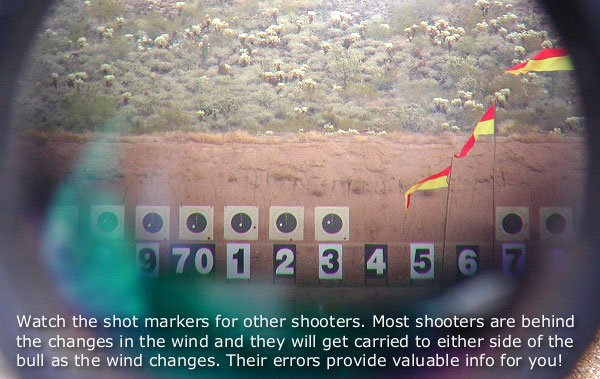
Before you begin a match, take a few minutes to look around the range at the terrain, any obstructions, range topography (berms and backstop), and trees, buildings or structures that could affect wind flow over the range. Imagine what might happen if the wind was from the left or right, headwind or tailwind. Depending upon the direction, significant effects may be seen on range. A head or tail wind may ripple across the berms, causing elevation changes, both high and low. A tall side berm, like the east side berm at Ben Avery, may cause turbulence when the wind comes from that direction. Blocking features might shield most of the wind but a break along the range can funnel strong gusts through the gap with no other indications. Take a few notes about the effects of different wind directions and refer to them if the prevailing direction changes. (Tip courtesy Tony Robertson.)
Use a Spotting Scope, Even When Shooting a Scoped Rifle
A good spotting scope can “see” mirage much more clearly than even an expensive rifle scope. Take your spotting scope to the line and position it as sling shooters do, close enough to use without much movement. Focus the scope approximately 1/3 of the way down range or where the most significant wind effects are likely to occur. Take a quick look while waiting for pit service, glance at the flags and compare to your scope sight picture. I often see ambiguous indications at the target through the rifle scope, but see a clear indication of wind direction and speed through the spotting scope at the shorter distance. When shooting the Arizona Palma Championship at Ben Avery last weekend, I was scoring while the wind was coming from the east. Shooters up and down the line were out to the left, losing points. Mirage at the target looked moderate and the flags weren’t indicating strong wind. As I focused the spotting scope back, the mirage suddenly looked like it was flowing twice as fast around 500 yards than it was closer or farther. It wasn’t until I realized that the access road cut through the berm there that I understood what was happening. (Tip courtesy Gary Eliseo.)
Don’t Over-React to Something That May Be an Anomaly
On ranges with sizable berms, a headwind or tailwind can cause significant elevation problems. It is generally not possible to see or predict when this will occur. When the conditions exist that cause elevation changes and other competitors are experiencing the same problem, the best strategy is to ignore it. Certainly, avoid shooting when the head or tail wind is gusting, the same as you would in a crosswind. But, if you react to random, range-induced elevation changes, the only likely result is to make it worse. Whether the problem is caused by range or ammunition, maintain your waterline hold until you have evidence that something has fundamentally changed.
My .284 Shehane will usually require a click or two down during a string as the barrel warms. That is normal and manageable. But, if your shots are just bouncing up and down in the 10 ring, leave it alone. The same is also true of an occasional gust pushing a shot into the 9 ring. If the conditions have not changed and one shot just went out, it may be the result of a random occurrence that was not predictable. (Tip courtesy “School of Hard Knocks”.)
Adjust Spotting Scope Focus and Magnification as Needed to View Mirage vs. Target Details
In F-Class we only need to see mirage, spotters, and scoring disks. That does not take a lot of magnification. My scope is a Nikon 25-75x82mm ED. It is a superb scope for the money and makes it trivial to see minor variations in mirage. It is good to have the high magnification available, and it can always be reduced if necessary. I use different power settings for different situations.
Setting Magnification Levels
During a match, in very good viewing conditions, I set my spotting scope at 75X, full power. The mirage is more subtle in the morning and greater magnification is needed.
During a match with heavy mirage I set my spotting scope at about 40X. I have no problem seeing mirage, even at this magnification.
When practicing at 300 yards or closer I set my spotting scope at max power (75X) so I can see the little 6mm holes from my 6BR rifle. I usually need to focus back and forth between shots to see both bullet holes and mirage.
Steven Blair, 2012 California State Long Range F-Open Champion, has been shooting since childhood and competing for over 30 years. Before retiring, Steve spent 16 years in Engineering and IT with General Atomics. He has held Engineering and Marketing positions with several firearms companies and worked on projects from pistols to 155mm howitzers.
Credit our buddy Joe Friedrich for this simple yet effective accessory for your benchrest rifle. Joe shoots a .22 LR benchrest rig with a barrel tuner. When he added weights to his tuner, he found his rifle no longer balanced well. He wanted to add some weight in the rear without drilling holes in the stock. He also wanted the weight to be removable, and easily placed on another rifle in his stable. He wanted a weight that could be moved from gun to gun as needed.
At a local sporting goods shop Joe found a 1.5-lb ankle weight that comes in a padded, tubular elastic cover. It’s like a 1.5-lb sausage in a soft, stretchy nylon cover. (Imagine a really fat, heavy bungee cord). Joe simply attached a plastic zip tie at the end to make a loop that fits perfectly over his buttstock. CLICK HERE for full-screen photo.
To “tune” the rifle’s balance, Joe just slides the ankle weight fore and aft on the stock. We have tried this moveable ankle weight on a variety of different BR stocks (including a McMillan Edge) and it worked perfectly. This is a great invention, and would work with sporter rifles and ARs just as well.
NOTE: Obviously, this ring will increase the measured weight of your rifle. So, if you are competing in a registered match with weight restrictions, you have to ensure that your rifle still makes class weight limits with the ankle weight ring in place.
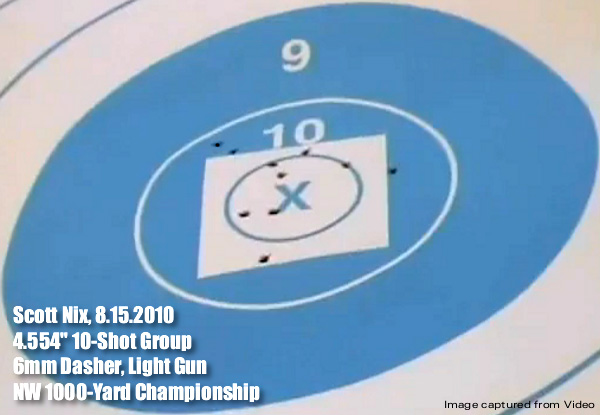
How well can the little 6mm Dasher perform at 1000 yards when the conditions are good, and the shooter is riding a hot streak? Well here’s a shot-by-shot record of Scott Nix’s 4.554″ ten-shot group shot at the Deep Creek Range outside Missoula, Montana at the Northwest 1000-yard Championship a few years back. All 10 shots were centered for a 100-6X score. That’s about as good as it gets. If Scott had stopped after 5 shots, his group would have been under three inches.
Video Demonstrates Amazing 1000-Yard Accuracy
Watch the video. You can see the group form up, shot by shot. It’s pretty amazing. Scott’s first shot (at the 45-second mark of the video) was right in the X-Ring, and four of Scott’s first five shots were Xs. That’s drilling them! This video was recorded from the pits at the 1000-yard line, during record fire.
Deep Creek Range
The Deep Creek Range in Missoula, MT is one of the nicest places to shoot in the Intermountain West region. The range is located in the mountains within a few minutes drive of Missoula, and there is camping on-site. When conditions are good at Deep Creek, records get broken. To learn more about shooting at Deep Creek, contact Jamey Williams at jameydan[at]gmail.com.
Here is an aerial view of the Deep Creek Range (Drone video by David Gosnell):




 Research indicates the Second Class target was a 48″ x 48″ square with 24″ inner circle and 36″ outer circle. The sight mark was a central 12″ x 12″ shape representing a soldier. ALL hits scored points (3 for center circle, 2 for outer circle, 1 for outer square). NOTE: Though some sources say the Mad Minute drill used a 12″-diameter round target, this appears to be a mistake from Ian Hogg’s book “The Encyclopedia of Weaponry”. No other source mentions a 12″ circle, which would be a mere 3.82 MOA. In reality the true drill target was a 48″ x 48″ square, roughly 15 times larger. (From

 This video shows a conventional chronograph with front and rear light sensors. The bullet first trips the front sensor and then the rear sensor as it flies over the unit. The difference in sensor time is used to calculate bullet speed. This is not the only kind of chrono in common use today. The popular




 Setting Magnification Levels
 Credit our buddy Joe Friedrich for this simple yet effective accessory for your benchrest rifle. Joe shoots a .22 LR benchrest rig with a barrel tuner. When he added weights to his tuner, he found his rifle no longer balanced well. He wanted to add some weight in the rear without drilling holes in the stock. He also wanted the weight to be removable, and easily placed on another rifle in his stable. He wanted a weight that could be moved from gun to gun as needed.
 How well can the little 6mm Dasher perform at 1000 yards when the conditions are good, and the shooter is riding a hot streak? Well here’s a shot-by-shot record of Scott Nix’s 4.554″ ten-shot group shot at the Deep Creek Range outside Missoula, Montana at the Northwest 1000-yard Championship a few years back. All 10 shots were centered for a 100-6X score. That’s about as good as it gets. If Scott had stopped after 5 shots, his group would have been under three inches.


