|
|
June 9th, 2008
Competing at the NRA Long-Range Regionals this weekend, Charles Ballard of North Carolina shot a new, pending F-Class Open record of 200-13X at 1000 yards. Charles also won the Regionals. Charles was shooting a straight .284 Winchester with 180gr Bergers and H4831sc powder. His rifle was smithed by Ray Bowman of Precision Rifle & Tool.

Charles told us: “It was about 103 degrees when I shot the 200-13x. The wind was running left to right, with 3-4 mph let-offs. But the velocity changes were pretty easy to read from the mirage. I dialed down the scope to 25-power and really locked into the mirage. Then, I got in a zone. I had a lot of confidence in what the mirage was telling me and I never took my head up and looked around at the flags. As soon as the spotter came up and it looked right, I broke the next shot — no hesitation. I probably shot the whole string in under 9 minutes. At about round 15, I started thinking that this might be a record and my heart really started pounding.”
The .284 Win for F-Class
Charles reports: “This rifle project began several years ago. I wanted a cartridge that would launch the high-BC, 180gr 7mm bullets with barrel life superior to that of a short mag. I read the article on this site about Jerry Tierney’s .284 and the cogs began to turn. After speaking with Mr. Tierney at the 2006 F-Class Nationals I decided this was the caliber I was going with, despite several shooters telling me I would not be able to obtain the desired velocities.


The action of choice was the 1.55″ round BAT MB. The MB model’s extended front end (allowing more barrel support and more bedding surface) was also a determining factor. The barrel is a 32″, 1.250″ straight contour Broughton 5C. As my gunsmith Ray Bowman says, “the Broughtons just shoot”. The chamber was cut with a reamer made for Lapua 6.5-284 necked up, throated for the 180s. The laminated stock is Precision Rifle & Tool’s F-Class. This low-profile stock has full adjustment and an extended, super-stiff fore-end. It rides the bags better than any stock I have ever shot.
Berger 180s at 2900 FPS, with Single-Digit ES
Ballard’s match load, 54.5 grains of H4831sc with Berger 180s, runs 2900 fps with an ES of 7 and SD of 2. Charles noted: “It took a lot of development work to get to that ideal load, but the velocity consistency really helps at 1000 yards.”
Charles noted that his gun likes to shoot well-fouled. “This Broughton barrel seems to shoot best at 50-150 rounds after it’s been cleaned. The vertical tightens up. Since the last cleaning, I had about 60 rounds through the barrel when I shot the record string. I credit Jerry Tierney for giving me the idea to go shoot an entire match without cleaning.”
June 8th, 2008
We recently had a chance to visit John Adams, and to shoot his wickedly accurate 22 Dasher (3300 fps with 80gr Amax) at the monthly Pala Range Varmint Silhouette Match in Southern California. John, a founder of IHMSA and a former owner of SAECO Tool Company, has a vast collection of dies and reloading tools. While visiting John’s workshop, we were impressed with the wooden die rack he has constructed above his main reloading bench. This would be a great do-it-yourself project for your reloading room.

John’s Loading Die Rack is a simple flat plank of wood, about 3/4″ thick. It is mounted with wood side brackets to stand at eye-level above a tool chest. The Rack is set at about a 45° angle from vertical. This holds the dies securely, but they are still easy to move in and out of the rack. At the top rear is a flat section with a single row of dies mounted upright.

You can see that all the dies for a particular chambering are arranged in a column, one above the other. The die sets’ respective calibers are marked with highly visible labels made with a label-printing machine. John also has labels on many of the dies themselves.
Vintage RCBS Die Rack
Below is an older, metal die rack. These were once manufactured by RCBS, but they are no longer sold. John Adams managed to snag a couple from RCBS years ago. The design is handy, but you can achieve the same results with a home-made wood block (perhaps that’s why RCBS discontinued its metal rack).

Quick Access vs. the Rust Factor
WARNING: While it is handy to keep your dies in a rack, this leaves them exposed to the elements. If you reload in a basement or garage where it gets cold and damp, your dies will rust much more quickly out in the air than if they are kept enclosed in their original boxes, with a small desiccant pack. Always keep a thin layer of oil or corrosion blocker on your dies. We recommend Eezox or Corrosion-X for that task.
June 8th, 2008
 Many readers have been interested in building a Short Magnum to shoot the high-BC 7mm bullets in F-Class and 1000-yard competition. The Berger 180gr VLD boasts a .684 BC, making it very appealing for the 1K game. To propel the 180s to 2900+ fps velocities, you need a pretty big case. Some guys have achieved 2900 fps with the standard .284 Win case, but a bigger cartridge can do that more reliably. The 7mm WSM and 7mm-300 WSM were favored initially, but there has been increased interest in the 7mm Remington SAUM.

7mm SAUM Has 9% Less Capacity than the WSM
Compared to the WSM cases, the 7mm SAUM has a longer neck, and slightly less case capacity: 73.6 grains of H20 for the 7mm SAUM vs. 81.0 grains for the 7mm WSM. This actually makes the SAUM a better match for the 180 VLDs. There’s enough case capacity to drive the 180s close to 3000 fps, and the longer neck gives you more flexibility with seating depths. For the 7mm bullets, the WSM probably has excess capacity. The SAUM case design looks like a 6BR on steroids and it offers good efficiency. The knock on the 7mm SAUM was that, until recently, only Remington brand brass was available. That’s changed….
 Norma’s SAUM Brass
Readers may not know that Norma now produces 300 Rem SAUM brass. This brass can be easily necked down to 7mm. The Norma brass is good, and can shoot the Berger 180s at 2950 fps or more. Forum member Steven Ikeda has been working with the 7mm SAUM and it looks very promising, with velocities equaling the 7mm WSM. The Norma brass (300 SAUM necked to 7mm) is what makes the 7mm SAUM deliver outstanding accuracy.
Norma 300 Rem SAUM brass is available from Grafs.com, Russ Haydon, and other vendors. Graf’s currently charges $102.55 for Norma 300 SAUM brass (item N27654), including shipping. The Norma 300 SAUM cases are in stock, ready to ship. A full selection of Norma brass is offered by Grafs.com. In addition to the most popular calibers such as .223 Rem and .243 Win, here are some of the other Norma brass types sold by Graf’s:
204 RUGER: Item N25510, 100 for $90.20
22-250: Item N25731, 100 for $99.70
7.5×55 SWISS: Item N27511, 100 for $113.95
270 WSM: Item N26907, 100 for $112.05
300 WSM: Item N27676, 100 for $112.05
375 H&H MAG: Item N29501, 100 for $170.95
June 7th, 2008
Carl Bernosky is one of America’s top marksmen, having won the NRA High Power Rifle Championship at Camp Perry eight times, most recently in 2007. What you may not know is that Carl is also a highly skilled and respected stock-maker. He produces stock blanks for Master Class Stocks, and he also sells a variety of designs in both laminated and fancy wood. Visit CarlBernosky.com to see the full selection.

While Carl specializes in target stocks such as the prone stock shown above, he also offers varmint and hunting patterns. Shown below are some of the stocks available from his inventory. Carl also has a stock duplicator and he can reproduce the shape and features of a favorite stock you may already own. Stock blanks, uninletted and unfinished, start at $200.00. Stock duplication for standard hunting style stocks starts at $150.00


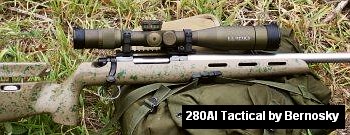
Carl also does gunsmithing — from rebarreling jobs to building complete custom rifles. Shown below is a custom, 280AI tactical rifle Carl built on a trued Rem 700 action with Broughton barrel and Master Class Prone Stock.
June 6th, 2008
The Pentax PF-100ED is one of the best spotting scopes you can buy. It has a huge 100mm front objective, and high-quality ED (low-dispersion) glass for reduced chromatic aberration. The big Pentax accepts all American standard 1.25″ eyepieces, and the Pentax long-eye-relief eyepieces are excellent. The PF-100ED received rave reviews in our Spotting Scope Comparison test a while back, and it’s the scope that tester D. Reever chose for himself.

Right now there’s an “as-new” PF-100ED on eBay, item 120268278337, with a starting price of $899.00 and no reserve. It includes a 20-60X Pentax zoom eyepiece. $899.00 may sound pricey, but this unit, BODY ONLY with NO EYEPIECE, now retails for $1599.00 at leading vendors (Adorama, Amazon, B&H). With zoom eyepiece, new PF-100EDs cost $1800-$1900. If you can grab this Pentax for under $1200.00 it’s a steal. The auction ends in two days.

If you’re looking for big serious spotting scope that can resolve bullet holes at 600 yards and beyond, the Pentax PF-100ED is up to the task. We hope one of our readers snags this unit with a bargain bid.
June 6th, 2008
 Iowa skies unleashed a deluge recently, so the Iowa 1K BR championship has been moved back two weeks.
Gunsmith and match official Gordy Gritters reports: “I’m Letting everyone know our range is under water and there’s lots more rain in the forecast for this weekend, so we are postponing our June 7th, Iowa 1000-Yard State Championship match two weeks — until July.
We are not going to shoot our State Championship rain date on June 21, but are going to do it on our next regularly scheduled match date- July 12.
In the rush to make this last minute change when we got flooded out, I did not think to check the other nearby club’s schedules until later, and we would have been shooting the same day as Varmint Hunter 600 yard and the Missouri 1000 yard matches that weekend. So we just decided to wait until our regular July match to hold our State Championship match and we’ll make up the missing two matches on September 27. Sorry for any inconvenience!”
June 5th, 2008
The short videos we have produced for this site have been very popular, and readers have requested more (and better) video offerings. Thanks to Adorama, a large camera and optics retailer, we will be getting a new Canon FS10 video camera. With the new Canon we will be able to shoot higher resolution videos, with better colors, and much improved audio quality.

 The Canon FS10 is part of Canon’s new line-up of Flash-memory video cameras. There are no tapes to fuss with, and you don’t have to worry about internal hard drives or DVD systems. The new Canons record to Flash memory cards so there are no moving parts. This has numerous benefits. Flash-based cameras are less sensitive to shock and vibration and the camera can start recording almost instantly. Importantly, with Flash memory, batteries last much longer since there are no electric motors to run. And the FS10 can record up to 5 hours of video on an 8 Gig SDHC memory card.

After looking at a wide variety of camcorders, we chose the Canon FS10 because it has a number of important features. First, of course, is the Flash memory. Second it has a “microphone in” jack. Using an external microphone will help us reduce background noise when filming interviews or shooting sessions at the range. Third, the camera offers internal image stabilization, and a built-in movie light. Both those features will produce better quality in low light situations. Adorama.com sells the Canon FS10 (item CAFS10) for $419.95, with FREE shipping.
The model FS10 records in standard definition both 4:3 and 16:9 (wide) aspect ratios. We considered Canon’s new High Definition camcorders but these cost twice as much and the AVCHD video files they produce are not yet compatible with most video editing software. Also true High Definition video files are “overkill” for the web — they need to be highly compressed for web use. However, if you’re looking to playback your videos on a High Definition television then Canon’s HD option makes sense. We recommend the Canon VIXIA HF10 for those who want High Definition output. It’s available for $819.95 at Adorama.com.

Adorama has provided a Canon FS10 to AccurateShooter.com in return for promotional considerations.
June 5th, 2008

Sierra Bullets offers a vast, FREE online library, derived from the 4th and 5th Editions of The Sierra Loading Manual. On Sierra’s ExteriorBallistics.com website, you’ll fine dozens of technical articles, plus useful reference charts for powder burn rates, bullet BCs, and measurement conversions. There’s even a comprehensive Glossary of Shooting Terminology. Overall, ExteriorBallistics.com offers hundreds of pages of great, FREE information.

Tech articles from Sierra’s 5th Ed. Manual that are available online include:
Section 2-2.1 The Ballistic Coefficient Explained
Section 2.3 How the Ballistic Coefficient is Measured
Section 2.3.2 Initial Velocity and Time of Flight Method
Section 2.3.3 Doppler Radar Method
Section 2.4 Lessons Learned from Ballistic Coefficient Testing
Section 3.0 Exterior Ballistic Effects on Bullet Flight
Section 3.1 Effects of Altitude and Atmospheric Conditions
Section 3.2 Effects of Wind
Section 3.3 Effects of Shooting Uphill or Downhill
Section 3.4-3.4.1 Trajectory Considerations for Sighting-In
Section 3.4.2 Determining Zero Range from Firing Test
Section 3.4.3 Sighting in for a Change in Shooting Location
Section 3.5 Point Blank Range
Section 4.2 Yaw of Repose and Resulting Crossrange Deflection
and much, much more….
In addition to the ballistics articles listed above, ExteriorBallistics.com offers a detailed Reloading Section covering equipment and loading methods. Some of the more useful reloading articles include:
Scale and Measures
Case Inspection
Neck- and Full-length Sizing
Bullet Seating.
June 3rd, 2008
Most serious shooters can tell you the muzzle velocity (MV) of their ammunition, based on measurements taken with a chronograph, or listed from a manufacturer’s data sheet. (Of course, actual speed tests conducted with YOUR gun will be more reliable.)

Bullet RPM = MV X 720/Twist Rate (in inches)
Photo by Werner Mehl, www.kurzzeit.com, all rights reserved.
However, if you ask a typical reloader for the rotational rate of his bullet, in revolutions per minute (RPM), chances are he can’t give you an answer. Knowing the true spin rate or RPM of your bullets is very important. First, spin rate, or RPM, will dramatically affect the performance of a bullet on a game animal. Ask any varminter and he’ll tell you that ultra-high RPM produces more dramatic hits with more “varmint hang time”. Second, RPM is important for bullet integrity. If you spin your bullets too fast, this heats up the jackets and also increases the centrifugal force acting on the jacket, pulling it outward. The combination of heat, friction, and centrifugal force can cause jacket failure and bullet “blow-ups” if you spin your bullets too fast.
Accuracy and RPM
Additionally, bullet RPM is very important for accuracy. Nearly all modern rifles use spin-stablized bullets. The barrel’s rifling imparts spin to the bullet as it passes through the bore. This rotation stablizes the bullet in flight. Different bullets need different spin rates to perform optimally. Generally speaking, among bullets of the same caliber, longer bullets need more RPM to stabilize than do shorter bullets–often a lot more RPM.
It is generally believed that, for match bullets, best accuracy is achieved at the minimal spin rates that will fully stabilize the particular bullet at the distances where the bullet must perform. That’s why short-range 6PPC benchrest shooters use relatively slow twist rates, such as 1:14″, to stabilize their short, flatbase bullets. They could use “fast” twist rates such as 1:8″, but this delivers more bullet RPM than necessary. Match results have demonstrated conclusively that the slower twist rates produce better accuracy with these bullets.
Calculating Bullet RPM from MV and Twist Rate
The lesson here is that you want to use the optimal RPM for each bullet type. So how do you calculate that? Bullet RPM is a function of two factors, barrel twist rate and velocity through the bore. With a given rifling twist rate, the quicker the bullet passes through the rifling, the faster it will be spinning when it leaves the muzzle. To a certain extent, then, if you speed up the bullet, you can use a slower twist rate, and still end up with enough RPM to stabilize the bullet. But you have to know how to calculate RPM so you can maintain sufficient revs.
Bullet RPM Formula
Here is a simple formula for calculating bullet RPM:
MV x (12/twist rate in inches) x 60 = Bullet RPM
Quick Version: MV X 720/Twist Rate = RPM
Example One: In a 1:12″ twist barrel the bullet will make one complete revolution for every 12″ (or 1 foot) it travels through the bore. This makes the RPM calculation very easy. With a velocity of 3000 feet per second (FPS), in a 1:12″ twist barrel, the bullet will spin 3000 revolutions per SECOND (because it is traveling exactly one foot, and thereby making one complete revolution, in 1/3000 of a second). To convert to RPM, simply multiply by 60 since there are 60 seconds in a minute. Thus, at 3000 FPS, a bullet will be spinning at 3000 x 60, or 180,000 RPM, when it leaves the barrel.
Example Two: What about a faster twist rate, say a 1:8″ twist? We know the bullet will be spinning faster than in Example One, but how much faster? Using the formula, this is simple to calculate. Assuming the same MV of 3000 FPS, the bullet makes 12/8 or 1.5 revolutions for each 12″ or one foot it travels in the bore. Accordingly, the RPM is 3000 x (12/8) x 60, or 270,000 RPM.
 Implications for Gun Builders and Reloaders
Calculating the RPM based on twist rate and MV gives us some very important information. Number one, we can tailor the load to decrease velocity just enough to avoid jacket failure and bullet blow-up at excessive RPMs. Number two, knowing how to find bullet RPM helps us compare barrels of different twist rates. Once we find that a bullet is stable at a given RPM, that gives us a “target” to meet or exceed in other barrels with a different twist rate. Although there are other important factors to consider, if you speed up the bullet (i.e. increase MV), you MAY be able to run a slower twist-rate barrel, so long as you maintain the requisite RPM for stabilization and other factors contributing to Gyroscopic Stability are present. In fact, you may need somewhat MORE RPM as you increase velocity, because more speed puts more pressure, a destabilizing force, on the nose of the bullet. You need to compensate for that destabilizing force with somewhat more RPM. But, as a general rule, if you increase velocity you CAN decrease twist rate. What’s the benefit? The slower twist-rate barrel may, potentially, be more accurate. And barrel heat and friction may be reduced somewhat.
Just remember that as you reduce twist rate you need to increase velocity, and you may need somewhat MORE RPM than before. (As velocities climb, destabilizing forces increase somewhat, RPM being equal.) There is a formula by Don Miller that can help you calculate how much you can slow down the twist rate as you increase velocity.
CLICK HERE for Miller Formula in Excel Spreadsheet Format
That said, we note that bullet-makers provide a recommended twist rate for their bullets. This is the “safe bet” to achieve stabilization with that bullet, and it may also indicate the twist rate at which the bullet shoots best. Though the RPM number alone does not assure gyroscopic stability, an RPM-based calculation can be very useful. We’ve seen real world examples where a bullet that needs an 8-twist barrel at 2800 FPS MV, would stabilize in a 9-twist barrel at 3200 FPS MV. Consider these examples.
MV = 2800 FPS
8-Twist RPM = 2800 x (12/8) x 60 = 252,000 RPM
MV = 3200 FPS
9-Twist RPM = 3200 x (12/9) x 60 = 256,000 RPM
Of course max velocity will be limited by case capacity and pressure. You can’t switch to a slower twist-rate barrel and maintain RPM if you’ve already maxed out your MV. But the Miller Formula can help you select an optimal twist rate if you’re thinking of running the same bullet in a larger case with more potential velocity.
June 3rd, 2008

Hornady provides a good, basic Guide to External Ballistics, covering the key principles of small arms ballistics. This is a good starting point to learn how bullet shape, wind, and velocity determine how bullets perform in flight.

If you’ve ever wondered about the meaning of Ballistics Coefficient, or wondered how different zeros affect bullet trajectories, this article will explain the basics that you need to know. Here’s an example:
Ballistic Coefficient Definition
“A ballistic coefficient is the measure of a bullet’s relative ability to overcome air resistance. Each bullet can be assigned a numerical value expressing this efficiency. The basis of this value is a ratio comparing the performance characteristics of a particular bullet against the known trajectory characteristics of a standard projectile. The ratio compares the drag of a bullet (loss of velocity caused by air resistance encountered in flight) to the drag of the standard projectile. Expressed as a formula:

The standard projectile on which all Hornady Bullets were compared was the G1 Model, based on work begun in France and refined at the U. S. Army Ballistic Research Laboratories, Aberdeen Proving Ground, Maryland. Ballistic coefficients for all Hornady Bullets were determined by computer calculations using data from test firing research performed in our 200 yard underground test range.”

Hornady also offers a free, interactive Ballistics calculator on its web site. While not as detailed or sophisticated as the JBM web ballistics calculator, the Hornady Ballistics Calculator is clean, simple, and easy to use. This will generate bullet drop in minutes of angle (MOA) at distances out to 1000 yards, along with wind drift in MOA and inches. The Hornady ballistics calculator also allow you to pre-select for handgun, short-range rifle, match (High Power) rifle, and long-range rifle. This simplifies the data presented, giving you just the ranges you need.
CLICK HERE for Hornady Ballistics Calculator

|


