|
|
May 19th, 2009
FMG Publications teamed up with P2K Shooting Range in San Diego, CA last week to host the first-ever “First Shots for Media”. FMG (which publishes GUNS Magazine and American Handgunner) invited members of the local press to the range to learn about firearm safety and shooting. Many of the media attendees admitted they held a fearful and/or negative attitude toward firearms when they arrived. However, after participating in the program, many of these same reporters and editors explained that their attitudes had changed dramatically. They learned that shooting could be safe and fun.
FMG’s Russ Thurman and NSSF President Steve Sanetti were on hand to provide the media with information on the industry’s efforts to promote firearm safety and responsible firearms ownership. Said one local columnist who had never tried shooting before, “It was not as ominous as I expected. . . . It’s less negative to me. This was fun, and it’s exciting, and it’s not people going crazy about their guns. It’s a sport, and I can see that now.” NSSF President Sanetti observed: “You change attitudes one person at a time.” Click on the frame below to watch a video that shows the successful “First Shots for Media” program.

May 18th, 2009
 Mark your calendars for Wednesday, May 20th, when a “must-watch” episode of ShootingUSA television is broadcast. On the 20th, Sergeant Grant Singley and other members of the USAMU Service Rifle Team explain wind-reading for long range competition. This should be a very informative segment, enhanced with on-screen graphics illustrating key points. Mark your calendars for Wednesday, May 20th, when a “must-watch” episode of ShootingUSA television is broadcast. On the 20th, Sergeant Grant Singley and other members of the USAMU Service Rifle Team explain wind-reading for long range competition. This should be a very informative segment, enhanced with on-screen graphics illustrating key points.
Sgt. Singley notes: “A 5-mph crosswind at 600 yards will move an 80gr .223 bullet about 15 inches. You can see that being able to accurately read the wind will greatly enhance your success on the rifle range.” The USAMU uses a clock method to estimate wind value based on the direction. Then you add in the measured (or estimated) velocity for the vector value (wind strength and angle).
Sgt. Singley recommends the use of a wind meter, such as a Kestrel, to gauge wind speed. But observed conditions will also indicate wind velocity. Sgt. Singley explains: “Zero-to-three mph, is hardly felt on the shooters face, but smoke will drift. Three-to-five mph is felt lightly on the shooter’s face. Five-to-eight mph keeps leaves in constant movement. Eight-to-12 mph will blow dust and loose paper, and 12-to-15 mph winds cause small trees to sway.”
Using Mirage to Estimate Wind Speed and Direction
Long-range shooters also need to learn how to read mirage. Mirage is the reflection of light through layers of air that have a different temperature than the ground. These layers are blown through by the wind, and can be monitored through a spotting scope, to detect direction and speed. You can see what appear to be waves running across the screen. This is the mirage. The waves appear to be running right to left, which indicates a wind coming out of the right. To clearly see the mirage through a spotting scope, you bring the target into focus, then adjust the focus about a quarter turn counter-clockwise.”
Graphics copyright 2009 ShootingUSA, used with permission.
May 18th, 2009
Ruger has jumped on the “black rifle” bandwagon. One of the more popular (and unexpected) product releases at the 2009 NRA Annual Meeting was yet another AR15-style rifle, Ruger’s new $2000.00 SR-556 carbine with gas-piston upper. For tactical applications the gas piston design is a good idea. It keeps vented gases away from the bolt/bolt carrier assembly, allowing the gun to run MUCH cleaner and cooler. This is something the U.S. military should have adopted 40 years ago, and in fact, the father of the M16, Gene Stoner, employed a gas piston on his Stoner 63 back in the ’60s. More recently Heckler & Koch (and other smaller companies) have developed gas-piston uppers for the AR platform. Ruger’s new SR-556 represents the first time a major American gun-maker has offered a complete AR-style rifle with the gas-piston technology.

CLICK HERE to watch Ruger SR-556 Video.
The Ruger SR-556 does offer some nice components, including a full-length Picatinny-style rail on top, folding Troy Industry battlesights, and a comfortable Hogue pistol grip. However the SR-556 still uses the common six-position adjustable AR stock, something we consider a poor design (the cheek weld is too low for use with scopes and the stock’s underside has many projections that can hang up on slings and gear). Doubtless Ruger will sell many SR-556 rifles to a market starved for AR-style inventory, but we wish Ruger had gone a step farther in design evolution and done more than just slap a piston upper and rails on a 40-year old design. We also wonder if many buyers will be deterred by the SR-556’s hefty $1995.00 (MSRP) price-tag.
CLICK HERE for Ruger SR-556 Spec Sheet (.pdf file).

May 17th, 2009
 John Krieger is widely recognized as one of the wizards of barrel-making. Krieger cut-rifled barrels are widely recognized as among the best you can buy. You’ll find Krieger barrels winning in all major disciplines, from “point-blank” benchrest to 1000-yard prone matches. John Krieger, and his staff of highly-skilled employees, are strongly committed to quality manufacturing and customer satisfaction. When asked to describe his “business philosophy”, John stated: “Everybody in the company has one concern. That’s just to make the best barrels we can make — hopefully the best barrels that have ever been made — and to try and keep (as much as humanly possible) every customer happy.” John Krieger is widely recognized as one of the wizards of barrel-making. Krieger cut-rifled barrels are widely recognized as among the best you can buy. You’ll find Krieger barrels winning in all major disciplines, from “point-blank” benchrest to 1000-yard prone matches. John Krieger, and his staff of highly-skilled employees, are strongly committed to quality manufacturing and customer satisfaction. When asked to describe his “business philosophy”, John stated: “Everybody in the company has one concern. That’s just to make the best barrels we can make — hopefully the best barrels that have ever been made — and to try and keep (as much as humanly possible) every customer happy.”
During the NRA Annual Meeting, we had a chance to chat with John Krieger. John shared his views on a variety of technical topics, ranging from gain twist rifling, to advances in steel quality and manufacturing methods. John answered questions about barrel contours, barrel fluting, and stress relieving. John also provided some sage advice on how to protect your barrel’s crown during the cleaning process.

May 17th, 2009
One of the most popular activities at the 2009 NRA Annual Meeting was target shooting at an on-site air rifle range at the Phoenix Convention Center. There, shooters of all ages (and abilities) lined up to try a variety of air rifles and pistols at 10 meters (about 33 feet). Airguns were provided by Crosman, Beeman and other manufacturers.

From elementary school kids to senior citizens, a wide cross-section of visitors came to the air rifle range. It was great to see three and even four generations on the firing line. For many of the youngsters, this was their first opportunity to shoot a quality air rifle. A dedicated crew of volunteer range assistants provided instruction and ensured that safety was paramount.
NRA Disabled Shooting Services
In addition to the able-bodied, a number of shooters with disabilities or impairments joined the fun at the air rifle range. The NRA provided adaptive equipment that allowed shooters in wheelchairs or with limited arm strength to get (and stay) “on target”. Our friend Vanessa Warner, Manager of Disabled Shooting Services for the NRA, was helping out at the airgun range. When we arrived on Saturday morning with the cameras, Vanessa was helping Wayne, a wheelchair-bound, disabled veteran. Due to health problems, Wayne, a natural righty, was learning to aim with his left eye and pull the trigger with his left index finger. Switching from righty to left isn’t easy, but Wayne pulled it off.

Using a rifle rest, Wayne shot superbly, ripping out the center of the target. It turns out Wayne had learned a thing or two about marksmanship in his younger days — while in the military in the ’60s Wayne qualified as expert with four different weapons. He certainly demonstrated that even disabled shooters can enjoy the shooting sports, given the kind of adaptive support the NRA is providing under Warner’s leadership. In the video below, Vanessa explains what the NRA offers for disabled shooters.

May 16th, 2009
The NRA Annual Meeting & Exhibits continue today and tomorrow (May 16-17). Despite 103° heat in Phoenix, attendance is very high. NRA registrars said the turn-out was “way higher than expected”. Our friend Glen R. attended the American Values Forum (he said it was excellent), while your Editor worked the floors of the Exhibition Hall. Among shooting companies, there was a very impressive showing — all the big names (Glock, Remington, S&W, Winchester etc.) had large displays. Indeed, the Exhibits Hall looked like SHOT Show. However, as you might expect, some of the more interesting new products were found at the booths of small and medium-sized companies.
Below are some of the highlights from Friday’s show. Tomorrow tune into the Bulletin for interviews with barrel-makers and bullet-makers, and more product spotlights.

May 16th, 2009
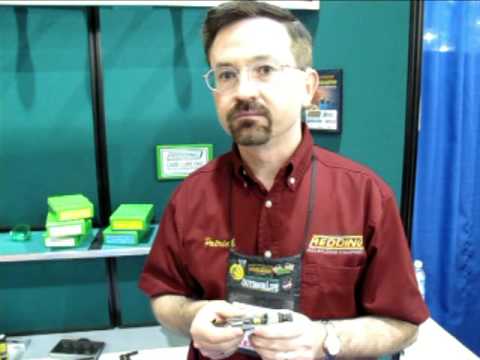
One of the most commonly-asked questions on our Shooters Forum is “what diameter bushing should I use with my neck-sizing die?” While we recommend that users obtain at least two bushings, you still have to know where to start. For hunting ammo and gas guns, we still recommend choosing a bushing that is 2 or 3 thousandths smaller than the neck diameter of a loaded round. However, in a bolt-action benchrest gun, you may well get superior accuracy with less neck tension. Larry Isenhour recently set a spectacular 50-5X 600-yard IBS record using very light tension — Larry employed a .268″ bushing for a .2695″ loaded round. At the NRA Annual meeting we discussed neck bushings during our visit to the Redding Reloading booth. It turns out that Redding has changed its recommendations for benchrest neck sizing, and now recommends that you chose a bushing that yields less tension. In the video below Patrick Ryan of Redding explains how to measure your cartridge brass and select the proper bushing diameter. Patrick also reviews some new Redding products for 2009.
May 16th, 2009
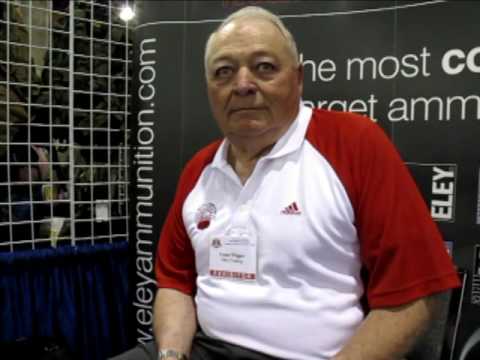
 Lones (pronounced “lon-ess”) Wigger is the first and only American shooter to be inducted into the U.S. Olympic Hall of Fame. At the NRA annual meeting in Phoenix, Arizona, we were privileged to chat with Wigger at the Eley booth where he is answering questions and providing information about Eley products. Lones (pronounced “lon-ess”) Wigger is the first and only American shooter to be inducted into the U.S. Olympic Hall of Fame. At the NRA annual meeting in Phoenix, Arizona, we were privileged to chat with Wigger at the Eley booth where he is answering questions and providing information about Eley products.
We discussed many topics, ranging from Cold War politics (he was not allowed to shoot in the 1980 Moscow Olympics due to the U.S.A. boycott), to barrel tuners. Wigger is a true legend among American shooters, having participated as shooter or coach with five USA Olympic teams. He also set many world records during his long shooting career. In the video below, Wigger talks about his Hall of Fame Olympic accomplishments, and offers advice to young persons getting started in competitive shooting.
May 16th, 2009
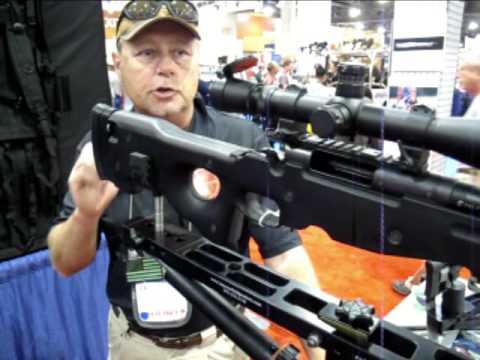
We had a chance to check out the SPEC-REST from Lone Star Field Products at the NRA Meeting in Phoenix. This is one solid, well-built piece of kit, we can assure you. The SPEC-REST is finely engineered, and very smooth in operation (both elevating and traversing). To be honest, the spec-rest makes some other stamped metal portable shooting platforms look like kids’ toys. The main beam is solid metal and all the adjustment controls are well-placed and sturdy. A SPEC-REST is not going to bend or break under hard use. This rig was designed from the ground up to work with even the heaviest-recoiling calibers, such as 338 Lapua Magnum and 50 BMG. The unique design of the SPEC-REST even helps it dissipate recoil when shooting the “big boomers”.

Our Assistant Editor, Jason Baney, currently has a SPEC-REST plus low-profile Lone Star Quad base for testing and evaluation. The photo above shows the SPEC-REST on the Quad base which can be adjusted low enough to allow use on a bench. To view Lone-Star’s SPEC-REST in action, watch the video below. Lone Star President Robert Black puts a tripod-mounted SPEC-REST through its paces. I think you’ll be impressed… this Editor was.
May 16th, 2009
Meopta is not a well-known name in the North American market, but we predict that may change in the near future. Meopta, a leading optics maker in the Czech Republic, makes optical components for many of the most respected “big name” companies in the business. With Meopta’s introduction of its 75mm APO (apochromatic) spotting scope, Meopta has served notice that it can build a scope that rivals far more expensive optics. We tried one out at the NRA meeting in Phoenix, and we’re very impressed from what we could see. The image is very sharp. Eye relief with a 20-60 zoom eyepiece is good. We liked the large full-diameter focus ring in the center of the scope body. Swarovski uses a similar central focus ring on its ATS line of scopes, and we’ve always found this to be a user-friendly design.


The Meopta 75mm APO spotting scope retails for up to $1449.00 at various online optics and camera houses. However, at the NRA Convention, Alex Roy of EuroOptic.com offered a spectacular offer to AccurateShooter.com readers. For a limited time, while supplies last, EuroOptic.com will sell the Meopta 75mm APO complete with 20-60X zoom eyepiece for just $1175.00, including a free compact tripod. That’s a true bargain. This is a very nice spotting scope that compares well to other European and Japanese spotting scopes costing much, much more. From what we can tell, the Meopta is also the most economical option for folks seeking a 72mm+ objective and APO glass. Watch the video below for more details of this special offer. NOTE: The offer is limited to stock in hand. (Don’t complain to us if you procrastinate and miss out on this bargain.)

|


