Nosler is running a great special right now on over-stock 6mm varmint bullets. Nosler is selling 55gr flat-base spitzer bullets at just $103.80 for ONE THOUSAND bullets. That’s right, you read that correctly — you can buy 1000 bullets for just $103.80. And get this, shipping on all Nosler orders over $150.00 is FREE in the contiguous USA.
55-grainers Were Produced for Australian Shooters
These bullets were specifically made for the Austrailian kangaroo market. They are a flat-base, soft-point, spitzer bullet. According to Nosler, these 55-grainers do “very well for target shooting and varmint hunts”. Why are the bullets so cheap? There was a factory overrun in production, so that’s why Nosler has excess inventory. If you need lightweight 6mm varmint bullets, get your orders in right away. We expect this deal to sell out quickly. (And by that, we mean they could well be gone within 24 hours. You snooze, you lose.)
When Olympian Matt Emmons wasn’t on the firing line at the 2010 International Shooting Sport Federation (ISSF) World Cup Final in October, the shooting community took note. Emmons was in New York battling thyroid cancer and recovering from a surgery that removed his entire thyroid. After his surgery, Emmons competed in the 2010 USA Shooting Winter Airgun Championship and reached the podium each day in Men’s 10m Air Rifle.
In February, Emmons won the 2011 Rocky Mountain Rifle Overall Championships. With that gutsy performance, Emmons served notice that he is back, and he’s the man to beat. Emmons set a new USA Shooting National Record with 1188 points in Men’s 50m Rifle 3P qualifier. Moreover, Emmons finished the three-position match with a 19.6 point margin over the silver medalist. His final score was 1188 points in day one, 1179 points in day two and 101.6 points in the final for a total of 2468.6 points. He also topped the competition in Men’s 50m Rifle Prone with 1303.6 total points. Emmons also took gold in the Men’s 10m Air Rifle event with 1295.3 total points.
Emmons was named the match’s Overall Champion after winning all three events in the Rocky Mountain Rifle Championships and finishing an impressive 27 points ahead of the next competitor. National Rifle Coach Major Dave Johnson said, “Emmons continues to build towards the spring World Cups; he’s had an incredible tournament and has worked very hard in recovery.” Performances such as Emmons’ deserve to be recognized, which is why Matt Emmons is the ELEY/USA Shooting Athlete of the Month. We congratulate Emmons and wish him continued success as he prepares for his first ISSF World Cup of the season in Sydney, Australia, March 21 to 30.
In our Shooters’ Forum one member asked for an explanation of the free recoil shooting method. This style, or some variant thereof, is used by many successful short-range (100/200 yard) benchrest shooters. However, we must point out that there is a difference between “pure free recoil” and what you may actually see on the firing line of a registered benchest match. Different shooters may employ a slightly different style — perhaps shouldering the gun a bit, or maybe laying a thumb lightly behind the tang. Technically speaking, that’s no longer free recoil. Remember, there is no “best” technique for every caliber and every gun. And to shoot with a “pure” free recoil method, i.e. touching only the trigger, and not contacting the stock in any way, requires a well-balanced rifle and a highly optimized set-up of front rest and rear bag.
Tony Boyer Video
In the video below you’ll see Hall of Fame shooter Tony Boyer shooting his gun at the Shamrock tournament in 2009. Tony only touches the trigger, but he does index his right hand on the side of the stock. Note: there are some audio problems with this video when you view it at 360p resolution and the playback speed seems slowed down slightly. If the audio cut-outs bother you, try viewing at 720p (HD), or just turn down the volume and focus on Tony’s technique. The slight “slow-motion” effect actually makes it easier to see what Tony is doing. The video does seem to run best at 720p, if you have a high-speed connection.
Introduction to Benchrest Video In this second video, Birgir Runar Saemundsson of Iceland demonstrates free recoil technique near the start of the video. If you watch carefully you’ll see that only Birgir’s index finger touches the trigger. The rifle’s butt is not contacting Birgir’s shoulder when he pulls the trigger. This 11-minute video is part of an introduction to benchrest shooting that Saemundsson offers through his BRS Custom Rifles website. Birgir is a skilled shooter who set a 10-shot 200-yard IBS world record at the Kelbly Range in 1988. At right is Birgir’s 10-shot record target.
Lapua recently announced that it is replacing three of its .224-caliber bullet types with new and improved versions. For service rifle shooters, the new GB541 looks like a good choice for short-course events.
55gr Softpoints Replaced with Non-Cannelure E539 Bullet
Two older soft point bullet designs, the 55gr E372 and the 55gr E369, are being replaced by Lapua’s new E539 55gr bullet. The E539 is a multi-purpose NON-cannelure soft point design with a 0.202 G1 BC.
New Higher-BC GB541 Bullet Replaces 69gr GB401
The .224 GB501 69gr Scenar has been replaced by a ballistically superior GB541 69gr Scenar bullet designed especially for long range target shooting. The new GB541 bullet has a 0.341 G1 Ballistic Coefficient and a 0.171 G7. Both numbers were established in field testing using Doppler Radar.
German Salazar has posted an informative article about concentricity-checking tools on his Rifleman’s Journal Blog. In that article, German provides a detailed review of the impressive new Bruno Concentricity Checker which features a high-grade dial indicator and an innovative system for holding both loaded cartridges and empty brass in place during the measurement process. German gives the Bruno tool high marks and it is now his favored concentricity gauge, replacing on older Sinclair tool (also reviewed in the article).
German writes: “When measuring a seated bullet, the Bruno [tool] is simple and intuitive in use: adjust the length of the tip holder, set up the indicator to bear on the ogive and get to it. I usually slip a Sinclair hex nut comparator over a bullet to make a faint mark right at the ogive to help me in determining where to set the indicator. I then set the indicator tip about 0.010″ behind the mark so that I am definitely on the bearing surface even if some of the bullets have a bit of variance. It’s a handy way to get set up consistently from one session to another.”
German continues: “Reading an empty case requires a little more effort, but not much…. Once the case mouth is smooth, the readings are in line with those of the Sinclair tool, although easier to read to a fine level of precision due to the finer gradations on the indicator and its horizontal mounting. The Bruno tool has become my principal tool for checking the concentricity resulting from different die setups and for comparing the results of one loading process to another. I simply have more confidence in my ability to get an accurate reading from it. After many years of service, I’ve decided to retire the old Sinclair and make the Bruno tool my primary concentricity tool. It is simply a better made, easier-to-use, more accurate tool and those are the qualities I value in any tool.”
The NRA Intercollegiate Pistol Championships will be hosted March 15-19 by the USAMU in Ft. Benning, Georgia. The event will determine the National Collegiate Individual and Team Champions for 2011 in the categories of Free Pistol, Standard Pistol, Open Air Pistol, Women’s Air Pistol and Women’s Sport Pistol. ROTC teams participating are invited only for Standard Pistol disciplines. To receive invitations to the Championships, shooters had to achieve qualifying scores in the annual NRA Intercollegiate Pistol Sectionals held throughout the U.S. in January and February. Visit the NRA Intercollegiate Pistol Championships website to learn more about the 2011 Championships.
Steel Challenge Demonstration at Ft. Benning
Prior to the Championships, on March 11-12, the Steel Challenge Shooting Association (SCSA) will conduct a free Scholastic Steel Challenge demonstration at Ft. Benning. This is the second demonstration event that the USAMU has hosted for the youth shooting program. The demonstration will feature two Steel Challenge stages: Smoke & Hope and Roundabout. The free shooting demonstration will take place from 9:00 am to 4:00 pm on Friday and Saturday, March 11 and 12 on the Parks Range at Ft. Benning. Handguns and ammunition will be provided.
Winchester recently issued an important product safety notice, recalling certain lots of Winchester 64gr Power-Point .223 Rem ammo. According to The Firearm Blog, “catastrophic failures destroyed a number of law enforcement AR15 type rifles.” That Blog cited LEO agency notices describing guns that suffered cracked uppers and bowed lowers after firing Winchester’s 64gr Power-Point .223 Rem ammo. Rifles built by three different manufacturers (Colt, Bushmaster, and Stag Arms), all sustained similar damage. Below is Winchester’s Recall Notice dated 3/1/2011:
PRODUCT WARNING AND RECALL NOTICE
WINCHESTER® RANGER® LAW ENFORCEMENT 223 Remington 64 Grain Power-Point®
Olin Corporation, through its Winchester Division, is recalling six (6) lots of its RANGER® 223 Remington 64 Grain Power-Point® (PP) centerfire rifle ammunition (Symbol Number RA223R2).
Lot Numbers (last four characters): DK01, DK11, DK21, DK31, DK41, and DK51
Through extensive evaluation Winchester has determined the above lots of RANGER® Law Enforcement ammunition may contain incorrect propellant. Incorrect propellant in this ammunition may cause firearm damage, rendering the firearm inoperable, and subject the shooter or bystanders to a risk of serious personal injury when fired.
DO NOT USE WINCHESTER® RANGER® 223 REMINGTON 64 GRAIN POWER-POINT® AMMUNITION THAT HAS A LOT NUMBER ENDING IN DK01, DK11, DK21, DK31, DK41 or DK51. The ammunition Lot Number is ink stamped inside the right tuck flap of the 20-round carton, as indicated here:
To determine if your ammunition is subject to this notice, review the Lot Number. If the last four characters of the Lot Number are DK01, DK11, DK21, DK31, DK41 or DK51 immediately discontinue use and contact Winchester toll-free at 866-423-5224 to arrange for replacement ammunition and free UPS pick-up of the recalled ammunition.
This notice applies only to RANGER® 223 Remington 64 Grain Power-Point® centerfire rifle ammunition with lot numbers ending in DK01, DK11, DK21, DK31, DK41, and DK51. Other Symbol Numbers or Lot Numbers are not subject to this recall.
If you have any questions concerning this RANGER® Law Enforcement ammunition recall please call toll-free 866-423-5224, write to Winchester (600 Powder Mill Road, East Alton, IL 62024 Attn: RA223R2 Recall), or visit our website at www.winchester.com.
If you’re looking for a versatile carry revolver, consider the new Smith & Wesson Governor, introduced at the 2011 SHOT Show. The six-shot Governor will chamber three types of ammo: .45 ACP, .45 Long Colt, and .410ga 2.5″ shotshells.
The ability to chamber shotshells makes this piece more useful as a “trail gun” that can put down snakes and other threats that are difficult to hit quickly with a pistol round. If you choose, you can load a mix of shotshells and regular cartridges. The 29.6 oz. Governor has a Scandium frame with blackened stainless cylinder. The basic model ($679.00 MSRP) comes standard with a Tritium dot front sight. There is also a more expensive ($899.00 MSRP) version with a Crimson Trace grip with built-in laser. A button in the grip activates the laser.
This Editor personally likes the shape and feel of the laser grip better than the standard grip. The laser grip (shown in the slideshow below) lets you position your hand up higher on the frame for better control, and it has a smoother profile. The laser obviously offers an advantage in low-light situations. We think, if you can afford the laser version, that’s the smart choice.
Ransom recently introduced the Ransom Rifle Master ‘SL Mega Rest’, a large, modular rest system for FSCA, NBRSA, and IBS shooters and other shooting disciplines that allow a rest system. We persuaded accomplished NBRSA point blank and long range shooter John Crawford to check out this system and share his experiences. This article is Part One of a two-part series.
Ransom’s SL Mega Rest: Part One (First Impressions) by John Crawford
Upon receiving the Ransom SL Mega Rest, the first thing I noticed was how well the rest was packaged. There were two boxes, a large box holding the two base plates and a small box holding all of the small parts for the rest. The large box is double-walled, cardboard construction. It held up well to the rigors of shipping, keeping the two rest halves, each in their own inner box, in perfect shape.
Unpacking the Ransom SL Mega Rest one could not help but notice the weight of each half and their very attractive, black, Rhino coating. [Rhino coating is a heavy, extremely durable and tough, textured polyurethane coating commonly sprayed in the bed area of pickup trucks to protect the bed from damage.] Unpacking the small parts, which were all packaged separately for protection, gave me a good chance to note their excellent fit and finish. The small parts are made of steel and have a black oxide finish, including the ½:20-threaded legs which have nicely knurled knobs and lock rings. The black oxide finish compliments the bases.
Front Section
The front base and post, used exclusively for elevation adjustment, are well built and have some very nice features. The post, which is 1.25″ in diameter, has a keyway and key in the front to keep it from turning, and the lockdown bolt has a carbide ball in the end to lock the post in place. The mariner’s wheel has a cogged rubber belt on the outside (fits into a groove) and makes adjusting height easy and comfortable without hand slippage. The post assembly can be located, front-to-rear, in one inch increments, to provide a center-of-front-rest-base-to-center-of-rear-rest-base distance of from 24″ to 32″, thus accommodating an 8″ difference in stock length.
The Ransom SL Mega Rest’s elevation rest top is a modular system. The base for the rest top broke tradition and has two bolts, side by side, to hold it to the post, a welcome change from having a single bolt to hold the top on. With two bolts you reduce the stress when putting a heavy rifle on the rest. The front post is mounted to a plate that bolts down to the rest base. The rest base has a series of tapped holes that allows one to adjust the front rest location, front-to-rear, to fit different stock lengths.
Rear Section
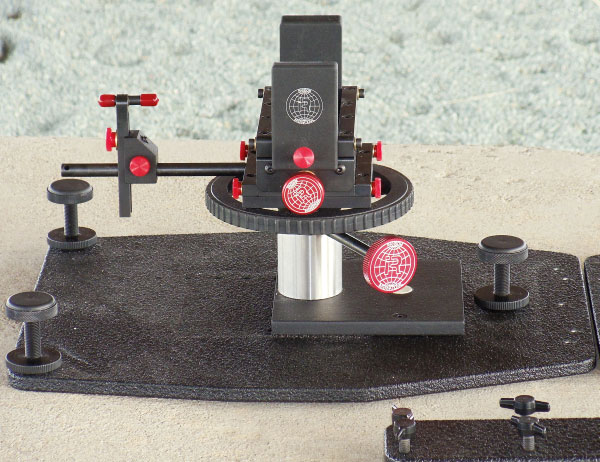
The rear rest, used exclusively for windage adjustment, has the rest top holder bolted in place. As a modular system, you can put the elevation rest top bag holder or windage top bag holder in either the front or rear rest as needed. You could also have a few different elevation rest tops or windage tops for different rifles. Both front and rear rests have a bubble level.
The Ransom SL Mega Rest’s windage top and bag holder are also modular. You can put the windage top and bag holder, or just the bag holder, in either the front or rear rest by removing four thumb screws and changing the tops. You can buy different width rest tops and swap them out in a few minutes, a nice feature for different stock length and width configurations. The windage top has a dovetail fit with a center bolt to hold the top in place and has no perceivable side play or movement, nice and tight and the windage adjusts easily.
The forearm stop is well thought out and fully adjustable for height and length to accommodate different front bag heights and stock lengths/positions. It can be adjusted forward about 4″ and, in height, from 1-1/2″ to 3-1/2″. It easily adjusts with two thumb screws.
83 pounds of Steel Solidity
The bridge plate between the front and rear rests is also black Rhino-coated, matching the bases. There are four dowel pins in the bridge plate for alignment and six 5/16-18 bolts that securely hold the bridge plate in place. The rest can be shot with the bridge plate in place, as a one-piece rest system, or the bridge plate can be removed, making it a two-piece rest system.
The rear rest with windage top weighs 38 pounds and the front rest weighs 45 pounds, for a total weight of 83 pounds. This is without sand bags or sand. Overall the all-steel-construction, Ransom SL Mega Rest is well thought out, nicely finished, and made to the standards and quality you would expect from the Ransom Company. The MSRP for the whole unit (everything except sand bags) is $1,330.00. This includes front heavy bag plate, and rear windage-adjustable bag plate. Additional plates (for different sized bags) start at about $90.00. Next step is to fill my sand bags and do some field testing. We’ll cover that in Part Two of this review, later this spring.
Black Hills Ammunition has released a video showing the production process at Black Hills’ ammo plant in Rapid City, South Dakota. As you’d expect there is footage showing the assembly-line, with massive machines churning out loaded cases (look for the bullet seating machine). But this video has a second, softer side — it also focuses on the human factor at the Black Hills facility.
Black Hills President Jeff Hoffman narrates the video, which profiles some of the key production staff at Black Hills. There’s AJ the ‘gearhead’, who supervises the production process, making sure all the machinery is running optimally. When AJ’s not at the plant, he’s tinkering with his hot rods. Then there’s JB, the loading machine operator, who arrives each day at the crack of dawn and can’t wait to get to his machine. And there’s Laverne, who, for 22 years, has been Black Hills’ ace ammo inspector. The video provides an insight into the human side of the production process. We think you’ll enjoy watching.


 When Olympian Matt Emmons wasn’t on the firing line at the 2010 International Shooting Sport Federation (ISSF) World Cup Final in October, the shooting community took note. Emmons was in New York battling thyroid cancer and recovering from a surgery that removed his entire thyroid. After his surgery, Emmons competed in the 2010 USA Shooting Winter Airgun Championship and reached the podium each day in Men’s 10m Air Rifle.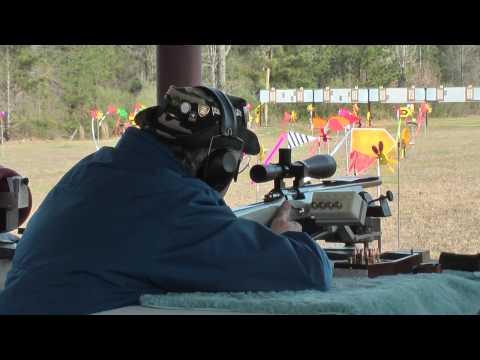
 In this second video,
  Lapua recently announced that it is replacing three of its .224-caliber bullet types with new and improved versions. For service rifle shooters, the new GB541 looks like a good choice for short-course events.
 The
The  Steel Challenge Demonstration at Ft. Benning
 Winchester recently issued an important product safety notice, recalling certain lots of Winchester 64gr Power-Point .223 Rem ammo. According to
  DO NOT USE WINCHESTER® RANGER® 223 REMINGTON 64 GRAIN POWER-POINT® AMMUNITION THAT HAS A LOT NUMBER ENDING IN DK01, DK11, DK21, DK31, DK41 or DK51. The ammunition Lot Number is ink stamped inside the right tuck flap of the 20-round carton, as indicated here:
 The ability to chamber shotshells makes this piece more useful as a “trail gun” that can put down snakes and other threats that are difficult to hit quickly with a pistol round. If you choose, you can load a mix of shotshells and regular cartridges. The 29.6 oz. Governor has a Scandium frame with blackened stainless cylinder. The basic model ($679.00 MSRP) comes standard with a Tritium dot front sight. There is also a more expensive ($899.00 MSRP) version with a Crimson Trace grip with built-in laser. A button in the grip activates the laser.
 Rear Section