Eurooptic vortex burris nightforce sale


teslong borescope digital camera barrel monitor


As an Amazon Associate, this site earns a commission from Amazon sales.


November 5th, 2022

.22 Creedmoor INFO and LOAD DATA from Peterson Cartridge

Peterson Cartridge Company 22 .22 Creedmoor wildcat cartridge load data recipe powder

Peterson Cartridge Company (“Peterson”) has released a lengthy, authoritative guide to the 22 Creedmoor cartridge, a popular wildcat based on the 6.5 Creedmoor or 6mm Creedmoor necked down to .224 caliber. We think the .22 Creedmoor would be a great long-range varmint cartridge, similar to the .22-250 Rem, but with a more modern, efficient cartridge design. In addition, some PRS/NRL competitors may turn to the .22 Creedmoor because it has less recoil and is flatter-shooting than the 6mm Creedmoor. In addition, .224-caliber match bullets are typically less expensive than heavier 6mm and 6.5mm projectiles. Less recoil, and less cost — what’s not to like?*

DOWNLOAD Peterson .22 Creedmoor Load Data Article PDF »

Along with load data, this article has specific sections dedicated to: Primers, Rifling Twist Rates, and Reloading Supplies. If you are considering building a .22 Creedmoor, we recommend you download the full Peterson .22 Creedmoor article, which is available in PDF format.

Peterson Cartridge Company 22 .22 Creedmoor wildcat cartridge load data recipe powder

Peterson states, “Since its inception in 2007… the 6.5 Creedmoor has seen some pretty meteoric growth in popularity. That growth continues as of this writing, as the cartridge has now gone mainstream with hunters and shooters alike. As the popularity of the 6.5 Creedmoor has increased, so has the number of wildcat cartridges based off of it. Some of those popular wildcat cartridges are the 6mm Creedmoor, the .25 Creedmoor, and now the .22 Creedmoor. This data sheet will cover the .22 Creedmoor.

To help our customers, and anyone else who shoots .22 Creedmoor, we decided to create this Data Sheet and distribute it. [In this LOAD DATA Document] you will find four (4) common bullets, and four (4) common rifle powders used when handloading the .22 Creedmoor cartridge. We then took the different bullet and powder combinations and loaded them up to the SAAMI Maximum Average Pressure (MAP) for the 6.5 Creedmoor and 6mm Creedmoor cartridges, which is 62,000 PSI. [O]ur goal was to provide a wide spectrum of bullet weights and the powders used with them.

All of the following data was gathered by our ballistician in our indoor ballistics lab located in our factory in Pennsylvania. Although we were able to gather pressure and velocity data in our lab, we have NOT tested these loads for accuracy. Again, these loads are just designed to give shooters information regarding what velocity, a given bullet and powder charge combination, will produce the SAAMI Maximum Average Pressure (MAP) of 62,000 psi.”

Sample 22 Creedmoor LOAD DATA

Peterson Cartridge Company 22 .22 Creedmoor wildcat cartridge load data recipe powder

IMPORTANT — Pressures can vary significantly with different Cartridge Overall Lengths (COAL). In addition, ANY change to ANY load components — primers, bullets, brass, powder — can affect pressure. Always load conservatively. In addition, because of variances in bore dimensions, some barrels may show higher pressures than others. Again, always start with conservative loads, well below MAX pressures.


*Actually there IS a potential downside — reduced barrel life. We expect that a .22 Creedmoor running hot varmint loads would experience shorter useful barrel life compared to a 6.5 Creedmoor. This is based on what we’ve observed with .22-250 and .22-250 Ackley barrels compared to our 6.5 CM barrels.

Permalink Bullets, Brass, Ammo, Reloading, Tech Tip No Comments »
November 4th, 2022

Find FFL Locations and Compare Fees with FFL Finder Sites

gunbroker sportsman's guide FFL finder index search engine Federal Firearms license map

Do you need to find an FFL for a firearms transfer in your local area? Or perhaps you are selling a gun and need it shipped to an FFL in another city or state. Thankfully, there are two good online resource that can, in a matter of seconds, provide a list of Federal Firearms License holders in the area you need. These web resources will even locate those FFLs on a map AND list the fees they typically charge for transfers.

Sportsman’s Guide FFL Finder
The first resource is the Sportsman’s Guide FFL LOOKUP Page. This online search tool is fast and easy to use. Simply enter a Zip Code and then select a radius (in miles) within which to find FFLs. Here is an example for Billings, Montana with Zip Code 59103. Note that the transfer fees are listed for the first three “In-Network” FFLs. Click on each FFL business name to get more details.

gunbroker sportsman's guide FFL finder index search engine Federal Firearms license map

gunbroker sportsman's guide FFL finder index search engine Federal Firearms license mapGunbroker FFL Finder
A good second resource is offered by GunBroker, the online gun trading/auction site. Gunbroker offers a handy online FFL Finder. This resource allows you to quickly find an FFL by zip code or state. Along with the FFL business name, this also lists fees. Click the “Map It” button to see a local map.

Gunbroker states: “Use our FFL Finder to locate FFL dealers in your area. You can search for FFL dealers by your zip code or by state. Use our FFL finder to get in touch with a local FFL dealer in order to complete your firearms purchase, or sign up to be part of our FFL Dealer Network.”

Shown below are the FFL Finder results for Billings, Montana and Zip Code 59103:

gunbroker sportsman's guide FFL finder index search engine Federal Firearms license map

Permalink Hot Deals, Tech Tip 1 Comment »
November 2nd, 2022

Vote in the Election — Make Your Voice Heard & Protect 2A Rights

2022 election gunvote second amendment register vote red wave

NOTE: The above image (with time count-down) was captured Wednesday morning 11/2/22. But the clock is ticking. CLICK HERE for the current time remaining. Register now, and be sure to vote in this election.

Get out and vote people. It’s not too late to register to vote in many states — you can do so in person or remotely. It’s absolutely vital that all Americans who believe in the Second Amendment and personal freedom vote in this November election. The Biden administration is pushing for further restrictive gun control measures, and Blue State politicians wish to restrict CCW, limit your gun purchases, and ban many types of guns outright. For example, Ballot Measure 114 in Oregon would create a published, searchable database of gun members and require a special state permit to buy or sell a firearm.

The forces against freedom are relentless, and they will not be satisfied until gun rights are gone. Just look at what is happening in Canada. Prime Minister Trudeau recently imposed a complete ban on sale, transfer, and importation of handguns. Don’t want that to happen here in America? Then get out and VOTE.

The Gunvote.org site has helpful links that provide information on registration and voting in all 50 states. Use that site to find out WHERE and WHEN you can vote in your jurisdiction. Now more than ever it is vital for ALL American gun owners to make their voices heard.


REGISTER and VOTE People — DO IT!

The last day to vote in most states will be Tuesday, November 8, 2022.

Permalink - Articles, News No Comments »
November 2nd, 2022

Brownells Launches DEALS Page with Bargains and Discounts

Brownells deals discounts coupon codes sale price bargain

Good news for shooting gear shoppers. Brownells customers can now find all the deals, promotions, and specially-priced products in one convenient location via the new Brownells Deals site. The Deals site is accessible through www.Brownells.com with the word “Deals” highlighted in red text near the top right of the main page. From a smartphone, click on the menu icon upper left, then select “DEALS”.

Brownells deals discounts coupon codes sale price bargain

On the Deals page, customers can access to Featured Deals on Brownells house products, AR-15 parts, and items from Magpul, Aero Precision, and other popular manufacturers. There are also clickable images for deals on product categories such as ammunition and reloading components. Below the categories you can click specific products on sale. To see all the deals available at Brownells, visit Brownells.com/deals.

SAVE More Money with Brownells DISCOUNT CODES

IMPORTANT: To save the most on a wide variety of Brownells products, you’ll want to use a current Brownells DISCOUNT CODE. Check our Daily Bulletin regularly for current codes. Here are some of the CODES for today, 11/2/2022. Use these codes during check-out to save up to 13% on your purchases.

CODE: NOV20 — $20 Off Orders $150
Expiration date: November 20, 2022

CODE: NOV40 — $40 Off Orders $300
Expiration date: November 20, 2022

CODE: NOV65 — $65 Off Orders $500
Expiration date: November 20, 2022

CODE: NOV95 — $95 Off Orders $750
Expiration date: November 20, 2022

CODE: NOV150 — $150 Off Orders $1000
Expiration date: November 20, 2022

CODE: NOV225 — $225 Off Orders $1500
Expiration date: November 20, 2022

CODE: HOME10 — $10 Off $100
Expiration date unknown

CODE: TA10 — 10% OFF over $150
Expiration date unknown

CODE: WLS10 — 10% OFF over $150
Expiration date unknown

CODE: BACK15 — $15 off $150
Expiration date unknown

CODE: 20OFF200 — $20 off $200
Expiration date unknown

CODE: Q63 — Free S/H over $99
Expiration date unknown

Codes are subject to change at any time. Find current Brownells discount codes at Gun.deals/coupons.
Permalink Hot Deals, Reloading No Comments »
November 1st, 2022

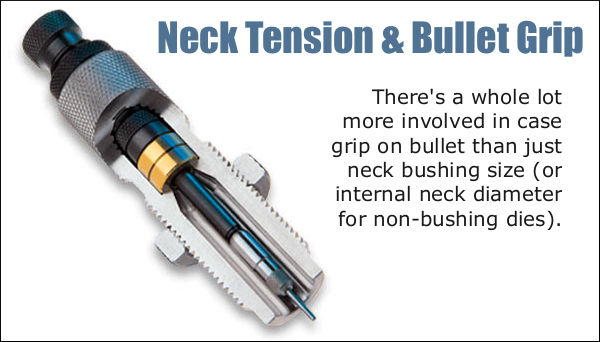
Grip on Bullet — Many Factors Involved, Not Just Bushing Size

case neck bushing reloading die tension bullet release

Many novice hand-loaders believe that neck bushing Inside Diameter (ID) size is the only important factor in neck tension. In fact, many different things will influence the grip on your bullet and its ability to release from the case neck. To learn more about neck tension and “case grip”, take the time to read this article carefully. We bet you’ll gain knowledge that will let you load more accurate ammo, with better ES/SD.

Editor: Guys, this is a VERY important article. You really should read it over carefully, twice. Variations in the force required to release a bullet can significantly affect accuracy and ES/SD. You really need to know how the grip on bullet can be altered by many different factors.

Neck Tension (i.e. Grip on Bullets) Is a Complex Phenomenon
While we certainly have considerable control over neck tension by using tighter or looser bushings (with smaller or bigger Inside Diameters), bushing size is only one factor at work. It’s important to understand the multiple factors that can increase or decrease the resistance to bullet release. Think in terms of overall brass-on-bullet “grip” instead of just bushing size (or the internal neck diameter in non-bushing full-length sizing dies).

Bullet grip is affected by many things, such as:

1. Neck-wall thickness.
2. Amount of bullet bearing surface (shank) in the neck.
3. Surface condition inside of neck (residual carbon can act as a lubricant; ultrasonic cleaning makes necks “grabby”).
4. Length of neck (e.g. 6mmBR neck vs. 6mm Dasher).
5. Whether or not the bullets have an anti-friction coating.
6.The springiness of the brass (which is related to degree of work-hardening; number of firings etc.)
7. The bullet jacket material.
8. The outside diameter of the bullet and whether it has a pressure ridge.
9. Time duration between bullet seating and firing (necks can stiffen with time).
10. How often the brass is annealed.
11. Amount (length) of neck sized (e.g. you can size only half the neck).
12. Interior diameter of bushing, or neck section of non-bushing die.


– and there are others…

One needs to understand that bushing size isn’t the beginning and end of neck tension questions, because, even if bushing size is held constant, the amount of bullet “grip” can change dramatically as the condition of your brass changes. Bullet “grip” can also change if you alter your seating depth, and it can even change if you ultrasonically clean your cases.

5-time U.S. National Long-Range Champion John Whidden adds: “Our tests show us that the condition of the necks in regards to lubed or not, carbon inside or not, squeaky clean or not, etc., matter even more than the size of the bushing used. An ultrasonically cleaned or brand new dry case neck make for some quite high seating force.”

Redding neck bushingsIn our Shooters’ Forum a reader recently asked: “How much neck tension should I use?” This prompted a Forum discussion in which other Forum members recommended a specific number based on their experience, such as .001″, .002″, or .003″. These numbers, as commonly used, correspond to the difference between case-neck OD after sizing and the neck OD of a loaded round, with bullet in place. In other words, the numbers refer to the nominal amount of interference fit (after sizing).

While these commonly-used “tension numbers” (of .001″, .002″ etc.) can be useful as starting points, neck tension is actually a fairly complex subject. The actual amount of “grip” on the bullet is a function of many factors, of which neck-OD reduction during sizing is just one. Understanding these many factors will help you maintain consistent neck tension as your brass “evolves” over the course of multiple reloadings.

Seating Depth Changes Can Increase or Decrease Grip on Bullet
You can do this simple experiment. Seat a boat-tail bullet in your sized neck with .150″ of bearing surface (shank) in the neck. Now remove the bullet with an impact hammer. Next, take another identical bullet and seat it with .300″ of bearing surface in another sized case (same bushing size/same nominal tension). You’ll find the deeper-seated bullet is gripped much harder.

PPC lapua brassNeck-Wall Thickness is Important Too
I have also found that thinner necks, particularly the very thin necks used by many PPC shooters, require more sizing to give equivalent “grip”. Again, do your own experiment. Seat a bullet in a case turned to .008″ neckwall thickness and sized down .003″. Now compare that to a case with .014″ neckwall thickness and sized down .0015″. You may find that the bullet in the thin necks actually pulls out easier, though it supposedly has more “neck tension”, if one were to consider bushing size alone.

In practical terms, because thick necks are less elastic than very thin necks, when you turn necks you may need to run tighter bushings to maintain the same amount of actual grip on the bullets (as compared to no-turn brass). Consequently, I suspect the guys using .0015″ “tension” on no-turn brass may be a lot closer to the guys using .003″ “tension” on turned necks than either group may realize.

Toward a Better Definition of Neck Tension
As a convenient short-cut, we tend to describe neck tension by bushing size alone. When a guy says, “I run .002 neck tension”, that normally means he is using a die/bushing that sizes the necks .002″ smaller than a loaded round. Well we know something about his post-sizing neck OD, but do we really have a reliable idea about how much force is required to release his bullets? Maybe not… This use of the term “neck tension” when we are really only describing the amount of neck diameter reduction with a die/bushing is really kind of incomplete.

My point here is that it is overly simplistic to ask, “should I load with .001 tension or .003?” In reality, an .001″ reduction (after springback) on a thick neck might provide MORE “grip” on a deep-seated bullet than an .003″ reduction on a very thin-walled neck holding a bullet with minimal bearing surface in the neck. Bushing ID is something we can easily measure and verify. We use bushing size as a descriptor of neck tension because it is convenient and because the other important factors are hard to quantify. But those factors shouldn’t be ignored if you want to maintain consistent neck tension for optimal accuracy.

Consistency and accuracy — that’s really what this all about isn’t it? We want to find the best neck tension for accuracy, and then maintain that amount of grip-on-bullet over time. To do that you need to look not only at your bushing size, but also at how your brass has changed (work-hardened) with time, and whether other variables (such as the amount of carbon in the neck) have changed. Ultimately, optimal neck tension must be ascertained experimentally. You have to go out and test empirically to see what works, in YOUR rifle, with YOUR bullets and YOUR brass. And you may have to change the nominal tension setting (i.e. bushing size) as your brass work-hardens or IF YOU CHANGE SEATING DEPTHS.

Remember that bushing size alone does not tell us all we need to know about the neck’s true “holding power” on a bullet, or the energy required for bullet release. True bullet grip is a more complicated phenomenon, one that is affected by numerous factors, some of which are very hard to quantify.

Permalink - Articles, Bullets, Brass, Ammo, Reloading, Tech Tip 2 Comments »