As we wrap up the winter season there remains plenty of rain and snow in many areas of the country. With rain and snow comes increased moisture in the air, i.e. increased humidity. And that, in turn, can affect how your powders perform by altering their burn rates.
Most shooters realize that significant changes in temperature will alter how powders perform. That’s why you want to keep your loaded ammo out of the hot sun, and keep rounds out of a hot chamber until you’re ready to fire. But there are other factors to be considered — HUMIDITY for one. This article explains why and how humidity can affect powder burn rates and performance.
We’ve all heard the old adage: “Keep your powder dry”. Well, tests by Norma have demonstrated that even normal environmental differences in humidity can affect the way powders burn, at least over the long term. In the Norma Reloading Manual, Sven-Eric Johansson, head of ballistics at Nexplo/Bofors, presents a very important discussion of water vapor absorption by powder. Johansson demonstrates that the same powder will burn at different rates depending on water content.
Powders Leave the Factory with 0.5 to 1.0% Water Content
Johansson explains that, as manufactured, most powders contain 0.5 to 1% of water by weight. (The relative humidity is “equilibrated” at 40-50% during the manufacturing process to maintain this 0.5-1% moisture content). Importantly, Johansson notes that powder exposed to moist air for a long time will absorb water, causing it to burn at a slower rate. On the other hand, long-term storage in a very dry environment reduces powder moisture content, so the powder burns at a faster rate. In addition, Johansson found that single-base powders are MORE sensitive to relative humidity than are double-base powders (which contain nitroglycerine).
Tests Show Burn Rates Vary with Water Content
In his review of the Norma Manual, Fred Barker notes: “Johansson gives twelve (eye-opening) plots of the velocities and pressures obtained on firing several popular cartridges with dehydrated, normal and hydrated Norma powders (from #200 to MRP). He also gives results on loaded .30-06 and .38 Special cartridges stored for 663 to 683 days in relative humidities of 20% and 86%. So Johansson’s advice is to keep powders tightly capped in their factory containers, and to minimize their exposure to dry or humid air.”
Confirming Johansson’s findings that storage conditions can alter burn rates, Barker observes: “I have about 10 pounds of WWII 4831 powder that has been stored in dry (about 20% RH) Colorado air for more than 60 years. It now burns about like IMR 3031.”
What does this teach us? First, all powders start out with a small, but chemically important, amount of water content. Second, a powder’s water content can change over time, depending on where and how the powder is stored. Third, the water content of your powder DOES make a difference in how it burns, particularly for single-base powders. For example, over a period of time, a powder used (and then recapped) in the hot, dry Southwest will probably behave differently than the same powder used in the humid Southeast.
Reloaders are advised to keep these things in mind. If you want to maintain your powders’ “as manufactured” burn rate, it is wise to head Johannson’s recommendation to keep your powders tightly capped when you’re not actually dispensing charges and avoid exposing your powder to very dry or very humid conditions. The English-language Norma Reloading Manual (2d. Edition) is available from the Norma Brand Shop and ReloadingSolutions.com.
Real-World Example — “Dry” H4831sc Runs Hotter
Robert Whitley agrees that the burn rate of the powder varies with the humidity it absorbs. Robert writes: “I had an 8-lb. jug of H4831SC I kept in my detached garage (it can be humid there). 43.5-44.0 gr of this was superbly accurate with the 115 Bergers out of my 6mm Super X. I got tired of bringing it in and out of the garage to my house for reloading so I brought and kept the jug in my reloading room (a dehumidified room in my house) and after a few weeks I loaded up 43.5 gr, went to a match and it shot awful. I could not figure out what was going on until I put that load back over the chronograph and figured out it was going a good bit faster than before and the load was out of the “sweet spot” (42.5 – 43.0 gr was the max I could load and keep it accurate when it was stored in less humid air). I put the jug back in the garage for a few weeks and I now am back to loading 43.5 – 44.0 gr and it shoots great again. I have seen this with other powders too.”
If you have two jugs of the same powder, one kept in a room in your house and one somewhere else where it is drier or more humid, don’t expect the two jugs of the same lot of powder to chrono the same with the same charge weights unless and until they are both stored long enough in the same place to equalize again.
Here’s something all shooters need — a smartphone App that calculates bullet-hole group sizes from your own photos. The Ballistic-X App is simple to use. Take a photo of your target, set some values (such as bullet diameter and distance to target), then use the touchscreen to place circles around each hole. The App will calculate group size (in MOA or Mils), distance to point of aim, and provide all the info in an overlay. Then click “save” to record your group for posterity!
This App works well, is relatively easy to set-up, and costs just $7.99. It is available for both Android devices and iOS (Apple) devices. There are other ways to measure group sizes from target images, such as the excellent On-Target program, which we have used for years. However On-Target requires a software installation on a Windows platform desktop or laptop. Ballistic-X is a simple, easy-to-install App with versions for both Android and iOS (Apple) Mobile devices.
The Ballistic-X App has a relatively easy-to-use interface. Of course you can choose either MOA or Milrad group values, and Inch or Metric dimensions. There are various labeling options that provide useful info for Load Development. There is even an ATZ (Adjustment To Zero) feature for adjusting your turrets.
How to Use Ballistic-X App
1. Select Photo Source — Choose Camera to take new photo or get image from Photo Library.
2. Set Reference Values — Select Bullet Diameter and enter Distance to Target.
3. Establish Scale on Image — Mark two points on target photo to set scale. For example, if the target has a 1″-square grid lines, mark two points on grid for 1″ distance.
4. Mark Point Of Aim — Put the central X on the aim point.
5. Designate Shot Locations — Place the green circles around each shot.
6. Finalize Data Display — Position Overlay, select size/color options, and export file.
Android Options — Range Buddy FREE App
Along with Ballistic-X, there is another Mobile App, Range Buddy, that also measures shot groups. Range Buddy is currently offered for Android devices only. It is FREE, but has adverts. Range Buddy isn’t bad, but users complained about the program crashing, and there are compatibility issues with newer phones. We recommend you pay $7.99 and stick with Ballistic-X.
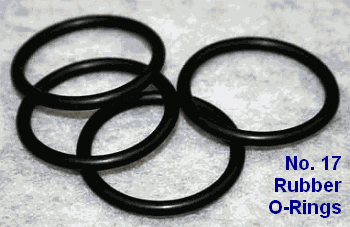
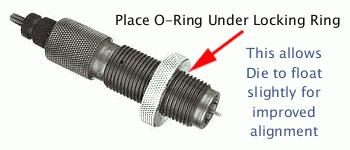
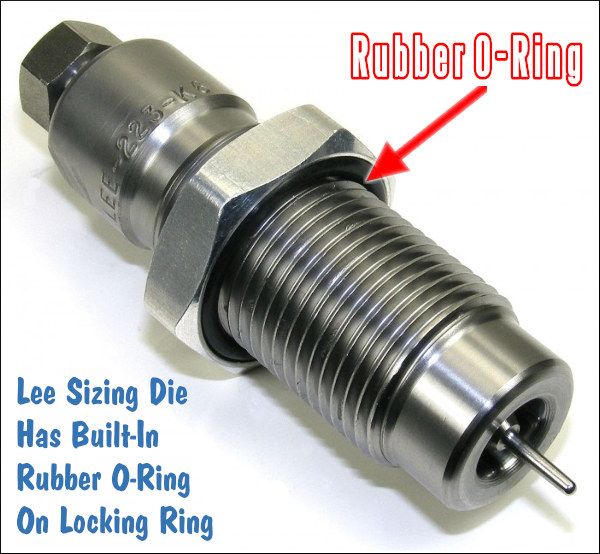
Here’s an inexpensive procedure that can help you load straighter ammo, with slightly better measured concentricity (i.e. less run-out) on the case necks and bullets. Simply use a Rubber O-Ring on the underside of the die locking ring. This allows the die to self-align itself (slightly) to the case that is being sized. Without the O-Ring, if the flat surface on the top of your press is not perfectly square with the thread axis, your die can end up slightly off-angle. This happens when the bottom of the locking ring butts up tight against the top of the press. The O-Ring allows the die to float slightly, and that may, in turn, reduce the amount of run-out induced during case sizing.
Top prone shooter GSArizona, who sadly passed in 2022, tried this trick and said it works: “Go to your local hardware store and get a #17 O-Ring (that’s the designation at Ace Hardware, don’t know if its universal). Slip the O-Ring on the die and re-adjust the lock ring so that the O-Ring is slightly compressed when the die is at the correct height. Size and measure a few more cases. You will probably see a slight improvement in neck concentricity as the die can now float a bit as the case enters and leaves it. This isn’t going to be a dramatic improvement, but it’s a positive one.”
We want to stress that adding O-Rings to sizing dies may help some reloaders, but we don’t offer this as a panacea. Try it — if using the O-Ring reduces measured runout that’s great. If it doesn’t, you’ve only spent a few pennies to experiment.
Lee Precision makes die lock rings with built-in O-Rings. Lee’s distinctive lock ring design allows the same kind of self-alignment, which is good. However, Lee lock rings don’t clamp in place on the die threads, so they can move when you insert or remove the dies — and that can throw off your die setting slightly. By using an O-Ring under a conventional die lock ring (that can be locked in place), you get the advantages of the Lee design, without the risk of the lock ring moving.
A while back, Cal Zant at PrecisionRifleBlog.com did a big muzzle brake comparison test. Along with measuring recoil reduction, Cal’s team recorded sound levels in PRB’s exhaustive muzzle brake field tests. In the PRB archives you’ll find comprehensive muzzle brake sound test results, with hard data on 20 different muzzle brakes.
Sound can be a tricky subject, but Cal Zant, the editor of PrecisionRifleBlog.com, presents everything an informed shooter should know about muzzle brake noise in a straightforward and practical way. Most sound tests are measured from the side of the muzzle, in accordance with mil-spec standards, and Cal did that. But he also measured the sound level of each brake from behind the rifle, closer to the shooter’s position. This provides a more accurate indicator of the actual sound levels gun owners encounter while shooting.
Muzzle brakes ARE really loud — that’s something most active shooters have observed. But this study finally gives us some hard data and makes objective comparisons. The difference between brakes was quite significant. Some brakes were ear-splitting — more than twice as loud as other brakes tested.
As a bonus, Cal also provides data on how the Ultra series suppressors from Thunder Beast Arms Corp (TBAC) compare in terms of sound level behind the rifle.
Will you be traveling (with firearms) to other states this year? Are you concerned about the laws that might apply when you are transporting guns across state lines? Or are you puzzled about the requirements for obtaining a carry permit in your own state? If you have any of these questions, you should definitely get expert guidance on State statutes and regulations controlling firearms. To do that, you can purchase Attorney Scott Kappas’s Traveler’s Guide to the Firearms Laws of the 50 States (2025) for just $16.95 from the publisher or $19.95 on Amazon. You can also get an eBook version for $15.95 (or $23.90 for eBook/Print combo). The latest 2025 edition includes 100+ updates since last year.
This very popular resource has sold over 2,000,000 copies since it was first released in 1996. The 2025 Edition just started shipping on 2/10/2025 — so this book is up to date. The print book is just $16.95 with FREE Shipping, or $20.95 with first-class shipping for quicker delivery.
Free State Law Summaries Online
If you don’t want to spend the money on the book, there is a FREE alternative. There’s a very helpful set of State Law Summaries on the web, presented by PewPewTactical.com. Despite the silly name, the PewPewTactical website has an abundance of information that is particularly beneficial for pistol shooters and CCW holders.
One of the best features of PewPewTactical.com is the Gun Laws by State online reference guide. We looked through four of these State Law Summaries and were impressed by the depth of the coverage. But we caution — if you have specific legal questions, particularly with recently-enacted statutes, you should consult a licensed attorney for your state (or the state to which you will travel). In addition, many of the State Law Summaries have not been updated for 3-5 YEARS! But they are still a good place to start. Below are links to state law articles from PewPewTactical.com. To access any State summary, simply click the State name below:
A good riflescope is essential for many types of competition, and the vast majority of hunters have scoped rifles. Some F-Class and benchrest competitors are now using optics with up to 60X magnification. Over the past 30 years, scopes have continued to evolve with improved glass, more reticle types, vastly increased elevation travel, bigger main tubes, FFP and SFP options, and even built-in electronics.
When shopping for a riflescope, it’s useful to understand how scopes work — how the internal mechanisms control windage and elevation, how parallax controls work, and how magnification levels are controlled.
Basics of How Riflescopes Work
This Burris video (above) covers the key aspects of scope function: zoom magnification, windage control, elevation control, parallax control (front or side mount), and ocular lens focus. There are some tips on getting a new scope running smoothly — it’s wise to rotate the power control a few times as well as both windage and elevation knobs. The video below also explains how to set ocular focus controls optimally.
Scope Break-In Methods and Diagnosing Issues — Great Video
We recommend that all serious shooters watch this video start to finish. A very knowledgeable scope engineer, Leupold’s Mike Baccellieri, explains the fine details of scope operation — with very useful recommendations on how to ready a new scope for use (See 36:50 time-mark). With a new optic he advises to run the controls multiple times to full travel. Also, take your time to get the diopter control just right (See 26:40 time-mark).
The video also explains why, with a new scope or one that hasn’t been used much, it is sometimes effective to rotate the elevation PAST the desired setting then come back a click (See 35:40 time-mark). In addition, near the end of the video, the expert explains how you can use a mirror to determine if the scope mount (base and/or rings) is NOT aligned with the bore axis, forcing excess travel to get on target (See 42:00 time-mark). We have seen this caused by scope rails attached slightly off axis.
Large diameter turrets make windage and elevation markings easier to see, and the click “feel” may be more noticeable given the greater diametrical travel between clicks.
First Focal Plane (FFP) vs. Second Focal Plane (SFP)
The main visual difference between First Focal Plane (FFP) and Second Focal Plane (SFP) scopes is the appearance of the reticle (and its hash marks) at different magnification levels. With a FFP scope, the reticle increases in visible size (and line thickness) with increased magnification. This is so the angular hash marks remain constant (in Mils or MOA angular span) at all magnification levels. So, on a 10-30X FFP scope, a 0.1 Mil hash mark represents the SAME angular measurement at 10X, 20X, or 30X (or any magnification). The downside of the FFP system is that the reticle lines can appear very thick at high magnification. But for a PRS/NRL match, with targets at multiple distances, it is important that the hash marks represent the same angular measurement at all power settings.
On a Second Focal Plane (SFP) scope, by contrast, the reticle lines (and hash marks) appear visually (in thickness) the same at all magnification levels. This means the hash mark divisions will only be precise at one magnification level, as designed by the manufacturer. For example, you could have exact 1 MOA Hash marks at 10X. But zoom the scope to 20X and the same reticle hash mark would then cover 2 MOA. SFP scopes are popular with competition shooters who shoot at specific known distances. Not having thick reticle lines at 25X to 50X is an advantage when aiming at precise benchrest and F-Class targets.
ZEISS now makes excellent FFP Scopes with both MOA and Milrad options
Minute of Angle (MOA) vs. Milliradian (MILRAD or MIL)
This video also explains MOA vs. MRAD (Milliradian) controls. A Minute of Angle (MOA) is an angular measurement that represents 1.047″ at 100 yards. Modern MOA scopes are typically configured with 1/4 MOA or 1/8 MOA clicks. A Milliradian (MRAD) is another angular measurement defined as one-thousandth of a radian. Milrad scopes are commonly configured with 0.1 Milrad clicks. How much is a 0.1 mil at 100 yards? One mil equals 3.6 inches at 100 yards; therefore, 1/10th of that, 0.1 Mil, equals 0.36” – roughly a third of an inch – at 100 yards. That’s pretty close to the common quarter-inch (1/4 MOA) increment found on MOA riflescopes.
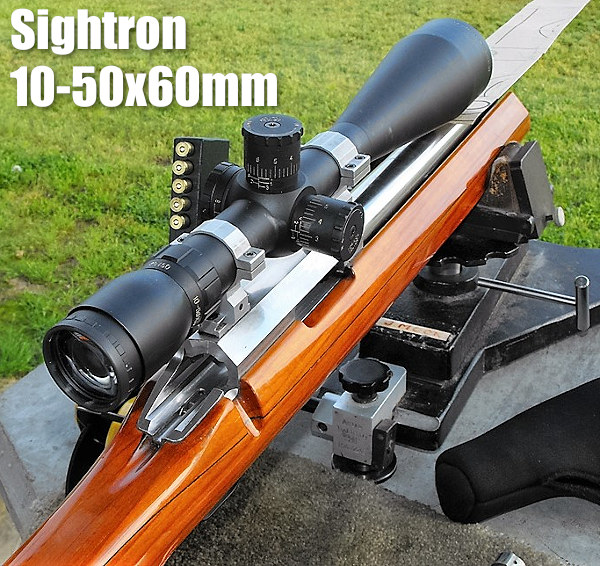
Sightron makes excellent high-magnification SFP zoom scopes favored by many competitors. These have proven quite reliable and offer very good performance for the price.
Scope Mounting Method and Alignment
When mounting a scope, you want to make sure the scope is aligned properly, so that vertical travel is precisely up and down, not offset. Begin by supporting the rifle with a good front and rear rest. Use a portable level to ensure the rifle is not tilting slightly left or right around the barrel bore axis. Then you want to align your scope’s vertical axis. For this, we recommend setting up a plumb bob — a weighted line that hangs straight down. This can be set up indoors or outdoors. Align your reticle’s vertical axis precisely with the plumb bob line, making sure not to move the rifle.
One caution — we have seen some riflescopes that are internally off-axis by up to 4 degrees. In this case, you can align the reticle’s vertical axis with the plumb bob line but then find that your turrets are slightly titled. That is a scope manufacturing fault that will result in some error when you input a large click value (e.g. 10+ MOA up or down).
When mounting your scope, a key factor to consider is the eye relief — the distance of the rear “ocular” lens to your eye. When mounting the scope, put your head in the position at which you normally shoot. NOTE: As your optimal head position may be quite a bit different when shooting prone vs. shooting from a bench, you may want to adjust the scope placement for different shooting positions. This Editor had to move his comp rifle scope about an inch rearward when local club matches changed from prone to bench.
The 2025 Southwest Nationals (SWN) concluded yesterday at the Ben Avery Range outside Phoenix. The individual long-range matches were held for F-Open, F-TR, and Sling shooters. There was a good turn-out, particularly in the F-Open class. The match was very challenging at the end, with strong winds (see Brandon Green short video below). Along with the individual competitions there were team matches for F-Open, F-TR, and Sling (Palma/Optic) Teams. The weekend featured individual and team matches at 1000 yards on Saturday and Sunday. This was preceded by multi-distance (800, 900, 1000 yard) events on Thursday (Team) and Friday (Individual). EDITOR’s NOTE: We are still awaiting the final published results for some events. We will update/correct the information when available.
Shown above are Tim Vaught (left) and Keith Trapp, winners in F-Open and F-TR classes respectively. Congratulations to Tim (F-Open) and Keith (F-TR) for their first-place finishes among very tough competition. Well done!
2025 SWN Long-Range Match, Individual Results
2025 Southwest Nationals F-Open, F-TR, Sling 600-Yard Top 10
F-Open LR Top Ten
TIM VAUGHT 1245-66X *MW*
ROBERT MASSINGILL 1241-59X
DOUG SKOGMAN 1240-62X
ALAN KULCAK 1239-65X
WILLIAM KOLODZIEJ 1236-82X
JOSEPH FAIRLEY 1236-62X HiGS
SCOTT MCNEELY 1235-75X
PETER JOHNS 1235-69X
SHANE HOWETH 1235-68X
JOSHUA MASSINGILL 1235-62X HiJr
F-TR LR Top Ten
KEITH TRAPP 1237-72X *MW*
OLEG SAVELYEV 1234-48X
NIKLAS MONTIN 1227-49X
ALLEN TAMPKE 1223-54X
BRAD SAUVE 1223-47X HiSr
JEREMY NEWELL 1223-40X
ERIC BISSON 1222-53X
ALAN BARNHART 1221-50X
BENOIT VAUTOUR 1221-50X
TRACY HOGG 1220-39X
SLING LR Top Ten
BOBBY GILL A 791-33X *MW*
DAVID LUCKMAN P 790-35X
JUSTIN SKARET A 790-33X
MICHAEL STORER P 788-36X
MIKE KELLEY P 788-34X
JESS MELLEN F 788-28X
LARRY SOLLARS P 787-35X
PHIL HAYES A 787-32X
PARAG PATEL P 787-30X
RYAN HAYES P 786-30X
Forum member Johnnyi praised the folks who worked hard to run this major match: “Thank you so much to all of the volunteers organizers and staff who run one of the best matches in the country. So many friendly and welcoming faces! Much much appreciated in donating your time away from your families to put on this event!”
The Southwest Nationals is one of the few American events where sling shooters compete on the same firing line as F-Class competitors (though in separate groups).
2025 SWN Long-Range Match, TEAM Results
2025 Southwest Nationals F-Open, F-TR, Sling TEAM Results
USA F-TR BERGER 2556-125X
USA F-TR VORTEX 2556-106X
GUN RUNNERS 2551-117X
TEAM USA VIHTAVUORI 2543-114X
SPIN DRIFTERS 2526-102X
SLING LR Top Five
USNRT FRIGUGLIETTI 2570-115X
USNRT-VFB THEURER 2560-119X
USNRT MRNAK 2557-127X
THREE MEN & A BABY 2556-125X
USNRT GROSS 2546-107X
Congrats to the Winning Teams in F-Open, F-TR, and Sling disciplines: F-Open, Bayou Boyz
Captain: Neil Woody, Coach: Peter Johns
Johnny Ingram, Joseph Fairley, Pat Wood, Alan Kulcak, Michael Kurtz
F-TR, Team USA F-TR Berger
Captain: Charles Rowe, Coach: Jim Crofts
Robert Garibay, Todd Strasavich, Kimberly Rowe, Oleg Savelyev, Adam Husted
SLING (Palma), USNRT Friguglietti
Captain: Justin Utley, Coach: John Friguglietti
Michael Storer, Curtis Gordon, Trudie Fay, Benjamin Lucchesi, John Friguglietti
Interview with 2025 F-Open Winner Tim Vaught and Range View Video at Ben Avery:
Here are two members of winning Team USA F-TR Berger with Brandon Green (at left). Brandon posted: “Helping good friends celebrate their F-TR team win yesterday. Great job guys!”
The SWN was made possible this year through the participation of three dozen sponsors including Berger, Lapua, Vihtavuori, Applied Ballistics, BAT Machine, Brux Barrels, SEB Rests, Lilja Barrels, F-Class Products, Borden Accuracy, McMillen Stocks, Whidden Gunworks, 21st Century, Sightron, PMA Tool, Kelbly’s, Creedmoor Sports, Doan Trevor, Nightforce, SW Action Works and many other companies.
Photo by Nancy Tompkins near Ben Avery Shooting Facility in 2022. Nancy posted: “Thank you to all of the sponsors, volunteers, and shooters who have traveled from all over… to make this match so special.”
Spring is coming soon, and that means it’s time to get ready for early varmint season. Here are eight great rifles from our Shooters’ Forum Favorite Varmint Rifles Thread. You’ll see a variety of action types and stock designs, both custom and factory. And we’ve featured a wide range of chamberings, from 17 Fireball up to a .243 Super Rock Chucker (aka 6mm-06). The common factor is serious accuracy. All these rigs are great shooters that have brought smiles to their owners while bringing doom to varmints.
1. Rem 700 in 20-222 — with Birthday Gift Barrel from Dad
This is proof that you don’t have to spend a fortune to have a great varmint rig. Forum member JDS Holler posted: “Here’s my baby, ‘Plain Jane’. I took a $500 birthday check that my Dad gave me, and ordered a great barrel from PacNor, chambered in 20-222. I got busted up in a fall, and had four months down time to accumulate the components to add to my old .222 Rem 700 donor action. I couldn’t be happier with the outcome. That old Bushnell has been replaced by a Vortex Viper, and this rifle just flat shoots.”
2. 6 BRA with Krieger Barrel from Alex Wheeler
Alex Wheeler of Wheeler Accuracy knows a thing or two about accurate rifles, having built many match-winning benchrest rifles. For varmint work he likes the 6 BRA (BR Ackley) wildcat cartridge: “My favorite varmint setup is this 6mm rifle with BAT SV action in a Nesika bay varmint stock with a 1:8″-twist Krieger HV contour barrel chambered for 6 BRA. I like the 6mmBR and variants (Dasher, BRX, 6BRA) with zero freebores.” He gets great results with 55-60 grain Sierras and Noslers with H322 powder: “I shot 55 Sierra Blitzking, 55 Nosler Ballistic Tip, and 60gr Sierra Varminter HP. H322 was the best powder. Jam ‘em 10 thou in the rifling — and of them — and man they were like magic.” Alex also feels the 6mm rifles are easier to tune than 22-caliber varmint rigs and the 6mm barrel throats last longer. He often puts an older 6mm match barrel on a varmint gun and it still holds quarter-MOA.
Alex recommends sticking with a 1:8″-twist even when shooting light 6mm bullets. The extra RPM makes the bullets MUCH more explosive on critters: “I’ve done one 1:13.5″-twist and I’ll never do that again. I’m not kidding, with the 8-twist it’s twice as energetic. It can lift those ground squirrels 20 feet in the air. With the 13.5-twist it’s not half that.”
About the Suppressor — The rifle is wearing a “can” in the photo. However, Alex tells us that he now avoids suppressors for most varmint work: “I didn’t like the suppressor — it put off so much heat that the mirage was terrible. With the heat mirage, after 5-10 shots you couldn’t see. I learned my lesson. I pulled that sucker off after the first time I shot it.”
3. 6mm Dasher in Convertible Laminated Stock
The 6mm Dasher has won many benchest matches, and it’s also an ultra-accurate varminting cartridge. This Dasher belong to Forum member MTLager who posted: “Here’s my baby — 6 Dasher with BAT SV action. First one built. Serial number PT1.” This impressive rig features a tack-driving, 1:8″-twist Brux Heavy Varmint contour barrel. This rig is “Smokin the 75gr V-Maxs” reports MTLager. The stock is very interesting. MTLager explains: “This is a Richard Franklin laminated blank made into a stock by J.T. Barber. It has a 3″-wide fore-end for varmint shooting. But I can change the front to 4″-width and a rear section can be removed.” The angled rear “toe” of the buttstock can be taken off, allowing a flat, straight bottom for benchrest competition.
4. Slick 17 Fireball with BAT Action and Stunning Stock
This rifle is almost too pretty to carry out into the varmint fields. Look at that wood! This handsome small-caliber varminter belongs to Forum member “20 TAC”. Chambered for the 17 Fireball wildcat (.221 Fireball necked down), this rig features a BAT Action, Jewell Trigger, and a custom exhibition-grade walnut stock sporting a true ebony fore-end cap. The checkering is exceptional. Owner 20 Tac report this rig “shoots 20 grain V-Max bullets with H4198 very well.” That’s a Nightforce scope on top.
5. 6mmBR in McMillan Stock with Krieger Barrel
This website stated 17 years ago as 6mmBR.com, so we had to include a classic 6mmBR Norma in today’s varmint rifle line-up. Forum member Powderbrake posted: “Here is my favorite varmint rifle — [a 6BR with] Stiller Predator V RBLP action, bedded in a McMillan stock.” This accurate varminter features a 1:8″-twist 6mm Krieger barrel and Jewell trigger. Up top is a Nightforce NXS 8-32x56mm scope. Below are the owner’s key gear items: Leica Laser-Rangefinding Binoculars, Smartphone with Applied Ballistics software, and Kestrel Weather Meter. Powderbrake told us he recently upgraded to a Model 5700 Kestrel with ballistics software and LiNK. (Editor: The $399.00 Kestrel 5700 has ballistics software, but if you want the full Applied Ballistics suite, order the $699.00 Kestrel 5700 Elite).
6. Efficient 20 Vartarg for Prairie Dog Adventures
The .20 Vartarg is based on the .221 Fireball case, necked down to .204 and slightly modified for extra capacity. This very efficient cartridge offers low recoil and great accuracy. It’s one of our first choices for ground squirrels and P-dogs out to 300 yards. 20 Vartarg here belongs to Forum Member DogBuster, an avid varminter based in Utah. He posted: “If I recall, I had a hot spot in this location — probably kilt 150+ prairie dogs that morning. The hay wagon helped too, offering added elevation.”
7. AR-10 Custom in .243 Winchester
Forum Member Urban Rifleman calls this .243 AR10-platform rifle the “Goblin Killer”. This Gen 2 DPMS rifle features a Craddock Precision Bartlein 1:8″-twist 5R barrel chambered in .243 Winchester with a Tubb assymmetrical muzzle brake. Up front is the unique Tubb Bipod which reduces hop. The buttstock is a Magpul PRS Gen 2. The scope is a Leupold VX-3i LRP 6.5-20x50mm FFP TMR. We’re told this rig “will easily shoot 1/2 MOA, sometimes much smaller”.
Urban Rifleman produces a variety of great gun accessories sold through TheUrbanRiflemanStore.com. That green grip is his Urban Rifleman/Tubb ergonomic grip.
8. Savage 20 BR Varmint Rifle with Hart Barrel
This rifle is owned by Forum member VolDoc. The action is a Savage Dual Port, with an aftermarket Sharp Shooter Supply (SSS) 4 oz. Evolution trigger. The stock is a modified Savage factory unit that has been pillar-bedded. The factory barrel was replaced with a 28″ Hart stainless, 1:9″ twist barrel fitted with a Rayhill muzzle brake. The gun is chambered in 20 BR with a 0.235″ no-turn neck. Kevin Rayhill did the smithing. To provide enough elevation to shoot at 1,000 yards plus, Ray fitted a +20 MOA Bench Source scope base. This +20 rail is very well-crafted, and made especially for the Savage Model 12. VolDoc reports: “The mild recoil of the 20 BR, along with a very good muzzle brake (Rayhill’s design) enables me to spot every hit or miss myself. Kevin also re-contoured the underside of the Savage stock so it tracks straight back on recoil, also making seeing hits easier. My 55gr Berger load with runs about 3590 fps. Varget was very accurate with the 55s.”
The 20 Caliber 1000-Yard Prairie Dog Quest
Making the 1032-Yard Shot with a 20 BR by Dr. John S. (aka “VolDoc”)
Here’s my account of a successful quest for a 20-caliber varmint kill past 1,000 yards. This may be a first — I couldn’t find anyone else with a confirmed 20-Cal Prairie Dog kill at 1000+. Well, folks, I can tell you, hitting a Prairie Dog at 1000 yards isn’t easy — but it IS possible. Here’s how it was done….
Gale-Force Winds and High Temps
At our Prairie Dog Ranch in Colorado, I soon realized my quest was going to be especially difficult because we had 40+ mph winds and 100° heat every day. We had a special place where Birdog and I had made many 1,000-yard+ kills in years past, so I knew the ideal location but needed a small window of opportunity either early morning or late afternoon. Based on past experience, I knew I needed about 21 MOA from my 100-yard zero to get to 1,000 yards. On the first day of the Safari, I shot the 20 BR in the 45 mph brutal winds and heat of 97°. But after about 20 shots, I connected on a dog and lifted him about three feet high. Well, that’s a start.
Winds Subside — Here’s Our Chance …
On the second day of our shoot, I had listened to the early weather forecast, so I knew that there was to be a brief period of light winds early in the morning. We were out on the Colorado prairie at daylight and the conditions were perfect. The sunrise was at my back and we had about a 10 mph tailwind. I looked through my Leica Geovid Rangefinder Binos and the Prairie Dogs were out for breakfast. I quickly ranged the targets and found a group at about 1,050 yards. The technique is to find the dogs, range them, click-up according to your ballistic chart and shoot.
My first shot was very, very close. I added about four clicks up and a couple of clicks left for windage and let another go. That shot threw dirt all over, but the dog didn’t even flinch. This is another good point to remember about long-range Prairie Dog hunting. To be successful, the dogs can’t be too skittish, because if they have been shot at even a few times, they will go down and stay down. So, you should have an agreement with those in your party as to where each member is going to be shooting and respect this boundary. Drive-by shooting style is OK if that’s your thing, it’s just not mine.
Hitting the Mark — Dead Dog at 1032 Yards
On the fourth shot, I saw the dog go belly up and kick its final throws. My quest for the 20-Caliber 1,000-yard Prairie Dog had become a reality. We confirmed the distance with our lasers at 1,032 yards. Our technique for retrieving a dead dog at that range is worth mentioning. When I killed that dog, I left it in the crosshairs of my Nightforce scope. My shooting buddy kept looking through the scope (of my gun) and guided me to the deceased dog using Motorola walkie-talkies.
When I got to the dog I was jubilant. I marked it with my tripod and orange jacket, and we took some pictures. The 55gr Bergers require a center mass hit as they will not expand, especially at that range. I centered this dog in the head — his BAD LUCK, my GOOD.
After making the 1,032-yard kill, I shot many many other Prairie Dogs with the Savage 20 BR using the 40gr V-Maxs. The dog flights were spectacular — red mist and helicopters, counter-clockwise or clockwise on demand. I killed at least five at over 500 yards. I will not use the 55 Bergers on Prairie Dogs again since the quest is over. I will use the 40gr V-Maxs and 39gr Sierra BlitzKings for next trip’s 20 BR fodder.
Parting Shot from Groundhog Country, SW Pennsylvania
This nice tripod with rifle mount (and Rem 40XB 22-250 on top) belongs to Forum Member Snert.
Are you a do-it-yourself kind of guy with a creative eye? Then you’ll love the FREE Target Generator from the folks at ShooterShed.com. This FREE, interactive webpage allows you to design a variety of fun targets, including grids, benchrest-type Score/Group Shooting targets, sight-in targets, and even playing card targets. Choose the paper size and orientation (vertical or horizontal), then select the number of target elements on the page. For example, you could have four (4) bulls or a dozen playing cards. Then click the Style TAB to choose your target style. Use the OPTIONS TAB to overlay a grid on the target, choose squares or diamonds, or include load information blocks. For bullseye targets, you can control the number, color, and spacing (diameter) of the rings. LINK to TARGET GENERATOR.
QWIK TIP: For Super-Quick Target Creation, click the “Target Style” tab, then select a design from the list on the left. Then go to OPTIONS.
Click the TARGET STYLE TAB to select one of many target styles, including NBRSA Benchrest targets and 20+ types of NRA bullseye targets, scaled to distance:
Benchrest
Bullseye
Shapes
NRA High Power
NRA Pistol
NRA Rimfire
Images
Playing Cards
Load Test Blocks
Creating new targets is fast and easy. No computer graphics skills required! We created this green diamonds grid target in just five minutes using the ShooterShed Target Generator:
And here is a handy target with short-range range Benchrest competition-style box/circle aiming points, along with fields for entry of gun/load data:
The program provides a preview of each target you generate. There are controls to choose border and fill colors. If you like a particular design, save the file, and then print as many targets as you want. Check it out, this program is fun and handy to use. Here are four (4) targets your Editor created just for this article. With a bit of practice, you can be generating your own custom targets in minutes.
About the Creator of the Target Generator
The Target Generator program was created by Rod Brown of Sheridan, Wyoming. Rod tells us: “I build custom rifles… I’ve got a 100-yard range out my back door. I shoot short- and long-range benchrest competitively around the country. I’m a full-time software development consultant and an FFL holder. When I’m not developing custom software for my clients, I’m usually fiddling in the shop, building a custom benchrest rifle, traveling to a match, chambering a barrel, or reloading some ammunition.”
Story tip from Boyd Allen. We welcome reader submissions.
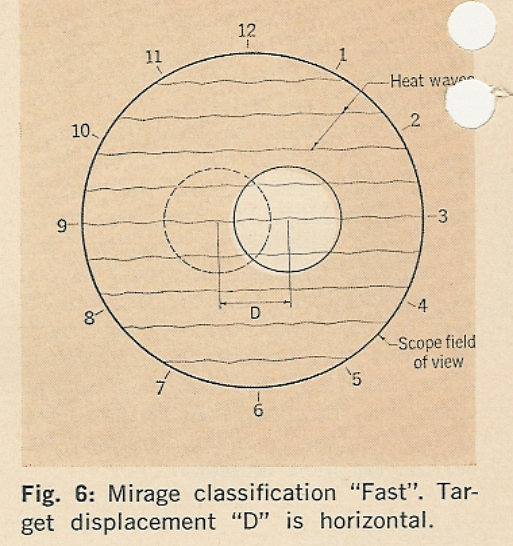
This was one of our 25 Most Popular Articles in 2017. We’re repeating it for those of you who may have missed it the first time around. These diagrams were created by the South Texas Shooting Marksmanship Training Center (STMTC).
There was an excellent article about Mirage created for the South Texas Marksmanship Training Center (STMTC). This article explains what causes mirage and how mirage can move the perceived aiming point on your target. Most importantly, the article explains, in considerable detail, how you can “read” mirage to discern wind speeds and wind directions.
Mirage Is Your Friend
While hot days with lots of mirage can be frustrating, mirage can reveal how the wind is flowing (and changing). If you learn how to recognize and read mirage patterns, you can use that information to shoot higher scores. That’s why many leading long-range shooters tell us: “Mirage is your friend.” As the STMTC article explained: “A mirage condition is not a handicap, since it offers a very accurate method of perceiving small wind changes[.]”
Mirage Illustrated with Diagrams
With simple but effective graphic illustrations, this is one of the best explanations of mirage (and mirage reading) we have found on the internet. This is a “must-read” for any serious competitive shooter. Here is a brief sample from the article, along with an illustration. NOTE: the full article is six times longer and has 8 diagrams.
The term “mirage” as used by the shooter does not refer to a true mirage, but to heat waves and the refraction of light as it is bent passing through air layers of different density. Light which passes obliquely from one wind medium to another it undergoes an abrupt change in direction, whenever its velocity in the second medium is different from the velocity in the first wind medium; the shooter will see a “mirage”.
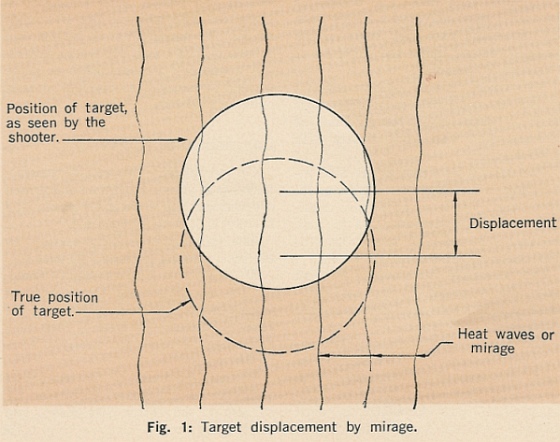
The density of air, and therefore its refraction, varies with its temperature. A condition of cool air overlaying warm air next to the ground is the cause of heat waves or “mirage”. The warm air, having a lower index of refraction, is mixed with the cooler air above by convection, irregularly bending the light transmitting the target image to the shooter’s eye. Figure 1 shows (greatly exaggerated) the vertical displacement of the target image by heat waves.
Heat waves are easily seen with the unaided eye on a hot, bright day and can be seen with spotting scope on all but the coldest days. To observe heat waves, the scope should be focused on a point about midway to the target. This will cause the target to appear slightly out of focus, but since the high power rifle shooter generally does not try to spot bullet holes, the lack in target clarity is more than compensated by clarity of the heat waves.
Story tip from Boyd Allen. We welcome reader submissions.


 Tests Show Burn Rates Vary with Water Content






 Making the 1032-Yard Shot with a 20 BR
 Hitting the Mark — Dead Dog at 1032 Yards