|
|
June 18th, 2007
Here’s an excellent product for the home gunsmith at a good price. Now through the end of June, MidwayUSA has the DPMS AR15 Upper Receiver Holding Fixture on sale for $30.00–twenty bucks off the regular price. This precisely-milled Delrin unit holds an AR15 upper securely during smithing or cleaning operations, without denting or scratching the surface. Just put the Holding Fixture (Midway item #730930) in a bench vise, pop in the pins front and rear, and you’re good to go. While designed primarily for assembly/disassembly, the fixture is also ideal for cleaning AR15 uppers. Here’s a user review by C. Ogle of California: “The DPMS Upper receiver holder works perfect. It is well-designed and very easy to use. It held the receiver in very sturdy with no play or wiggle. You can have piece of mind using this product and not worry about damaging your receiver while torquing down your barrel.”

June 16th, 2007
Field Report by Zak Smith
One of the best field-style hike-and-shoot long-range rifle challenges is known only to a small number of shooters. Dave Wheeler has been running his “Steel Safari” match for about ten years on his 1000-acre private ranch near Logan, NM. The match showcases practical rifle shooting in the field. Competitors locate small and medium-sized steel targets (often hidden), range them, and engage with one shot only, under a challenging time limit. Some movement on the clock is required, and shoot positions are always improvised, the best you can do while on a reverse incline, over a rock face, shooting down a gully, or leaning out the side of a truck.

The Steel Safari is a “Hunting Rifle Championship, a non-standard contest that examines practical hunting skills, including target recognition, range estimation, wind doping, trail skills, and marksmanship”, according to the match entry form. (Dr. David Kahn’s Kenyathlon is another well-known “hunting match”.) However, these skills are not limited to hunting. Events such as the Practical Rifle Team Challenge (NM), Int’l Tactical Rifleman Championship (WY), and various Sniper Challenge matches around the country use a similar format. The game involves target location, ranging, and making first-round hits in field conditions, while moving through natural terrain. This is a far cry from Benchrest and NRA Highpower Long-Range events.

Click for Large PHOTO.
Billed as the “last Steel Safari,” this year’s event attracted 26 shooters (from TX to CA) shooting a variety of rifles and calibers. The match defines two classes: standard and light rifle. The light rifles are limited to 9.5 pounds, while the standard rifles can be as heavy as the shooter wants. Caliber must be .243 Win or larger, up to a max of .300 Win Mag.
The match is primarily composed of two, day-long field courses, each between 2 and 2.5 miles in length, termed the “short” and “long” courses. The short course had 11 shooting locations in addition to the first stage on the known-distance (KD) range. The long course had 9 shooting locations plus a 100-yard mover back near Match HQ.
Click HERE to read Zak’s full 2007 Steel Safari match report, with many more photos.
Editor’s Note: Reporter Zak Smith won the 2006 Steel Safari. This year he finished second, shooting his .260 Rem AI AW. Zak notes: “A local Colorado shooter Mike Dowd shot like a house on fire both days, winning light rifle and the over-all match by four points. My decent but consistent shooting on both days put me at first in standard class and second overall.” Though Dave Wheeler has announced he’ll no longer be sponsoring the match, several Colorado shooters hope to run the Safari again in 2008, in association with Colorado Multi-Gun LLC.
June 16th, 2007
Sinclair Int’l now sells the Tubb Shooting Hat, in three colors, Tan (#47-900), Green (#47-925), and Blue (#47-950). Designed by 11-time Nat’l Highpower Champ David Tubb, this $29.50 product has many features that benefit prone and position shooters. Large, folding panels on either side of the brim block unwanted light and glare. In the rear, an extended flap protects your neck from sun (and hot brass from other shooters). The crown, which can be adjusted to any head size, features an integral sweatband, and mesh vent panels on both sides for cooling.


When you consider the money Highpower shooters invest in rifles, sights, and ammo, not to mention the costs of attending major matches, it makes sense to purchase a hat of this type. Side shades definitely help when using iron sights, and this hat will protect you from blazing summer sun.
June 15th, 2007
Precision shooters favor premium brass from Lapua, Norma, or RWS. (Lake City also makes quality brass in military calibers.) Premium brass delivers better accuracy, more consistent velocities, and longer life. Shooters understand the importance of good brass, but many of us have no idea how cartridge cases are actually made. Here’s how it’s done.
The process starts with a brass disk stamped from strips of metal. Then, through a series of stages, the brass is extruded or drawn into a cylindrical shape. In the extrusion process the brass is squeezed through a die under tremendous pressure. This is repeated two or three times typically. In the more traditional “draw” process, the case is progressively stretched longer, in 3 to 5 stages, using a series of high-pressure rams forcing the brass into a form die. While extrusion may be more common today, RWS, which makes some of the most uniform brass in the world, still uses the draw process: “It starts with cup drawing after the bands have been punched out. RWS cases are drawn in three ‘stages’ and after each draw they are annealed, pickled, rinsed and subjected to further quality improvement measures. This achieves specific hardening of the brass cases and increases their resistance to extraordinary stresses.”

After the cases are extruded or drawn to max length, the cases are trimmed and the neck/shoulder are formed. Then the extractor groove (on rimless cases) is formed or machined, and the primer pocket is created in the base. One way to form the primer pocket is to use a hardened steel plug called a “bunter”. In the photos below you see the stages for forming a 20mm cannon case (courtesy OldAmmo.com), along with bunters used for Lake City rifle brass. This illustrates the draw process (as opposed to extrusion). The process of draw-forming rifle brass is that same as for this 20mm shell, just on a smaller scale.


River Valley Ordnance explains: “When a case is being made, it is drawn to its final draw length, with the diameter being slightly smaller than needed. At this point in its life, the head of the draw is slightly rounded, and there are no provisions for a primer. So the final drawn cases are trimmed to length, then run into the head bunter. A punch, ground to the intended contours for the inside of the case, pushes the draw into a cylindrical die and holds it in place while another punch rams into the case from the other end, mashing the bottom flat. That secondary ram holds the headstamp bunter punch.

The headstamp bunter punch has a protrusion on the end to make the primer pocket, and has raised lettering around the face to form the headstamp writing. This is, of course, all a mirror image of the finished case head. Small cases, such as 5.56×45, can be headed with a single strike. Larger cases, like 7.62×51 and 50 BMG, need to be struck once to form a dent for the primer pocket, then a second strike to finish the pocket, flatten the head, and imprint the writing. This second strike works the brass to harden it so it will support the pressure of firing.”
Thanks to Guy Hildebrand, of the Cartridge Collectors’ Exchange, OldAmmo.com, for providing this 20mm Draw Set photo. Bunter photo from River Valley Ordnance, RVOW.com.
June 15th, 2007
 It’s time to pay our respects to our patriarchs. This Sunday, perhaps take your dad to the range, or spend a day with him doing his favorite activity–whether shooting, golf, fishing, or just firing up the grill in the backyard. If you’re looking for a special gift for Father’s Day, both Cabelas.com and Orvis.com have some excellent promotions running right now. It’s time to pay our respects to our patriarchs. This Sunday, perhaps take your dad to the range, or spend a day with him doing his favorite activity–whether shooting, golf, fishing, or just firing up the grill in the backyard. If you’re looking for a special gift for Father’s Day, both Cabelas.com and Orvis.com have some excellent promotions running right now.

June 14th, 2007
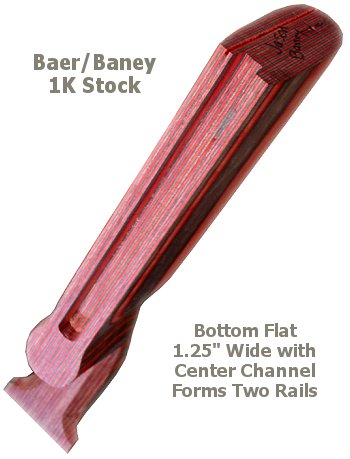
Thanks to sponsors Bruce Baer, Bartlein Barrels and smiths Mark King and Alex Sitman, we are developing a new long-range project gun with two barrels, one chambered in 6mm-6.5×47 and the other in 6.5×47 Lapua. For this project, Jason wanted a hybrid stock that combined features of the popular MBR Tooley-style stock, with an I-beam style fore-end, plus something new and different in the rear.


The new stock, crafted by Bruce Baer, features an I-beam style fore-end with long, straight flats similar to a McMillan Edge™ short-range BR stock. The underside of the fore-end is relieved to allow smoother tracking over a front sand bag. We’ve noticed a trend to wider flats in the back, so we specified a 1.25″ rear flat. We didn’t want to go ultra-wide (2.0″ +) to keep weight manageable and so that a conventional blank (1.5″ wide at comb) could be used. We were also concerned about friction and bag-handling if the flat was too wide. To lessen drag and improve tracking, Jason told Bruce to cut a relieved area, or “channel” in the underside of the toe. The idea here was to reduce friction and to provide improved contact with the ears of the rear bag. With a very wide flat, there is a tendency to ride on the stitching between the ears. With this design, we hope, the left and right edges of the rear flats will engage the ears.
June 14th, 2007

Jeff Bartlett of GIBrass.com has some great prices on new Sierra production 55gr varmint bullets, .224 diameter. Two varieties are offered:
55gr BlitzKing with cannelure. Sierra item #9373.
Prices: $12/100; $55/500; $100 per thousand
55gr Varminter Soft Point. Sierra item #1360.
Prices: $12/100; $55/500; $100 per thousand.
Bartlett’s special production BlitzKings have cannelures, making them better for reloaders who prefer to crimp their ammo. Regular production Sierra 55gr BlitzKings (Sierra #1455) have no cannelure and typically sell for $16/box. Jeff also reports that he has plenty of the ultra-accurate ‘Euro’ 4895 powder, highly recommended by G. Salazar of ShootersJournal.com. This burns slightly slower than IMR 4895, closer to IMR 4064. It works great in the 6mmBR and .308 Win. Price is $100 per 8-lb jug.
June 13th, 2007
Over the past decade and a half we’ve seen a definite trend to smaller calibers in both Highpower and long-range benchrest competition. Smaller projectiles have allowed a whole new style of bench-shooting, where you don’t have to hold the rifle at all. In the Service Rifle discipline, the .223 “Mouse Guns” changed the sport forever. Many would say this “downsizing” is all for the good. But have we lost something in the process? In engineering away recoil, have we “neutered” the sport and made it less exciting?
 Here’s what the legendary Col. Jeff Cooper had to say: Here’s what the legendary Col. Jeff Cooper had to say:
“Do you enjoy recoil? A recent article in Magnum magazine from South Africa points out that the retroactive shock delivered by the shooting of a firearm is not necessarily punishment. The sock you feel when your racket centers a tennis ball, or when you floor the throttle on a highly-bred car in third gear, or when you hit the water from the boat deck of your fishing cruiser–these things are exhilarating. It seems possible that this tendency to mitigate the shock of recoil maybe overlooking something. Personally I enjoy shooting a full-sized weapon more than I do a 22, and if I can remember that far back, I used to anticipate with distinct pleasure an unavoidable tackle when running back a kickoff. Perhaps we should think further upon this.” — Jeff Cooper Commentary
Is the Colonel right? Is recoil part of the fun of the sport, like the heeling force of a sailboat when it catches a puff of wind? Have we gone too far in reducing recoil in our “full-bore” match calibers? Has shooting become a sport for wimps?
What are your views?
To comment, click the “comments” link below.
June 13th, 2007
 Grafs.com is offering huge savings on the Sightron SIII SS, 6-24×50 side-focus scope. Having made a special buy of this quality optic, item SIIISS624X50, Grafs.com is selling it at just $479.99 while supplies last. That’s $150.00 to $200.00 less than other optics vendors are charging. This scope features a “satin black” finish, plex reticle, 1/4-MOA clicks, tall “target-style” turrets, and a side parallax adjustment. If you contact Graf & Sons, be sure to tell them you heard about this deal on AccurateShooter.com. Note: no further discounts available. $479.99 price limited to supplies on hand. Click HERE for scope specifications. Grafs.com is offering huge savings on the Sightron SIII SS, 6-24×50 side-focus scope. Having made a special buy of this quality optic, item SIIISS624X50, Grafs.com is selling it at just $479.99 while supplies last. That’s $150.00 to $200.00 less than other optics vendors are charging. This scope features a “satin black” finish, plex reticle, 1/4-MOA clicks, tall “target-style” turrets, and a side parallax adjustment. If you contact Graf & Sons, be sure to tell them you heard about this deal on AccurateShooter.com. Note: no further discounts available. $479.99 price limited to supplies on hand. Click HERE for scope specifications.

June 12th, 2007
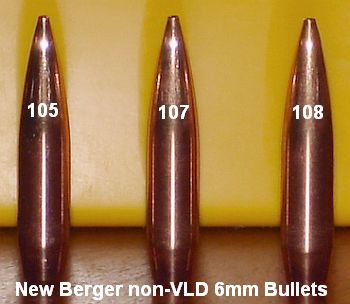
Berger Bullets has issued three new prototype non-VLD 6mm bullets for testing, in 105, 107, and 108 grain weights. Initial results are promising to say the least, particularly with the 108s. Here’s a photo of all three by Wm. Roscoe.
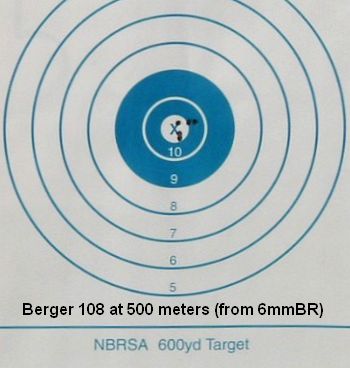
Danny Reever reports: “Here’s the best group I shot today with the Prototype Berger 108 grain BT at 500 meters (547 yards). The group measured a fantastic .870 inch! The worst group I shot today with the same bullet measured 1.752 inch which is none too shabby either.”
Danny adds: “I do think this new bullet is a winner. All the bullets shot well for me, but the 108 was hands down the best performer. I had the chance to test the new lot #591 105gr VLD since Eric polished the die out and it shot very well also. Best group being a 1.544″ @ 500 meters which was shot in a 5-15 MPH wind. I’m now anxious to find out which bullet they will select for production. If it’s the 108 I’m going to order 3000 right from the get-go. That’s how impressed I am with that bullet!” Danny’s load was Berger 108, .015″ into the lands, neck-turned Lapua 6mmBR brass, CCI450 primer, 30.5 grains of Varget (the usual disclaimer applies here).
Bob Woodward (Matsubob) agrees: “Here is a group I shot with a 6mm Grendel on an AR15 space gun at 200 meters (8-twist Whitley upper). Very good group for an over-the-course national match rifle.”

What’s the secret to the accuracy of the 108s? It looks like Berger is pointing up nice, consistent meplats. But it appears the 108 has a shorter boat-tail than the 105 or 107 prototype. We should add that the 107s are shooting well too. William Roscoe got promising results with the 107s. Holding dead center (no wind correction), five of the new 107s went into .614″ vertical at 330 yards. More Details.
|


