Hunting season continues in many areas of the nation, so many game hunters have questions about terminal performance and particular caliber/cartridge combinations. Bryan Litz of Applied Ballistics says there are really a number of questions that need to be answered:
1) What’s the max range that the shooter/rifle is capable of hitting the intended target?
2) What’s the max range that a bullet can kill the intended game?
3) How do bullets kill?
4) Effects of Muzzle Velocity on Lethality.
(Your MV may be lower in winter with temp-sensitive powders).
5) Long Range Lethality and the Ballistic Coefficient.
You’ll find answers to these and other questions in Bryan’s book, Applied Ballistics for Long-Range Shooting. These topics are covered in Chapter 15: Lethality of Long Range Hunting Bullets. Bryan says: “For responsible hunting, knowing your limits and your rifle’s limits, is important.”
Bryan’s book also includes Bullet Lethality Charts for a variety of calibers and cartridge types. These charts feature categories for 600-lb, 300-lb, and 150-lb Game animals so you can match performance to the size of your prey. Bryan explains: “If I wanted to know how a Medium Capacity Cartridge shooting the 6mm Berger 115 VLD will perform on 300-pound game, I can reference the bullet-specific chart.”
A modern F-Class or Benchrest competition rifle can cost $4000.00 or more. Add $2500 for a top-tier scope and you can easily have $6500.00 or more invested in your rig. With that kind of money involved, you should transport that valuable rifle in a very high-quality case — one that is strong, durable, and secure. In addition, the case should have quality, customizable internal foam that cushions the barreled action, stock, scope, and key accessories.
These video reviews look at quality, durability, features, price, and other factors.
TSA-Approved Rifle Cases — Performance Tested
This Warrior Poet Society video covers the key features you need with a gun case. The reviewer also explains the important TSA rules you need to consider when flying with firearms. The reviewer, has used all kinds of cases to travel with his firearms on planes, over seas, across continents. In this video he reviews a range of cases — from basic affordable cases to high-end cases that costs many hundreds of dollars.
Five Hard Shell Rifle Cases Showcased
This review looks at five (5) of the best rifle transport cases. The video considers key features including hinges, locks, padding, and wheels. The five cases reviewed are:
This 6.5-minute video covers five affordable hard shell cases ranging in price from $50 to $177. The video provides a good look at the external and internal features of these five cases, using mostly manufacturer-supplied video, including some field tests.
This video covers a unique large, long-gun case that holds multiple rifles in a vertical arrangement. The Case Club 4 Rifle/Shotgun Case holds up to 4 long guns, along with 3 pistols in a tough wheeled, waterproof case with a lifetime warranty. The case fits any rifle or shotgun under 41″ long, with room for for optics, foregrips, under-barrel attachments, pistol grips, and more.
The case itself is crushproof, waterproof, stackable, and TSA-approved. Dual purge valves keep moisture out while allowing the case to be opened in high or low altitude. The foam is long-lasting, oil-proof military grade polyethylene that won’t tear. This case is not cheap — it retails for $632.45.
Plano All-Weather Rifle Case — Great Protection for the Price
Plano cases offer excellent value for the money. Priced at $109.99 on Amazon (for 42″ model), the Plano All-Weather Tactical Gun Case offers a strong shell, tough hinges, and secure weather-proofing. The case has pre-perforated, pluck-to-fit foam for easy customization. This airline-approved case boasts a Dri-Loc seal providing a watertight, dust-proof shield that protects your firearms from water damage. For $30 more Plano offers the new All Weather Rustrictor Case with VCI-infused resin and foam emitter blocks that fight rust and corrosion.
Harbor Freight Apache 9800 Weatherproof Rifle Case
This video features the Harbor Freight APACHE 9800 Weatherproof Rifle Case. The reviewer states this $169.99 case has served him well, proving rugged and durable with the ability to securely transport multiple firearms. The video showcases the Apache 9800 in detail, and explains steps that can provide additional long-term durability. This Apache 9800 case is offered in black, tan, and OD green.
BONUS Videos — How to Cut Foam for your Gun Cases
For the best fit of your firearms and accessories in a foam-interior hard case, you should customize the foam to fit. Some cases have “pluckable” foam. With these you remove small squares one an a time until the stored items fit. With other cases with dense foam interiors, you’ll need to cut the foam to fit. Here are two videos that show the process of tailoring foam to a rifle using an electric cutting tool. Watch these videos carefully — they can really help create the best custom-fit for your firearms.
Here is an interesting project by one of our Forum members. Martin C. (aka “Killick”) modified an Anschutz 1411 Match 54 rimfire prone stock to become a comfortable, great-tracking F-Class Open Division Stock. No Killick didn’t sacrifice a perfectly good rimfire rifle for this project — he bought the Anschutz stock by itself on eBay, then transformed it…
Killick explains: “This project started about seven years ago. I bought the Anschutz prone stock on eBay and whittled it a bit into a Palma rifle with a Barnard action and block and a Doan Trevor cheek piece and scope rail. Then about two years ago I decided to re-task the stock/action assembly into an F-Open rig. With more whittling, gluing, sanding, body fillering, sanding, filling, sanding, more sanding…and sanding, forming, priming, sanding, painting, waiting, painting, painting…painting and before you know it, Bob’s your uncle.”
Here is the eBay-sourced Anschutz 1411 stock, with new high-gloss blue finish, as initially modified for use in Killick’s centerfire Palma rifle. Looks nice!
Next step was the addition of a 3″-wide wood fore-end for F-Open duties with front rest:
Almost done here… just needs priming and final painting:
Here is Killick’s completed F-Open rifle with its much-modified Anschutz stock now finished in fire-engine red lacquer. This image shows the detail of the grip and customized cheekpiece.
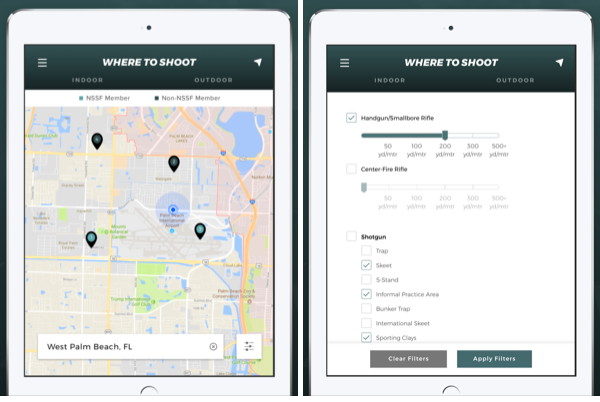
The Where To Shoot Mobile App quickly locates shooting ranges near you, drawing on North America’s most comprehensive directory of shooting ranges. Users can search by current location, state, or zip code. Once you locate a range, you can view activities offered along with a summary of range facilities. You can even get driving directions.
The app is modeled after NSSF’s popular WhereToShoot.org® website and is updated frequently with range information for every U.S. state and Canadian province. Once you’ve located a place to shoot, the App can provide directions to the range. The App also includes video tips for shooters, news, and firearm-safety information.
“On that day, let us solemnly remember the sacrifices of all those who fought so valiantly, on the seas, in the air, and on foreign shores, to preserve our heritage of freedom, and let us reconsecrate ourselves to the task of promoting and enduring peace so that their efforts shall not have been in vain.”
– 1954, President Dwight D. Eisenhower, Veterans Day proclamation.
104 Years Later…
On the 11th hour, of the 11th day, of the 11th month of 1918, bugle calls signaled the ‘cease fire’ ending the First World War. (The official Armistice was signed earlier that morning.) To those who endured it, WWI was the “Great War”, “the War to End All Wars.” Tragically, an even greater conflict consumed the world just two decades later.
Today, 104 years after the end of WWI, Americans mark the anniversary of the WWI Armistice as “Veterans Day”. In Canada it is known as Remembrance Day. On this solemn occasion we honor all those who have served in the military in times of war and peace.
While more veterans pass away each year, there are still about 19 million veterans in the United States. Take time today to honor those soldiers, sailors, and airmen who have served their nation with pride. Today we remember that… “All gave some, and some gave all.” History of Veterans Day.
Former Secretary of Veterans Affairs Dr. James Peake asked Americans to recognize the nation’s 19 million living veterans and the generations before them who fought to protect freedom and democracy: “While our foremost thoughts are with those in distant war zones today, Veterans Day is an opportunity for Americans to pay their respects to all who answered the nation’s call to military service.”
On Veterans Day we especially need to remember the seriously wounded combat veterans. These men and women summon great courage every day to overcome the lasting injuries they suffered in battle. Some of these soldiers have lost limbs, yet volunteered to return to combat duty. That is dedication beyond measure — true patriotism.
National Veterans Day Ceremony
The Veterans Day National Ceremony is held each year on November 11th at Arlington National Cemetery. The ceremony commences precisely at 11:00 a.m. with a wreath laying at the Tomb of the Unknowns and continues inside the Memorial Amphitheater with a parade of colors by veterans’ organizations. The ceremony is intended to honor and thank all who served in the U.S. Armed Forces. Major regional ceremonies and events are also held throughout the country.
Top to bottom – Remington firing pin assembly with ISS, Tubb SpeedLock alloy-composite system without ISS (current versions have dual, opposite-wound springs), and Remington short action firing pin assembly without ISS.
The U.S. Army Marksmanship Unit regularly publishes technical articles on the USAMU Facebook page. One informative USAMU article covered mechanical issues and related ignition irregularities that can cause vertical fliers even with good ammunition in an otherwise excellent rifle. We highly recommend you read this article, which offers some important tech tips.
Vertical Dispersion: Mechanical/Ignition Issues?
Poor or inconsistent ignition has long been known to be one of the “usual suspects” when one encounters vertical fliers that just shouldn’t be there. By having a sense of some of the basic principles involved, and a few basic areas to check, the shooter may avoid colsiderable frustration, not to mention time, expensive loading components and barrel wear.
Is your well-built rifle of high-quality components plagued with vertical fliers across more than 1-3 handload combinations? Consider the bedding, crown and scope/sight mounts. Are they correct? If so, then you might check for ignition issues before boldly undertaking an extensive, expensive, and quite possibly fruitless quest for the “magic handload”.
SEEING IS BELIEVING: While the author had been aware for many years that poor ignition should be considered and ruled out when dealing with vertical fliers in an otherwise-excellent rifle, actually seeing the problem and its almost instantaneous cure really drove the lesson home.
He was working with a “dot” rifle – a .22 LR match rifle that really stacked bullets into little piles at 50 yards and beyond. With one lot of ELEY Tenex, it produced consistent “bughole” groups at 50, but with another, selected lot of Tenex, similar groups were regularly ruined by single, vertical fliers that did not appear in other rifles. Rather than spending days burning up expensive, select ammunition looking for “magic lots”, he contacted a well-respected rimfire gunsmith and explained the situation.
Without so much as batting an eye, the highly-experienced ‘smith tore into the rifle’s action, and quickly found the cause(s) of the problem. He discovered a demonstrably weak firing pin spring, plus a chip out of the face of the firing pin where it contacted the cartridge rim.
After replacing and tuning the offending parts, the rifle immediately began shooting tiny, bughole groups with the previously “unacceptable” lot of Tenex. Centerfire rifles can also benefit from ensuring positive, consistent ignition. A wise riflesmith is literally worth his weight in gold!
So, what are some issues we as shooters can inspect in our rifles to help determine if ignition woes could be part of our problem? At the club level, ask yourself if that “experienced” Remington, Winchester 70, or even Springfield-based match bolt gun you’re using is still running its’ original 40-80 year-old factory striker spring? If so, a new replacement is cheap insurance against current or future problems. (And BTW, it might be best to stick to the normal, factory-spec spring weight. A super-powerful spring can cause vertical, just as a weak one one can.) Along with that, a routine check for proper firing-pin protrusion is a quick preventive measure that can rule out potential issues.
Other areas to consider are the centering and consistency of the firing pin’s operation in the bolt. Admittedly, with the increasing use of precision-machined custom actions, this is becoming less an issue every day. Below is the firing pin assembly from a custom BAT action:
However, particularly with factory actions, a very quick and easy check is to remove the bolt, let the firing pin go forward, and look at the firing pin tip through the firing pin hole. Is the tip off-center in the hole, and possibly striking it as it moves forward? Is the hole out-of-round or burred from being struck repeatedly? If so, a trip to the riflesmith is likely in order.
Similarly, machining issues in the bolt/firing pin system can lead to rough and erratic firing pin movement, in which the firing pin drags against an internal surface of the bolt. In high-quality rifles these issues are relatively rare, but not unheard-of, and it takes mere minutes to rule them out. It may be worthwhile to remove the cocking piece/firing pin/spring assembly and look for any unusual gouges, dings, peening, burrs or signs of abnormal wear.
This task is especially easy with Winchester 70s, Springfields, and the similar Mauser 98s, involving little more than the push of a button and unscrewing the cocking piece assembly. This is just one of the many reasons these tried-and-true actions have earned such a loyal following in the field, among hunters who must maintain their rifles away from a shop.
Particularly with older rifles, watch for and remove excess grease (or even Cosmoline!) from both the firing pin assembly and inside the bolt. This can help improve firing pin speed and consistency. Other bolt-action designs may need a take-down tool or other measures.
As part of this inspection, AFTER ENSURING THE RIFLE IS UNLOADED, slowly cock the rifle, dry-fire, and repeat several times. Listen carefully near the action for inconsistency in the sounds it generates. Does the striker falling make the same sound each time? Do you hear or feel grinding upon operation? If so, where?
Be sure to check the operation of the cocking piece (bolt shroud), firing pin within the bolt shroud, the cocking piece cam and the rear of the bolt body where the cocking piece cam operates. As with our examination for abnormal wear marks discussed above, look for marks indicating roughness or a possible need for light polishing. Then, clean and lightly grease the bearing surfaces while you’re at it.
Remington 700 bolt shroud and cocking cam
These are relatively easy checks that shooters can undertake to perform a preliminary inspection on their own. Other mechanical issues can also cause ignition issues, chiefly centered around the action of the trigger, sear and sear spring. If these are suspected, a trip to an experienced, qualified riflesmith for diagnosis is recommended. We hope you find this information helpful! Join us again next week, and in the meantime, enjoy the shooting sports safely!
Forest of Windflags at World Benchrest Championships in France in 2011
There’s a simple, inexpensive “miracle device” that can cut your groups in half. If you’re not using this device, you’re giving away accuracy. The “miracle device” to which we refer is a simple wind indicator aka “windflag”. Using windflags may actually improve your accuracy on target much more than weighing charges to the kernel, or spending your life savings on the “latest and greatest” hardware.
Remarkably, many shooters who spend $3000.00 or more on a precision rifle never bother to set up windflags, or even simple wood stakes with some ribbon to show the wind. Whether you’re a competitive shooter, a varminter, or someone who just likes to punch small groups, you should always take a set of windflags (or some kind of wind indicators) when you head to the range or the prairie dog fields. And yes, if you pay attention to your windflags, you can easily cut your group sizes in half. Here’s proof…
Miss a 5 mph Shift and You Could DOUBLE Your Group Size
The table below records the effect of a 5 mph crosswind at 100, 200, and 300 yards. You may be thinking, “well, I’d never miss a 5 mph let-off.” Consider this — if a gentle 2.5 mph breeze switches from 3 o’clock (R to L) to 9 o’clock (L to R), you’ve just missed a 5 mph net change. What will that do to your group? Look at the table to find out.
Values from Point Blank Ballistics software for 500′ elevation and 70° temperature.
Imagine you have a 6mm rifle that shoots half-MOA consistently in no-wind conditions. What happens if you miss a 5 mph shift (the equivalent of a full reversal of a 2.5 mph crosswind)? Well, if you’re shooting a 68gr flatbase bullet, your shot is going to move about 0.49″ at 100 yards, nearly doubling your group size. With a 105gr VLD, the bullet moves 0.28″ … not as much to be sure, but still enough to ruin a nice small group. What about an AR15, shooting 55-grainers at 3300 fps? Well, if you miss that same 5 mph shift, your low-BC bullet moves 0.68″. That pushes a half-inch group well past an inch. If you had a half-MOA capable AR, now it’s shooting worse than 1 MOA. And, as you might expect, the wind effects at 200 and 300 yards are even more dramatic. If you miss a 5 mph, full-value wind change, your 300-yard group could easily expand by 2.5″ or more.
If you’ve already invested in an accurate rifle with a good barrel, you are “throwing away” accuracy if you shoot without wind flags. You can spend a ton of money on fancy shooting accessories (such as expensive front rests and spotting scopes) but, dollar for dollar, nothing will potentially improve your shooting as much as a good set of windflags, used religiously.
Windflags Sources and Options
Which Windflag to buy? There are many vendors selling windflags of various types, some with daisy wheels others without. You may want to go to a match and see what types works best for you. CLICK HERE for the Benchrest Central Classifieds with multiple windflag types and accessories for sale. Here is a sample:
This can be very important — even life-saving. For example, with a hang fire, i.e. a round that does not fire immediately, it is vital to keep the gun pointed DOWN-RANGE. And with a squib load, which may have left a round inside the barrel, it is vital to UNLOAD and NOT take another shot! If you did, the gun could blow up in your hand when the second, full-charge bullet hits the trapped bullet.
The Five Topics Covered Are:
Misfeed (aka Tip-Up)
Double Feed
Stovepipe (Failure to Extract)
Misfire / Hangfire
Squib Load
1. Misfeed or Tip-Up: With any misfeed you should stop firing. With the muzzle pointed safely down-range, remove the magazine, then pull the slide back and remove the round that did not feed. Check the slide for dirt, debris, and check the round that did not feed. After re-inserting the magazine, make sure the mag is seated properly.
2. Double-Feed: This is a fairly common issue with some gun types with worn springs or cheap magazines. Again you want to remove the magazine. CTD states: “Remove the magazine and cycle the action until your double-fed rounds fall out — always keeping the muzzle pointed in a safe direction[.]”
3. Stove-Pipe: This occurs when the case of a fired round does not eject fully. There can be many causes — damaged extractor, low-pressure powder charge, dirty chamber, or greasy cartridge brass. In addition the issue is common with old, worn-out recoil springs. To avoid Stove-Pipes, replace the recoil spring every 4000 rounds, and make sure your chamber is clean and the extractor is not chipped or damaged.
4. Misfires and Hang-Fires: There are multiple causes for misfires (“click no bang”) and hang-fires (slow ignition). There can be a defective primer, the firing pin could be damaged, the powder many have been bad, or the case not filled properly. With a misfire, keep the gun pointed down-range at least one minute. If the case does not fire, eject it but leave it on the ground. With a hang-fire (delayed ignition after firing pin strike), keep the gun pointed down-range, then drop the magazine and eject the (new) unfired cartridge in the chamber and inspect the gun when completely empty.
5. Squib Load: A squib load is when the gun fires, but the actual case ignition is very light with little noise, smoke, or recoil. This can be because the case had a primer but no powder. Or it can be because the powder did not ignite. Squib loads can be very dangerous in rapid-fire situations. If you EVER get a squib load STOP immediately! Do NOT fire another round! This is because the squib may have left a bullet inside the barrel.
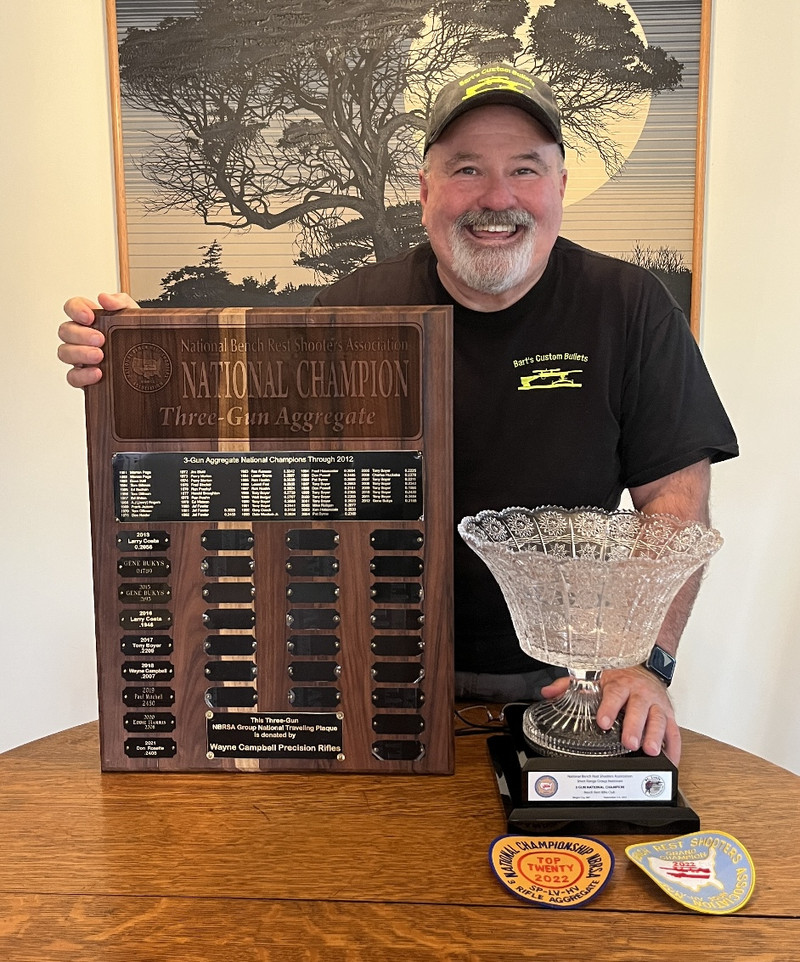
Bullet-maker Bart Sauter is the king of 300 meters, winning his second straight Tack Driver III multi-discipline match in South Carolina. For the second year in a row, Bart won the Tack Driver Grand Agg, after finishing sixth in Group shooting and first in Score shooting. Finishing second overall was short-range Benchrest ace Wayne Campbell. Wayne finished first in the Group-shooting phase and took eighth place in score shooting. Third overall was Jeff Peinhardt who, interestingly, was fifth in Group AND fifth in Score — that’s consistency. According to reports, 6mm PPCs dominated this year’s Tack Driver III match held November 5-6, 2022. We believe 6 or 7 out of the top 10 finishers shot a 6PPC. For decades the 6PPC has been the leading chambering for 100/200-yard benchrest-for-group competition.
The Tack Driver Showdown is a one-of-a-kind “all comers” rifle match. This unique multi-discipline match, with both SCORE and GROUP targets, reveals what rifle types are truly the MOST accurate, at least out to 300 meters. The Tack Driver Showdown III match took place last weekend, November 5-6, 2022 at the Mid-Carolina Gun Club in Orangeburg, South Carolina. The organizers invited virtually any type of rifle (except railguns) to compete at 300 meters for group and score honors. No organization membership is required. There were 89 competitors this year.
Unlike any other rifle match in the world, on the Tack Driver firing line you might see 6 PPC LV/HV rifles, 30 BR score rigs, and 17-lb 600-yard and 1000-yard benchrest guns together all lined up together. There may also be a few F-Class rifles, a PRS rifles, and maybe even an AR15 or two. But in 2022, nearly all the competitors had benchrest-style rifles, the majority designed for the 100/200 yard score and group games. That’s not surprising, as low-profile, smooth-recoiling BR rifles rule the roost at 100, 200, and 600 yards. Here are the list of rifles that competed this year according to cartridge type:
Tack Driver III targets were placed at 300 meters (328 yards). That’s not even “mid-range” by benchrest standards, but it is far enough that higher-BC bullets should have an advantage in windy or rapidly changing conditions. This year, however, the 6PPCs shooting lighter-weight 6mm bullets dominated.
Commentary by Tack Driver III Winner Bart Sauter
Winning Equipment — I shot a 6PPC with a .273 no-turn neck, Bartlein 1:13.5″-twist barrel, BAT DS action, Jewell trigger, Harris tuner, and Scarborough stock. On top was a great big ole 10-60X Valdada “Precision” scope with 40mm tube. I also used Vihtavuori N133 powder and my 68gr boat-tail bullets.
Shooter vs. the Gun — The long and the short of it is… you’re only as good as your equipment and the equipment can only perform up to the ability of the shooter. It’s a system. I’ve won it last year with a 6BRA and now with a 6PPC. I’m telling you, caliber-wise, there are a lot of different cartridges and combinations that can win. Jeff Godfrey (of the Piedmont Mafia) brought his 6BRX (I believe), and it shot like a laser. Jeff was in second place at the end of Day 1. If not for a couple of “Orangeburg Gotchas” Jeff would have been right there for the win.
Rifle and Cartridge Choice — Why did I shoot the 6PPC? It’s simple — the goal for this year was to try to make the benchrest World Team. So my resources were directed towards barrels for the 6PPC. I didn’t buy a single long range barrel this year. I used the last of my competitive long range gear for the 600- and 1000-yard Nationals. If I had both the 6BRA and 6PPC working, for this match I’d pick the 6BRA EVERY TIME and TWICE ON SUNDAY.”
Video of Bart Explaining Rest/Bag Set-Up and Showing Shooting Technique
Editor’s Note: 2022 has been a good year for Bart Sauter. He also won the 2022 NBRSA 3-Gun Short Range National Championship shooting his no-turn-neck 6PPC.
Comments by Forum Members:
“Congratulations Bart for your second Tack Driver win! Bart is no doubt a great shooter. He has [the ability] to prepare for a match to the Nth degree, then adapt and overcome changes that arise during a match. Not many have his skill, knowledge, and dedication! Congratulations to all that were there. You are all winners… I hear it was a great time had by all competitors!” — Samuel Hall (Past IBS Champion)
“While the Tack Driver concept is designed to attract shooters from Short Range Group, Short Range Score, F Class, PRS, and all of the other disciplines that require the ultimate in rifle accuracy, it is still a Benchrest match, run under Benchrest rules. Downrange ballistics such as a bullet’s ability to buck conditions take a back seat to a combination’s overall Agging capability. That includes the bullets, the barrel, the tune, the bench equipment[.]” — Jackie Schmidt
“What [the Tack Driver match] shows is the domination of the 6mm bore and small cases. It is a great event to showcase precision bench shooting [with] different disciplines coming together. Good job to Mr. Cline and all those involved including the shooters.” — Jeff PPC
Basic Information on the Tack Driver Shoot:
There are two divisions — bolt-action rifles and semi-auto gas guns. There are no specific design limits other than a 22-lb maximum weight, and a .338 maximum caliber. Past IBS President Jeff Stover tells us: “We envision the full array of the world’s most accurate rifles on the line: short and long range benchrest rifles, F-Class, AR, other tactical, egg-shoot rifles, whatever…[.]” Semi-autos required chamber flags, otherwise bolts must be out at all times.
Shooting USA TV has a very good show released today. Shooting USA’s Wednesday Night episode features an interesting tactical-style airgun competition, and then there’s a sequence from Julie Golob on how to use video recordings to improve your pistol handling and marksmanship. For fans of military firearms, this week’s episode also features a notable WWII German rifle — the Gewehr 43.
Shooting USA SHOW TIMES: This Shooting USA Episode airs Wednesday, November 9, 2022 at 9:00 PM Eastern and Pacific; 8:00 PM Central. If you miss the regular broadcast, you can stream the show online at any time on Vimeo for $0.99 per episode.
The Rocky Mountain Airgun Challenge
The 2022 Rocky Mountain Airgun Challenge in Provo, Utah attracted top shooters with over $100,000 worth of prizes. The stages look like what you’d see at PRS/NRL events, but the targets are smaller, the range is shorter, and the power behind each shot is air. Practical Air-Gun competition has a well-established community that spans the globe, and recently competitors from other shooting disciplines, the powder burners, beginning to take notice. Air-Gun practical competition is fun and inexpensive — you are paying pennies a round vs. a $1.25 or more for premium centerfire ammo. The Rocky Mountain Airgun Challenge is leading the way in this interesting air-powered shooting discipline. This multi-day event featured a variety of events on multiple stages.
Germany’s Answer to the M1 Garand — the Gewehr 43
The Gewehr is now one of History’s Guns on Shooting USA. When the legendary M1 Garand served as the US standard issue rifle in WWII the impact on the battlefield was undeniable. And the effectiveness of the Garand was not lost on the German military, armed with bolt-action Mausers that dated back to the first world war. For Nazi Germany the pressure was on to develop a semi-automatic battle rifle that could match the repeating firepower of the M1. The result was the Gewehr 43 was created to serve the German armed forces.
Using Video to Improve Your Shooting — S&W Pro Tip
The talented Julie Golob has another Smith & Wesson Pro Tip on using video to improve your shooting. Julie states: “Did you know that one of the best tools for self-diagnosing technique is your smart phone? You can set up your smartphone to record your shooting and coach yourself through valuable skills. In this Pro Tip I am going to walk you through three different ways to use your [smartphone’s video camera] to become a better shot. READ FULL STORY with More TIPs and 14 Photos.
When setting up the shot for the draw you can use either landscape or portrait, that doesn’t matter. A small tripod is useful, or you can use a larger one.
One last tip when we’re using video is to use the pause function and drag the frames along so that you can stop frame-for-frame so you can see exactly your positioning when you draw, reload, or shoot positions and your footwork. Until the next one be safe and have fun.


 You’ll find answers to these and other questions in Bryan’s book, Applied Ballistics for Long-Range Shooting. These topics are covered in Chapter 15: Lethality of Long Range Hunting Bullets. Bryan says: “For responsible hunting, knowing your limits and your rifle’s limits, is important.”







 Is your well-built rifle of high-quality components plagued with vertical fliers across more than 1-3 handload combinations? Consider the bedding, crown and scope/sight mounts. Are they correct? If so, then you might check for ignition issues before boldly undertaking an extensive, expensive, and quite possibly fruitless quest for the “magic handload”.


 There’s a simple, inexpensive “miracle device” that can cut your groups in half. If you’re not using this device, you’re giving away accuracy. The “miracle device” to which we refer is a simple wind indicator aka “windflag”. Using windflags may actually improve your accuracy on target much more than weighing charges to the kernel, or spending your life savings on the “latest and greatest” hardware.