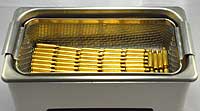
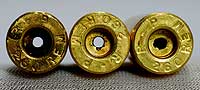
If you read our lengthy article on Ultrasonic Case Cleaning by Jason Baney, you’ve seen the remarkable results that can be achieved with this method, as shown by the photo above. Ultrasonic cleaning has many advantages over traditional tumbling methods of case cleaning. There is no dust or media residue to remove from the brass, and when done right, the cases come out clean and shiny, inside and out, even the primer pockets.
In its Benchtalk Archives, Brownell’s has an excellent article discussing Ultrasonic Case Cleaning. Brownell’s staff compares results, with measured dwell times from 5 to 75 minutes, using both Mpro-7 and HCS 200 cleaning solutions. Tests are performed with once-fired and 5X-fired Tactical 20 (Tac20) cases, as well as once-fired .260 Rem Cases. The article also compares the results from ultrasonic cleaning vs. tumbling in walnut media. Below are Brownell’s results for Tac20 cases with the HCS 200 (non-acidic solution). Go to Brownell’s article for MPro7 results and Rem 260 results.
HCS 200 Cleaning Solution Test
Procedure — Solution was de-gassed for 15 minutes, then 63 Tac20 cases were placed in a single layer, in stainless steel mesh basket. The temperature of the starting solution was 102° F. When the cases were removed the temperature was 110° F.
Once-Fired Tactical Twenty Cases (HCS 200) — Observations 5 minutes: The exterior of the cases are not significantly brighter/cleaner. The primer pockets and case interiors are still dirty. 10 minutes: Exterior of the cases are brighter. 70% of the cases show some degree of cleaning of the primer pockets. Little difference seen inside the case, but case mouths are cleaner. 15 minutes: Case brightness is about the same. Still only 70% of the primer pockets are clean, but a larger portion of each is cleaner. A Q-tip swabbed inside the cases shows that carbon/powder residues are loosening up. 20 minutes: Case exteriors are brightening up. 80-85% of the primer pockets are about 90% clean. The insides of the cases and case mouths are cleaner. 25 minutes: Cases are brighter/cleaner than even new brass. 80-85% of the cases have almost completely clean primer pockets. The inside of the cases are 80-90% clean. 30 minutes: The insides of the cases and case mouths appear to be completely clean. 87% of the primer pockets are virtually 100% clean. 13% of the cases had stubborn primer pocket residue that could not be completely removed. 60 minutes: Eight cases (13%) were placed in the tank for another 30 minutes to try to remove the remaining residue in their primer pockets. Six out of the eight cases were completely clean.
Five-Times Fired Tac20 Cases — Observations 30 minutes: Based on the above observations, I didn’t begin to observe these 5-time fired cases until after 30 minutes: The exterior cases are bright/clean. Brighter than new cases. The primer pockets on 75% of the cases are 75% clean. The remaining cases had primer pockets that were only 25% clean. The inside of the cases appear to be clean. 65 minutes: 25% of the primer pockets were 95% clean, 25% of the primer pockets were 90% clean, 25% of the primer pockets were 85% clean; and 25% were 80% clean. 75 minutes: 75% of the primer pockets were 90% clean.
How Does Ultrasonic Cleaning Work? The Brownell’s Benchtalk article explains: “Ultrasonic cleaning uses high-frequency sound waves (generally between 20-80 kHz) to remove a variety of contaminants from objects immersed in a liquid. The result of these high-frequency sound waves is a process called cavitation. These high frequency bursts of ultrasonic energy produce a three-dimensional wave of alternating positive and negative pressure areas as the sound wave passes through the solution. During negative pressure, microscopic cavitation bubbles form and will continue to grown until they reach resonant size. As the positive sound wave passes, the pressure rises rapidly and implodes these tiny bubbles. Before these minuscule bubbles implode they store a tremendous amount of energy. These bubbles can be as hot as 10,000 degrees and have as much as 50,000 lbs per square inch of pressure. This sounds alarming, but you have to remember that these bubbles are microscopic in nature and pose no harm to anything, unless you are a carbon /powder residue deposit on a cartridge case!
When this cavitation bubble implodes near your brass case, it transforms the bubble into a jet about 1/10th of its size. This jet of energy can travel as fast as 400 km/hour. At 43 kHz, as is the frequency for our L & R HCS 200 ultrasonic cleaner, this is happening 43,000 times per second. This micro-burst of extreme energy is responsible for removing contaminants from the surface of your cartridge brass. Ultrasonic cleaning can reach into crevices and inaccessible areas and remove surface debris that can’t be cleaned by any other process.”
Some folks say you haven’t really mastered marksmanship unless you can hit a target when standing tall ‘on your own hind legs’. Of all the shooting positions, standing can be the most challenging because you have no horizontally-solid resting point for your forward arm/elbow. Here 10-time National High Power Champ Carl Bernosky explains how to make the standing shot.
Carl Bernosky is one of the greatest marksmen in history. A multi-time National High Power Champion, Carl has won ten (10) National High Power Championships in his storied shooting career, most recently in 2012. In this article, Carl provides step-by-step strategies to help High Power shooters improve their standing scores. When Carl talks about standing techniques, shooters should listen. Among his peers, Carl is regard as one of the very best standing shooters in the history of High Power shooting. Carl rarely puts pen to paper, but he was kind enough to share his techniques with AccurateShooter.com’s readers.
If you are position shooter, or aspire to be one some day, read this article word for word, and then read it again. We guarantee you’ll learn some techniques (and strategies) that can improve your shooting and boost your scores. This stuff is gold folks, read and learn…
How to Shoot Standing by Carl Bernosky
Shooting consistently good standing stages is a matter of getting rounds down range, with thoughtfully-executed goals. But first, your hold will determine the success you will have.
1. Your hold has to be 10 Ring to shoot 10s. This means that there should be a reasonable amount of time (enough to get a shot off) that your sights are within your best hold. No attention should be paid to the sights when they are not in the middle — that’s wasted energy. My best hold is within 5 seconds after I first look though my sights. I’m ready to shoot the shot at that time. If the gun doesn’t stop, I don’t shoot. I start over.
2. The shot has to be executed with the gun sitting still within your hold. If the gun is moving, it’s most likely moving out, and you’ve missed the best part of your hold.
3. Recognizing that the gun is sitting still and within your hold will initiate you firing the shot. Lots of dry fire or live fire training will help you acquire awareness of the gun sitting still. It’s not subconscious to me, but it’s close.
4. Don’t disturb the gun when you shoot the shot. That being said, I don’t believe in using ball or dummy rounds with the object of being surprised when the shot goes off. I consciously shoot every shot. Sometimes there is a mistake and I over-hold. But the more I train the less of these I get. If I get a dud round my gun will dip.* I don’t believe you can learn to ignore recoil. You must be consistent in your reaction to it.
5. Know your hold and shoot within it. The best part of my hold is about 4 inches. When I get things rolling, I recognize a still gun within my hold and execute the shot. I train to do this every shot. Close 10s are acceptable. Mid-ring 10s are not. If my hold was 8 inches I would train the same way. Shoot the shot when it is still within the hold, and accept the occasional 9. But don’t accept the shots out of the hold.
6. Practice makes perfect. The number of rounds you put down range matter. I shudder to think the amount of rounds I’ve fired standing in my life, and it still takes a month of shooting standing before Perry to be in my comfort zone. That month before Perry I shoot about 2000 rounds standing, 22 shots at a time. It peaks me at just about the right time.
This summarizes what I believe it takes to shoot good standing stages. I hope it provides some insight, understanding, and a roadmap to your own success shooting standing.
— Good Shooting, Carl
* This is very noticeable to me when shooting pistol. I can shoot bullet holes at 25 yards, but if I’ve miscounted the rounds I’ve fired out of my magazine, my pistol will dip noticeably. So do the pistols of the best pistol shooters I’ve watched and shot with. One might call this a “jerk”, I call it “controlled aggressive execution”, executed consistently.
Lapua, producer of premium-quality bullets, brass, and ammo, has released a very impressive new mobile App for hunters. The FREE Lapua Hunt App is available now for Android and iOS (Apple) smartphones and tablets. This Hunt App can be downloaded for FREE via Google Play and the Apple iOS iStore.
The App provides ballistics plus mapping and weather reporting. Lapua Hunt really combines the features of other popular hunting Apps with a very sophisticated 6DOF ballistics programs. Lapua Hunt incorporates the product data and advanced ballistics calculator from the excellent Lapua Ballistics App. Lapua states: “Lapua Hunt is the new digital solver for hunters that appreciate ethical hunting, accuracy, and safety. Add your own rifle and reticle, select the best ammo and game category, and you are ready to enjoy your hunting success harvesting game of all sizes.” The basic Hunt App is FREE with all essential functionality. However, additional bonus features are offered for “In-App” purchase.
In Lapua Hunt’s basic calculator view, you can log the wind speed and direction (red needle in the circle), the shooting angle, and the distance to target/prey. In addition, you can easily log weather information including temperature, air pressure, and relative humidity (enter manually or get info from nearby weather station). Additional paid features allow cartography/map view, and the ability to setup a hunting team.
Key Features of Lapua Hunt App
– Utilizes 6DOF, the most accurate ballistics calculation method*
– Includes the latest Lapua cartridge and bullet information
– Maximum target distance 300 meters / 320 yards
– Choose metric or imperial values
– Several result outputs available depending on your needs: map, numerical, reticle, and table views
– Create your own teams and see the location of members on the map
– Compass helps to set the wind direction
– Measure distances in map view**
– Get the weather parameters from nearest weather station
– Safety elements: map view, own location, team member location, compass, maximum and current range for selected ammo
* 6DOF tracks both the pitch, yaw and roll as well as the up/down, left/right, and forwards/backwards movement of the bullet.
** In the map view, it is also possible to measure distances, verify the current and optimal maximum range and sweep area, and view the current and forecasted scent direction in the area.
Create and maintain your own profiles for Game, Rifle, Cartridges:
– Select game category
– Create profiles for your hunting rifles, with scope/reticle info, and ammunition types
– Define custom cartridges (calculations based on G1 or G7 BC and Siacci method)
– Access and share your data from multiple devices.
The Lapua Ballistics App is available for Android and iOS smart phones and mobile devices free of charge. For more info, visit www.lapua.com/support/lapua-hunt-app.
Bonus Feature Set Available as In-App purchases
Basic Hunter: All free features + the ability to create custom cartridges. Basic Hunter+: All free features + the ability to create custom cartridges, plus Ballistic map view. Advanced Hunter: All free features + the ability to create custom cartridges; Ballistic map and Advanced map views; 5 day wind direction. Pro Hunter: All free features + the ability to create custom cartridges; Ballistic map and Advanced map views; 5 day wind direction; Teams feature.
Do you have some ammo that got loaded incorrectly, perhaps with the wrong powder? Then you’ll want to disassemble the ammo for safety’s sake. You can use an impact puller to do this task, but if you have more than a dozen rounds or so, you may prefer to use a collet-style bullet puller. These work very quickly and positively, making quick work of big jobs. The efficiency of the collet-style puller is worth the investment if you frequently disassemble ammo. These devices retail for under $35.00 (collets sold separately). Normally, you’ll need a specific collet for each bullet diameter. But collets are not that costly, so this isn’t a big deal, particularly if you only load a few calibers, such as .223, 6mm, and .308.
Hornady and RCBS use different mechanisms to tighten the collet around the bullet. On the red lever Hornady Cam-Lock Bullet Puller, a lever-arm on the top of the bullet puller serves to tighten the collet around the bullet. Simply rotate the lever from the vertical to the horizontal position to grab the bullet. Lower the ram to remove the case. The bullet will drop out when you return the lever arm to the vertical position. This is demonstrated in the video below:
Hornady Cam-Lock Bullet Puller Demonstrated
Collet bullet-pullers resemble a loading die with a lever or handle on the top. They screw into a standard reloading press. Hornady and RCBS both make collet-style bullet pullers. They use the same basic principle — the device tightens a collet around the bullet, and then the bullet is separated from the case by lowering the press ram. NOTE: Collet pullers may leave small marks on your bullets, unlike impact (kinetic) pullers.*
Like the Hornady tool, the RCBS Bullet Puller employs a collet to grab the bullet. However, the RCBS tool tightens the collet in a different way. The head of the RCBS tool is threaded internally. By rotating the lever arm clockwise in a horizontal circle you squeeze the collet around the bullet. To remove the bullet, after lowering the press ram, simply spin the lever arm back in the opposite direction. The use of the RCBS tool is demonstrated in these two videos:
RCBS Collet Bullet Puller Demonstrated:
WARNING: When removing bullets from loaded cartridges, always make sure there are no obstructions or debris in your shell-holder or under the loaded round. NEVER engage a primer seating accessory on your press when working with loaded rounds. You can cause a round to discharge by contacting the primer! Also, we recommend you keep your head and torso away from the bullet puller tool at all times.
*By contrast, impact pullers rarely mark bullets, particularly if you put a little bit of foam or paper wadding in the closed end of your impact puller. When dismantling loaded rounds, powder kernels can get trapped in the wadding, so you should remove and replace the wadding before changing to cartridges loaded with a different powder type (assuming you intend to save the powder).
This popular video, viewed 3.4 million times on YouTube, provides a clear explanation of Minute of Angle (MOA) and how that angular measurement is used. Among novice shooters, there is much confusion over this term. In this NSSF Video, Ryan Cleckner, a former Sniper Instructor for the 1st Ranger Battalion, defines the term, “Minute of Angle” (MOA) and explains how you can adjust for windage and elevation using 1/4 or 1/8 MOA clicks on your scope. This allows you to sight-in precisely and compensate for bullet drop at various distances.
For starters, Ryan explains that, when talking about angular degrees, a “minute” is simply 1/60th. So a “Minute of Angle” is simply 1/60th of one degree of a central angle, measured either up and down (for elevation) or side to side (for windage). At 100 yards, 1 MOA equals 1.047″ on the target. This is often rounded to one inch for simplicity. Say, for example, you click up 1 MOA. That is roughly 1 inch at 100 yards, or roughly 4 inches at 400 yards, since the target area measured by 1 MOA increases in linear fashion with the distance.
More Minute of Angle (MOA) Explanatory Videos
This Gunwerks video explains that Minute of Angle subtends approximately 1″ for each 100 yards (well, 1.047″ to be more precise). That means a Minute of Angle increases in actual measured size the greater the distance of the target from the shooter.
This lengthy (24-minute) video defines Minute of Angle, and uses multiple diagrams to illustrate how MOA angular measurements works. The video also how MOA-based click values translate to point-of-impact changes at various distances.
A while back our Aussie friend Stuart Elliot of BRT Shooters Supply filmed some interesting videos at the QTS range in Brisbane, Australia. Stuart told us: “I was shooting in an Air Gun Benchrest match here in Brisbane, Australia. I finished my target early and was awaiting the cease fire and took a short, slow-motion video of windflag behavior.” You may be surprised by the velocity changes and angle swings that occur, even over a relatively short distance (just 25 meters from bench to target).
Here are windflags in slow motion:
The flags show in the videos are “Aussie Wind Flags”, developed by Stuart Elliot. For many years, these were sold in the USA by Butch Lambert, through Shadetree Engineering & Accuracy.
Here is a video in real time:
Stuart says this video may surprise some shooters who don’t use windflags: “Many people say the wind doesn’t matter. Well it sure does — whether for an airgun at 25 meters or a long range centerfire at 1,000.” This video illustrates how much the wind can change direction and velocity even in a small area.
The Civilian Marksmanship Program (CMP) has released its 2023 Travel Games schedule. The Travel Games are regional competitions that give competitors the chance to participate in notable CMP events found at the National Matches, but on a smaller scale. The CMP Games feature rifle and pistol matches designed for experienced competitors as well those who are new to the shooting sports. Along with shooting matches, each of the five scheduled 2023 Travel Games events will include Basic Rifle and Pistol Training Courses.
November 6-12, 2023 – Talladega 600, Talladega, Alabama.
For rifle shooters, the CMP Travel Games include a wide variety of modern and vintage rifle events including John C. Garand, Springfield, Rimfire Sporter, M1 Carbine, and Vintage Sniper Matches. The CMP High Power Matches offer more competitive possibilities such as the 4-Man Team Match, EIC Rifle Match, and three days of 80-Shot events. Pistol events include the CMP Match Pistol 2700, EIC Service Pistol, .22 Rimfire Pistol EIC, Military & Police Service Pistol, and 1911 As-Issued Pistol matches.
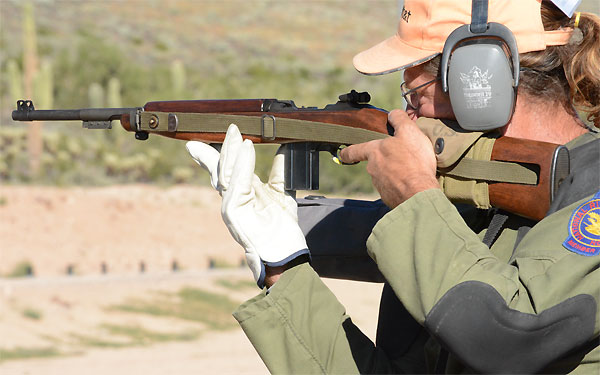
M1 Carbine Match at Western CMP Games
Electronic Targets for Rifle Events at CMP Travel Games
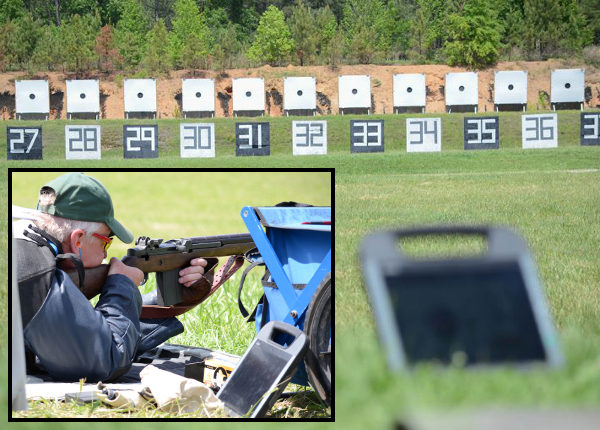
All CMP Travel Games rifle competitions will be fired on CMP Targets, a user-friendly electronic target system that instantly displays shot placement. The electronic targets also eliminate the need for pit duty. This helps matches run more quickly and efficiently with less physical strain for older shooters.
Training Programs at CMP Travel Games
In addition to competitions, educational opportunities such as the GSMM New Shooter Clinic, Basic Rifle and Pistol Courses and M1 Maintenance Clinics provide valuable experiences off the firing line. CMP-sanctioned GSMM (Garand-Springfield-Modern Military) rifle clinics teach basic and intermediate rifle marksmanship skills to new and beginning shooters. For newer shooters, the Basic Rifle and Basic Pistol Courses provide a solid introduction to firearm safety along with basic marksmanship skills and fundamentals. The courses also cover preparation for competitions and much more.
Garand Collectors Association Master Marksman Medal
For the first time, in 2023, those competing in the John C. Garand Match with As-Issued M1 Rifles at CMP Travel Games will have the chance to earn a Garand Collectors Association (GCA) Master Marksman Medal. The GCA Master Marksman program is set to begin in January 2023. Like the CMP’s established Distinguished Badge Program, the GCA program will work on an Achievement Award point system, based on performance at designated CMP events.
For many years, the Swarovski Optik website featured a blog with interesting technical articles. (Unfortunately some of these articles have been taken offline.) In the “On Target” series of blog stories, Swarovski provided a handy explanation of how optics systems work, with exploded diagrams of rifle scopes, spotting scopes, and binoculars. We’ve reproduced the key diagrams here. CLICK HERE for Swarovski On Target Archive.
Scope Terminology Focusing Lens
The focusing lens is an adjustable lens inside the optical system for focusing the image at different distances…. In the case of rifle scopes, apart from focusing, the focusing lens also facilitates parallax compensation.
Objective Lens
The objective lens is the optical system’s front lens group facing the object and operates like a converging lens. Its purpose is to display an image which, at the image plane, appears upside down, laterally transposed and reduced, and which is subsequently displayed correctly again by the reversal system.
Diopter Adjustment
For rifle scopes, the reticle can be focused using the diopter adjustment on the eyepiece, thereby correcting any visual impairment. [Editor’s Note: Movable eyepiece diopter adjustment is not offered on all rifle scopes. It is a useful feature on Swarovski and other premium scopes. This allows shooters who need eyeglasses to get a sharply focus image even without wearing corrective lenses. Of course shooters should always wear ANSI-certified eye protection. With the diopter, folks who need correction can use inexpensive, non-Rx safety eyewear instead of expensive prescription safety glasses.]
Reversal System
The purpose of the reversal system is to reverse the image by means of prisms in binoculars and telescopes, and lenses in rifle scopes….The lens reversal system is needed in rifle scopes to control the variable magnification and move the exit pupil[.]
Resource tip by EdLongRange. We welcome reader submissions.
At the request of our readers, we provide select “Deals of the Week”. Every Sunday afternoon or Monday morning we offer our Best Bargain selections. Here are some of the best deals on firearms, hardware, reloading components, optics, and shooting accessories. Be aware that sale prices are subject to change, and once clearance inventory is sold, it’s gone for good. You snooze you lose.
NOTE: All listed products are for sale to persons 18 years of age or older. No products are intended for use by minors.
1. KYGUNCO — Rock Island Armory TM22 Rifle, $278.00
⏺ Slick, AR-style rimfire rifle with new features
Looking to get started in NRL22 competition, or want a rimfire varmint rifle with familiar AR look and feel? Then check out the Rock Island Armory TM22. This handsome semi-auto .22 LR rimfire rig weighs 6.5 lbs. with its 18″ barrel. The modestly-priced TM22 sports an AR-type grip, commercial buffer tube adapter, top rail, and M-LOK fore-end. The rifle is set up with right-handed controls, but the TM22 can easily be modified for left-handed operation. The TM22 ships with two 10-rd aluminum magazines with aftermarket 15- and 25-round magazines available.
2. EuroOptic — Trijicon Scope Sale
⏺ Major savings now on quality Trijicon optics
Trijicon scopes are being used by more rifle competitors and varminters/hunters because they’re great scopes for the money. If you’ve been wanting to give one a try, EuroOptic is having a major Trijicon Scope Sale with discounts up to 60%. You’ll find big discounts on FFP and SFP scope in a wide variety of power ranges and configurations — everything from AR scopes to long-range competition models.
3. Bruno Shooters Supply — Rimfire Ammo Sale
⏺ Save big bucks on case-quantity rimfire ammo
.22 LR rimfire shooting is fun, requires less barrel cleaning, and rimfire ammo is much cheaper than centerfire. If you’re getting into rimfire shooting check out Bruno’s rimfire ammo sale. You’ll find 5000-round case quantities of ELEY, Norma, and Wolf ammo at very attractive prices. In addition, individual 50ct boxes of CCI and Federal rimfire ammo are priced competitively.
4. MidwayUSA — Factory Seconds Bullet Sale (Great Prices)
⏺ Amazingly low prices on good bullets — many weights/calibers
MidwayUSA is running a great sale right now on factory second Blem Bullets. Choose tipped, BTHP, or Spire Point rifle bullets with prices as low as $0.16/bullet. There are a wide choice of rifle calibers (from .22 to .338) on sale, plus 9mm, .40, and .45 pistol bullets. The 77gr .22 Cal bullets are just $17.99/100 while 168gr .30 Cal match bullets are just $19.99/100. If you shoot CMP matches with an M1 Carbine, Garand, M1903, or M1A, these bullets will work great for practice and local matches. We can’t reveal the manufacturer but it’s one of the best.
5. Midsouth — LEE Challenger Breech Lock Kit, $144.89
⏺ Full reloading set-up all for less than many presses alone
Here’s a remarkable deal on the LEE Breech Lock Challenger Reloading Kit. For just $144.99 you get the Lee Breech Lock Challenger single stage press, Lee Perfect Powder Measure, Lee Safety Scale (manual), Lee Large and Small Safety Prime tools (for on-press priming), Chamfer tool, Lg/Sm Primer Pocket Cleaner, Lee Case Trimmer, Lee Cutter + Lock Stud, Powder Funnel, and even 2 oz. Resizing Case Lube. The Breech Lock Challenger press boasts a quick change die system, and spent primers conveniently eject down through a tube.
⏺ Great deal on RIMFIRE silhouette steel target 20-Pack
There are few things as fun as plinking with a .22 LR Rimfire rig at steel targets. It’s fun for kids and adults alike and right now you can grab a 20-ct pack of RIMFIRE animal targets in assorted sizes and shapes. They are 1/5 size and made from A36 steel plate. IMPORTANT: These small steel targets work great for rimfire shooting, but should NEVER be used with centerfire rifle cartridges.
7. Midsouth — Lyman Case Prep Xpress Center, $142.99
⏺ Multi-function Case Prep center at great price
The Lyman Case Prep Xpress performs a multitude of case prep functions, saving you time and effort. On sale for just $142.99 at Midsouth, this unit is a GREAT DEAL now as the same unit is $199.99 at MidwayUSA, so you save $57 bucks. The Lyman Case Prep Xpress boasts a high-torque motor with five tool stations. This allows the user to chamfer cases inside and out, brush case-necks, clean/uniform primer pockets, and ream military crimps.
8. Amazon — Frankford Arsenal Quick-N_EZ Tumbler, $59.99
⏺ Reliable vibratory tumbler with see-through lid
It’s hard to beat a good vibratory tumbler for basic brass cleaning. We like the Frankford Arsenal Quick-N-EZ tumbler for the $59.99 price. This Frankford Arsenal unit features a unique bowl design to enhance brass agitation for faster cleaning. A clear lid allows you to watch the process. There is a convenient cord-mounted on/off switch. This tumbling machine works with both Walnut Media and Corn Cob Media.
9. Amazon — Hat Target Hangers, $24.99
⏺ Hat Hangers for cans are great for fun shooting
Soda cans make great fun targets. With the GoSports Outdoors Blast Hat Target Hangers 12-pack you can hang 12 oz. soda cans so you can shoot them over and over again without having to pick them up off the ground. NOTE: The $24.99 price includes 12 polymer hat hangers only, NOT the soda cans. Shoot empty cans for practice or full soda cans for foamy fun. For another $47.57 you can get a target stand kit with 12 hook fittings — just add your own 2×4 wood beams to red brackets.
10. Amazon — Eylar 53″ Tactical Case, $159.99
⏺ Great price for long case with high-quality foam
Here’s a rugged, waterproof, TSA-compliant long-length hard case for just $159.99. The Eylar 53″ Tactical Slim Rifle Hard Case boasts three layers of foam: upper convoluted foam layer, second perforated pull & pluck cubed layer, and a third solid foam layer. This Eylar case meets TSA requirements, and two padlock fittings provide good security during travel. Unloaded case weight is 14.5 pounds. Inside dimensions are: 51″ Long x 11.1″ Wide — big enough to hold a long-barrel, scoped competition rifle.
Here’s a very cool 3D Animation showing pistol rounds being chambered and fired in a semi-auto handgun. Computer-generated graphics provide a look inside the cartridge at the moment of ignition as the primer fires and the flame front moves through the ignited powder. It’s really kind of mesmerizing. If you’ve every wondered just what happens inside your cartridges the moment that firing pin strikes, then watch this video. It has racked up 6.1 million views on YouTube with over 48,000 likes.
Watch Video to See Handgun Ammo Being Chambered and Fired:
Mute Enabled — Click Speaker Icon to Hear Audio. Firing Sequence Starts at 1:28.
This animated video from German ammo-maker GECO (part of the Swiss RUAG group of companies) reveals the inside of a pistol cartridge, showing jacket, lead core, case, powder and primer. Employing advanced 3D rendering and computer graphics, the video shows an X-ray view of ammo being loaded in a handgun, feeding from a magazine.
Then it really gets interesting. At 1:28 – 1:50 you’ll see the firing pin strike the primer cup, the primer’s hot jet streaming through the flash-hole, and the powder igniting. Finally you can see the bullet as it moves down the barrel and spins its way to a target. This is a very nicely-produced video. If you’ve ever wondered what happens inside a cartridge when you pull the trigger, this video shows all. They say “a picture’s worth a thousand words”… well a 3D video is even better.


 If you read our lengthy article on Ultrasonic Case Cleaning by Jason Baney, you’ve seen the remarkable results that can be achieved with this method, as shown by the photo above. Ultrasonic cleaning has many advantages over traditional tumbling methods of case cleaning. There is no dust or media residue to remove from the brass, and when done right, the cases come out clean and shiny, inside and out, even the primer pockets.
 The Brownell’s Benchtalk article explains: “Ultrasonic cleaning uses high-frequency sound waves (generally between 20-80 kHz) to remove a variety of contaminants from objects immersed in a liquid. The result of these high-frequency sound waves is a process called cavitation. These high frequency bursts of ultrasonic energy produce a three-dimensional wave of alternating positive and negative pressure areas as the sound wave passes through the solution. During negative pressure, microscopic cavitation bubbles form and will continue to grown until they reach resonant size. As the positive sound wave passes, the pressure rises rapidly and implodes these tiny bubbles. Before these minuscule bubbles implode they store a tremendous amount of energy. These bubbles can be as hot as 10,000 degrees and have as much as 50,000 lbs per square inch of pressure. This sounds alarming, but you have to remember that these bubbles are microscopic in nature and pose no harm to anything, unless you are a carbon /powder residue deposit on a cartridge case!
 When this cavitation bubble implodes near your brass case, it transforms the bubble into a jet about 1/10th of its size. This jet of energy can travel as fast as 400 km/hour. At 43 kHz, as is the frequency for our L & R HCS 200 ultrasonic cleaner, this is happening 43,000 times per second. This micro-burst of extreme energy is responsible for removing contaminants from the surface of your cartridge brass. Ultrasonic cleaning can reach into crevices and inaccessible areas and remove surface debris that can’t be cleaned by any other process.”
 How to Shoot Standing
 5. Know your hold and shoot within it. The best part of my hold is about 4 inches. When I get things rolling, I recognize a still gun within my hold and execute the shot. I train to do this every shot. Close 10s are acceptable. Mid-ring 10s are not. If my hold was 8 inches I would train the same way. Shoot the shot when it is still within the hold, and accept the occasional 9. But don’t accept the shots out of the hold.


 Like the Hornady tool, the





 Garand Collectors Association Master Marksman Medal





 This animated video from German ammo-maker


